

Introduction: The Gastric Peptide That Captivated Regenerative Research
BPC-157, formally known as Body Protection Compound-157, is a synthetic pentadecapeptide that has become one of the most extensively investigated regenerative peptides in preclinical science. Derived from a protective protein native to human gastric juice, this 15-amino-acid fragment has generated over 100 peer-reviewed publications across domains ranging from gastrointestinal cytoprotection and musculoskeletal repair to neuroprotection and vascular signaling.[1] Despite this substantial body of preclinical evidence, BPC-157 remains unapproved by any drug regulatory agency for human therapeutic use, and the translation of its animal-model findings into clinical practice is still in its earliest stages.
This article provides a comprehensive overview of BPC-157 for researchers approaching the peptide for the first time or seeking a consolidated reference. For foundational context on peptide biology, see our guide on how peptides work in laboratory research. Detailed explorations of specific topics — including mechanism of action, gastrointestinal research, laboratory methods, and stability and storage — are available throughout this cluster.
Discovery and Origin
From Gastric Juice to the Laboratory
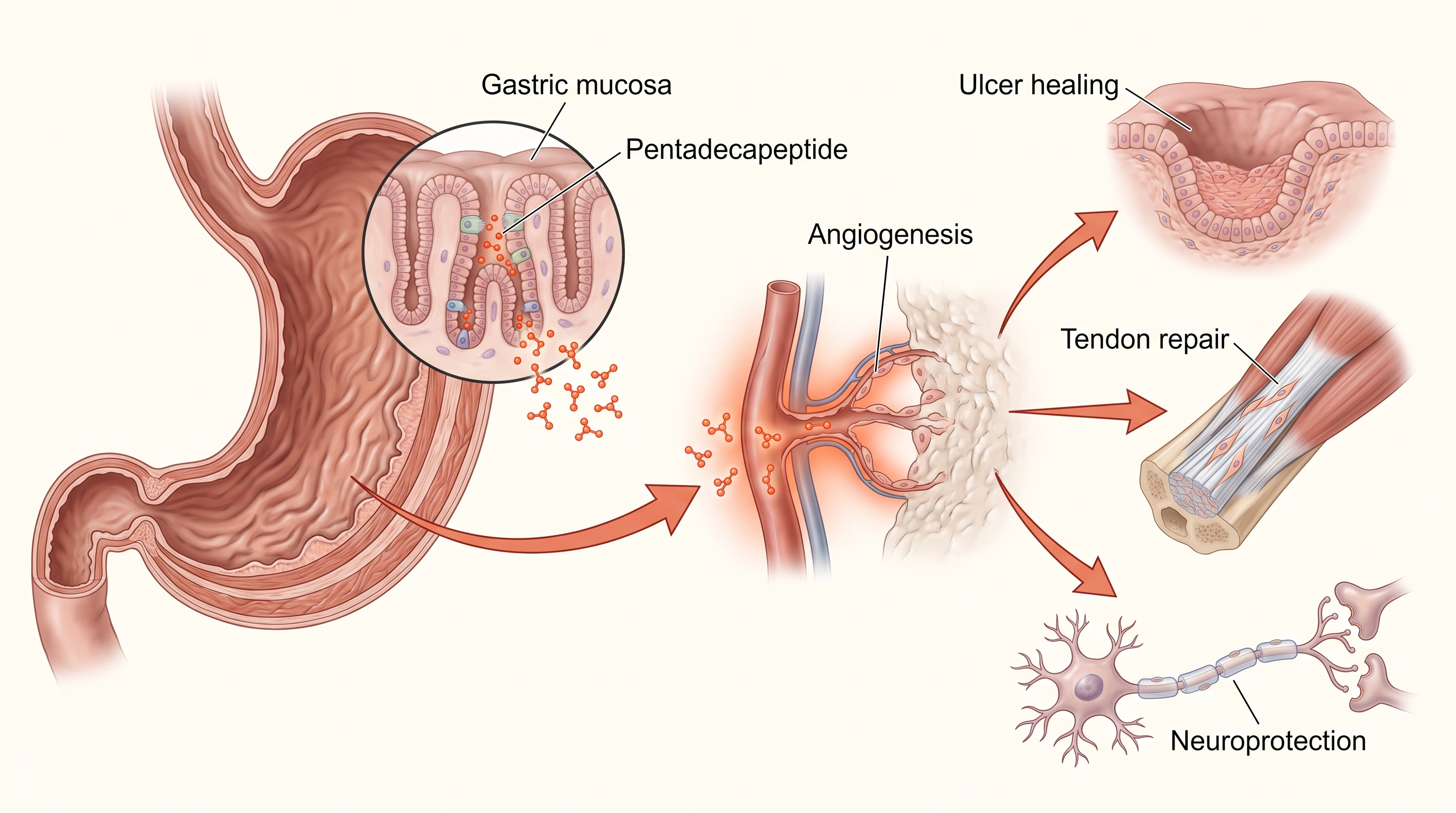
The story of BPC-157 begins with the stomach itself. Researchers had long observed that the gastric mucosa possesses a remarkable capacity for self-repair — healing erosions and ulcers despite continuous exposure to hydrochloric acid, pepsin, and ingested irritants. This led to the hypothesis that gastric secretions must contain endogenous protective factors beyond the well-characterized mucus-bicarbonate barrier.[2]
In the early 1990s, Dr. Predrag Sikiric and colleagues at the University of Zagreb identified a protein in human gastric juice with potent cytoprotective properties, which they designated Body Protection Compound (BPC). From this larger protein, they isolated a 15-amino-acid fragment that retained significant biological activity while being small enough for practical synthesis and experimental use. This fragment, BPC-157, was first described in the published literature in 1993, and the peptide has since been assigned the designation PL 14736 for clinical trial purposes.[1]
Amino Acid Sequence and Molecular Identity
BPC-157 consists of the following amino acid sequence: Gly-Glu-Pro-Pro-Pro-Gly-Lys-Pro-Ala-Asp-Asp-Ala-Gly-Leu-Val (GEPPPGKPADDAGLV). Its molecular weight is approximately 1,419 Daltons. The peptide is freely soluble in water at physiological pH and, uniquely among bioactive peptides, demonstrates remarkable stability in human gastric juice — remaining structurally intact for more than 24 hours under conditions that degrade most peptides within minutes.[2] This gastric stability is consistent with its origin as a fragment of a protein that evolved to function within the harsh acidic environment of the stomach.
The sequence contains a notable triple-proline motif (Pro-Pro-Pro) at positions 3-5, which contributes to conformational rigidity and resistance to enzymatic cleavage. The peptide carries a net negative charge at physiological pH due to its glutamate and aspartate residues, and contains no cysteine residues — eliminating the possibility of disulfide-mediated aggregation and simplifying both synthesis and handling. For researchers working with the physical peptide, our BPC-157 stability and storage guide provides detailed protocols for reconstitution and preservation.
Salt Forms: Acetate vs. Arginine
BPC-157 is commercially available primarily in two salt forms, each with distinct stability characteristics. The acetate salt was the original formulation and remains widely used. It offers good aqueous solubility but is more susceptible to degradation from heat and pH fluctuations after reconstitution.[3]
The arginine salt (pentadeca arginate) was developed to address the acetate form's stability limitations. By incorporating L-arginine as a stabilizing counterion, the arginine salt form demonstrates enhanced resistance to thermal and pH-induced degradation. This improved stability profile is particularly relevant for oral administration protocols, where the peptide must survive transit through the acidic gastric environment before absorption. The core 15-amino-acid sequence is identical in both forms; the arginine serves exclusively as a protective buffer rather than altering the peptide's biological activity.[3]
Researchers should verify which salt form was used in any study they reference, as differences in stability could influence experimental outcomes, particularly in protocols involving prolonged incubation or oral dosing. Both forms are supplied as lyophilized powders — a standard preservation approach discussed in our article on lyophilized peptides.
Primary Mechanisms of Action
BPC-157 exerts its biological effects through multiple interconnected signaling pathways rather than a single receptor-ligand interaction. This pleiotropic mechanism profile is consistent with its broad tissue effects but also complicates the identification of a definitive primary target. The key pathways implicated in the current literature are summarized below, with detailed molecular analysis available in our dedicated mechanism of action article.
Nitric Oxide System Modulation
The interaction between BPC-157 and the nitric oxide (NO) system is among the most extensively documented aspects of its pharmacology. The peptide activates endothelial nitric oxide synthase (eNOS) through at least two distinct pathways: the VEGFR2-Akt-eNOS cascade and the Src-Caveolin-1-eNOS pathway.[4] In the latter, BPC-157 promotes phosphorylation of Src and Caveolin-1 (Cav-1), disrupting the inhibitory Cav-1-eNOS complex and releasing eNOS for activation. This dual-pathway activation results in sustained NO production, vasodilation, and enhanced blood flow to injured tissues.
Importantly, BPC-157 appears to function as a modulator rather than a simple stimulator of NO production. Studies have demonstrated that it can counteract the adverse effects of both NO synthase blockade (by L-NAME) and NO precursor excess (L-arginine), suggesting a homeostatic regulatory function rather than unidirectional stimulation.[5]
VEGFR2 and Angiogenesis
BPC-157 promotes angiogenesis — the formation of new blood vessels from existing vasculature — primarily through upregulation of vascular endothelial growth factor receptor 2 (VEGFR2). The peptide enhances VEGFR2 expression and internalization in endothelial cells, activating downstream Akt signaling and eNOS phosphorylation.[4] This angiogenic capacity is particularly relevant in poorly vascularized tissues such as tendons and myotendinous junctions, where blood supply is often the rate-limiting factor in repair.
Growth Factor and Gene Expression Modulation
BPC-157 stimulates expression of the early growth response gene Egr-1, which functions as a transcriptional regulator controlling the expression of multiple downstream genes involved in cell growth, differentiation, and tissue repair. The peptide also upregulates growth hormone receptor (GHR) expression in tendon fibroblasts, with cDNA microarray analysis showing GHR among the most abundantly upregulated genes following BPC-157 treatment.[6] Additional pathways include FAK-paxillin signaling (promoting cell migration), ERK1/2 activation (regulating cell division and survival), and JAK-2 signaling (mediating growth hormone sensitivity).
Anti-Inflammatory Effects
BPC-157 demonstrates anti-inflammatory properties through downregulation of NF-κB, a master transcription factor driving inflammatory gene expression. The peptide also modulates the balance between pro-inflammatory and anti-inflammatory cytokines, and reduces Nos2 expression — the gene encoding inducible nitric oxide synthase (iNOS), which produces large quantities of NO during pathological inflammation.[7]
Research Domains
Gastrointestinal Cytoprotection
Given its gastric origin, the gastrointestinal tract represents BPC-157's most extensively studied and differentiated research domain. The peptide has demonstrated cytoprotective effects across the entire GI tract, including healing of gastric and duodenal ulcers, protection against NSAID-induced and ethanol-induced mucosal damage, and therapeutic effects in models of inflammatory bowel disease.[2] The peptide has been used in Phase II clinical trials for ulcerative colitis (under the designations PL-10, PLD-116, and PL 14736) and has subsequently entered trials for multiple sclerosis. Comprehensive analysis of BPC-157's gastrointestinal effects is provided in our dedicated GI research article.
Musculoskeletal Repair
BPC-157 has shown significant regenerative effects in preclinical models of tendon, ligament, muscle, and bone injuries. In rat Achilles tendon transection models, the peptide improved outcomes across biomechanical (increased load to failure, stiffness, and Young's modulus), functional (improved Achilles functional index), and histological (superior collagen organization, advanced vascular formation) parameters.[8] Similar benefits have been observed in medial collateral ligament healing, quadriceps muscle repair, and segmental bone defect models. A 2025 systematic review of the orthopedic literature identified 35 preclinical studies and one clinical study, consistently showing improved functional, structural, and biomechanical outcomes across musculoskeletal injury types.[9]
Neuroprotection and the Brain-Gut Axis
BPC-157 modulates serotonergic and dopaminergic neurotransmitter systems, with evidence of region-specific effects on serotonin synthesis in the brain when administered peripherally. The peptide has demonstrated neuroprotective properties in models of traumatic brain injury, spinal cord compression, and MPTP-induced dopaminergic neurotoxicity (a model relevant to Parkinson's disease). It also counteracts encephalopathies induced by NSAID overdose, insulin overdose, and cuprizone — a neurotoxin that produces multiple sclerosis-like brain lesions.[10]
The concept of a brain-gut axis interaction is central to understanding BPC-157's neurological effects: as a peptide native to the GI tract with strong antiulcer potency, it appears capable of beneficially influencing central nervous system function from the periphery.[10]
Vascular Protection
BPC-157 has demonstrated the ability to counteract vessel occlusion syndromes by rapidly activating collateral blood vessel pathways, effectively bypassing occluded or damaged vessels. In models of ischemic colitis, the peptide restored blood flow through activation of arcade vessel interconnections and collateral circulation.[5] This vascular recruitment capacity represents what Sikiric and colleagues describe as the third major component of the cytoprotection concept: beyond cell protection and endothelium protection, the active control of blood vessel function in response to injury.
Comparison with TB-500
BPC-157 is frequently discussed alongside TB-500 (a fragment of thymosin beta-4), as both peptides promote tissue repair through distinct but complementary mechanisms. While BPC-157 operates primarily through NO system modulation, VEGFR2 signaling, and growth factor receptor upregulation, TB-500 functions through actin sequestration and cytoskeletal dynamics — facilitating the physical migration of cells toward injury sites. Their overlapping but non-identical angiogenic pathways (BPC-157 upregulates the VEGF receptor; TB-500 upregulates VEGF itself) have generated substantial interest in potential synergistic applications. For a comprehensive head-to-head analysis, see our detailed comparison of TB-500 vs BPC-157.
Safety Profile and Limitations
Preclinical Safety Data
In preclinical animal models, BPC-157 has demonstrated a favorable safety profile. No toxic or lethal dose has been identified across a wide range of concentrations (6 μg/kg to 20 mg/kg), and the lethal dose for 1% of subjects (LD1) has not been achievable. Single-dose toxicity studies in mice using oral and intravenous routes revealed an LD50 higher than 2,000 mg/kg, with transient sedation as the only observed effect at the highest dose. Repeated-dose studies (4 weeks) in rats and dogs showed no treatment-related morphological findings across organs including liver, spleen, lung, kidney, brain, thymus, prostate, and ovaries.[9]
Critical Limitations
Despite the extensive preclinical literature, several important limitations must be acknowledged. The majority of published studies — estimated at over 80% — originate from a single research center at the University of Zagreb, which raises questions about independent replicability. Most preclinical experiments employ only one or two dose levels (typically 10 μg/kg and 10 ng/kg), leaving the dose-response relationship incompletely characterized.[11] The peptide's short plasma half-life (less than 30 minutes in rats and dogs) contrasts with its reported sustained therapeutic effects, and the mechanisms underlying this temporal disconnect remain inadequately explained.
Most critically, human clinical data are extremely limited. Only three pilot studies have examined BPC-157 in humans: one addressing intra-articular knee pain, one concerning interstitial cystitis, and one evaluating intravenous safety and pharmacokinetics.[9] The absence of large-scale, randomized controlled trials means that efficacy and safety in humans cannot be established from the available evidence.
Regulatory Status
BPC-157 is not approved for human therapeutic use by any drug regulatory agency worldwide. In 2022, the World Anti-Doping Agency (WADA) banned the peptide under its S0 Unapproved Substances category. In September 2023, the U.S. Food and Drug Administration classified BPC-157 as a Category 2 substance, further restricting its availability through compounding pharmacies. Researchers should be aware of the current regulatory landscape in their jurisdiction when designing studies involving this peptide.[9]
Pharmacokinetics
BPC-157 is metabolized primarily in the liver and cleared by the kidneys, with a plasma half-life of less than 30 minutes in animal models. It is detectable in urine for up to four days by mass spectrometry methods. Despite this brief pharmacokinetic presence, the biological processes initiated by BPC-157 — including gene expression changes and angiogenic responses — appear to persist for weeks to months after administration. In spinal cord injury studies, functional improvements were maintained for up to 360 days after a single treatment, while tendon healing studies showed persistent biomechanical improvements through 21-72 day observation periods.[9]
The peptide's gastric stability enables effective oral administration — a route unavailable to most peptide therapeutics. Animal studies using oral (intragastric) BPC-157 demonstrate healing effects not only in gastrointestinal conditions but also in distant tissues including tendons and nerves, suggesting systemic absorption and distribution from the GI tract.[2]
Practical Considerations for Researchers
BPC-157 is supplied as a lyophilized powder requiring reconstitution before use in experimental protocols. Regardless of the research question, ensuring adequate peptide purity is essential for reproducibility — a topic addressed in our guide to peptide purity in scientific studies. Researchers should verify purity by independent HPLC analysis and confirm sequence identity by mass spectrometry before incorporating BPC-157 into experimental designs.
For detailed reconstitution protocols, storage conditions, aliquoting strategies, and degradation prevention, see our comprehensive BPC-157 stability and storage guide. For information on how BPC-157 is investigated across different experimental platforms — including in vitro assays, ex vivo models, and in vivo protocols — see our article on how BPC-157 is studied in laboratories.
Conclusion
BPC-157 represents a unique intersection of gastric physiology and regenerative biology. Its origin in the protective machinery of the stomach, combined with its remarkable stability and pleiotropic signaling profile, has generated a substantial and growing body of preclinical literature spanning multiple organ systems. The peptide's effects on angiogenesis, NO system modulation, growth factor signaling, and anti-inflammatory pathways position it as a versatile research tool for investigating fundamental mechanisms of tissue repair and cytoprotection.
However, the field faces important challenges: the concentration of research in a single laboratory, limited dose-response data, an incompletely understood pharmacokinetic-pharmacodynamic disconnect, and — most critically — the near-absence of rigorous human clinical trials. Researchers entering this field should approach BPC-157 with both scientific curiosity and appropriate critical evaluation, recognizing the strength of the preclinical evidence while acknowledging the substantial gaps that remain before clinical translation can be considered validated.
Related research: Explore the KLOW 4-peptide research blend — BPC-157 + TB-500 + GHK-Cu + KPV in a single tetrapeptide framework.