

Introduction: The Experimental Landscape
The preclinical literature on BPC-157 encompasses over 100 peer-reviewed studies conducted primarily in rodent models, supplemented by cell culture experiments and a small number of ex vivo tissue studies. Understanding how these experiments are designed, executed, and evaluated is essential for researchers entering the field — both for interpreting existing data and for planning new investigations.[1]
This article provides a practical overview of the experimental platforms, injury models, dosing protocols, endpoints, and analytical methods used in BPC-157 research. For foundational information on the peptide itself, see our pillar article on what BPC-157 is. For detailed mechanistic context that informs endpoint selection, see our article on BPC-157 mechanism of action.
In Vitro Studies: Cell-Based Assays
Cell Types Used
BPC-157 has been studied in multiple cell types reflecting its diverse tissue effects. Tendon fibroblasts (tenocytes) derived from rat Achilles tendon are among the most frequently used, particularly for investigating the peptide's effects on cell migration, survival, and growth factor receptor expression.[2] Human umbilical vein endothelial cells (HUVECs) are standard for angiogenesis and NO pathway experiments. Additional cell types include gastric mucosal epithelial cells, fibroblasts from various tissue sources, myoblasts, and neuronal cell lines.
Migration Assays
Cell migration is a primary endpoint in BPC-157 research given the peptide's well-documented pro-migratory effects. The transwell filter migration assay (Boyden chamber) is widely used: cells are seeded in the upper compartment of a permeable membrane insert, BPC-157 is added to the lower compartment as a chemoattractant, and migrated cells are counted after a defined incubation period. Chang and colleagues demonstrated that BPC-157 markedly increased tendon fibroblast migration in a dose-dependent manner using this approach, with the effect mediated through FAK-paxillin signaling.[2]
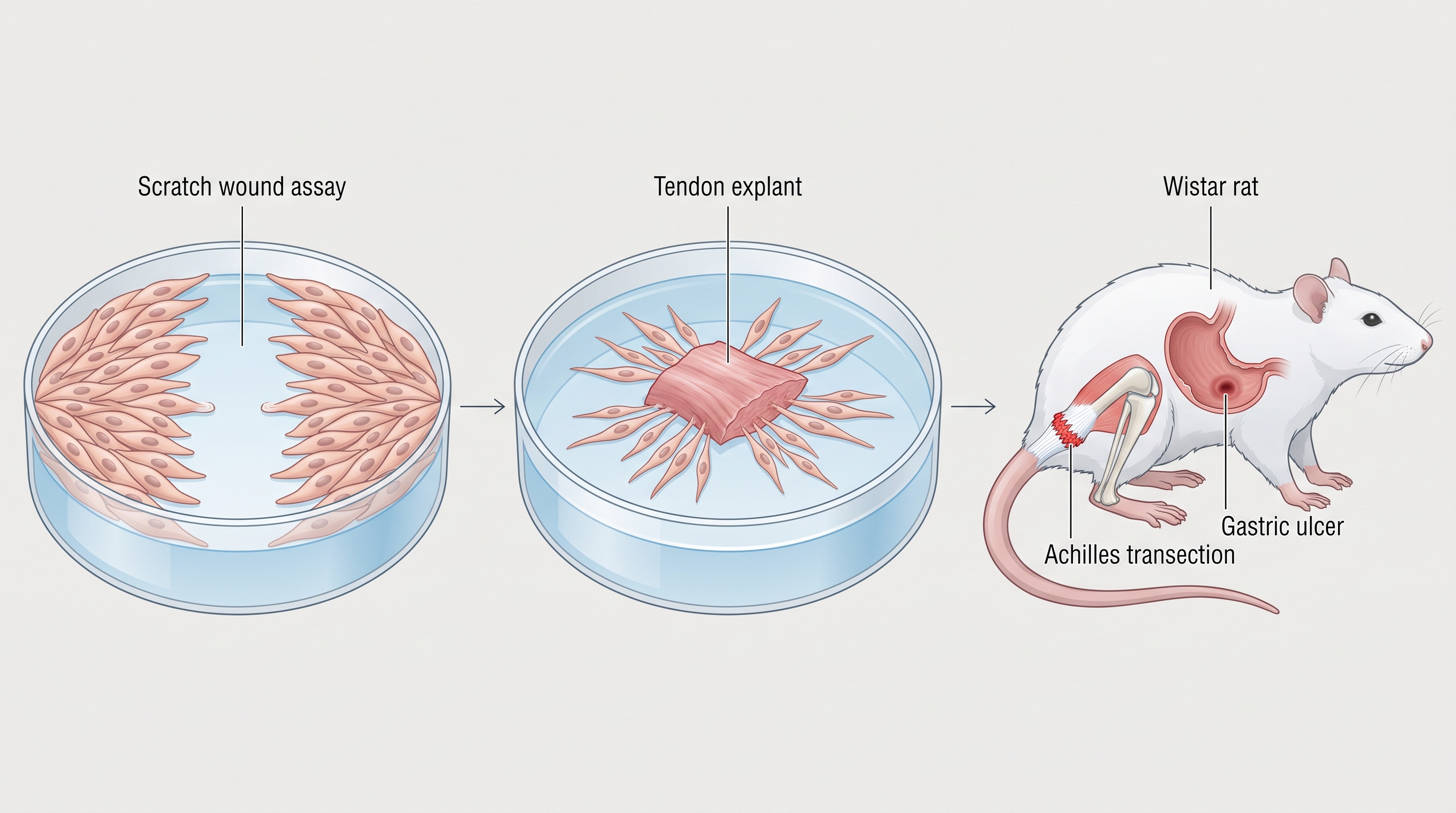
The scratch wound assay (wound healing assay) provides a complementary measure of migration: a confluent cell monolayer is scratched with a pipette tip to create a uniform gap, BPC-157 is added, and gap closure is quantified by imaging at defined intervals. This assay additionally captures contributions from cell proliferation to wound closure.
Cell Survival and Proliferation Assays
The MTT assay — a colorimetric method measuring mitochondrial metabolic activity as a proxy for cell viability — has been used to evaluate BPC-157's effects on cell proliferation and survival. Notably, BPC-157 does not directly stimulate cell proliferation in standard culture conditions, but significantly enhances cell survival under oxidative stress (H2O2 challenge).[2] This distinction between proliferative and protective effects is important for understanding BPC-157's mechanism: the peptide appears to be primarily cytoprotective and pro-migratory rather than directly mitogenic.
Tendon Explant Outgrowth
An informative ex vivo approach uses intact tendon explants cultured with or without BPC-157. Tendon tissue is excised, divided into standardized pieces, and cultured in growth medium. The outgrowth of fibroblasts from the explant edges is quantified over time. BPC-157 significantly accelerates fibroblast outgrowth from tendon explants, providing evidence that its pro-migratory effects translate from isolated cell assays to organized tissue contexts.[2]
Gene Expression Analysis
Quantitative PCR (qPCR) and cDNA microarray analysis are used to characterize BPC-157's effects on gene expression. Key genes assessed include Vegfr2, Nos1, Nos2, Nos3, Egr1, Nab2, Akt1, Nfkb1, growth hormone receptor (GHR), and FAK-related genes. The temporal profile of gene expression changes — which genes are upregulated or downregulated, at what time points, and in what sequence — provides insight into the cascade of molecular events initiated by BPC-157.[3]
In Vivo Studies: Animal Models
Species and Strains
The vast majority of in vivo BPC-157 research has been conducted in rats, primarily Wistar and Sprague-Dawley strains. Mice (typically Albino NMRI or C57BL/6) have been used for specific applications including traumatic brain injury models. The predominant use of rodents reflects their well-characterized physiology, availability of validated injury models, ethical considerations, and cost-effectiveness for the large number of experimental groups required in dose-response and multi-timepoint studies.[1]
Common Injury Models
Achilles Tendon Transection: One of the most extensively studied BPC-157 models involves sharp transection of the rat Achilles tendon, typically 5 mm proximal to the calcaneal insertion. This model produces a standardized, clinically relevant tendon injury with clear functional and biomechanical endpoints. Animals are assessed at multiple timepoints (commonly days 1, 4, 7, 10, 14, and 21) for functional recovery (Achilles Functional Index), biomechanical properties (load to failure, stiffness, Young's modulus), and histological parameters (collagen organization, vascular density, cellular infiltration).[4]
Gastric Ulcer Models: Given BPC-157's gastric origin, ulcer models are foundational to its research literature. Common induction methods include ethanol administration (producing acute mucosal injury), cysteamine injection (producing duodenal ulcers), NSAID administration (indomethacin-induced gastric erosions), and stress-induced ulceration. Endpoints include ulcer size, depth, mucosal integrity scoring, and histological assessment of healing quality.[5]
Ligament and Muscle Injury: Medial collateral ligament transection in the rat knee and quadriceps muscle detachment models have been used to assess BPC-157's effects on connective tissue and muscle healing. These models complement the Achilles tendon data by demonstrating tissue-type specificity and breadth of musculoskeletal effects.[6]
Vascular Occlusion Models: BPC-157's vascular effects have been investigated using ligation of the left colic artery and vein (ischemic colitis model), superior mesenteric vessel occlusion, and inferior caval vein ligation. These models evaluate the peptide's ability to activate collateral circulation and restore blood flow after vessel obstruction.[7]
Traumatic Brain Injury: In mice, controlled cortical impact or weight-drop models produce graded traumatic brain injuries. BPC-157 is evaluated for effects on consciousness recovery (righting reflex), mortality reduction, brain edema, hemorrhagic lesion distribution, and long-term neurological function.[8]
Inflammatory Bowel Disease Models: Trinitrobenzene sulfonic acid (TNBS)-induced colitis and other IBD models have been used to evaluate BPC-157's gastrointestinal anti-inflammatory effects, building on the peptide's clinical trial history in ulcerative colitis. For comprehensive coverage of GI-specific models and findings, see our gastrointestinal research article.
Dosing Protocols
Standard Dose Range
The most commonly studied dose of BPC-157 across the preclinical literature is 10 μg/kg body weight, administered intraperitoneally. A secondary dose of 10 ng/kg (1,000-fold lower) is frequently included to evaluate dose-response relationships. Both doses have demonstrated biological activity across multiple models, and some studies show similar efficacy between the two — an unusual finding that suggests the peptide may not follow a conventional linear dose-response curve.[1]
In the systematic review by Vasireddi et al. (2025), no toxic or lethal dose was achieved across a wide range from 6 μg/kg to 20 mg/kg, indicating a remarkably wide therapeutic window in animal models.[9]
Administration Routes
Intraperitoneal (IP): The most common route in rodent studies. IP injection provides reliable systemic delivery and is technically straightforward in small animals. First injection is typically administered 30 minutes after injury induction, with subsequent doses given once daily until the assessment timepoint.[4]
Intragastric (IG / Oral): Exploiting BPC-157's unique gastric stability, oral administration has been used in gastrointestinal models and to demonstrate systemic effects from GI absorption. Oral doses are typically higher than IP doses (approximately 10-fold) to account for reduced absorption through the gut lining.[5]
Local Application: Direct application to the injury site — including topical application to skin wounds, intra-articular injection for knee pathologies, and intraperitoneal bath for abdominal injuries — has been used to evaluate localized effects versus systemic administration.[9]
Intravenous (IV): Less commonly used in preclinical studies but important for pharmacokinetic characterization. One human pilot study evaluated IV BPC-157 for safety and pharmacokinetics.[9]
Timing and Duration
Most protocols begin BPC-157 administration 30 minutes after injury induction, reflecting a therapeutic rather than prophylactic approach. Daily administration continues until the assessment timepoint. Some studies have also examined prophylactic administration (before injury) and delayed-start protocols (beginning hours to days after injury) to characterize the therapeutic window.[4]
Key Endpoints and Biomarkers
Functional Endpoints
The Achilles Functional Index (AFI) is the primary functional measure in tendon studies, assessing gait parameters through footprint analysis. Water maze testing evaluates learning and memory in neurological models. The inclined beam walk and lateral push test assess motor coordination following brain injury or spinal cord compression. Consciousness assessment (righting reflex) is used in acute brain injury models.[4]
Biomechanical Endpoints
Biomechanical testing of healed tendons and ligaments measures load to failure (maximum force before rupture), stiffness (resistance to deformation), and Young's modulus of elasticity (material-level mechanical property). These parameters provide quantitative evidence of structural repair quality that complements histological assessment.[4]
Histological and Immunohistochemical Endpoints
Standard histological assessment evaluates tissue architecture, cellular composition (fibroblasts, inflammatory cells, endothelial cells), collagen fiber organization and density, and the presence of pathological features (fibrosis, necrosis, edema). Collagen typing (type I vs. type III) by immunohistochemistry indicates repair maturity, as the transition from type III to type I collagen reflects progression from provisional to mature repair tissue.[4]
Vascular endpoints include vessel density (CD34 or FVIII immunostaining), VEGFR2 expression, and assessment of angiogenic activity. Inflammatory markers include infiltrating cell quantification (mononuclears vs. granulocytes) and cytokine profiling.[6]
Molecular Endpoints
Gene expression analysis by qPCR targets the key signaling pathways described in our mechanism of action article: Vegfr2, Nos1, Nos2, Nos3, Akt1, Egr1, Nab2, Nfkb1, Kras, Mapk1, Srf, and Foxo1. Protein-level endpoints include Western blotting for phosphorylated Akt, eNOS, Src, and Cav-1, as well as VEGFR2 expression levels.[3]
Oxidative Stress Markers
Nitric oxide levels, malondialdehyde (MDA, a lipid peroxidation product), and myeloperoxidase (MPO) activity are commonly measured to assess BPC-157's effects on oxidative stress and inflammatory cell activity. The NO/MDA ratio provides an integrated measure of the balance between protective NO signaling and oxidative damage.[7]
Angiogenesis-Specific Assays
Chorioallantoic Membrane (CAM) Assay
The CAM assay uses the vascular membrane of developing chick embryos to evaluate angiogenic activity in a semi-in-vivo context. BPC-157-containing preparations are applied to the CAM surface, and vessel formation (number, density, branching complexity) is quantified by stereomicroscopy after a defined incubation period. This assay provides a physiologically relevant angiogenesis assessment that bridges in vitro endothelial cell studies and in vivo animal models.[10]
Matrigel Tube Formation
Endothelial cells seeded on Matrigel (a basement membrane matrix) form tube-like structures that model the early stages of vascular network assembly. BPC-157 treatment effects on tube number, length, branching points, and network complexity are quantified by image analysis. This assay specifically evaluates the endothelial cell-autonomous component of angiogenesis, independent of contributions from other cell types.[10]
Critical Design Considerations
Controls and Comparators
Appropriate control groups are essential for interpretable BPC-157 studies. Vehicle-only controls (saline or the reconstitution solvent without peptide) should be included in every experiment. Sham-operated controls (surgical procedure without injury induction) help distinguish treatment effects from surgical stress responses. Where possible, positive comparator agents — such as established growth factors (TGF-β, EGF, VEGF), anti-inflammatory agents (methylprednisolone), or anti-ulcer drugs (omeprazole, ranitidine) — should be included to contextualize BPC-157's effects relative to known pharmacological benchmarks.[4]
Blinding and Randomization
Observer blinding is critical for subjective endpoints such as histological scoring and functional assessments. Treatment groups should be randomly assigned, and animals should be coded so that researchers performing assessments are unaware of group allocation. The BPC-157 literature has been criticized for insufficient reporting of blinding and randomization procedures, and new studies should explicitly address these methodological requirements.[9]
Sample Size and Statistical Power
Preclinical BPC-157 studies typically use 6-10 animals per group per timepoint. A priori power calculations based on expected effect sizes and variance from pilot data should guide sample size selection to ensure adequate statistical power while minimizing animal use in accordance with the 3Rs principles (Replacement, Reduction, Refinement).[9]
Addressing the Single-Center Limitation
The concentration of BPC-157 research in a single laboratory is a widely acknowledged limitation. Independent replication studies — ideally conducted by groups without collaborative ties to the original research center — are among the most valuable contributions new investigators can make to the field. Replication efforts should use standardized protocols, pre-registered endpoints, and transparent reporting to maximize their contribution to the evidence base.[11]
Peptide Quality in Experimental Design
The validity of any BPC-157 experiment depends on the integrity of the peptide used. Researchers should verify purity by independent HPLC analysis (target: ≥98%) and confirm molecular identity by mass spectrometry before beginning experiments. The salt form (acetate or arginine) should be documented and consistent across all experiments within a study. Proper handling and storage — detailed in our BPC-157 stability and storage guide — prevents degradation that could confound results. For a broader discussion of why purity verification is essential, see our guide to peptide purity in scientific studies.
From Preclinical Models to Clinical Questions
The BPC-157 preclinical literature is extensive but almost entirely confined to animal models. Only three small human studies exist: a retrospective study of intra-articular injection for chronic knee pain (12 patients, 7 reporting relief beyond 6 months), a pilot study in interstitial cystitis, and an IV safety and pharmacokinetics study.[9] The transition from preclinical to clinical investigation requires addressing dose translation (allometric scaling from rodent to human doses), route of administration optimization, safety monitoring protocols, and regulatory requirements that vary by jurisdiction.
For researchers interested in the broader context of BPC-157's biological effects across organ systems, our articles on gastrointestinal research and the TB-500 vs BPC-157 comparison provide complementary perspectives on how different experimental platforms address different biological questions.