


Peptides are among the most versatile and biologically significant molecules in modern biomedical research. Composed of short chains of amino acids linked by peptide bonds, these molecules serve as the fundamental signaling units that regulate virtually every physiological process in the human body — from metabolic homeostasis and immune defense to tissue repair and neurological function. In the laboratory setting, peptides have evolved from objects of basic biochemical inquiry into precision tools for drug development, receptor pharmacology, and regenerative medicine.
With approximately 120 peptide-based drugs currently on the global market and a therapeutic market projected to grow from $38 billion in 2023 to $106 billion by 2033 [1], the scientific community's investment in peptide research has never been greater. This guide provides a comprehensive overview of how peptides work at the molecular level, how they are synthesized and studied in laboratory environments, and why they have become indispensable to modern pharmaceutical science.
Peptide Fundamentals: Structure, Classification, and Biological Significance
At their most basic level, peptides are polymers of amino acids joined by amide bonds (peptide bonds) formed through condensation reactions between the carboxyl group of one amino acid and the amino group of the next. While proteins are generally defined as polypeptides exceeding 50 amino acids, peptides typically range from 2 to 50 amino acid residues, placing them in a unique pharmacological space — larger and more specific than small-molecule drugs, yet smaller, less immunogenic, and more cost-effective to produce than monoclonal antibodies [1].
This intermediate molecular size confers distinct advantages in laboratory research and drug design. Peptides offer high target specificity due to their ability to adopt defined three-dimensional conformations that precisely complement receptor binding sites. They exhibit lower immunogenicity compared to larger protein therapeutics, reducing the risk of immune-mediated adverse reactions. And their relatively short amino acid sequences make them amenable to systematic structure-activity relationship (SAR) studies, where individual residues can be substituted, deleted, or modified to map functional contributions to biological activity [2].
In research contexts, peptides are classified by several criteria. By origin, they may be endogenous (naturally produced, such as insulin, oxytocin, or endorphins), synthetic (chemically manufactured to replicate or modify natural sequences), or hybrid (engineered combinations incorporating non-natural amino acids or backbone modifications). By function, peptides are categorized as hormones, neuropeptides, antimicrobial peptides, cell-penetrating peptides, or tumor-targeting peptides, among others. By structure, they may be linear, cyclic (head-to-tail or disulfide-bridged), or stapled (chemically constrained to enforce alpha-helical conformations) [3].
Mechanisms of Action: How Peptides Exert Biological Effects
Understanding how peptides work at the molecular level is essential for designing effective laboratory experiments and translating preclinical findings into therapeutic candidates. Peptides exert their biological effects through several distinct mechanisms, each of which can be studied and exploited in controlled research environments.
1. Receptor-Mediated Signaling
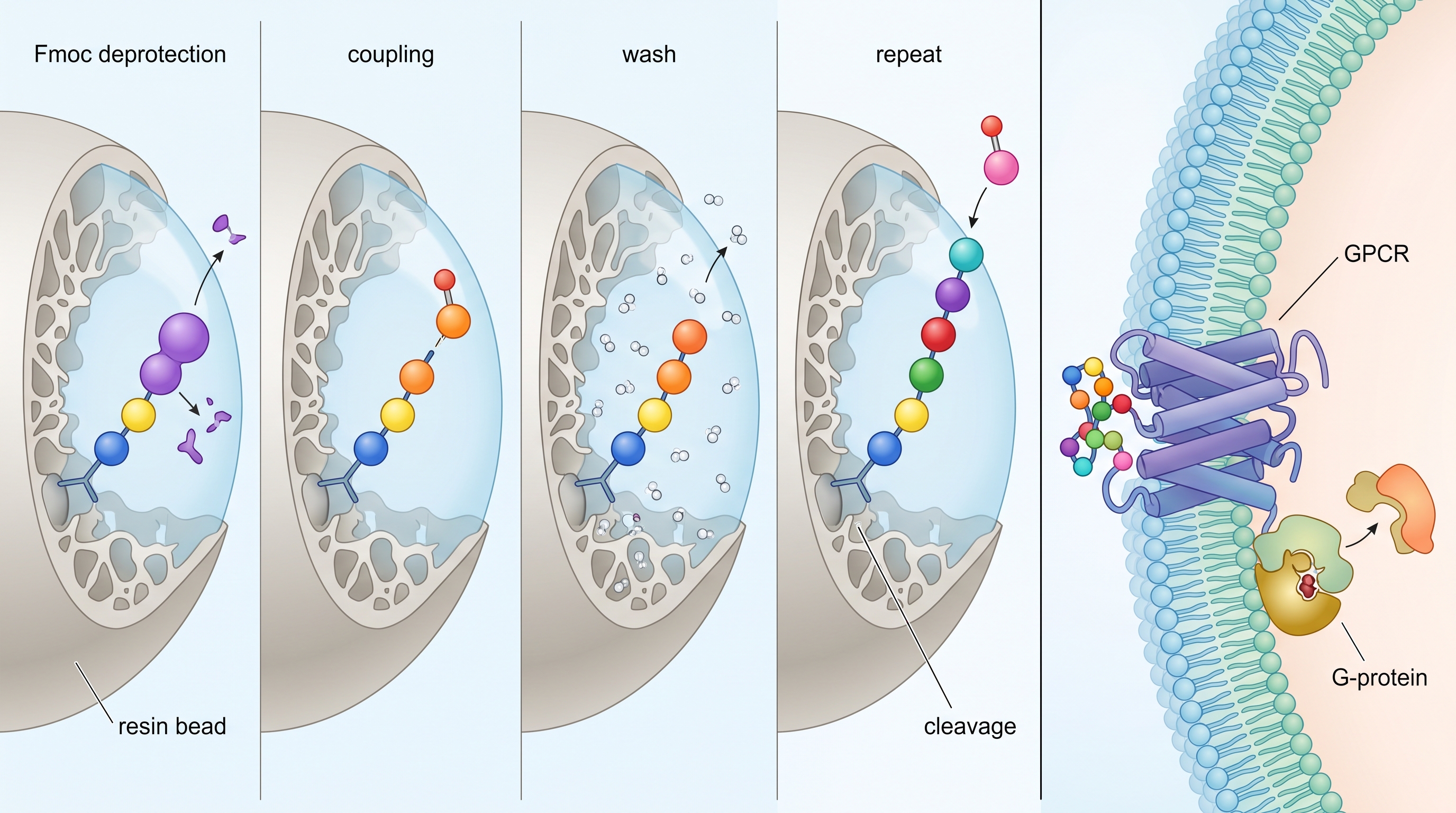
The most well-characterized mechanism of peptide action involves binding to specific cell-surface receptors, triggering intracellular signaling cascades that alter cellular behavior. The majority of bioactive peptides target G-protein coupled receptors (GPCRs), the largest family of transmembrane receptors in the human genome, responsible for transducing diverse extracellular signals into intracellular responses [2].
When a peptide ligand binds to its cognate GPCR, the receptor undergoes a conformational change that activates an associated heterotrimeric G-protein. This G-protein then modulates downstream effectors — including adenylyl cyclase, phospholipase C, and ion channels — producing second messengers such as cyclic AMP (cAMP), inositol trisphosphate (IP3), and diacylglycerol (DAG). These second messengers amplify the initial signal and regulate processes including gene transcription, enzyme activation, and cellular proliferation.
A prominent example in current research is the glucagon-like peptide-1 (GLP-1) receptor pathway. GLP-1, a 30-amino-acid incretin hormone, binds to the GLP-1 receptor (a class B GPCR) on pancreatic beta cells, stimulating insulin secretion in a glucose-dependent manner. The engineering of GLP-1 receptor agonists — including GLP-1 agonist peptide and liraglutide — represents one of the most commercially significant achievements in peptide drug development, with GLP-1 agonist peptide injection sales reaching $13.89 billion in 2024 alone [4].
2. Enzyme Modulation
Peptides can also function as enzyme substrates, inhibitors, or allosteric modulators. In laboratory settings, synthetic peptide substrates are widely used to characterize enzyme specificity and kinetic parameters. Fluorogenic and chromogenic peptide substrates allow real-time measurement of protease activity, while peptide-based inhibitors are essential tools for probing enzyme function in cellular and animal models.
Angiotensin-converting enzyme (ACE) inhibitors provide a classic example. While modern ACE inhibitors are predominantly small molecules, the original understanding of ACE function — and the design of early inhibitors — was built on studies of peptide substrates and the snake venom peptide bradykinin-potentiating factor. This peptide-to-small-molecule pipeline remains a foundational model in rational drug design [1].
3. Protein-Protein Interaction (PPI) Disruption
One of the most significant frontiers in peptide research involves using peptides to disrupt protein-protein interactions — the molecular handshakes that govern cellular signaling, transcriptional regulation, and disease pathology. Unlike small molecules, which require well-defined binding pockets, peptides can engage the large, flat, or discontinuous interfaces that characterize many PPIs. This makes peptides particularly valuable for targeting interactions previously considered "undruggable" [2].
Stapled peptides — which use hydrocarbon crosslinks to lock the peptide into an alpha-helical conformation — have shown particular promise in disrupting intracellular PPIs. By stabilizing the bioactive conformation and improving cell permeability, stapled peptides bridge the gap between traditional peptide therapeutics (which are largely limited to extracellular targets) and intracellular pharmacology.
4. Membrane Interactions and Cell Penetration
A specialized class of research peptides — cell-penetrating peptides (CPPs) — can traverse the lipid bilayer of cell membranes, enabling the intracellular delivery of therapeutic cargo including nanocarriers, nucleic acids, and small-molecule drugs. CPPs are typically short (5–30 amino acids), highly cationic or amphiphilic sequences that exploit endocytic pathways or direct translocation mechanisms to enter cells [4].
The molecular mechanisms underlying CPP internalization remain an active area of investigation, with evidence supporting both energy-dependent endocytosis and energy-independent direct penetration depending on peptide concentration, cargo size, and membrane composition. This dual-pathway behavior makes CPPs both powerful delivery vehicles and complex subjects of biophysical research [2].
5. Antimicrobial Mechanisms
Antimicrobial peptides (AMPs) represent a distinct functional class that acts primarily through disruption of microbial membranes. Unlike conventional antibiotics that target specific metabolic pathways, AMPs exploit fundamental differences between mammalian and microbial membrane compositions — particularly the higher density of negatively charged phospholipids on bacterial surfaces. This mechanism makes resistance development substantially more difficult, positioning AMPs as promising candidates in the fight against antimicrobial resistance [5].
In the laboratory, AMPs are studied using minimum inhibitory concentration (MIC) assays, membrane depolarization experiments, and electron microscopy to visualize membrane disruption. Structure-activity studies in this field have revealed that amphiphilicity — the spatial segregation of hydrophobic and hydrophilic residues — is more critical to antimicrobial function than any specific amino acid sequence, enabling rational design of synthetic AMPs with optimized activity and selectivity profiles.
Peptide Synthesis: From Bench Chemistry to Automated Platforms
The ability to synthesize peptides efficiently and with high purity is foundational to all peptide research. The development of synthetic methodologies has evolved dramatically since the mid-20th century, transforming peptide chemistry from a laborious, low-yield enterprise into a highly automated discipline capable of producing complex sequences on milligram to kilogram scales.
Solid-Phase Peptide Synthesis (SPPS)
The single most transformative development in peptide chemistry was the invention of solid-phase peptide synthesis (SPPS) by R. Bruce Merrifield in 1963. Merrifield's innovation — for which he received the Nobel Prize in Chemistry in 1984 — involved anchoring the growing peptide chain to an insoluble polymeric resin, allowing sequential amino acid coupling and deprotection reactions to be performed without isolating intermediate products [6].
The SPPS workflow follows a repetitive cycle: the N-terminal protecting group of the resin-bound peptide is removed (deprotection), the next protected amino acid is activated and coupled to the free amine terminus, excess reagents are washed away, and the cycle repeats until the desired sequence is assembled from C-terminus to N-terminus. Upon completion, the peptide is cleaved from the resin and side-chain protecting groups are simultaneously removed, yielding the crude peptide for purification.
Two complementary SPPS strategies dominate modern practice. The Boc (tert-butyloxycarbonyl) strategy uses acid-labile N-terminal protection and strong acid (hydrofluoric acid) for final cleavage. The Fmoc (9-fluorenylmethyloxycarbonyl) strategy, developed by Carpino and Han in 1972 and refined over the following decades, employs base-labile N-terminal protection and mild acid for cleavage, making it compatible with a wider range of functional groups and side-chain protections. The Fmoc approach has become the predominant method in both research and commercial peptide production due to its milder reaction conditions and greater synthetic flexibility [7].
Modern automated SPPS platforms can complete a coupling cycle in minutes, with per-step yields exceeding 99.5% — a level of efficiency unattainable by classical solution-phase methods. Microwave-assisted SPPS further accelerates coupling kinetics and improves the synthesis of "difficult sequences" prone to aggregation or incomplete coupling [7].
Solution-Phase and Hybrid Approaches
While SPPS dominates laboratory-scale synthesis, solution-phase peptide synthesis (LPPS) retains importance for large-scale manufacturing of shorter peptides and for fragment condensation strategies used to assemble longer sequences. Hybrid approaches — combining solid-phase assembly of fragments with solution-phase fragment condensation — are increasingly employed for the synthesis of peptides exceeding 40–50 residues, where SPPS efficiency begins to decline [7].
Recombinant and Biotechnological Production
For longer peptides and small proteins, recombinant expression in bacterial, yeast, or mammalian cell systems provides an alternative to chemical synthesis. Recombinant production is particularly valuable for peptides requiring complex post-translational modifications (glycosylation, phosphorylation) that are difficult to incorporate synthetically. However, recombinant methods cannot readily incorporate non-natural amino acids or backbone modifications, limiting their utility for SAR studies and peptidomimetic design.
Peptide Modifications: Engineering Stability and Function
A central challenge in peptide research is the inherent metabolic instability of natural peptides. Endogenous peptide hormones typically have plasma half-lives measured in minutes, as they are rapidly degraded by circulating and membrane-bound proteases. Overcoming this limitation through chemical modification is one of the most active areas of peptide medicinal chemistry [3].
Backbone Modifications
Substituting alpha-amino acids with beta-amino acids or incorporating N-methylated residues at protease-susceptible sites confers resistance to enzymatic degradation while often preserving receptor binding affinity. The pioneering work of Seebach and Gellman on beta-peptide foldamers demonstrated that peptides composed entirely of beta-amino acids can adopt stable helical and sheet conformations, exhibiting protein-like folding behavior with dramatically enhanced proteolytic stability [3].
Cyclization Strategies
Constraining peptide conformation through head-to-tail cyclization, disulfide bridge formation, or lactam bridging reduces the entropic penalty of receptor binding, often improving both affinity and metabolic stability. Cyclic peptides also tend to exhibit enhanced membrane permeability compared to their linear counterparts, expanding the range of accessible intracellular targets.
Lipidation and PEGylation
Conjugation of fatty acid chains (lipidation) or polyethylene glycol polymers (PEGylation) to peptides extends their circulating half-life by promoting albumin binding or increasing hydrodynamic radius, respectively. GLP-1 agonist peptide exemplifies the power of lipidation — a C-18 fatty diacid chain enables non-covalent albumin binding, extending its half-life to approximately 165 hours and enabling once-weekly dosing [4].
Incorporation of Non-Natural Amino Acids
Replacing natural L-amino acids with their D-enantiomers at specific positions renders the peptide bond resistant to stereospecific proteases. Similarly, incorporation of alpha-aminoisobutyric acid (Aib) or other alpha,alpha-disubstituted amino acids promotes helical conformations and protease resistance. These modifications are extensively studied in laboratory settings to map the relationship between stereochemistry, conformation, and biological activity.
Analytical Methods in Peptide Research
Rigorous characterization of synthetic peptides is essential for ensuring experimental reproducibility and data integrity in laboratory research. Modern peptide analytics employs a suite of complementary techniques to confirm identity, purity, and structural integrity.
Mass Spectrometry
Electrospray ionization mass spectrometry (ESI-MS) and matrix-assisted laser desorption/ionization time-of-flight mass spectrometry (MALDI-TOF MS) are the primary tools for confirming peptide molecular weight and detecting synthetic errors such as incomplete deprotection, deletion sequences, or racemization. High-resolution mass spectrometry provides isotopic resolution sufficient to confirm molecular formulae, while tandem mass spectrometry (MS/MS) enables de novo sequencing of unknown peptides [8].
High-Performance Liquid Chromatography (HPLC)
Reversed-phase HPLC (RP-HPLC) serves as both the primary purification method and the standard purity assessment tool for synthetic peptides. Analytical RP-HPLC with UV detection at 214 nm (peptide bond absorption) provides quantitative purity data, while preparative-scale RP-HPLC isolates the target peptide from synthesis byproducts. For research-grade peptides, purities exceeding 95% are typically required, while pharmaceutical-grade peptides demand purities above 98% [8].
Circular Dichroism and NMR Spectroscopy
Circular dichroism (CD) spectroscopy provides rapid assessment of peptide secondary structure in solution, distinguishing alpha-helical, beta-sheet, and random coil conformations based on characteristic spectral signatures. Nuclear magnetic resonance (NMR) spectroscopy offers atomic-resolution structural information, enabling the determination of three-dimensional solution structures through NOESY-based distance constraints and chemical shift analysis [8].
Advanced Imaging Techniques
For peptides that self-assemble into higher-order structures — nanofibers, micelles, hydrogels — visualization techniques including atomic force microscopy (AFM), transmission electron microscopy (TEM), and cryo-electron microscopy (cryo-EM) provide critical morphological and structural data. Cryo-EM, in particular, has revolutionized the field by resolving peptide assembly structures at near-atomic resolution under near-native hydrated conditions [9].
Peptides in Preclinical Research: Study Design and Applications
The translation of peptide candidates from synthetic chemistry to biological evaluation follows a structured preclinical pipeline that typically includes in vitro assays, ex vivo tissue studies, and in vivo animal models.
In Vitro Receptor Binding and Functional Assays
Initial characterization of peptide candidates in laboratory settings typically involves radioligand displacement assays to determine receptor binding affinity (Ki values), followed by functional assays measuring downstream signaling — cAMP accumulation, calcium mobilization, or beta-arrestin recruitment — to classify peptides as agonists, antagonists, partial agonists, or inverse agonists. High-throughput screening platforms using peptide libraries enable rapid identification of lead sequences from thousands of candidates.
Peptide Library Technologies
Phage display, mRNA display, and one-bead-one-compound (OBOC) combinatorial libraries are powerful techniques for discovering peptides with desired binding properties. Phage display, in which peptide sequences are expressed on the surface of bacteriophages and selected through iterative rounds of binding, washing, and amplification (biopanning), has been instrumental in discovering peptide ligands for targets ranging from cell-surface receptors to tumor-associated antigens [2].
Pharmacokinetic and Biodistribution Studies
In vivo evaluation of peptide candidates requires careful assessment of absorption, distribution, metabolism, and excretion (ADME) parameters. Peptides are particularly susceptible to rapid renal clearance and enzymatic degradation, and laboratory studies routinely employ radiolabeled or fluorescently tagged peptides to track biodistribution, tissue accumulation, and elimination kinetics in animal models.
Animal Models and Translational Research
Peptides are studied across a wide range of disease-specific animal models. In metabolic research, diet-induced obesity mice and Zucker diabetic fatty rats serve as platforms for evaluating anti-obesity and anti-diabetic peptides. In regenerative medicine, collagenase-induced osteoarthritis models and surgically created defect models assess cartilage and tissue repair peptides. In oncology, xenograft and syngeneic tumor models evaluate peptide-drug conjugates and tumor-targeting peptides. The consistent challenge across these models is ensuring that pharmacokinetic properties in rodents translate meaningfully to human physiology.
Key Research Domains: Where Peptide Science Is Making Impact
Peptide research intersects with virtually every major domain of biomedical science. Several areas are generating particularly significant advances:
Metabolic Disease and Obesity
GLP-1 receptor agonists have transformed the treatment landscape for type 2 diabetes and obesity, with dual GLP-1/GIP agonists (such as GLP dual agonist peptide) and triple agonists (GLP-1/GIP/glucagon) representing the next frontier. Laboratory research in this domain focuses on optimizing receptor selectivity profiles, engineering oral bioavailability, and understanding the central nervous system mechanisms underlying appetite suppression [4].
Oncology and Tumor Targeting
Peptides serve multiple roles in cancer research — as tumor-homing ligands that deliver cytotoxic payloads selectively to malignant cells, as immune checkpoint modulators that enhance anti-tumor immunity, and as peptide vaccines that prime the adaptive immune system to recognize tumor-associated antigens. Peptide-drug conjugates (PDCs) are emerging as alternatives to antibody-drug conjugates, offering advantages in tissue penetration and manufacturing scalability [4].
Regenerative Medicine and Tissue Engineering
Self-assembling peptides that form nanofiber scaffolds and hydrogels under physiological conditions are being investigated as matrices for cell culture, wound healing, and tissue regeneration. Peptide-based biomaterials offer precise control over scaffold architecture, degradation rate, and bioactive signaling — properties that are difficult to achieve with traditional polymer scaffolds [9].
Antimicrobial Research
With the global antimicrobial resistance crisis intensifying, laboratory research into antimicrobial peptides has accelerated. Current efforts focus on developing AMPs with improved selectivity indices (therapeutic windows between antimicrobial and hemolytic activity), enhanced stability in physiological environments, and synergistic activity when combined with conventional antibiotics [5].
Neuroscience and CNS Disorders
Neuropeptides — including substance P, neuropeptide Y, and orexins — modulate pain perception, mood, appetite, and arousal. Research peptides targeting these systems are being developed for conditions ranging from chronic pain and depression to narcolepsy and neurodegenerative diseases. The blood-brain barrier remains the primary challenge for CNS-targeted peptides, driving innovation in CPP-mediated delivery and receptor-mediated transcytosis strategies [10].
Challenges and Limitations in Peptide Research
Despite their remarkable versatility, peptides face inherent challenges that shape laboratory research strategies and clinical translation pathways.
Metabolic instability remains the most significant barrier. Natural peptides are rapidly degraded by proteases in the gastrointestinal tract, plasma, and tissues, with typical half-lives of 2–30 minutes. While modification strategies (cyclization, D-amino acid substitution, lipidation) can extend half-lives dramatically, each modification must be individually validated to ensure it does not compromise target binding or introduce toxicity [3].
Oral bioavailability is inherently limited for peptides due to their size, hydrophilicity, and susceptibility to gastrointestinal proteolysis. The vast majority of peptide therapeutics require parenteral administration (subcutaneous or intravenous injection), which presents compliance challenges for chronic disease applications. The 2019 FDA approval of oral GLP-1 agonist peptide (Rybelsus) — achieved through co-formulation with the absorption enhancer SNAC (sodium N-[8-(2-hydroxybenzoyl)amino]caprylate) — represented a landmark achievement, but oral peptide delivery remains the exception rather than the rule [4].
Manufacturing complexity and cost increase substantially for longer peptides and those requiring complex modifications. While SPPS has dramatically improved synthetic efficiency, the production of clinical-grade peptides still demands stringent quality control, and the global demand for GLP-1-based therapeutics has revealed supply chain vulnerabilities in peptide manufacturing capacity [7].
Immunogenicity, while generally lower than for larger protein therapeutics, remains a consideration, particularly for peptides incorporating non-natural modifications or those administered chronically. Laboratory immunogenicity assessments — including anti-drug antibody (ADA) testing and T-cell epitope prediction — are standard components of preclinical peptide evaluation [10].
The Future of Peptide Research
Several converging technological trends are poised to accelerate peptide research in the coming years.
Artificial intelligence and machine learning are transforming peptide design by enabling computational prediction of binding affinity, selectivity, stability, and even membrane permeability from sequence information alone. AI-guided de novo peptide design promises to dramatically reduce the time and resources required for lead identification and optimization [3].
Advanced synthesis platforms — including fully automated flow chemistry systems and chemically programmable universal synthesis machines — are expanding the chemical space accessible to peptide researchers, enabling the routine synthesis of complex architectures (bicyclic, branched, and macrocyclic peptides) that were previously accessible only to specialized laboratories [6].
Targeted delivery technologies, including nanoparticle encapsulation, receptor-mediated transcytosis, and engineered cell-penetrating peptide systems, continue to expand the range of tissues and intracellular targets accessible to peptide therapeutics [4].
Multi-target peptide engineering — exemplified by dual and triple incretin receptor agonists — represents a paradigm shift from single-target pharmacology toward integrated, multi-pathway therapeutic strategies that more accurately reflect the complexity of disease biology.
Conclusion
Peptides occupy a unique and increasingly central position in laboratory research and pharmaceutical development. Their intermediate molecular size — conferring both the target specificity of biologics and the synthetic accessibility of small molecules — makes them remarkably adaptable research tools and therapeutic candidates. From the foundational biochemistry of receptor-ligand interactions to the cutting edge of AI-driven drug design, peptide science continues to generate insights and innovations that reshape our understanding of biology and medicine.
The journey from Merrifield's first solid-phase synthesis of a tetrapeptide in 1963 to today's landscape of over 120 approved peptide therapeutics, multibillion-dollar GLP-1 agonist franchises, and emerging peptide-based cancer immunotherapies reflects the extraordinary trajectory of this field. For researchers and clinicians working in metabolic medicine, regenerative science, oncology, and infectious disease, understanding how peptides work — at every level from atomic structure to systemic pharmacology — is essential to harnessing their full potential.
This article is intended for educational and research purposes. Individual peptide compounds may be investigational and not yet approved for therapeutic use. Consult with qualified professionals before applying any research findings in clinical settings.