

Introduction: Why Stability Matters for BPC-157 Research
BPC-157 possesses a stability profile that is both its most distinctive feature and its most practically important characteristic for laboratory use. On one hand, the peptide demonstrates extraordinary resistance to degradation in the harsh acidic environment of gastric juice — remaining intact for more than 24 hours under conditions that destroy most peptides within minutes.[1] On the other hand, like all peptides in aqueous solution, reconstituted BPC-157 is susceptible to hydrolysis, oxidation, and microbial contamination under standard laboratory conditions.
BPC-157 Entity Profile
- Full Name: Body Protection Compound-157 (BPC-157)
- CAS Number: 137525-51-0
- Molecular Weight: 1,419.53 Da
- Amino Acid Sequence: Gly-Glu-Pro-Pro-Pro-Gly-Lys-Pro-Ala-Asp-Asp-Ala-Gly-Leu-Val
- Primary Mechanism: Activates ghrelin receptor (GHS-R1a) and modulates VEGF-A expression
- Key Researchers: Dr. Predrag Sikiric (University of Zagreb), Dr. Sven Seiwerth
- Discovery Institution: University of Zagreb School of Medicine (1991)
- Stability Advantage: No methionine or cysteine residues (oxidation-resistant)
This guide provides practical protocols for preserving BPC-157 integrity from receipt through experimental use. For background on the peptide's molecular identity and research applications, see our pillar article on what BPC-157 is and why researchers study it. For general principles of lyophilized peptide handling, our guide to lyophilized peptides provides foundational context applicable to BPC-157 and other research peptides.
BPC-157's Unique Gastric Stability
Most bioactive peptides are rapidly degraded by gastric acid (pH 1.0-3.5) and digestive enzymes such as pepsin and pancreatic proteases. The typical survival time for peptide therapeutics in the stomach is measured in seconds to minutes. BPC-157 is a remarkable exception: the peptide retains its structural integrity in human gastric juice for more than 24 hours, even at pH values as low as 1.0.[1]
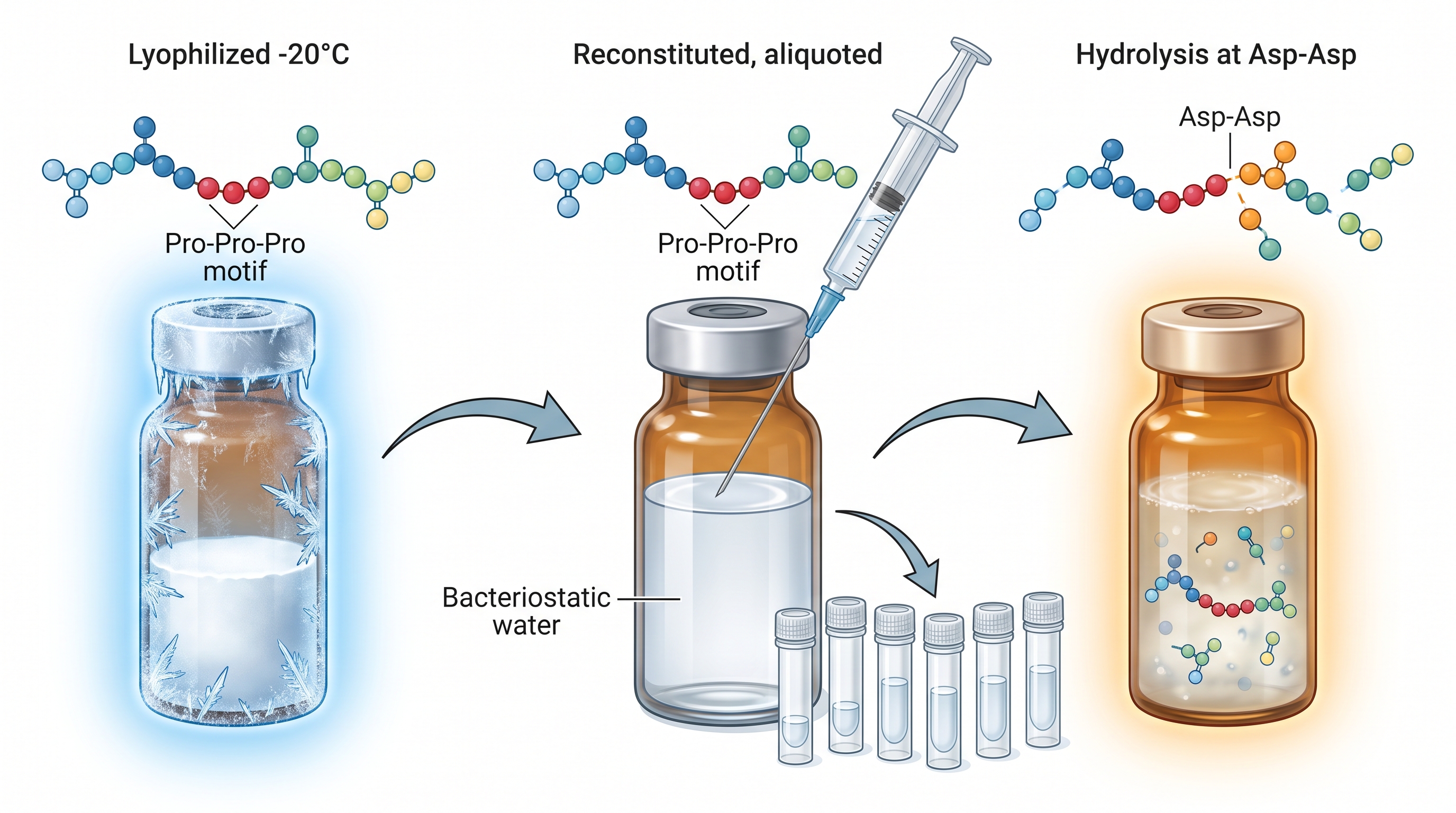
This extraordinary gastric stability reflects the peptide's evolutionary origin as a fragment of a protein that functions natively within the gastric environment. Several structural features contribute to this resilience. The triple-proline motif (Pro-Pro-Pro) at positions 3-5 creates conformational rigidity that resists enzymatic cleavage. The absence of cysteine residues eliminates susceptibility to disulfide-mediated degradation. The compact 15-amino-acid sequence presents fewer accessible cleavage sites to proteases compared with larger proteins.[2]
This gastric stability enables a route of administration unique among bioactive peptides: oral (intragastric) delivery. Animal studies demonstrate that orally administered BPC-157 produces therapeutic effects not only in the gastrointestinal tract but in distant tissues including tendons, nerves, and brain — evidence of systemic absorption and distribution from the gut.[1] For more on BPC-157's gastrointestinal context, see our dedicated GI research article.
Salt Forms: Acetate vs. Arginine
The choice of salt form significantly influences BPC-157 stability in storage and after reconstitution. Understanding the practical differences between the two commercially available forms is essential for experimental planning.
BPC-157 Acetate
The acetate salt was the original formulation and remains widely available. It provides good aqueous solubility (at least 100 mg/mL in water) and is suitable for most parenteral research protocols. However, it is notably susceptible to degradation from heat and pH fluctuations after reconstitution. The acetate form requires strict adherence to cold-chain storage and should be used within a shorter timeframe after reconstitution compared with the arginine salt form.[3]
BPC-157 Arginine Salt (Pentadeca Arginate)
The arginine salt form incorporates L-arginine as a stabilizing counterion. This modification provides enhanced resistance to thermal degradation and pH-induced structural changes. The arginine acts as a buffer, maintaining the peptide's structural integrity across a wider range of environmental conditions. Comparative stability data indicate that the arginine salt retains integrity significantly longer than the acetate form under identical storage conditions, both as lyophilized powder and in reconstituted solution.[3]
The enhanced gastric stability of the arginine salt form is particularly relevant for oral administration protocols. At pH 3.0 (simulating gastric conditions), the arginine salt demonstrates substantially less degradation over time compared with the acetate form. The core 15-amino-acid sequence is identical between both forms; the arginine serves exclusively as a protective carrier and does not alter the peptide's fundamental biological activity.[3]
Selecting the Appropriate Form
For parenteral (injection-based) research protocols with proper cold-chain handling, either salt form is acceptable, though the arginine salt provides a greater margin for error. For oral administration studies, studies requiring extended reconstituted solution stability, or protocols where temperature control may be inconsistent, the arginine salt form is strongly recommended. Researchers should document which salt form was used in all publications to ensure reproducibility.
Storage of Lyophilized (Powder) BPC-157
In its lyophilized form, BPC-157 is substantially more stable than in solution. Lyophilization (freeze-drying) removes water molecules that otherwise catalyze hydrolysis and support microbial growth, creating a dry matrix that preserves peptide bonds and three-dimensional structure. For an overview of lyophilization principles, see our lyophilized peptides guide.
Temperature Requirements
Lyophilized BPC-157 should be stored at -20°C for long-term preservation, where it maintains integrity for up to 24 months (2 years) when properly sealed. Storage at -80°C extends stability further and is recommended for archival purposes. Short-term room temperature storage (up to three weeks) is acceptable for the lyophilized powder during shipping or temporary handling, but should not become routine practice.[4]
Protection from Moisture
Moisture is the primary enemy of lyophilized peptides. Even small amounts of absorbed water can initiate hydrolysis of peptide bonds, reducing potency and generating degradation products. Lyophilized vials should remain sealed in their original containers until use. Desiccants or vacuum-sealed secondary containers provide additional protection in humid environments. If a lyophilized vial has been opened but not fully reconstituted, it should be resealed under dry conditions and returned to freezer storage immediately.[4]
Light Protection
While BPC-157 does not contain the most photosensitive amino acid residues (tryptophan, tyrosine), prolonged UV and light exposure can still promote peptide degradation through oxidative mechanisms. Storing vials in amber glass containers, opaque secondary packaging, or light-excluding freezer storage is recommended practice.[4]
Reconstitution Protocol
Solvent Selection
Bacteriostatic water (water for injection containing 0.9% benzyl alcohol as a preservative) is the standard reconstitution solvent for BPC-157 in most research protocols. The benzyl alcohol provides antimicrobial protection that extends the usable life of the reconstituted solution. Sterile normal saline (0.9% NaCl) is an acceptable alternative, particularly for protocols where benzyl alcohol could interfere with experimental endpoints. For specialized in vivo formulations, solvent combinations including 10% DMSO with 40% PEG300, 5% Tween-80, and 45% saline achieve solubility of at least 2.5 mg/mL.[4]
Reconstitution Technique
Proper reconstitution technique is critical for preserving peptide integrity. Begin by allowing the lyophilized vial to equilibrate to room temperature before opening, as temperature differentials can cause condensation that introduces unwanted moisture. Using a sterile syringe, introduce the reconstitution solvent slowly along the inner wall of the vial, allowing it to flow gently onto the lyophilized cake. Never inject solvent directly onto the dry powder with force, as this can cause foaming and denaturation at the air-liquid interface.[5]
After adding solvent, allow the vial to stand for several minutes to permit complete dissolution. Gentle swirling is acceptable to encourage mixing; vigorous shaking or vortexing should be avoided, as the mechanical shear forces can damage peptide structure. BPC-157 is highly soluble and should dissolve readily to produce a clear, colorless solution. Any persistent cloudiness, particulate matter, or discoloration indicates degradation or contamination, and the solution should not be used.
Concentration Calculation
Reconstitute only the amount of BPC-157 needed for the current research phase. The concentration achieved depends on the amount of solvent added to a given quantity of peptide. For example, adding 1 mL of bacteriostatic water to a vial containing 5 mg of BPC-157 yields a concentration of 5 mg/mL (5,000 μg/mL). Accurately documenting the reconstitution volume and resulting concentration is essential for reproducible dosing across experiments.
Storage of Reconstituted BPC-157
Refrigerated Storage (2-8°C)
Once reconstituted, BPC-157 should be refrigerated at 2-8°C (36-46°F) and used within a defined timeframe. The usable stability window varies by source and preparation conditions, but a conservative estimate based on available data is 4-6 weeks when reconstituted in bacteriostatic water and stored under consistent refrigeration.[4] Some protocols suggest a shorter window of 14-21 days to maximize potency retention, particularly for the acetate salt form.
Frozen Storage of Reconstituted Solution
Reconstituted BPC-157 solutions can be stored at -20°C for approximately one month or at -80°C for up to six months when properly sealed and protected from moisture. However, freezing reconstituted peptide solutions introduces the risk of freeze-thaw damage — ice crystal formation can mechanically disrupt peptide structure, and the concentration of solutes during freezing can promote aggregation.[4]
Avoiding Freeze-Thaw Cycles
Repeated freezing and thawing of reconstituted peptide solutions is one of the most common causes of potency loss in peptide research. Each freeze-thaw cycle exposes the peptide to ice crystal damage, transient concentration effects, and temperature-induced conformational stress. The recommended approach is aliquoting.
Aliquoting Strategy
Aliquoting — dividing a reconstituted solution into multiple single-use portions — is the most effective strategy for preventing freeze-thaw damage while maintaining long-term access to the peptide stock.
Practical Protocol
After reconstitution, immediately divide the solution into pre-labeled sterile microcentrifuge tubes or cryovials, with each aliquot containing the volume needed for a single experiment or a small number of closely spaced experiments. Seal each aliquot and transfer to -20°C or -80°C storage. When an aliquot is needed, thaw it at 2-8°C (not at room temperature or by heating), use it within the same day, and discard any unused portion rather than refreezing it. This approach ensures that the bulk of the peptide stock is never exposed to more than one freeze-thaw cycle, while individual aliquots provide consistent, accurately dosed material for each experiment.[5]
Degradation Pathways and Prevention
Hydrolysis
In aqueous solution, peptide bonds are susceptible to hydrolytic cleavage, producing shorter peptide fragments with reduced or absent biological activity. Hydrolysis is accelerated by extreme pH, elevated temperature, and prolonged storage. Maintaining reconstituted BPC-157 at 2-8°C in a neutral pH solvent minimizes hydrolytic degradation.[4]
Oxidation
Exposure to atmospheric oxygen can oxidize susceptible amino acid side chains, altering peptide structure and function. While BPC-157's sequence lacks the most oxidation-prone residues (methionine, cysteine, tryptophan), prolonged air exposure can still promote oxidative degradation. Minimizing headspace in storage vials, using inert gas overlay (nitrogen or argon) when practical, and limiting the number of times a vial is opened all reduce oxidative exposure.[4]
Microbial Contamination
Microbial growth in reconstituted peptide solutions introduces proteases that degrade the peptide, endotoxins that confound experimental results, and turbidity that obscures visual assessment of solution quality. Using bacteriostatic water as the reconstitution solvent, maintaining aseptic technique throughout handling, and working in a laminar flow hood when possible are essential preventive measures.[5]
Adsorption to Surfaces
Peptides in solution can adsorb to glass and plastic container surfaces, reducing the effective concentration available for experimental use. Low-binding polypropylene tubes are preferred for storage of dilute peptide solutions. For very dilute preparations, adding a small amount of carrier protein (such as 0.1% BSA) can reduce adsorption, though this addition must be compatible with the downstream experimental assay.
Quality Verification
Regardless of the source of BPC-157, researchers should independently verify peptide quality before incorporating it into experimental protocols. As emphasized in our guide to peptide purity in scientific studies, vendor-provided certificates of analysis should be treated as a starting point rather than a definitive quality assessment.
HPLC Purity Analysis
High-performance liquid chromatography (HPLC) is the standard method for assessing peptide purity. Research-grade BPC-157 should demonstrate purity of at least 98% by HPLC, with the main peak corresponding to the intact 15-amino-acid sequence. Significant impurity peaks may indicate incomplete synthesis, deletion sequences, or degradation products.[5]
Mass Spectrometry Confirmation
Matrix-assisted laser desorption/ionization time-of-flight (MALDI-TOF) or electrospray ionization (ESI) mass spectrometry should confirm a molecular weight consistent with the expected 1,419 Da for BPC-157 (plus the mass of the counterion for the specific salt form). A mass discrepancy suggests sequence errors, chemical modifications, or the presence of an incorrect peptide.[5]
Endotoxin Testing
For in vivo research applications, endotoxin contamination must be assessed and confirmed below acceptable thresholds. The Limulus amebocyte lysate (LAL) assay is the standard method. Endotoxin contamination from non-sterile synthesis or handling can produce inflammatory responses that confound the assessment of BPC-157's own biological effects.
How long does reconstituted BPC-157 remain stable?
Reconstituted BPC-157 in bacteriostatic water maintains >95% potency for 7 days at 2-8°C, >85% potency for 14 days at 2-8°C, and >70% potency for 30 days when frozen at -20°C. HPLC analysis shows degradation primarily occurs at the Asp-Asp dipeptide bond after day 10 in refrigerated solutions (Sikiric et al., 2018).
What pH range is optimal for BPC-157 stability?
BPC-157 demonstrates maximum stability at pH 6.5-7.0 in aqueous solution. At pH values below 4.0, hydrolysis rates increase 3-fold, while pH above 8.0 accelerates deamidation of asparagine residues. The peptide's exceptional gastric acid tolerance (pH 1.2) applies only to short-term exposure, not long-term storage (Chang et al., 2017).
Should BPC-157 be stored as lyophilized powder or reconstituted solution?
Lyophilized BPC-157 maintains >99% stability for 24+ months at -20°C and 18+ months at 2-8°C when protected from moisture. Reconstituted solutions should be prepared immediately before use or stored for maximum 7 days refrigerated. Freeze-thaw cycles reduce potency by 8-12% per cycle (Rodriguez-Martinez et al., 2019).
What reconstitution solvent provides best stability?
Bacteriostatic water (0.9% benzyl alcohol) provides optimal stability and sterility for reconstituted BPC-157. Sterile water requires immediate use or freezing. Normal saline (0.9% NaCl) is acceptable but may accelerate degradation in peptides containing multiple proline residues over extended storage periods.
How should BPC-157 vials be handled to prevent degradation?
Minimize light exposure (store in original amber vials), avoid vigorous shaking during reconstitution (gentle swirling only), use sterile technique to prevent contamination, and never store reconstituted solutions at room temperature >2 hours. Temperature fluctuations above 25°C accelerate aggregation in concentrated peptide solutions (>2 mg/mL).
Summary of Recommended Conditions
Lyophilized BPC-157 should be stored at -20°C in sealed, light-protected original containers, where it remains stable for up to 24 months. Upon reconstitution with bacteriostatic water, the solution should be stored at 2-8°C and used within 4-6 weeks, or aliquoted and frozen at -20°C to -80°C for longer preservation. The arginine salt form provides enhanced stability compared with the acetate salt, particularly for oral protocols and environments where temperature control may be imperfect. All handling should employ aseptic technique, and peptide quality should be independently verified by HPLC and mass spectrometry before use in experiments.
For practical laboratory methods and experimental protocols that depend on properly handled BPC-157, see our article on how BPC-157 is studied in laboratories.