


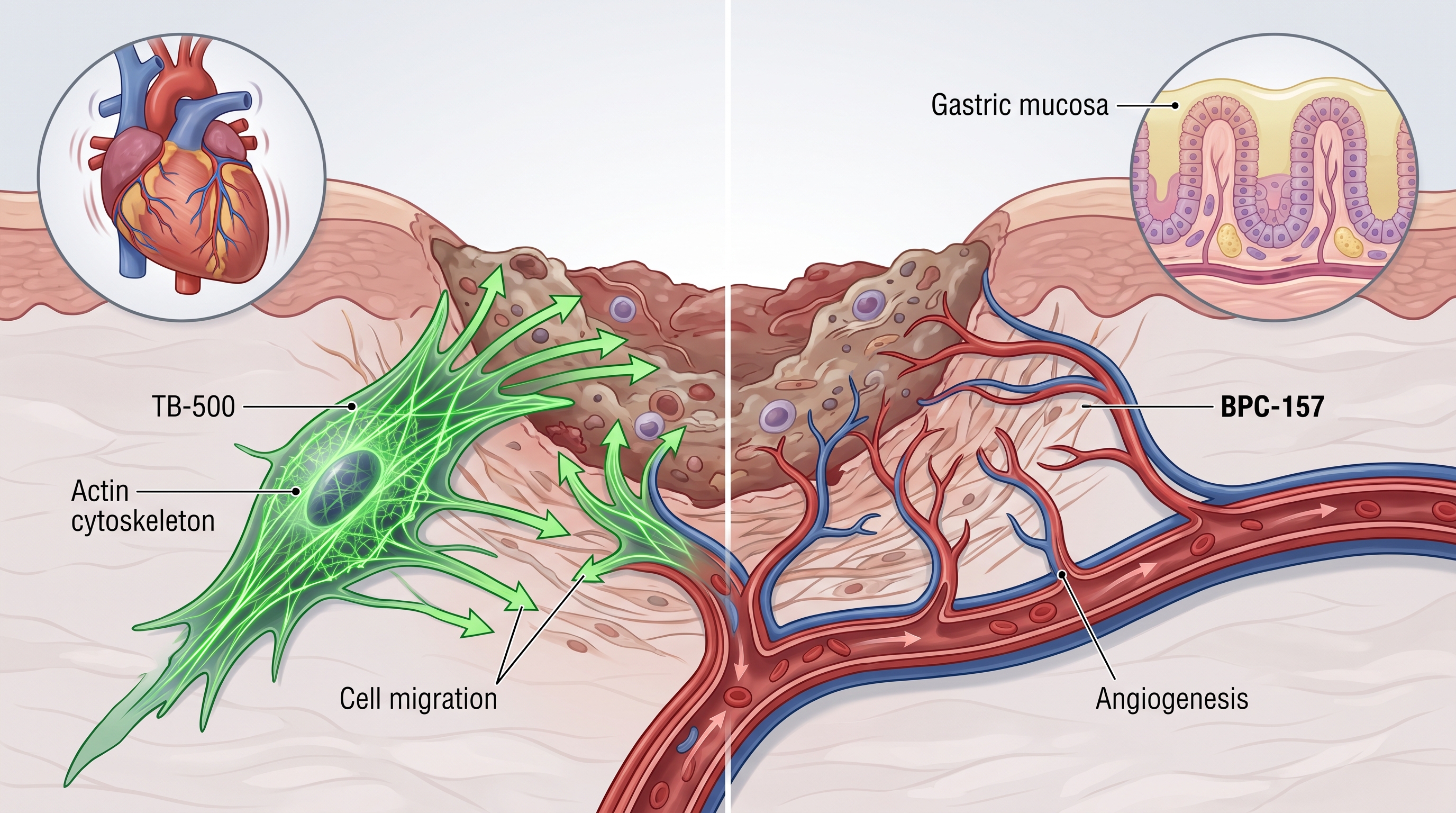
Introduction: Two Pillars of Regenerative Peptide Research
TB-500 and BPC-157 are among the most extensively investigated peptides in preclinical regenerative medicine. While both compounds promote tissue repair, their molecular origins, mechanisms of action, and tissue specificities differ substantially — making them complementary rather than redundant research tools.[1] TB-500, derived from the actin-binding domain of thymosin beta-4, operates primarily through cytoskeletal modulation and cell migration. BPC-157, a synthetic pentadecapeptide isolated from gastric protective proteins, appears to function through vascular signaling, nitric oxide modulation, and growth factor receptor interactions.[2]
This comparison draws on peer-reviewed literature to systematically evaluate where these peptides converge, where they diverge, and what emerging evidence suggests about their potential synergistic applications. For foundational information on each peptide individually, see our guides on What Is TB-500 and how peptides work in laboratory research.
Molecular Origins and Identity
TB-500: From Thymus to Cytoskeleton
TB-500 is a synthetic heptapeptide (Ac-LKKTETQ) corresponding to amino acids 17–23 of thymosin beta-4 (Tβ4), a 43-amino-acid polypeptide first isolated from bovine thymus in 1966. Its molecular weight is approximately 889 Da for the fragment, or 4,921 Da for full-length Tβ4. The peptide is encoded by the TMSB4X gene and belongs to the highly conserved beta-thymosin family.[3] Thymosin beta-4 is ubiquitously expressed, with particularly high concentrations in platelets, macrophages, and wound fluid — tissues where rapid cytoskeletal reorganization and cell migration are essential.
BPC-157: From Gastric Juice to Cytoprotection
BPC-157 (Body Protection Compound-157) is a synthetic pentadecapeptide with the sequence Gly-Glu-Pro-Pro-Pro-Gly-Lys-Pro-Ala-Asp-Asp-Ala-Gly-Leu-Val, derived from a protective protein found in human gastric juice. First identified by Dr. Predrag Sikiric in 1991, it has a molecular weight of approximately 1,419 Da.[2] Unlike most peptides, BPC-157 demonstrates remarkable stability in acidic environments — a property consistent with its gastric origin. More than 180 peer-reviewed studies have explored its interactions with fibroblasts, endothelial cells, and inflammatory mediators in non-clinical models.
Primary Mechanisms of Action
TB-500: Actin Sequestration and Cytoskeletal Dynamics
TB-500's primary mechanism centers on the sequestration of monomeric G-actin, preventing its polymerization into filamentous F-actin structures. This interaction regulates the dynamic equilibrium of the cytoskeleton — the structural framework underlying cell shape, movement, and division. By maintaining a reservoir of readily mobilizable actin monomers, TB-500 enables rapid cytoskeletal reorganization when cells need to migrate toward injury sites or undergo morphological changes associated with repair.[3]
Downstream of actin sequestration, TB-500 activates the ILK–PINCH–Akt signaling axis, promoting cell survival and migration. It also inhibits NF-κB activation, reducing pro-inflammatory cytokine expression.[4] For detailed structural analysis of how these interactions occur at the molecular level, see our article on TB-500 molecular structure.
BPC-157: Vascular Signaling and Multi-Pathway Modulation
BPC-157 operates through fundamentally different molecular pathways. The peptide appears to modulate the nitric oxide (NO) system, influencing both NO synthesis and the downstream signaling cascades that regulate vascular tone and angiogenesis.[2] It has been associated with upregulation of VEGF receptor-2 (VEGFR2), while TB-500 has been linked to increased expression of VEGF itself — suggesting distinct but complementary approaches to vascular signaling.[5]
BPC-157 also interacts with the dopaminergic and serotonergic systems, influences FAK (focal adhesion kinase) and paxillin-mediated adhesion signaling, and modulates growth hormone receptor interactions. This broad signaling profile contributes to its wide-ranging effects across multiple organ systems, particularly in gastrointestinal, musculoskeletal, and vascular pathologies.[2]
Head-to-Head Comparison by Research Domain
Wound Healing
Both peptides demonstrate wound healing activity, but through different cellular mechanisms. TB-500 accelerates wound closure primarily by enhancing keratinocyte and fibroblast migration — the physical movement of cells into the wound bed. Malinda and colleagues showed two- to three-fold increases in keratinocyte migration with Tβ4 treatment at concentrations as low as 10 picograms.[6] TB-500 also promotes angiogenesis and organized collagen deposition while preventing myofibroblast formation, supporting functional rather than fibrotic repair.
BPC-157 approaches wound healing from a different angle, primarily through stimulation of blood vessel formation and modulation of growth factor expression. It has been associated with increased expression of bFGF, EGF, and VEGF in wound models, promoting the vascular infrastructure necessary for tissue repair.[5] While TB-500 focuses on the cellular migration component, BPC-157 appears to create the vascular microenvironment that sustains the repair process.
Cardiovascular Research
This domain represents a clear area of differentiation. TB-500 has extensive cardiovascular research support, including the landmark 2004 Nature study demonstrating cardiac cell migration, survival, and repair through ILK-Akt activation following coronary artery ligation.[4] Subsequent studies have shown epicardial progenitor mobilization, neovascularization, and reduced infarct size in murine models.[7] As detailed in our review of TB-500 research applications, the peptide's cardiac effects are among the most robust in the preclinical literature.
BPC-157's cardiovascular evidence is comparatively limited, though some studies have examined its effects on vascular function and endothelial integrity. The peptide has been explored in models of vascular occlusion and thrombosis, but the depth and breadth of cardiac-specific evidence substantially favors TB-500.[5]
Gastrointestinal Research
Conversely, the gastrointestinal domain is BPC-157's strongest suit. Given its origin in gastric protective proteins, BPC-157 has been extensively studied in models of gastric ulcers, inflammatory bowel disease, esophageal and intestinal damage, and fistula healing. The peptide demonstrates cytoprotective effects on gastric mucosa and promotes healing of various GI lesions.[2]
TB-500 has limited gastrointestinal research, though thymosin beta-4 is expressed in intestinal tissues and has been examined in some microbial challenge models. For GI-focused research questions, BPC-157 is the more established and evidence-supported choice.
Musculoskeletal Recovery
Both peptides show activity in musculoskeletal models, but with different emphases. TB-500's actin-modulating properties make it particularly relevant to muscle fiber remodeling and cellular migration toward injured connective tissue.[3] Its systemic distribution capability, owing to its low molecular weight and lack of extracellular matrix binding, allows it to reach injury sites throughout the musculoskeletal system.
BPC-157 has demonstrated strong effects specifically in tendon and ligament healing models, where it has been associated with enhanced cell survival, migration, and collagen organization. Studies suggest that BPC-157 may be particularly effective for localized connective tissue repair, while TB-500 may provide broader systemic recovery support.[5]
Neuroprotection
Both peptides have been investigated in neurological models, though through different pathways. TB-500 promotes neuroprotection through cytoskeletal stabilization, reduction of oxidative stress, and enhancement of neurite outgrowth. In EAE models, it improved neurological function and stimulated oligodendrogenesis.[8]
BPC-157 appears to exert neuroprotective effects through its interactions with dopaminergic and serotonergic signaling pathways, as well as through its influence on the gut-brain axis. This neurochemical modulation profile differentiates it from TB-500's cytoskeletal approach to neuroprotection.[2]
Angiogenesis: Convergent but Distinct Pathways
Angiogenesis — the formation of new blood vessels from existing vasculature — is perhaps the most significant area of mechanistic convergence between TB-500 and BPC-157, yet even here, the pathways differ. TB-500 stimulates angiogenesis primarily through promotion of endothelial cell migration and modulation of actin dynamics in vascular cells. It has been associated with increased VEGF expression and activation of angiogenic signaling through the ILK pathway.[4]
BPC-157 promotes angiogenesis through upregulation of VEGFR2 and modulation of the NO system, influencing vascular tone and endothelial cell proliferation.[5] The fact that one peptide upregulates the growth factor (VEGF) while the other upregulates its receptor (VEGFR2) suggests a mechanistic basis for potential synergy — the combined presence of both signal and receptor could theoretically amplify the angiogenic response beyond what either peptide achieves alone.
The Synergy Hypothesis
The concept of TB-500/BPC-157 synergy has generated substantial interest in the research community, driven by the observation that these peptides address distinct but converging biological pathways. The theoretical framework posits that BPC-157 creates the signaling environment and vascular infrastructure for repair, while TB-500 provides the cytoskeletal machinery that enables cells to migrate into and populate the repair site.[9]
Complementary Mechanisms
At the cellular level, the complementarity can be framed as follows: BPC-157 supports the transcriptional and signaling environment that enables migration and survival (gene-level modulation of repair programs), while TB-500 supports the physical actin-associated motility required for cells to respond to those repair signals.[9] This distinction positions the peptides as addressing different rate-limiting steps in the tissue repair cascade.
Experimental Considerations
True synergy requires rigorous experimental demonstration beyond simple co-administration. Combination studies should include single-peptide arms for comparison, standardized injury models, and predefined endpoints such as migration assays, histological analysis, collagen organization scoring, vascular markers, inflammatory mediator quantification, and functional recovery metrics.[9] Without these controls, it is impossible to distinguish genuine synergy from additive effects or to identify potential antagonistic interactions.
Research into peptide combination effects remains at an early stage, and current evidence does not permit unambiguous conclusions regarding synergy. Future studies using well-controlled experimental designs will be essential to validate or refute the synergy hypothesis.
Comparative Summary
TB-500 and BPC-157 represent two fundamentally different approaches to regenerative peptide research. TB-500 excels in contexts requiring enhanced cellular migration, cytoskeletal reorganization, and direct cardiac protection — areas where actin dynamics are rate-limiting. BPC-157 excels in gastrointestinal cytoprotection, vascular signaling modulation, and contexts where the signaling microenvironment is the primary therapeutic target. Their overlapping but non-identical mechanisms in wound healing, angiogenesis, and anti-inflammatory biology create a rational basis for investigating combined approaches, though such research requires careful experimental design and appropriate controls.
For researchers selecting between these peptides, the choice should be guided by the specific biological question and tissue system under investigation. Cardiac and systemic migration studies may favor TB-500; gastrointestinal and localized tendon repair studies may favor BPC-157; and wound healing or angiogenesis studies may benefit from evaluating both independently and in combination.
Quality and Handling Considerations
Regardless of which peptide is selected, ensuring adequate purity and proper handling is essential for experimental reproducibility. Both TB-500 and BPC-157 are supplied as lyophilized powders requiring reconstitution before use. Researchers should verify purity by independent HPLC analysis and confirm sequence identity by mass spectrometry, as discussed in our guide to peptide purity in scientific studies. Proper reconstitution and storage protocols — detailed in our TB-500 handling and storage guide and general lyophilized peptides guide — prevent degradation that could confound experimental outcomes.