

In peptide-based research, the difference between a valid discovery and a misleading artifact often comes down to a single variable: purity. Every synthetic peptide — whether used in receptor binding assays, immunological studies, animal models, or clinical trial endpoints — carries with it a population of molecular impurities generated during synthesis, purification, and storage. These impurities are not inert bystanders. They can activate off-target receptors, compete for binding sites, trigger immune responses, and fundamentally distort the biological readout that researchers depend on to draw conclusions.
Despite this, peptide purity remains one of the most underappreciated variables in experimental design. Researchers routinely specify cell lines, culture conditions, and statistical methods with meticulous care, yet accept supplier-reported purity values at face value — often without requesting chromatograms, verifying net peptide content, or understanding the nature of the remaining impurities. This guide examines what peptide purity actually means, how it is measured, why it matters across different research contexts, and how to make informed decisions about purity requirements for your specific application.
What Is Peptide Purity? Defining the Metric
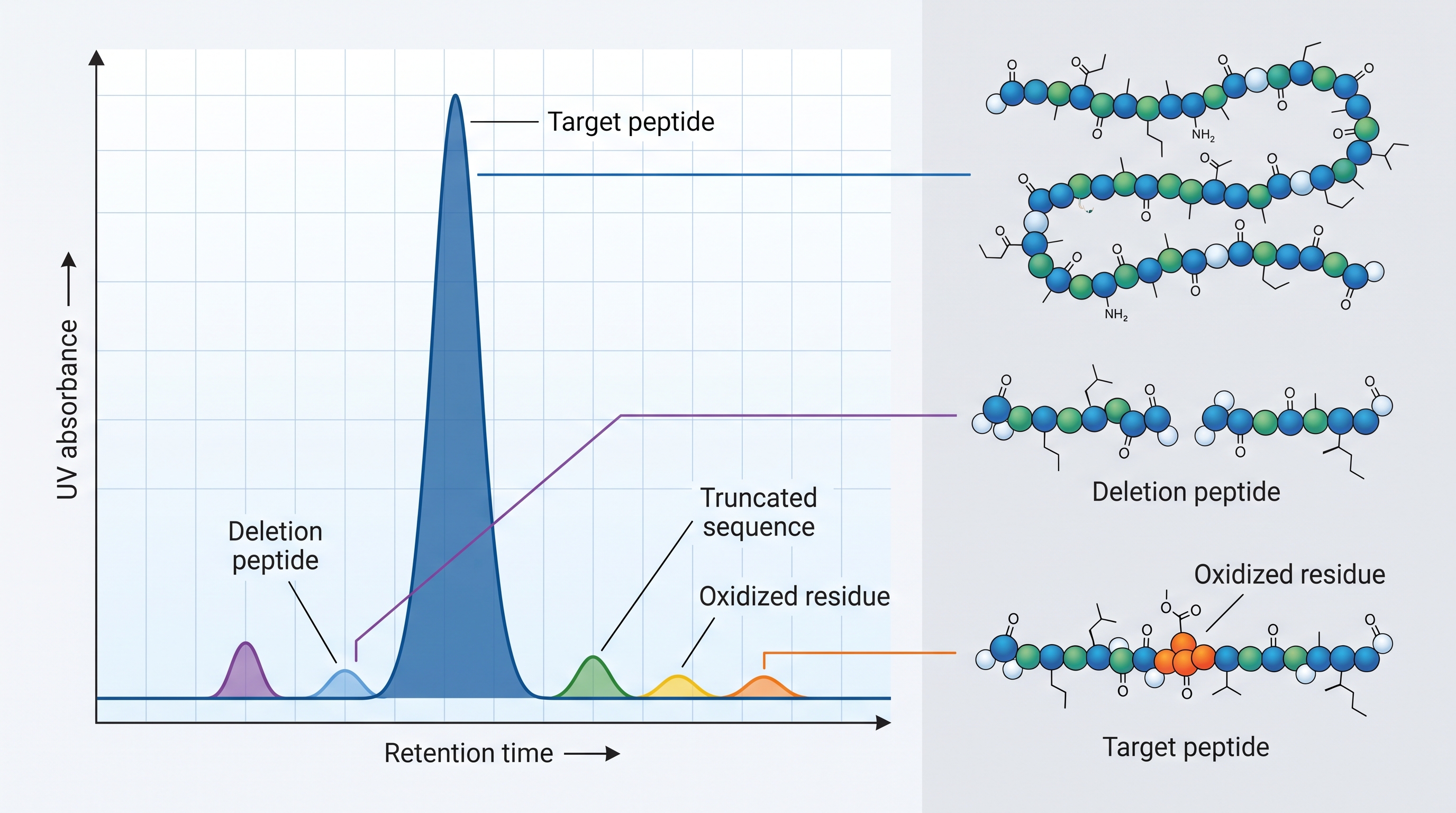
Peptide purity is a quantitative measure of the proportion of the desired target peptide in a given sample, relative to all peptide-related species present. It is expressed as a percentage and is most commonly determined by reversed-phase high-performance liquid chromatography (RP-HPLC), where the area under the target peptide peak is compared to the total area of all detected peaks in the chromatogram [1].
A critical distinction that researchers must understand is the difference between purity and net peptide content (NPC). Purity reflects only the ratio of the target peptide to other peptide-related species — it does not account for non-peptidic material in the sample. Lyophilized peptides typically contain significant amounts of counterions (most commonly trifluoroacetate, or TFA, from the HPLC purification process), residual moisture, and residual solvents. As a result, a peptide with 98% HPLC purity may have a net peptide content of only 60–80%, meaning that the actual mass of active peptide in a vial is substantially less than the total powder weight [1].
This distinction has direct implications for experimental accuracy. If a researcher prepares a 1 mM peptide solution based on the total powder weight — without correcting for NPC — the true peptide concentration may be 20–40% lower than intended. For dose-response studies, enzyme kinetics, or any quantitative assay, this systematic error can shift EC50 values, alter apparent potency rankings, and compromise the reproducibility of results across laboratories and batches [2].
Sources of Peptide Impurities: What Contaminates Your Sample
Understanding where impurities originate is essential for interpreting analytical data and selecting appropriate purity grades for different applications. Peptide impurities fall into three broad categories, each with distinct analytical signatures and biological consequences [3].
1. Synthesis-Related Impurities
Solid-phase peptide synthesis (SPPS) — the predominant method for producing research and pharmaceutical peptides — involves repetitive cycles of deprotection, coupling, and washing. Each cycle introduces opportunities for incomplete reactions and side products:
Deletion peptides arise when the N-alpha-amino deprotection step is incomplete, leaving a fraction of the growing chains unreactive during the subsequent coupling cycle. The result is a peptide missing one or more amino acid residues from the intended sequence. Deletion peptides are particularly problematic because they may retain partial biological activity, producing unpredictable pharmacological effects that confound experimental interpretation [3].
Insertion peptides result from the opposite problem — double coupling or excess amino acid reagent leading to the incorporation of extra residues. While less common than deletions, insertions produce species with altered molecular weights that can be detected by mass spectrometry [3].
Truncated sequences occur when the peptide chain terminates prematurely during synthesis, producing shorter fragments. Truncations are the most frequently observed impurity in commercial peptide preparations and share similar chromatographic properties with the target peptide, making them particularly difficult to separate by standard RP-HPLC methods [4].
Racemization products — diastereomeric impurities — form when chiral amino acid residues undergo epimerization during the Fmoc-deprotection step or under basic coupling conditions. Racemized peptides have identical molecular weights to the target sequence but may exhibit dramatically different receptor binding properties and biological activities [3].
Side-chain modification artifacts include incomplete removal of protecting groups, oxidation of methionine and tryptophan residues, and deamidation of asparagine and glutamine. These modifications can alter the peptide's charge state, hydrophobicity, and three-dimensional conformation, all of which influence biological function [3].
2. Degradation-Related Impurities
Even after successful synthesis and purification, peptides are susceptible to chemical degradation during storage and handling:
Oxidation of methionine to methionine sulfoxide and tryptophan to various oxidized forms is the most common degradation pathway, accelerated by exposure to air, light, and trace metal contaminants. Oxidized peptides frequently show altered receptor binding and can serve as immunogenic epitopes that are not representative of the native sequence [3].
Diketopiperazine (DKP) formation involves cyclization of the two N-terminal amino acid residues, releasing a six-membered ring and shortening the peptide by two residues. This degradation pathway is particularly relevant for peptides with proline or glycine at the second position [3].
Aspartimide and pyroglutamate formation represent additional degradation pathways that alter the backbone structure and biological properties of the peptide through intramolecular cyclization reactions [3].
3. Cross-Contamination
A third — and often overlooked — source of impurity is cross-contamination from unrelated peptides synthesized on the same equipment or in the same laboratory environment. In a landmark study published in Clinical and Vaccine Immunology, Currier et al. (2008) demonstrated that commercial HIV-1 peptide libraries obtained from two independent manufacturers contained contaminating peptides from an unrelated cytomegalovirus (HCMV) sequence. The contamination level was approximately 1% by weight — far below the detection threshold of standard HPLC purity assessment — yet it was sufficient to trigger robust false-positive CD8+ T-cell responses in both ELISPOT and cytokine flow cytometry assays [5].
This finding carries profound implications for any research using synthetic peptides as immunological reagents. The extraordinary sensitivity of T cells for their cognate antigens means that even trace-level cross-contamination can produce biologically meaningful — and entirely artifactual — results. The authors concluded that standard biochemical quality control (HPLC and mass spectrometry) should be supplemented with biological quality assurance protocols, particularly for peptides used in clinical trial endpoint assays [5].
How Peptide Purity Is Measured: Analytical Methods
Rigorous purity assessment requires multiple complementary analytical techniques, each addressing a different dimension of sample quality. No single method provides a complete picture of peptide purity — a point that underscores the importance of requesting comprehensive Certificates of Analysis (COAs) from peptide suppliers.
Reversed-Phase HPLC (RP-HPLC)
RP-HPLC is the gold standard for peptide purity determination and is the method specified by regulatory authorities including the FDA and EMA for characterizing peptide pharmaceuticals [1]. The technique separates peptide species based on their hydrophobicity — the target peptide and its impurities interact differentially with the hydrophobic stationary phase (typically C18-bonded silica) and are eluted by a gradient of increasing organic solvent (usually acetonitrile) concentration.
Purity is calculated by integrating the area under the target peptide peak and expressing it as a percentage of the total peak area in the chromatogram, typically with UV detection at 210–220 nm where the peptide bond absorbs strongly. A well-synthesized peptide of high purity will produce a chromatogram dominated by a single, symmetrical peak with minimal satellite peaks [1].
The limitations of RP-HPLC should be recognized. Co-eluting impurities — species with hydrophobic properties nearly identical to the target peptide — may not be resolved under standard gradient conditions. Truncated sequences and deletion peptides are particularly prone to co-elution, potentially inflating the apparent purity value. For this reason, HPLC purity should always be considered a necessary but not sufficient criterion for peptide quality assessment [6].
Mass Spectrometry (MS)
Electrospray ionization mass spectrometry (ESI-MS) and matrix-assisted laser desorption/ionization time-of-flight mass spectrometry (MALDI-TOF MS) confirm the molecular identity of the target peptide by measuring its mass-to-charge ratio. Mass spectrometry detects deletions, insertions, oxidation products, and incomplete deprotection artifacts as discrete mass shifts from the expected molecular weight [6].
When coupled with HPLC as LC-MS, mass spectrometry provides both separation and identification in a single analytical run, enabling characterization of individual impurity peaks in the chromatogram. This hyphenated approach is the most informative single analytical method available for peptide quality assessment and is increasingly considered the minimum standard for research-grade peptide characterization [1].
Amino Acid Analysis (AAA)
Amino acid analysis determines the net peptide content of a sample by hydrolyzing the peptide to its constituent amino acids and quantifying them individually. AAA is the definitive method for establishing the actual mass of peptide in a lyophilized sample and is essential for accurate concentration calculations in quantitative assays [6].
Complementary Techniques
Additional analytical methods used in comprehensive peptide characterization include capillary electrophoresis (CE) for charge-based separation of closely related species, ion chromatography for quantifying residual TFA and acetate counterions, Karl Fischer titration for moisture content determination, GC-MS for residual solvent analysis, and ICP-MS for trace metal and heavy metal detection. Each of these contributes a complementary dimension of quality information that HPLC alone cannot provide [7].
Purity Grades: Matching Quality to Application
Not all research applications require the same level of peptide purity. Understanding the relationship between purity grade and intended use allows researchers to balance analytical rigor with practical cost considerations — since purification costs increase exponentially as purity approaches 99% [1].
Crude and Desalted Grade (50–85%)
Crude peptides undergo no purification after cleavage from the synthesis resin. Desalted peptides receive only a basic salt-removal step. These grades are appropriate for initial screening applications where the primary goal is to confirm that a peptide sequence has biological activity before investing in higher-purity material — for example, preliminary epitope mapping with large overlapping peptide libraries, or initial receptor binding screens where hit identification takes priority over quantitative accuracy.
Research Grade (≥90–95%)
This is the most commonly specified purity for academic and preclinical research. At ≥95% purity, the target peptide constitutes the overwhelming majority of the sample, and impurity-related artifacts are unlikely to qualitatively alter experimental conclusions. This grade is suitable for in vivo studies, enzyme kinetics, cell-based functional assays, and most published research applications [8].
High Purity and Pharmaceutical Grade (≥98%)
For applications where even minor impurities could confound results — including structure-activity relationship (SAR) studies, quantitative receptor pharmacology, clinical trial endpoint assays, and NMR structural determination — purities of 98% or higher are recommended. At this level, the biological effects observed can be attributed with high confidence to the target peptide sequence alone, rather than to co-purifying impurities [8].
Pharmaceutical-grade peptides intended for human use in clinical trials must meet additional requirements beyond HPLC purity, including validated impurity profiling, endotoxin testing, sterility testing, and compliance with ICH Q6B and Q3C guidelines for specification, identification, and control of impurities [7].
When Purity Fails: Real-World Consequences
The practical impact of inadequate peptide purity is well-documented in the scientific literature, with consequences ranging from wasted research effort to the potential compromise of clinical trial data.
False-Positive Immune Responses in Vaccine Research
The Currier et al. (2008) study described above remains one of the most cited examples of purity-related research failure. In that investigation, HIV-1-derived peptide pools from two independent commercial manufacturers were found to contain trace contamination with HCMV-derived sequences — at levels of approximately 1% by weight. Because T cells can recognize their cognate peptide at picomolar concentrations, this low-level contamination produced robust CD8+ T-cell responses that were initially interpreted as HIV-specific immunity. Had this contamination gone undetected, it could have led to false-positive efficacy signals in vaccine clinical trials [5].
Erroneous Structure-Activity Conclusions
Research into quorum-sensing peptides — bacterial signaling molecules that coordinate group behaviors such as biofilm formation — has demonstrated that crude synthetic peptides frequently contain closely related impurities with stronger biological activity than the intended target sequence. In these cases, the observed biological effects were attributable not to the target peptide but to minor synthesis byproducts, leading to erroneous conclusions about the sequence determinants of quorum-sensing activity [4].
Supplier Purity Discrepancies
Independent laboratory testing has revealed significant discrepancies between supplier-claimed purity and actual measured purity in commercial peptide preparations. Reports from independent testing facilities indicate that a substantial proportion of peptide samples show purity values lower than what appears on supplier Certificates of Analysis, with GLP-1 receptor agonist peptides exhibiting particularly high discrepancy rates [4]. These findings underscore the importance of independent verification, particularly for high-stakes experiments or clinical applications.
Dose-Response Artifacts
When actual peptide content differs from assumed purity, dose-response curves become systematically unreliable. A peptide preparation with an actual purity 10 percentage points below the claimed value means researchers are effectively administering 10% less active compound than intended at every data point. For steep dose-response relationships, this systematic underdosing can shift apparent EC50 values, alter potency rankings between peptide candidates, and undermine the reproducibility of results when different laboratories use peptides from different suppliers or different batches [4].
Best Practices for Peptide Quality Assurance in Research
Based on the analytical and empirical evidence reviewed above, the following quality assurance practices are recommended for researchers working with synthetic peptides:
Before Purchase
Specify the appropriate purity grade based on your experimental requirements. For quantitative studies, SAR investigations, or any application where dose-response accuracy is critical, invest in ≥95% purity with net peptide content determination. For clinical endpoint assays, specify ≥98% purity with full impurity profiling.
Request lot-specific Certificates of Analysis that include the actual HPLC chromatogram (not just a purity percentage), the mass spectrometry confirmation of molecular identity, the net peptide content value, and the salt form and counterion identity. A COA that provides only a purity number without supporting chromatographic data offers limited quality assurance [6].
Upon Receipt
Verify storage conditions upon receipt. Most lyophilized peptides should be stored at −20°C or below, protected from light and moisture. Peptides in solution are generally less stable and should be stored at −80°C in single-use aliquots to avoid repeated freeze-thaw cycles, which accelerate degradation.
Consider independent analytical verification for critical experiments. A confirmatory RP-HPLC analysis on receipt provides an independent check on supplier data and establishes a baseline for monitoring stability over the course of an extended study.
During Experimentation
Calculate concentrations using net peptide content, not total powder weight. If NPC is not provided on the COA, request it from the supplier or determine it by amino acid analysis or UV spectrophotometry using the peptide's predicted molar extinction coefficient.
Include peptide quality controls in your experimental design. For immunological assays, biological QA/QC — such as testing peptides against cells from donors known to be negative for the target response — can detect cross-contamination that biochemical analysis alone may miss [5].
Document the supplier, catalog number, lot number, and verified purity of every peptide used in published research. This information is essential for reproducibility and should be included in the methods section of publications, as recommended by an increasing number of journals and funding agencies.
For Long-Term Studies
Monitor peptide stability throughout the study by periodically re-analyzing stored aliquots by RP-HPLC. Peptides containing methionine, tryptophan, asparagine, or aspartate residues are particularly susceptible to degradation over time. Establishing acceptance criteria for stability — such as a maximum allowable decline in purity over the study duration — ensures that late-timepoint data are not compromised by peptide degradation [3].
The Regulatory Perspective: ICH and Pharmacopeial Standards
For peptides advancing toward clinical use, regulatory frameworks establish rigorous purity and quality requirements. The International Council for Harmonisation (ICH) provides the primary guidance through several interconnected guidelines:
ICH Q6B (Specifications: Test Procedures and Acceptance Criteria for Biotechnological/Biological Products) establishes the framework for specifying identity, purity, and potency of peptide and protein therapeutics, including requirements for validated analytical methods and acceptance criteria based on clinical experience [7].
ICH Q3C (Impurities: Guideline for Residual Solvents) sets limits for residual solvents such as DMF, acetonitrile, and TFA that may be present in peptide preparations from the synthesis and purification process.
ICH Q2(R2) (Validation of Analytical Procedures) defines the parameters — specificity, linearity, accuracy, precision, detection limit, quantitation limit, and robustness — that must be demonstrated for any analytical method used to assess peptide quality for regulatory submissions [7].
The United States Pharmacopeia (USP) and European Pharmacopoeia (Ph. Eur.) publish individual monographs for established peptide drugs, specifying exact analytical methods, acceptance criteria, and reference standard requirements. Compliance with these pharmacopeial standards, supported by well-characterized reference materials, is mandatory for marketed peptide therapeutics [9].
Emerging Challenges and Future Directions
Several emerging trends are reshaping the landscape of peptide purity assessment and quality control:
Increasingly complex peptide structures — including stapled, bicyclic, and macrocyclic peptides — present analytical challenges that may not be fully addressed by conventional RP-HPLC methods. Orthogonal separation techniques, including hydrophilic interaction chromatography (HILIC), ion-exchange chromatography, and two-dimensional LC methods, are becoming increasingly important for characterizing these advanced peptide architectures.
Growing peptide market demand, driven largely by the commercial success of GLP-1 receptor agonists, has exposed supply chain vulnerabilities and quality control inconsistencies across the global peptide manufacturing landscape. The pressure to scale production rapidly has, in some cases, outpaced the implementation of adequate quality systems, making independent verification more important than ever [4].
Artificial intelligence and machine learning are being applied to chromatographic data analysis, enabling automated detection of co-eluting impurities and improved deconvolution of complex chromatograms. These computational approaches promise to enhance the sensitivity and throughput of peptide purity assessment, particularly for high-volume screening applications.
Biological quality assurance methods — as recommended by Currier et al. (2008) — are gaining acceptance as essential complements to biochemical analysis, particularly for peptides used in immunological assays. The integration of functional biological testing into routine peptide QC workflows represents an important paradigm shift toward fit-for-purpose quality assessment [5].
Conclusion
Peptide purity is not merely a technical specification on a Certificate of Analysis — it is a fundamental determinant of experimental validity, reproducibility, and scientific credibility. From the synthesis-related impurities that arise during solid-phase assembly to the degradation products that accumulate during storage, every deviation from the intended sequence has the potential to alter biological outcomes in ways that are difficult to predict and easy to miss.
The evidence is unequivocal: contamination at levels as low as 1% can produce false-positive results in sensitive immunological assays [5]; closely related impurities can exhibit stronger biological activity than the target peptide itself; and supplier-reported purity values cannot always be taken at face value. For researchers committed to producing reliable, reproducible, and translatable data, investing in appropriate purity grades, requesting comprehensive analytical documentation, and implementing independent quality verification are not optional refinements — they are essential components of rigorous experimental design.
As the peptide therapeutics market continues its rapid expansion — with projections exceeding $100 billion by 2033 — the standards of purity assessment will only become more exacting. Researchers who understand and apply these standards today are building the foundation for discoveries that will withstand the scrutiny of peer review, regulatory evaluation, and clinical translation.
This article is intended for educational and research purposes. Researchers should consult with qualified analytical chemists and regulatory specialists when establishing purity requirements for specific applications. Peptide quality standards may vary by jurisdiction and intended use.