

Introduction: A Pleiotropic Signaling Profile
Understanding how BPC-157 exerts its regenerative effects requires examining multiple interconnected molecular pathways rather than a single receptor-ligand interaction. Unlike many bioactive peptides that operate through well-defined receptor binding, BPC-157 engages a network of signaling cascades spanning the nitric oxide system, vascular growth factor receptors, intracellular kinases, transcription factors, and neurotransmitter systems.[1] This pleiotropic profile is consistent with the peptide's broad tissue effects but also represents one of the most significant challenges in fully characterizing its pharmacology.
This article provides a detailed molecular analysis of BPC-157's known and proposed mechanisms of action. For general background on the peptide's identity and research context, see our pillar article on what BPC-157 is and why researchers study it. For broader context on how peptides interact with biological systems, see our guide to how peptides work in laboratory research.
The Nitric Oxide System: BPC-157's Central Signaling Hub
The interaction between BPC-157 and the nitric oxide (NO) system is perhaps the most extensively documented and mechanistically understood aspect of the peptide's pharmacology. Nitric oxide is a gaseous signaling molecule produced by nitric oxide synthases (NOS) that regulates vasodilation, endothelial function, inflammation, and neurotransmission. BPC-157 engages this system through two distinct but converging pathways.[2]
Pathway 1: VEGFR2-Akt-eNOS
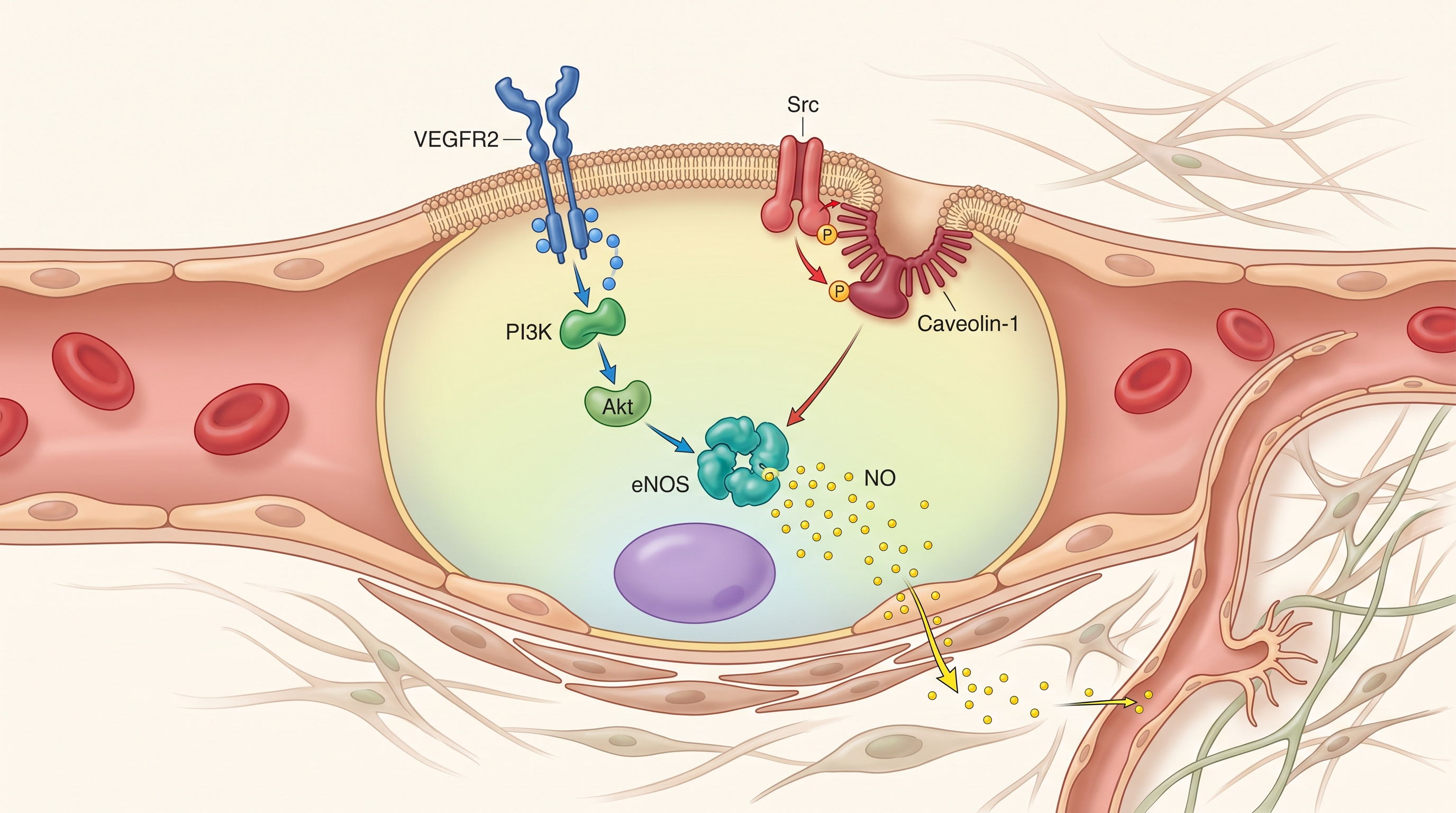
The first pathway involves vascular endothelial growth factor receptor 2 (VEGFR2), a transmembrane receptor tyrosine kinase critical for angiogenesis and endothelial cell survival. BPC-157 promotes VEGFR2 expression and activation on endothelial cells. Upon activation, VEGFR2 triggers a phosphorylation cascade through phosphoinositide 3-kinase (PI3K) to protein kinase B (Akt), which in turn phosphorylates endothelial nitric oxide synthase (eNOS) at its activating serine residue. Phosphorylated eNOS converts L-arginine to NO and L-citrulline, producing the vasodilatory and pro-angiogenic signal.[2]
This pathway is shared with the canonical VEGF signaling mechanism, but BPC-157 appears to act at the receptor level — enhancing VEGFR2 expression and internalization rather than increasing VEGF ligand concentration. This receptor-level modulation distinguishes BPC-157 from peptides like TB-500, which has been associated with upregulation of VEGF itself. The implications of this distinction for potential synergistic effects are explored in our TB-500 vs BPC-157 comparison.
Pathway 2: Src-Caveolin-1-eNOS
The second pathway operates through Src family kinases and the membrane protein Caveolin-1 (Cav-1). In resting endothelial cells, Cav-1 functions as a negative regulator of eNOS by directly binding to the enzyme and maintaining it in an inactive state within membrane microdomains called caveolae. This inhibitory interaction is a well-established mechanism of endothelial dysfunction associated with cardiovascular risk factors including diabetes, hypertension, and hyperlipidemia.[2]
BPC-157 promotes the phosphorylation of Src kinase, which subsequently phosphorylates Cav-1. Phosphorylated Cav-1 releases its inhibitory grip on eNOS, allowing the enzyme to associate with calmodulin and undergo activating phosphorylation by heat shock protein 90 and Akt. The result is eNOS activation independent of — and additive to — the VEGFR2 pathway described above.[2] Hsieh and colleagues demonstrated this mechanism in isolated rat aortic tissue, showing that BPC-157 produces concentration-dependent vasodilation through this Src-Cav-1-eNOS cascade.
NO Modulation, Not Stimulation
A critical distinction in BPC-157's NO pharmacology is its apparent modulatory rather than purely stimulatory character. The peptide does not induce uncontrolled increases in NO production. Instead, studies using pharmacological probes have revealed a complex interaction pattern: BPC-157 counteracts the adverse effects of both L-NAME (a NOS inhibitor that blocks NO production) and L-arginine excess (which can overstimulate NO synthesis). This bidirectional activity has been described as an "L-NAME non-responsive, L-arginine responsive" pattern in some experimental contexts, suggesting that BPC-157 operates as a homeostatic regulator that moves NO signaling toward physiological equilibrium regardless of the direction of perturbation.[3]
This modulatory character is significant because excessive NO production — particularly from inducible NOS (iNOS/Nos2) during pathological inflammation — generates reactive nitrogen species that cause tissue damage. BPC-157's ability to promote protective eNOS-derived NO while simultaneously counteracting pathological iNOS-derived NO may explain its combined pro-angiogenic and anti-inflammatory effects.[3]
Angiogenesis: Building the Vascular Infrastructure for Repair
Angiogenesis — the sprouting of new blood vessels from existing vasculature — is a fundamental requirement for tissue repair, and BPC-157 promotes this process through multiple convergent mechanisms. Beyond the VEGFR2-mediated pathway described above, the peptide influences angiogenesis at several additional levels.[4]
Endothelial Cell Migration and Proliferation
BPC-157 enhances endothelial cell migration, a rate-limiting step in new vessel formation. NO produced through the eNOS pathways promotes endothelial cell motility, while the peptide's effects on focal adhesion kinase (FAK) signaling contribute to the cytoskeletal reorganization necessary for directional cell movement. In the chorioallantoic membrane (CAM) assay — a standard angiogenesis assessment model — BPC-157 treatment significantly increased vessel density and branching complexity.[4]
Vascular Recruitment and Collateral Activation
One of BPC-157's most distinctive vascular effects is its ability to rapidly activate collateral blood vessel pathways in response to vessel occlusion. In models of ischemic colitis, superior mesenteric artery and vein occlusion, and other vascular obstruction scenarios, BPC-157 promotes the rapid formation of functional bypassing pathways through existing but normally dormant arcade vessel connections. This vascular recruitment represents a distinct mechanism from classical angiogenesis (new vessel growth) and may explain the peptide's rapid vascular effects that precede the slower process of neovascularization.[5]
Endothelial Barrier Stabilization
Beyond promoting new vessel growth, BPC-157 stabilizes existing vascular endothelium. The peptide acts as a stabilizer of cellular junctions, maintaining endothelial barrier integrity under stress conditions. This endothelium-protective function links BPC-157's vascular effects to its broader cytoprotection framework — protecting the vessel lining is as important as building new vessels for effective tissue repair.[3]
Growth Factor and Gene Expression Modulation
Egr-1: The Transcriptional Master Switch
BPC-157 stimulates expression of early growth response gene 1 (Egr-1), a zinc-finger transcription factor that functions as an immediate-early gene activated rapidly in response to growth factors, cytokines, and injury signals. Egr-1 controls the transcription of multiple downstream targets involved in cell growth, differentiation, and extracellular matrix remodeling. Importantly, BPC-157 also upregulates Nab2 (NGFI-A binding protein 2), a transcriptional repressor of Egr-1, suggesting that the peptide activates a self-limiting feedback mechanism that ensures transient and controlled Egr-1 activity rather than sustained overexpression.[6]
Growth Hormone Receptor Upregulation
In tendon fibroblasts, BPC-157 markedly increases growth hormone receptor (GHR) expression. cDNA microarray analysis identified GHR as one of the most abundantly upregulated genes following treatment, with dose-response studies demonstrating up to 7-fold increases by day three. This GHR upregulation activates the JAK2 signaling pathway, enhancing cellular sensitivity to circulating growth hormone and amplifying its anabolic effects on connective tissue repair.[7]
FAK-Paxillin Signaling and Cell Migration
Focal adhesion kinase (FAK) and its substrate paxillin are central regulators of cell adhesion, migration, and cytoskeletal dynamics. BPC-157 activates FAK and promotes paxillin expression, facilitating the assembly and disassembly of focal adhesion complexes that anchor cells to the extracellular matrix during migration.[1] This mechanism is particularly important in tendon and wound healing, where the directed migration of fibroblasts into the injury site is essential for organized tissue repair.
ERK1/2 and Cell Proliferation
The extracellular signal-regulated kinase (ERK1/2) pathway, activated downstream of Src family kinases, regulates cell division, survival, and differentiation. BPC-157 engages this pathway through SFK activation, resulting in FAK-ERK and PI3K-Akt signaling cascades that promote cell proliferation and inhibit apoptosis in injured tissues.[1] Recent computational work has proposed that BPC-157 may relieve the SH3 domain-mediated autoinhibition of Src family kinases, providing a structural basis for the simultaneous activation of both FAK-ERK and PI3K-Akt cascades.
Anti-Inflammatory Mechanisms
NF-κB Downregulation
Nuclear factor kappa B (NF-κB) is a transcription factor that drives the expression of pro-inflammatory cytokines, chemokines, and adhesion molecules. While some degree of inflammation is necessary for initiating repair, excessive or sustained NF-κB activation causes collateral tissue damage. BPC-157 downregulates NF-κB activity, reducing the expression of inflammatory mediators including TNF-α, IL-6, and IL-1β.[8] This anti-inflammatory effect operates in parallel with the peptide's pro-repair mechanisms, creating conditions favorable for organized healing rather than chronic inflammation.
iNOS Modulation
While BPC-157 promotes eNOS-derived NO (protective, low-level, vasodilatory), it simultaneously reduces Nos2 gene expression — the gene encoding inducible NOS (iNOS). Under pathological inflammatory conditions, iNOS produces large, potentially cytotoxic quantities of NO and peroxynitrite. By selectively modulating the balance between constitutive and inducible NOS isoforms, BPC-157 maintains the protective vascular effects of NO while attenuating its inflammatory damage potential.[3]
Cytoprotective Factor Upregulation
BPC-157 upregulates cytoprotective factors including heme oxygenase-1 (HO-1) and heat shock proteins, which preserve mitochondrial integrity and reduce oxidative stress at the cellular level. These effects contribute to a general cellular resilience that complements the peptide's more specific signaling pathway actions.[8]
Neurotransmitter System Interactions
Dopaminergic System
BPC-157 interacts extensively with the dopamine system, counteracting disturbances at multiple levels: dopamine receptor blockade, receptor supersensitivity development, receptor over-activation, dopamine over-release, nigrostriatal neuronal damage, and vesicle depletion. The peptide prevented and reversed catalepsy and stereotypy induced by various procedures targeting central dopamine function, and attenuated MPTP-induced neurotoxicity — a model of dopaminergic neuronal degeneration relevant to Parkinson's disease.[9]
Serotonergic System
Autoradiographic measurements using alpha-methyl-L-tryptophan have demonstrated that peripherally administered BPC-157 crosses the blood-brain barrier and affects region-specific serotonin (5-HT) synthesis in the rat brain. Acute administration reduced serotonin synthesis in the dorsal thalamus, hypothalamus, and hippocampus while enhancing it in the substantia nigra reticulata and medial anterior olfactory nucleus. Following seven-day treatment, synthesis decreased in the dorsal raphe nucleus and increased in the superior olive, substantia nigra, lateral caudate, and nucleus accumbens.[10] These region-specific modulations underlie BPC-157's observed effects against serotonin syndrome, depression-like behaviors, and anxiety models.
GABAergic and Glutamatergic Systems
BPC-157 normalizes disrupted glutamatergic signaling, including in models of NMDA receptor overactivation by agents such as ketamine and MK-801. By counteracting excitotoxic neurotransmission, the peptide helps restore synaptic plasticity following pharmacological or traumatic disruption. Additionally, BPC-157 modulates GABAergic signaling, contributing to its observed effects against seizure models (picrotoxin, isoniazid) and its broader stabilization of neuronal network activity.[8]
The Cytoprotection Framework
Perhaps the most useful conceptual framework for understanding BPC-157's diverse mechanisms is the cytoprotection model proposed by Sikiric and colleagues, building on Robert's original concept of gastric cytoprotection. This framework posits three interconnected levels of tissue protection: first, direct cell protection (maintaining the structural and functional integrity of epithelial and endothelial cells); second, endothelium protection (preserving the vascular lining that mediates blood flow and barrier function); and third, vascular function control (actively recruiting collateral vessels and reestablishing blood flow after obstruction).[5]
BPC-157 operates across all three levels simultaneously. Its NO modulation and barrier stabilization effects provide cell and endothelium protection; its VEGFR2-mediated angiogenesis and collateral vessel activation provide vascular function control; and its anti-inflammatory, growth factor, and gene expression effects support the broader repair programs that restore tissue architecture after the acute protective phase.[5]
Unresolved Questions and Research Frontiers
Despite the substantial mechanistic literature, several fundamental questions remain. No definitive primary receptor for BPC-157 has been identified, and the initial molecular event that triggers its signaling cascades is unknown. The recent computational proposal that BPC-157 relieves SH3 domain-mediated autoinhibition of Src family kinases awaits experimental validation.[1] The mechanism by which a peptide with a plasma half-life of less than 30 minutes produces sustained biological effects lasting weeks to months is poorly understood — though the current hypothesis centers on rapid gene expression changes that initiate cascading cellular processes continuing independently of the peptide's presence.[8]
The concentration of mechanistic research within a single laboratory also limits confidence in the generalizability of findings. Independent replication of key mechanistic experiments, particularly the NO system interactions and gene expression profiles, would substantially strengthen the field.[11]
For researchers interested in designing experiments to investigate these mechanisms, our article on how BPC-157 is studied in laboratories provides guidance on appropriate models, endpoints, and protocols. For practical handling of the peptide in experimental settings, see our stability and storage guide.
Related research: Explore the KLOW 4-peptide research blend — BPC-157 + TB-500 + GHK-Cu + KPV in a single tetrapeptide framework.