

Introduction to TB-500
TB-500 is a synthetic peptide that corresponds to the active region of thymosin beta-4 (Tβ4), a naturally occurring 43-amino-acid polypeptide first isolated from bovine thymus tissue in 1966 by Allan Goldstein and Abraham White.[1] Thymosin beta-4 is one of the most abundant intracellular peptides in mammalian cells, with concentrations reaching as high as 0.5 mM in certain cell types. Its extraordinary conservation across species — from humans to zebrafish — underscores its fundamental biological importance in tissue homeostasis and repair.
The synthetic derivative TB-500 specifically encompasses the N-acetylated amino acid sequence corresponding to residues 17–23 of the full-length Tβ4 molecule (Ac-LKKTETQ), capturing the critical actin-binding domain responsible for many of the peptide's primary biological activities.[2] This region, known as the actin-binding motif, has been the focus of extensive research since the early 2000s, when landmark studies demonstrated that thymosin beta-4 could promote cardiac cell migration, survival, and repair following myocardial infarction in animal models.[3]
Understanding what TB-500 is and how it operates at the molecular level provides essential context for researchers investigating tissue repair, cellular migration, and regenerative biology. For a broader foundation on how peptides function in laboratory settings, see our guide on how peptides work in laboratory research.
Discovery and Historical Context
The story of TB-500 begins with the isolation of thymosin fraction 5 from calf thymus by Goldstein and White in 1966. Initially believed to be a thymic hormone involved in immune function, thymosin beta-4 was the second peptide from this fraction to be fully sequenced and synthesized.[1] Throughout the 1970s and 1980s, researchers gradually recognized that Tβ4 was far more than a simple thymic factor — it was present in virtually every mammalian cell type, with particularly high concentrations in blood platelets, macrophages, and wound fluid.
The pivotal shift in understanding came in the late 1990s and early 2000s when researchers discovered that Tβ4 functioned primarily as an actin-sequestering molecule, fundamentally involved in cytoskeletal dynamics rather than immune signaling alone. Malinda and colleagues published a landmark 1999 study demonstrating that topical or intraperitoneal administration of Tβ4 increased wound re-epithelialization by 42% at four days and by as much as 61% at seven days compared to saline controls in a rat full-thickness wound model.[4] This finding catalyzed an entirely new field of investigation into the regenerative properties of thymosin beta-4.
The 2004 publication by Bock-Marquette and colleagues in Nature represented another watershed moment, demonstrating that Tβ4 promoted cardiac cell migration and survival through activation of integrin-linked kinase (ILK) and the Akt survival pathway.[3] After coronary artery ligation in mice, thymosin beta-4 treatment enhanced early myocyte survival and improved cardiac function — findings that positioned the peptide as a novel therapeutic target for acute myocardial damage.
TB-500 as a commercially available synthetic derivative emerged in the 2010s, initially explored in veterinary settings, particularly equine medicine. Its alleged performance-enhancing properties subsequently drew regulatory attention from organizations including the World Anti-Doping Agency (WADA), which added it to the prohibited list.[5]
TB-500 vs. Thymosin Beta-4: Clarifying the Distinction
A common source of confusion in the research literature involves the relationship between TB-500 and the full-length thymosin beta-4 molecule. While the terms are sometimes used interchangeably, they represent structurally distinct compounds with potentially different biological profiles.
Full-Length Thymosin Beta-4
The endogenous Tβ4 protein comprises 43 amino acids with the complete sequence: SDKPDMAEIEKFDKSKLKKTETQEKNPLPSKETIEQEKQAGES. It has a molecular weight of approximately 4,921 g/mol and is encoded by the TMSB4X gene located on the X chromosome. As an intrinsically unstructured protein, Tβ4 exists predominantly in an unfolded state in solution, containing at most six residues forming alpha-helical configurations.[6] This structural plasticity allows the entire peptide to interact with actin monomers across both the barbed and pointed ends, creating extensive binding interfaces.
Different segments of the full-length molecule serve distinct biological functions. The first four amino acids (Ac-SDKP) regulate anti-inflammatory and antifibrotic responses. Amino acids 1–15 contribute to anti-apoptotic properties. The LKKTET motif beginning at residue 17 is the principal actin-binding domain.[7]
TB-500 Fragment
TB-500 is a synthetic heptapeptide consisting of the N-acetylated sequence Ac-LKKTETQ, corresponding to amino acids 17–23 of Tβ4. Its molecular weight is approximately 889 g/mol — roughly one-fifth that of the full-length peptide.[2] While TB-500 retains the critical actin-binding motif, it lacks the additional functional domains present in the complete Tβ4 molecule. This means that certain biological activities attributed to full-length Tβ4, particularly those mediated by the N-terminal tetrapeptide or C-terminal regions, may not be fully replicated by the fragment alone.
For researchers designing experiments, this distinction carries practical implications. Studies using full-length Tβ4 may report broader biological effects than those achievable with TB-500 alone. The choice between the two depends on whether the research question targets actin-specific mechanisms or requires the full complement of Tβ4 activities.
Mechanism of Action: G-Actin Sequestration
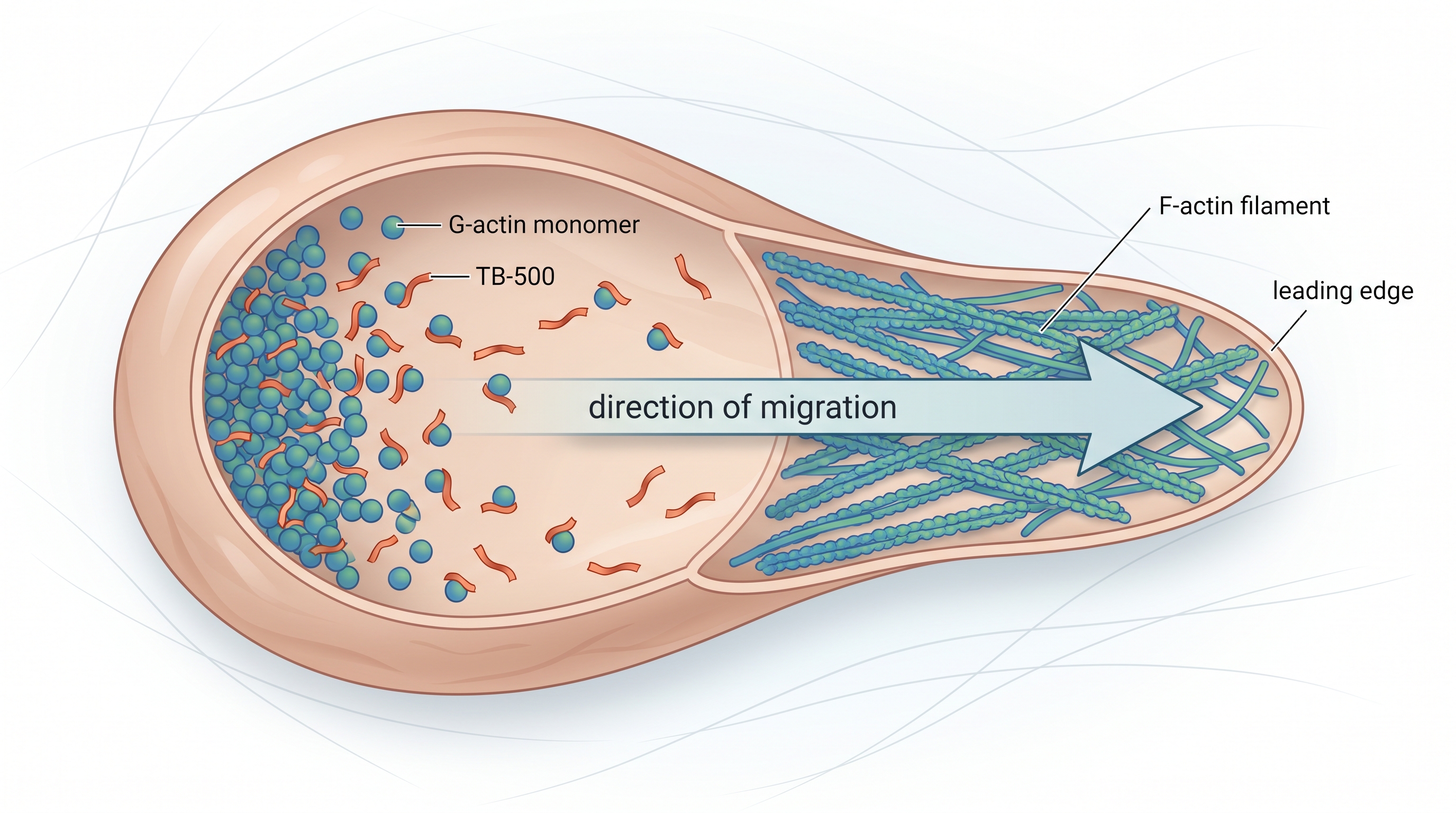
The primary mechanism through which TB-500 exerts its biological effects is the sequestration of monomeric G-actin (globular actin), preventing its spontaneous polymerization into F-actin (filamentous actin) structures. This interaction is central to cytoskeletal dynamics in virtually all eukaryotic cells.[6]
Actin Dynamics and Cellular Function
Actin exists in two primary forms within cells: monomeric G-actin and polymerized F-actin filaments. The dynamic equilibrium between these states drives fundamental cellular processes including migration, division, shape maintenance, and intracellular transport. Thymosin beta-4 sequesters approximately 40–50% of the total G-actin pool in most cell types, maintaining a ready reservoir of monomeric actin that can be rapidly mobilized when cellular demands require cytoskeletal reorganization.[6]
TB-500 binds G-actin with high affinity, forming a 1:1 stoichiometric complex with a dissociation constant (Kd) of approximately 0.5 μM. The binding involves multiple amino acid contacts: lysine residues interact with glutamate at the barbed end of the actin monomer, while additional residues make contact at the pointed end, effectively capping the monomer and preventing incorporation into growing filaments.[8] When bound, TB-500 strongly inhibits nucleotide exchange, maintaining actin in a sequestered, polymerization-incompetent state until cellular signals trigger release.
Downstream Signaling Cascades
Beyond direct actin sequestration, TB-500 influences several downstream signaling pathways. The peptide forms a functional complex with PINCH (particularly interesting new cysteine-histidine rich protein) and integrin-linked kinase (ILK), resulting in activation of the survival kinase Akt (protein kinase B).[3] This ILK–PINCH–Akt axis is crucial for cell survival, migration, and proliferation. Additionally, TB-500 has been shown to inhibit NF-κB activation and reduce expression of pro-inflammatory cytokines such as IL-8, potentially through its interaction with components of the focal adhesion complex.[7]
For a deeper exploration of the peptide's three-dimensional architecture and how structural features enable these interactions, see our dedicated article on TB-500 molecular structure explained.
Key Research Domains
TB-500 and thymosin beta-4 have been investigated across a remarkably diverse range of biological systems. The following overview summarizes the principal research domains; for detailed experimental findings and study designs, see our comprehensive guide to TB-500 research applications.
Wound Healing and Tissue Repair
Wound healing represents the most extensively studied application of TB-500 research. The 1999 study by Malinda and colleagues demonstrated that Tβ4 stimulated keratinocyte migration two- to three-fold over controls in Boyden chamber assays, with effects observed at concentrations as low as 10 pg.[4] Treated wounds showed increased collagen deposition, enhanced angiogenesis, and accelerated contraction compared to controls. These findings have been replicated across multiple wound models, including diabetic wound healing scenarios where the peptide's effects are particularly pronounced.
Cardiovascular Research
Cardiac tissue repair remains one of the most compelling frontiers in TB-500 investigation. Following the landmark Bock-Marquette 2004 Nature study, subsequent research demonstrated that Tβ4 could stimulate vessel growth, activate endogenous cardiac progenitors, and reduce infarct size in murine models of myocardial infarction.[9] Smart and colleagues showed in 2007 that Tβ4 could induce adult epicardial progenitor mobilization and neovascularization, effectively reminding the adult heart of its embryonic regenerative program.[10]
Neuroprotection and Neurological Recovery
In experimental autoimmune encephalomyelitis (EAE) models, thymosin beta-4 improved neurological function by reducing inflammatory infiltrates and stimulating oligodendrogenesis. The peptide's ability to promote myelin repair positions it as a research target for demyelinating diseases. Additional preclinical studies have explored its potential in traumatic brain injury and spinal cord injury models, where it has been associated with reduced neuronal loss and improved functional recovery.[7]
Corneal Repair and Ophthalmology
TB-500 has been extensively studied in corneal wound healing models. Research by Sosne and colleagues demonstrated that Tβ4 promotes corneal epithelial cell migration, reduces inflammation, and modulates matrix metalloproteinase activity following alkali injury.[11] These findings have led to clinical-stage investigations of thymosin beta-4 formulations for dry eye disease and corneal injury repair.
Clinical Translation and Regulatory Status
A first-in-human, randomized, double-blind Phase I study evaluated recombinant human thymosin beta-4 (NL005) in 84 healthy Chinese volunteers. Single intravenous doses ranging from 0.05 to 25.0 μg/kg and multiple daily doses of 0.5–5.0 μg/kg for 10 days were administered. All adverse events were mild to moderate in intensity, with no dose-limiting toxicities or serious adverse events reported. Plasma concentrations and AUC increased proportionally with dose.[12]
Despite promising preclinical evidence, clinical translation of TB-500 specifically (as opposed to full-length Tβ4) remains limited. Regulatory bodies including the FDA have not approved TB-500 for clinical use. The peptide is classified as a research compound, and WADA has placed it on the prohibited substances list for athletes. Researchers working with TB-500 should ensure compliance with applicable institutional and regulatory guidelines.
TB-500 in Context: Comparing Regenerative Peptides
TB-500 occupies a distinctive niche among regenerative peptides studied in preclinical research. Unlike classical growth factors that activate receptor-mediated signaling cascades, TB-500 operates primarily through direct modulation of cytoskeletal architecture. This mechanism distinguishes it from compounds such as BPC-157, which appears to function through vascular signaling, nitric oxide modulation, and growth factor receptor interactions.[13] For a detailed head-to-head analysis of these two peptides, see our comparative review of TB-500 vs BPC-157.
The peptide's relatively low molecular weight (approximately 889 Da for TB-500, ~4,921 Da for full-length Tβ4) allows it to diffuse more readily through tissues compared to larger protein therapeutics. Unlike growth factors that bind to extracellular matrix components and remain localized, TB-500 does not bind the extracellular matrix and can therefore travel relatively long distances through tissues to reach sites of injury.[8]
Practical Considerations for Researchers
TB-500 is typically supplied as a lyophilized (freeze-dried) white powder that requires reconstitution before use. The lyophilized form is stable for extended periods when stored properly, but reconstituted solutions have limited shelf life. Detailed protocols for reconstitution, storage temperature requirements, and stability considerations are covered in our TB-500 handling and storage guide.
Ensuring peptide purity is critical for experimental reproducibility. Researchers should request certificates of analysis (COAs) that include HPLC chromatograms and mass spectrometry confirmation of sequence identity. As discussed in our article on peptide purity in scientific studies, independent verification of supplier COAs is strongly recommended, since discrepancy rates can be significant across the industry.
For laboratories working with lyophilized peptides generally, our guide on what researchers need to know about lyophilized peptides covers universal best practices for reconstitution, aliquoting, and long-term storage that apply directly to TB-500 handling.
Future Research Directions
Several emerging research areas are expanding the boundaries of TB-500 investigation. Biomaterial-based delivery systems incorporating Tβ4 into hydrogels or scaffolds are being explored for localized, sustained-release applications in tissue engineering. The intersection of Tβ4 biology with the growing field of cardiac regeneration continues to yield new insights, particularly regarding epicardial progenitor cell activation and the molecular mechanisms governing post-infarction remodeling.[14]
Advances in analytical chemistry have enabled more precise characterization of TB-500 metabolism, including identification of specific metabolites generated through C-terminal cleavage in human serum and liver microsome systems.[5] These metabolic studies are crucial for understanding the peptide's pharmacokinetic profile and for developing detection methods in anti-doping applications.
The convergence of peptide science with artificial intelligence and machine learning is also opening new possibilities for rational design of TB-500 analogues with enhanced stability, selectivity, or tissue-targeting properties. As the field matures, well-designed clinical trials evaluating specific thymosin beta-4 formulations for defined indications will be essential to determine whether the remarkable preclinical promise translates into clinical benefit.
Conclusion
TB-500 represents a compelling intersection of fundamental cell biology and translational regenerative medicine. As a synthetic derivative of thymosin beta-4, it provides researchers with a focused molecular tool for investigating actin-mediated cellular processes, tissue repair mechanisms, and regenerative signaling pathways. The breadth of preclinical evidence spanning wound healing, cardiac repair, neuroprotection, and ophthalmology speaks to the fundamental importance of actin dynamics in tissue homeostasis and recovery. While significant questions remain regarding optimal formulations, dosing paradigms, and the specific contributions of the TB-500 fragment versus the full-length Tβ4 molecule, ongoing research continues to refine our understanding of this versatile peptide and its potential role in next-generation regenerative therapies.
Related research: Explore the KLOW 4-peptide research blend — BPC-157 + TB-500 + GHK-Cu + KPV in a single tetrapeptide framework.