

Introduction: Structure as the Foundation of Function
Understanding the molecular structure of TB-500 is essential for interpreting its biological activity and designing meaningful experiments. Unlike many bioactive peptides that adopt stable three-dimensional conformations, TB-500 and its parent molecule thymosin beta-4 (Tβ4) belong to a fascinating class of intrinsically disordered proteins (IDPs) — molecules that lack a fixed folded structure in solution yet achieve precise functionality through induced conformational changes upon binding to their partners.[1] This structural plasticity is not a limitation but rather a feature that enables the remarkable functional versatility observed across TB-500 research.
This article examines TB-500's molecular architecture from first principles: the primary amino acid sequence, the nature of its intrinsic disorder, the precise mechanism of actin binding at atomic resolution, and how different structural domains contribute to distinct biological activities. For readers seeking an overview of the peptide's identity and research significance, our companion article on What Is TB-500 provides essential context.
Primary Sequence and Chemical Identity
Full-Length Thymosin Beta-4
Thymosin beta-4 is a 43-amino-acid polypeptide encoded by the TMSB4X gene on the X chromosome (with a homolog TMSB4Y on the Y chromosome). The complete human sequence is: Ac-SDKPDMAEIEKFDKSKLKKTETQEKNPLPSKETIEQEKQAGES.[1] Key chemical properties include a molecular formula of C₂₁₂H₃₅₀N₅₆O₇₈S, a molecular weight of approximately 4,921 g/mol (4,963.5 g/mol including the N-terminal acetyl group), and an isoelectric point between 5.0 and 7.0, classifying it among the acidic beta-thymosins.
The sequence is notably devoid of hydrophobic amino acid clusters, rendering Tβ4 highly water-soluble — an important property for a protein that must function in aqueous intracellular environments at concentrations as high as 0.5 mM. The single methionine residue at position 6 represents a potential site for oxidative modification, a consideration relevant to both biological function and storage stability.[2]
TB-500 Fragment Identity
TB-500 specifically corresponds to the N-acetylated heptapeptide fragment encompassing residues 17–23: Ac-LKKTETQ. Its molecular formula is C₃₈H₆₈N₁₀O₁₄ (some sources report C₃₆H₆₆N₁₀O₁₃ for the unacetylated form), with a molecular weight of approximately 889 g/mol. The compound is registered under CAS number 885340-08-9 and PubChem CID 62707662.[3]
The N-terminal acetylation of the leucine residue is a critical structural feature. This modification protects the N-terminus from proteolytic cleavage and enhances the peptide's metabolic stability compared to the unacetylated form. Metabolic studies have demonstrated that TB-500 undergoes serial cleavage at the C-terminus while the acetylated N-terminus remains efficiently protected.[4]
Intrinsic Disorder: The Structural Paradox
What Are Intrinsically Disordered Proteins?
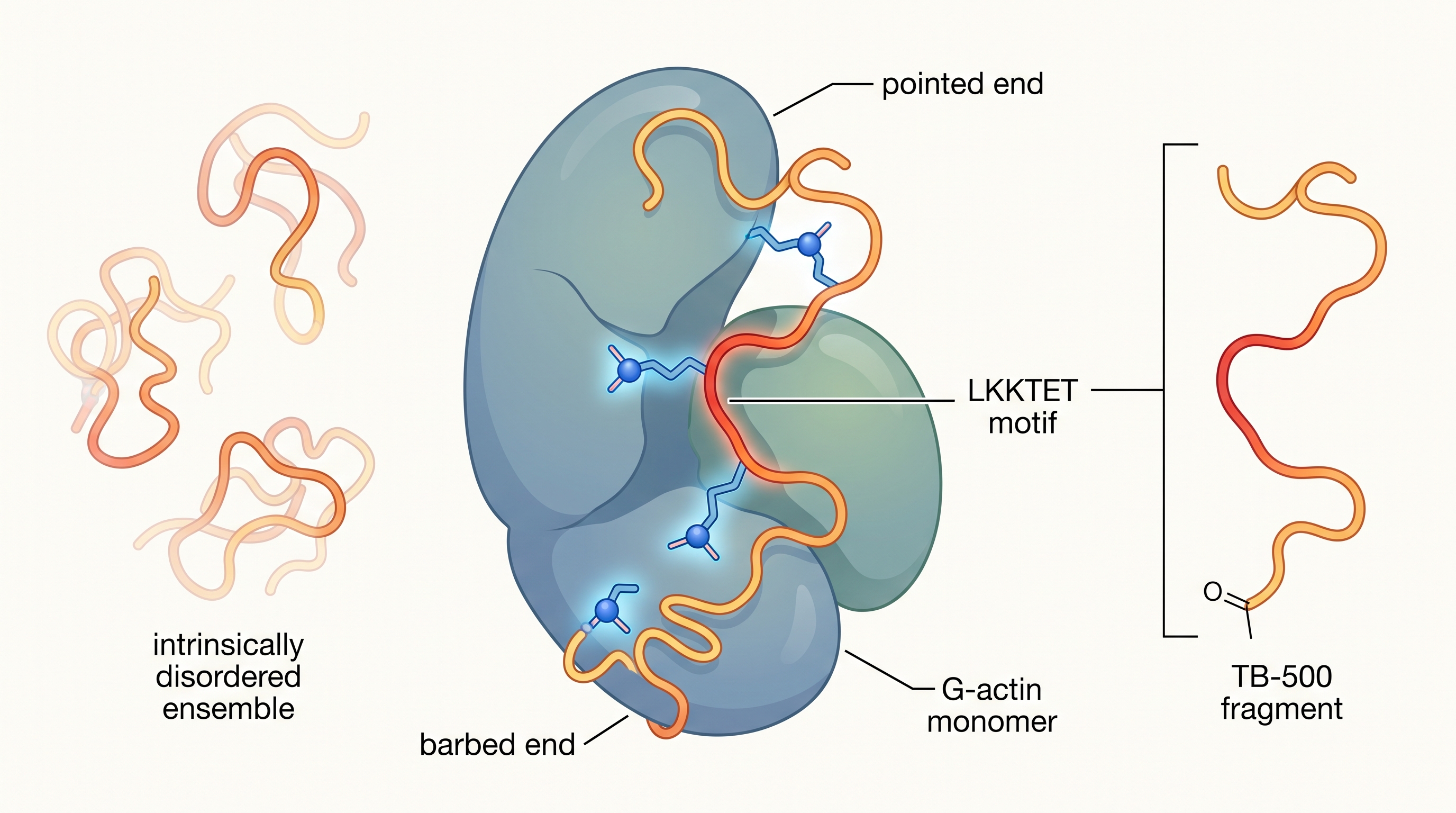
Classical biochemistry assumed that protein function required a defined three-dimensional fold. Intrinsically disordered proteins (IDPs) challenge this dogma: they exist predominantly in unfolded or partially folded states in aqueous solution yet perform essential biological functions. Thymosin beta-4 is a canonical example of this class, containing at most six residues forming alpha-helical configurations in its free state.[1]
The absence of stable folded structure arises from Tβ4's amino acid composition. The sequence is enriched in charged and polar residues while lacking the hydrophobic core residues that typically drive protein folding. Without hydrophobic collapse, the peptide chain remains extended and dynamic in solution, sampling a large conformational ensemble rather than settling into a single stable structure.
Functional Implications of Disorder
This disorder is functionally significant for several reasons. First, it enables Tβ4 to interact with multiple binding partners by adopting different conformations upon each interaction — a phenomenon known as partner promiscuity or protein moonlighting.[1] The entire length of the Tβ4 sequence can participate in binding interactions depending on the partner protein, allowing a single small peptide to mediate diverse biological effects.
Second, the extended conformation facilitates rapid binding kinetics. IDPs can engage binding partners through a "fly-casting" mechanism, where the extended peptide chain samples a larger capture radius than a compact folded protein of similar molecular weight. This kinetic advantage is particularly relevant for Tβ4's role in rapidly mobilizing actin monomers during dynamic cytoskeletal reorganization.
For researchers working with peptides, understanding intrinsic disorder also has practical implications for analytical characterization. Standard techniques that rely on secondary structure detection, such as circular dichroism, will show minimal features for TB-500. Mass spectrometry and HPLC-based purity analysis remain the gold standards for quality verification. For general principles of how peptide structure relates to function, see our overview of how peptides work in laboratory research.
The Actin-Binding Interface: Atomic-Level Detail
The LKKTET Motif
The sequence LKKTET, beginning at residue 17 of thymosin beta-4, is strongly conserved across all beta-thymosins and is historically designated as the principal actin-binding motif. A similar sequence is found in WH2 (WASP-homology 2) domains, a family of actin-binding modules found in diverse cytoskeletal regulators.[5] This evolutionary conservation across unrelated protein families underscores the fundamental importance of this motif for actin interaction.
However, crystallographic and modeling studies have revealed that the designation of LKKTET as the sole actin-binding region is an oversimplification. X-ray crystallography has demonstrated that essentially the entire length of the thymosin beta-4 sequence interacts with actin in the actin-thymosin complex.[1] The LKKTET motif represents the highest-affinity contact point within a much more extensive binding interface.
Three-Point Contact Model
Detailed biochemical and cross-linking studies have mapped the precise amino acid contacts between Tβ4 and actin monomers. The binding involves three principal contact regions: Lys-3 cross-links to Glu-167 at the barbed end of the actin monomer, Lys-18 interacts with N-terminal acidic residues of actin, and Lys-38 contacts Gln-41 at the pointed end.[6] This three-point contact model explains how Tβ4 effectively caps both the barbed and pointed ends of the actin monomer simultaneously, creating a stable 1:1 stoichiometric complex that prevents incorporation into growing filaments.
The extended conformation that Tβ4 adopts upon binding is critical for this dual-end capping. A compact, folded protein could not simultaneously reach both ends of an actin monomer. Only the extended chain of an intrinsically disordered protein can span the approximately 50 Å distance between the barbed and pointed end contact sites.
Binding Thermodynamics
The Tβ4-actin complex forms with a dissociation constant (Kd) of approximately 0.5 μM, positioning thymosin beta-4 among the highest-affinity actin-binding proteins in mammalian cells.[6] The binding is primarily driven by electrostatic interactions between the positively charged lysine residues of Tβ4 and negatively charged residues on the actin surface. When bound, Tβ4 strongly inhibits nucleotide exchange on actin, maintaining the monomer in an ADP-bound, polymerization-incompetent state.
The exchange between Tβ4-bound actin and profilin-bound actin represents a critical control point for actin polymerization dynamics in the cell. Profilin, another actin-binding protein, promotes nucleotide exchange and delivers actin monomers to growing filament barbed ends. The competition between Tβ4 and profilin for G-actin effectively determines the rate and extent of actin polymerization, linking TB-500's molecular mechanism directly to cellular behavior.[7]
Functional Domain Mapping
Different segments of the thymosin beta-4 sequence contribute to distinct biological activities, creating a modular functional architecture within a single small peptide. Understanding this domain map is essential for interpreting the differences between full-length Tβ4 and the TB-500 fragment.
N-Terminal Tetrapeptide: Ac-SDKP (Residues 1–4)
The N-terminal tetrapeptide Ac-Ser-Asp-Lys-Pro (Ac-SDKP), also known as Seraspenide or Goralatide, is enzymatically cleaved from Tβ4 by prolyl oligopeptidase and possesses independent biological activity. It is best known as an inhibitor of the proliferation of hematopoietic stem cells in bone marrow and has demonstrated potent anti-inflammatory and antifibrotic properties.[8] This fragment is not present in TB-500 (which begins at residue 17), meaning that experiments using TB-500 alone will not capture Ac-SDKP-mediated effects.
Anti-Apoptotic Region (Residues 1–15)
Amino acids 1–15 of thymosin beta-4 contribute to anti-apoptotic properties and reduce toxicity-induced cellular damage. Studies have shown that this region modulates pathways associated with cell survival independently of the actin-binding function.[8] Again, this region is absent from TB-500, which may explain why some anti-apoptotic effects reported for full-length Tβ4 are less prominent in studies using the fragment alone.
Actin-Binding and Migration Domain (Residues 17–23)
This is the TB-500 fragment itself: Ac-LKKTETQ. It represents the core actin-binding motif and is the minimal sequence that retains the ability to modulate cytoskeletal dynamics and promote cell migration. The three positively charged residues (Leu-Lys-Lys) and the polar residues (Thr-Glu-Thr-Gln) create an amphiphilic character that facilitates interaction with the actin surface.[3]
C-Terminal Signaling Region (Residues 24–43)
The C-terminal region of Tβ4, while less extensively characterized than the actin-binding domain, contributes to the peptide's stability, solubility, and interactions with non-actin partners. This region participates in the extended binding interface with actin's pointed end and may mediate interactions with receptors distinct from actin, including the candidate extracellular receptor beta subunit of cell surface-located ATP synthase.[1]
Beyond Actin: Multi-Partner Interactions
The ILK-PINCH-Akt Complex
One of the most biologically significant non-actin interactions of Tβ4 involves the formation of a complex with integrin-linked kinase (ILK) and PINCH (particularly interesting new cysteine-histidine rich protein). This ternary complex activates the survival kinase Akt, promoting cell survival and migration through phosphorylation of downstream targets including GSK-3β and BAD.[9] The precise structural basis for this interaction is still under investigation, but it likely involves Tβ4's disordered regions adopting specific conformations upon engagement with the ILK-PINCH complex.
Interaction with Arp2/3
Interaction with the Arp2/3 complex, a key regulator of branched actin network formation, has been explored in preclinical models. This interaction highlights TB-500's utility for studying branched actin network dynamics, a critical process in cell migration, phagocytosis, and membrane dynamics.[3]
Candidate Extracellular Receptors
For its diverse extracellular effects — which cannot be easily explained by intracellular actin sequestration alone — Tβ4 likely interacts with cell surface receptors. A candidate high-affinity receptor is the beta subunit of cell surface-located ATP synthase, which could allow extracellular thymosin to influence purinergic signaling.[1] This potential receptor interaction would explain how Tβ4 can affect cells that already have substantial intracellular concentrations of the peptide, without requiring additional cellular uptake.
Structural Comparison with Related Peptides
Other Beta-Thymosins
Three beta-thymosins are present in humans: Tβ4, Tβ10, and Tβ15. All share the conserved LKKTET actin-binding motif and function as actin-sequestering molecules, but they differ in expression patterns and relative abundance. Tβ4 is by far the most abundant, accounting for 70–80% of total beta-thymosin content in most tissues.[8] Structural differences in non-conserved regions may account for differences in tissue-specific expression and non-actin partner interactions.
WH2 Domain Proteins
The WH2 domain, found in proteins such as WASP (Wiskott-Aldrich syndrome protein) and its relatives, shares sequence similarity with the beta-thymosin actin-binding motif. However, WH2 domains are typically embedded within larger proteins where they function in conjunction with additional regulatory domains to control actin nucleation and branching. The isolated beta-thymosin actin-binding motif, as found in TB-500, functions primarily as a sequestration module rather than a nucleation factor.[5]
Comparison with BPC-157
BPC-157 (Gly-Glu-Pro-Pro-Pro-Gly-Lys-Pro-Ala-Asp-Asp-Ala-Gly-Leu-Val) has a completely different sequence composition, characterized by a high proline content that confers structural rigidity — in stark contrast to Tβ4's intrinsic disorder. This structural difference reflects their fundamentally distinct mechanisms: BPC-157's relatively rigid structure enables specific receptor-mediated signaling, while Tβ4's disorder enables conformational adaptability across multiple partners. For a comprehensive functional comparison, see our TB-500 vs BPC-157 analysis.
Metabolism and Structural Degradation
Understanding how TB-500's structure degrades over time and under biological conditions is important for both experimental design and proper handling. Metabolic studies using human liver microsomes, human S9 fraction, and human plasma have characterized the principal degradation pathways.[4]
TB-500 undergoes serial cleavage at the C-terminus, progressively losing amino acid residues from the glutamine end. The N-terminal acetylation provides efficient protection against aminopeptidase activity, meaning the N-terminus remains intact while the C-terminus is gradually trimmed. Three principal metabolites have been identified: TB-500 M(1-2), TB-500 M(1-3), and TB-500 M(1-5), corresponding to fragments of decreasing length.[4]
For full-length Tβ4, additional degradation pathways include oxidation of the Met-6 residue (producing the Tβ4-sulfoxide form, which may have independent anti-inflammatory activity), deamidation of asparagine residues, and proteolytic cleavage at multiple sites. These degradation pathways have direct implications for storage and handling protocols — particularly the importance of protecting the peptide from oxidative conditions and maintaining low-temperature storage to minimize proteolytic and chemical degradation. General principles of peptide stability in the lyophilized state are also highly relevant.
Structural Implications for Experimental Design
The structural features of TB-500 carry several practical implications for researchers. First, the peptide's small size and lack of disulfide bonds make it amenable to standard solid-phase peptide synthesis (SPPS), ensuring consistent production quality. However, the N-terminal acetylation must be verified, as unacetylated preparations may have different metabolic stability and potentially different biological activity profiles.
Second, the intrinsic disorder means that structural characterization by X-ray crystallography requires co-crystallization with binding partners (typically actin), as the free peptide does not form ordered crystals. NMR spectroscopy can provide ensemble-level structural information in solution, but the conformational dynamics complicate interpretation.
Third, researchers should be aware that the TB-500 fragment lacks the functional domains present in residues 1–16 and 24–43 of full-length Tβ4. Experiments designed to investigate anti-fibrotic effects (mediated by the Ac-SDKP tetrapeptide), anti-apoptotic effects (mediated by residues 1–15), or pointed-end actin contacts (mediated by C-terminal residues) will require full-length Tβ4 rather than TB-500 alone.
Conclusion
TB-500's molecular structure embodies a fascinating biological principle: that structural disorder can be a feature rather than a limitation. The intrinsically disordered nature of thymosin beta-4 enables a small 43-amino-acid peptide to interact with actin monomers through an extensive binding interface, form functional complexes with signaling partners like ILK-PINCH, and potentially engage extracellular receptors — a versatility that would be impossible for a rigidly folded protein of similar size. The TB-500 fragment captures the core actin-binding motif that drives cell migration and cytoskeletal reorganization, while the full-length molecule provides additional functional modules for anti-inflammatory, anti-apoptotic, and anti-fibrotic activities. Appreciating these structural distinctions is fundamental to designing rigorous experiments and correctly interpreting results in TB-500 research.