

Introduction: Why Handling Matters
Peptide integrity is the invisible foundation of experimental reproducibility. For TB-500 research, proper handling and storage practices directly determine whether the compound reaching your assay system is the same compound described in your protocol. Even minor degradation — undetectable by visual inspection — can alter biological activity, introduce spurious results, or reduce experimental sensitivity below meaningful thresholds.[1]
TB-500 is typically supplied as a lyophilized (freeze-dried) white powder, a format designed to maximize shelf life by eliminating the aqueous environment that drives most peptide degradation pathways. However, lyophilization is not permanent protection. Temperature excursions, moisture absorption, light exposure, and improper reconstitution can all compromise the peptide before it ever enters an experiment. This guide provides evidence-based protocols for every step of the TB-500 handling process, from initial receipt through final experimental use.
For foundational principles applicable to all lyophilized research peptides, see our comprehensive guide on lyophilized peptides: what researchers need to know. For the molecular context that explains why specific degradation pathways affect TB-500, see our article on TB-500 molecular structure.
Understanding the Lyophilized Form
What Lyophilization Achieves
Lyophilization (freeze-drying) removes water from the peptide formulation through sublimation — direct conversion of frozen water to vapor under reduced pressure. The resulting dry powder exists in an amorphous glassy state that dramatically reduces molecular mobility, effectively arresting the chemical reactions that drive degradation in solution. For TB-500, this eliminates hydrolysis-driven cleavage reactions and substantially slows oxidative degradation of the methionine residue present in full-length thymosin beta-4.[1]
A properly lyophilized TB-500 preparation appears as a white to off-white fluffy powder or cake within the vial. The residual moisture content should be below 2–3% for optimal long-term stability. Higher residual moisture levels, often resulting from incomplete lyophilization or improper packaging, can lead to accelerated degradation even before the vial is opened.
Visual Inspection Upon Receipt
Before storing newly received peptide, researchers should inspect the vial for signs of compromised lyophilization. An ideal lyophilized cake is uniform in appearance, occupies a defined portion of the vial, and separates cleanly from the glass walls. Warning signs include: a collapsed or shrunken cake (indicating product temperature exceeded the glass transition temperature during drying), discoloration from white to yellow or brown (suggesting Maillard reactions with reducing sugar excipients or severe oxidation), droplets of liquid visible inside the vial (indicating incomplete freeze-drying or moisture ingress during storage), and a fused or crystalline mass rather than a fluffy powder (suggesting recrystallization events during temperature cycling).[2]
Storage Protocols for Lyophilized TB-500
Temperature Requirements
Storage temperature is the single most important variable for preserving lyophilized peptide stability. The general principle is straightforward: colder is better, with each storage tier offering different shelf-life expectations.[1]
Ultra-cold storage (−80°C): Optimal for long-term archival storage spanning years. At these temperatures, molecular mobility in the lyophilized glass matrix is virtually eliminated. Studies on lyophilized proteins stored at −80°C have demonstrated stability extending beyond five years with minimal detectable degradation.[2]
Standard freezer (−20°C): Acceptable for storage durations of several months to approximately two years. Most commercial peptide suppliers specify −20°C as their recommended storage condition. Lyophilized TB-500 stored sealed at −20°C can be expected to maintain ≥95% purity for approximately 24 months, provided the vial remains sealed and protected from humidity.[3]
Refrigeration (2–8°C): Suitable for short-term storage of weeks to several months, particularly for peptide that will be used within the near term. Researchers who plan to use their TB-500 within 1–3 months after receipt can generally store lyophilized material under refrigeration without significant quality loss.
Room temperature (20–25°C): Lyophilized TB-500 is generally stable at room temperature for several weeks during transit and initial handling. However, room temperature should not be used for deliberate storage, as degradation rates increase significantly compared to refrigerated or frozen conditions, particularly in humid environments.[1]
Humidity and Moisture Protection
Lyophilized peptides are hygroscopic — they readily absorb moisture from the ambient atmosphere. Moisture absorption reintroduces the aqueous environment that lyophilization was designed to eliminate, reactivating hydrolysis and deamidation pathways. Research has demonstrated that untreated stoppers on lyophilized vials can permit significant water ingress within months at room temperature, while properly sealed vials with treated stoppers maintain low moisture content over the same period.[1]
To minimize moisture exposure: keep vials tightly sealed at all times when not actively dispensing peptide, store vials with desiccant packets in a sealed secondary container, and work quickly when opening vials in ambient laboratory air — particularly in humid climates or during seasons with elevated indoor humidity.
Light Protection
Thymosin beta-4 contains amino acid residues susceptible to photo-oxidation, including the methionine at position 6 (in full-length Tβ4) and tyrosine residues in the broader sequence. While the TB-500 fragment (Ac-LKKTETQ) lacks these specific photosensitive residues, co-formulated excipients and trace impurities can still be affected by light. As a general best practice, peptides should be stored in amber vials or kept in the dark. Prolonged exposure to ambient fluorescent or LED laboratory lighting during handling should be minimized.[1]
Reconstitution Protocol
Pre-Reconstitution Preparation
A critical but frequently overlooked step: allow the sealed lyophilized vial to equilibrate to room temperature before opening. Opening a cold vial in a warm laboratory causes condensation to form on the inner vial surface, introducing moisture that can partially dissolve and potentially degrade the lyophilized cake before the reconstitution solvent is added. This single step can prevent a substantial source of pre-experimental degradation.[2]
Prepare the work area with appropriate aseptic supplies: alcohol swabs for vial septa, sterile needles and syringes for solvent injection, and the selected reconstitution solvent.
Solvent Selection
TB-500 is a highly water-soluble peptide owing to its lack of hydrophobic amino acid clusters. The recommended primary reconstitution solvent is sterile bacteriostatic water (water containing 0.9% benzyl alcohol as a preservative), which combines peptide compatibility with antimicrobial protection for multi-use vials.[4]
If bacteriostatic water is unavailable, sterile water for injection can be used, though multi-use vials reconstituted with preservative-free water should be aliquoted immediately and used within a shorter timeframe. For specialized research applications requiring specific buffer conditions, phosphate-buffered saline (PBS) at physiological pH (7.2–7.4) is also compatible with TB-500.[4]
Organic solvents such as DMSO are unnecessary for TB-500 reconstitution given its high aqueous solubility and should be avoided unless specifically required by the experimental protocol. This is a notable difference from some hydrophobic peptides that require initial dissolution in DMSO before dilution into aqueous buffers.
Reconstitution Procedure
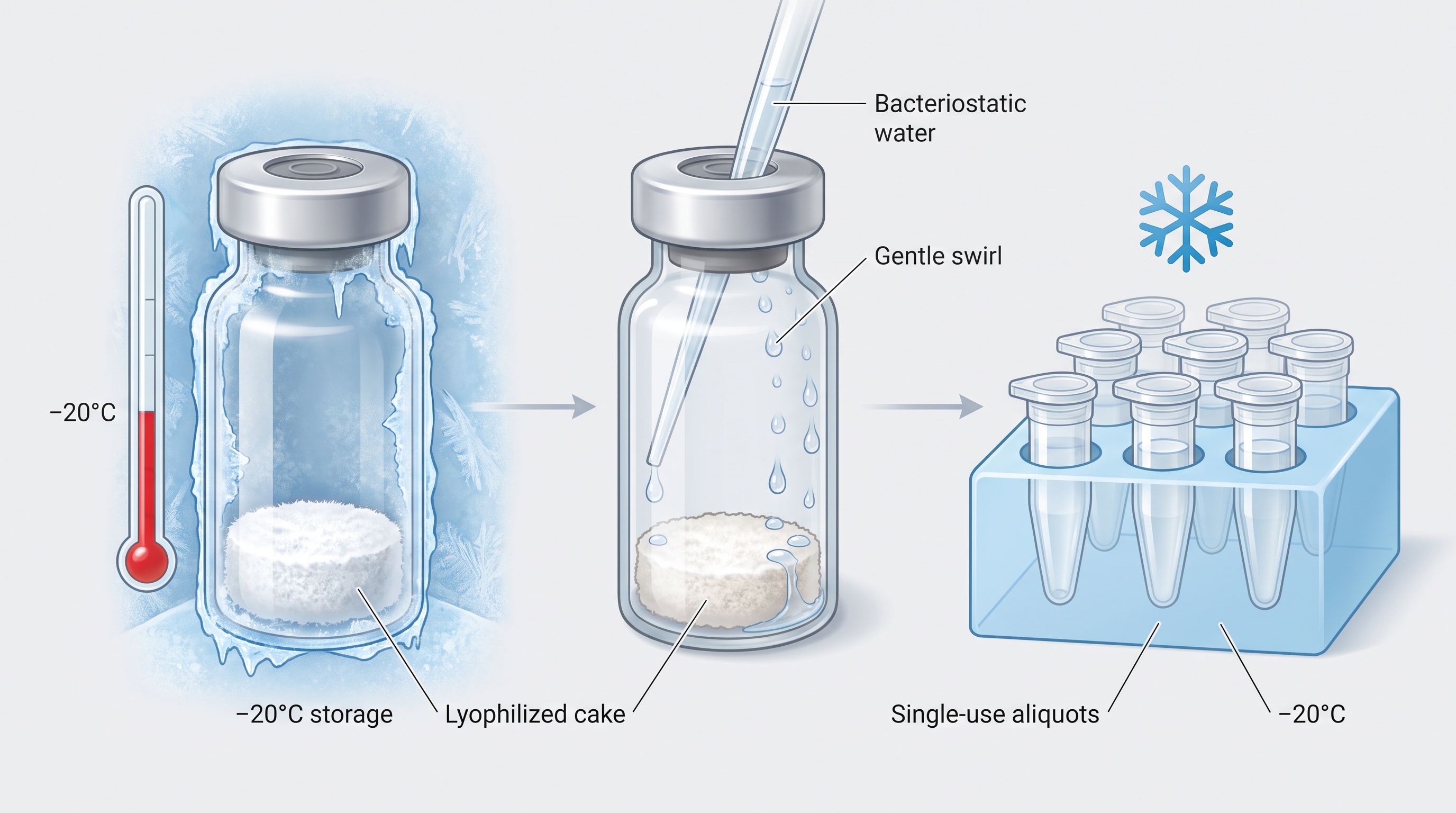
The reconstitution process should proceed as follows. First, sanitize the septum of both the peptide vial and the bacteriostatic water vial with 70% isopropanol alcohol swabs. Using a sterile syringe, draw the desired volume of reconstitution solvent. Inject the solvent slowly along the inner wall of the peptide vial, allowing it to flow down gently onto the lyophilized cake. Do not inject directly onto the powder, as this can cause foaming that denatures the peptide at the air-liquid interface.[2]
After adding the solvent, gently swirl the vial in a circular motion to promote dissolution. Do not shake vigorously — mechanical agitation can generate foam and introduce air-liquid interfaces that promote surface denaturation of the peptide. TB-500, being highly water-soluble, should dissolve completely within one to two minutes of gentle swirling, producing a clear, colorless solution. Any persistent turbidity, precipitation, or coloration after reconstitution indicates a potential quality problem and the preparation should not be used.
Concentration Calculation
The reconstitution concentration depends on the amount of peptide in the vial and the volume of solvent added. For a typical 5 mg TB-500 vial: adding 1 mL of bacteriostatic water produces a 5 mg/mL (5,000 μg/mL) solution; adding 2 mL produces 2.5 mg/mL (2,500 μg/mL). Researchers should select a concentration that allows convenient and accurate measurement of the doses required for their experimental protocol. Label the vial immediately after reconstitution with the date, concentration, and solvent used.[4]
Post-Reconstitution Storage
Refrigerated Storage
Reconstituted TB-500 must be stored under refrigeration at 2–8°C. At this temperature, the aqueous solution remains liquid while degradation rates are substantially reduced compared to room temperature. The general consensus across peptide suppliers and research protocols indicates a usable shelf life of approximately 2–4 weeks for reconstituted TB-500 stored under refrigeration, though some sources specify more conservative timelines of 1–2 weeks for optimal potency.[3]
Avoiding Freeze-Thaw Cycles
Repeated freezing and thawing of reconstituted peptide solutions is one of the most common and destructive handling errors. Each freeze-thaw cycle exposes the peptide to ice crystal formation (which concentrates solutes and can cause aggregation), pH fluctuations during freezing and thawing, and mechanical stress from volume changes. For TB-500, the recommended approach is to aliquot the reconstituted solution into single-use volumes immediately after reconstitution, freeze the aliquots at −20°C, and thaw each aliquot only once before use.[2]
Aliquoting Strategy
Effective aliquoting requires advance planning. Determine the volume needed per experimental session, prepare that number of single-use aliquots in sterile microcentrifuge tubes, and freeze promptly. Using pre-sterilized, low-binding microcentrifuge tubes minimizes peptide adsorption to tube surfaces — a consideration that can be significant for dilute peptide solutions. For added stability, some researchers overlay frozen aliquots with an inert gas (nitrogen or argon) before sealing to minimize oxidative exposure.[1]
Degradation Pathways Specific to TB-500
Understanding the specific chemical degradation pathways that threaten TB-500 integrity allows researchers to take targeted preventive measures. These pathways are detailed in our article on TB-500 molecular structure, but their practical implications for handling are summarized here.
C-Terminal Proteolytic Cleavage
Metabolic studies have demonstrated that TB-500 undergoes serial cleavage at the C-terminus in biological environments, while the N-terminal acetylation provides effective protection against aminopeptidase activity.[5] In laboratory handling, this means that contamination with proteolytic enzymes (from skin contact, non-sterile equipment, or bacterial contamination) can progressively shorten the peptide from its C-terminal glutamine residue. Strict aseptic technique during reconstitution and handling is the primary defense against enzymatic degradation.
Oxidation
While the TB-500 fragment (Ac-LKKTETQ) does not contain the methionine residue found at position 6 of full-length Tβ4, oxidation of other residues can still occur under extreme conditions. For researchers working with full-length thymosin beta-4, methionine oxidation is a significant concern — the resulting Tβ4-sulfoxide form has been shown to possess different (and potentially independent) biological activity compared to the parent molecule.[6] Minimizing exposure to atmospheric oxygen, using degassed solvents where practical, and maintaining cold storage all reduce oxidative degradation risk.
Deamidation
Asparagine and glutamine residues are susceptible to deamidation — the non-enzymatic loss of an amide group, converting asparagine to aspartate and glutamine to glutamate. The glutamine at position 7 of TB-500 (Gln in LKKTETQ) is a potential deamidation site, particularly at elevated temperatures and near-neutral to alkaline pH. Deamidation introduces a charge change that can alter biological activity. Low-temperature storage and mildly acidic reconstitution conditions help minimize this pathway.[1]
Quality Verification Before Use
Certificate of Analysis Review
Every TB-500 preparation should be accompanied by a Certificate of Analysis (COA) from the supplier. At minimum, the COA should include HPLC purity data (the chromatogram, not just the purity percentage), mass spectrometry confirmation of molecular identity, appearance description, and lot number with expiration date. As we discuss in detail in our article on peptide purity in scientific studies, independent verification of supplier COAs is strongly recommended — industry-wide discrepancy rates between stated and actual purity can be significant.[7]
In-House Quality Checks
For critical experiments, researchers should consider in-house quality verification. Reconstituted TB-500 can be assessed by analytical HPLC to confirm purity matches the COA specifications. LC-MS provides simultaneous confirmation of molecular weight and purity. Amino acid analysis can verify net peptide content — an important parameter since lyophilized preparations may contain counter-ions, residual solvents, and moisture that reduce the actual peptide mass relative to the stated vial weight.
Common Mistakes and How to Avoid Them
Mistake 1: Opening Cold Vials Immediately
Opening a vial stored at −20°C directly into ambient laboratory air (typically 20–25°C, 40–60% relative humidity) causes rapid condensation on the inner vial surface. This moisture dissolves portions of the lyophilized cake unevenly, creating areas of concentrated solution that may degrade before proper reconstitution occurs. Solution: Always allow sealed vials to reach room temperature before opening — typically 15–30 minutes on the bench.[2]
Mistake 2: Vigorous Shaking During Reconstitution
Shaking a reconstitution vial creates foam — air-liquid interfaces where peptide molecules accumulate and undergo surface denaturation. Denatured peptide is biologically inactive and may form aggregates that scatter light and interfere with downstream analytical measurements. Solution: Gently swirl the vial in a circular motion. TB-500 is highly soluble and dissolves readily without mechanical agitation.
Mistake 3: Repeated Freeze-Thaw of the Same Vial
Each freeze-thaw cycle degrades reconstituted peptide through ice crystal formation, solute concentration effects, and mechanical stress. Studies on protein therapeutics have shown measurable activity loss after as few as three freeze-thaw cycles. Solution: Aliquot immediately after reconstitution into single-use volumes.
Mistake 4: Using Frost-Free Freezers
Frost-free (auto-defrost) freezers cycle through warming periods to prevent ice buildup. These temperature oscillations effectively subject stored peptides to mini freeze-thaw cycles even while sealed, accelerating degradation over time. Solution: Use manual-defrost freezers for peptide storage, or store peptides in an insulated container within the frost-free freezer to buffer temperature fluctuations.
Mistake 5: Storing Without Desiccant
Even sealed vials can experience moisture ingress over time through imperfect septum seals or vial closures. Without desiccant in the storage container, accumulated humidity gradually compromises the lyophilized state. Solution: Store lyophilized peptide vials in sealed secondary containers with fresh desiccant packets, replaced periodically.
Mistake 6: Ignoring Net Peptide Content
A vial labeled "5 mg TB-500" contains 5 mg of lyophilized material, which includes the peptide itself plus counter-ions, residual moisture, and potentially residual solvents from synthesis. The actual peptide content (net peptide content) may be 70–85% of the stated weight. Failing to account for this discrepancy leads to under-dosing in experiments. Solution: Request net peptide content from the supplier or determine it by amino acid analysis, and calculate working concentrations based on actual peptide mass.[7]
TB-500-Specific Handling Notes
Several properties of TB-500 make its handling somewhat distinct from other research peptides. Its high water solubility eliminates the need for organic co-solvents, simplifying reconstitution. Its lack of cysteine residues means there are no disulfide bonds to manage and no concerns about intermolecular disulfide-mediated aggregation — a common challenge with many other peptides. Its relatively short sequence (seven amino acids for the fragment) means fewer potential degradation sites compared to longer peptides.[3]
However, the N-terminal acetylation is critical for biological activity and metabolic stability. Researchers purchasing TB-500 should confirm that the acetylated form (Ac-LKKTETQ, CAS 885340-08-9) is specified, not the unacetylated sequence. Non-acetylated preparations may exhibit different metabolic profiles and potentially different experimental outcomes.
Summary Protocol
For researchers seeking a concise reference, the essential TB-500 handling workflow is as follows. Upon receipt, store the sealed lyophilized vial at −20°C (standard) or −80°C (long-term) in a secondary container with desiccant, protected from light. When ready to use, allow the vial to equilibrate to room temperature for 15–30 minutes while still sealed. Reconstitute with sterile bacteriostatic water by injecting slowly along the vial wall, then swirl gently until dissolved. Aliquot into single-use volumes in sterile low-binding tubes. Freeze aliquots at −20°C. Thaw individual aliquots immediately before use and do not refreeze. Use reconstituted, refrigerated material within 2–4 weeks. Document lot numbers, reconstitution dates, and storage conditions for all preparations.
Adhering to these evidence-based handling practices ensures that the TB-500 reaching your experimental system faithfully represents the compound described in your research protocol — a prerequisite for generating reliable, reproducible data across the diverse research applications where this peptide is investigated.