

Introduction: The Research Landscape of TB-500
TB-500, the synthetic fragment derived from thymosin beta-4 (Tβ4), has become one of the most widely studied peptides in regenerative biology. Its unique mechanism of action — centered on G-actin sequestration and cytoskeletal modulation — positions it as a versatile research tool for investigating tissue repair across multiple organ systems.[1] Unlike growth factors that activate single receptor-mediated pathways, TB-500 influences fundamental cellular architecture, making its effects relevant to virtually any tissue where cell migration, survival, and reorganization are critical for recovery.
For readers unfamiliar with the peptide's identity and molecular basis, our companion article What Is TB-500? provides essential background on its discovery, structure, and primary mechanism of action. This article focuses specifically on the experimental evidence and research applications that have emerged from three decades of preclinical investigation.
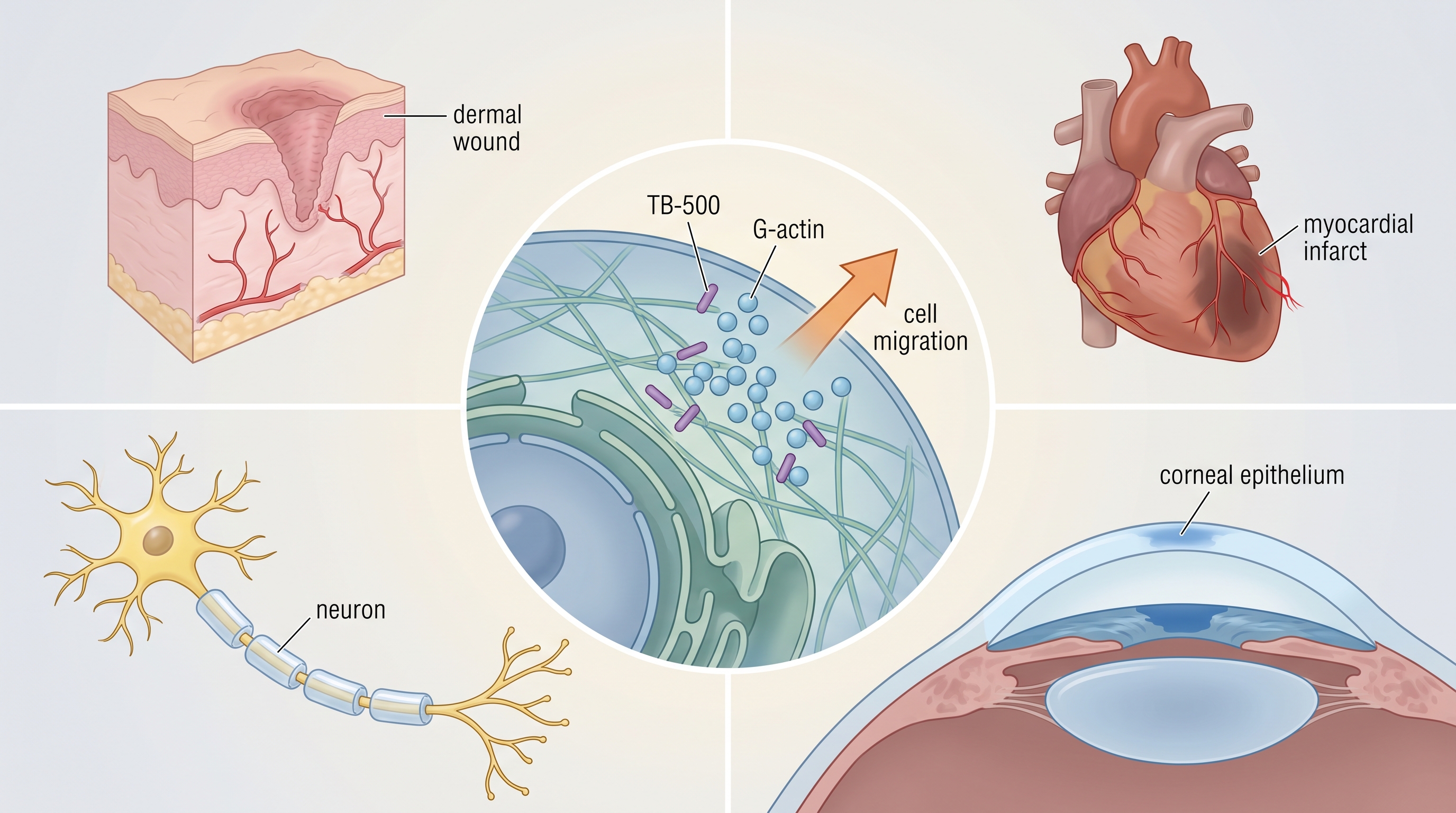
The scope of TB-500 research spans dermal wound healing, cardiovascular repair, neuroprotection, corneal regeneration, musculoskeletal recovery, and anti-inflammatory biology. Each domain reveals distinct facets of how actin dynamics influence tissue homeostasis and repair — insights that extend well beyond the peptide itself to fundamental questions in cell biology and regenerative medicine.
Dermal Wound Healing
The Landmark Malinda Study
The foundational wound healing study by Malinda and colleagues, published in the Journal of Investigative Dermatology in 1999, established thymosin beta-4 as a potent wound repair factor. Using a rat full-thickness wound model, the researchers demonstrated that topical or intraperitoneal administration of Tβ4 increased re-epithelialization by 42% at four days and by as much as 61% at seven days compared to saline controls.[2] Treated wounds also contracted at least 11% more than controls by day seven. Histological analysis revealed increased collagen deposition and enhanced angiogenesis in treated wounds.
Critically, the study also demonstrated that Tβ4 stimulated keratinocyte migration in Boyden chamber assays, with migration increased two- to three-fold over controls at concentrations as low as 10 picograms. This extraordinary potency at minimal concentrations suggested that the peptide's wound healing effects were mediated through specific signaling mechanisms rather than simple bulk biological activity.
Diabetic Wound Models
TB-500's effects are particularly pronounced in diabetic wound healing contexts, where impaired vascularity and chronic inflammation dramatically slow recovery. Kim and Kwon demonstrated in 2014 that thymosin beta-4 improved dermal burn wound healing in db/db diabetic mice via downregulation of the receptor for advanced glycation end products (RAGE).[3] Treated animals showed accelerated re-epithelialization, reduced inflammatory infiltrate, and improved extracellular matrix organization compared to untreated diabetic controls.
These findings are particularly significant because diabetic wounds represent a major clinical challenge where conventional therapies frequently fail. The peptide's multi-modal mechanism — simultaneously promoting cell migration, reducing inflammation, and enhancing vascularization — addresses multiple pathological features of diabetic wound healing simultaneously.
Collagen Organization and Anti-Fibrotic Effects
Ehrlich and Hazard published important findings in 2010 showing that thymosin beta-4 enhances repair by organizing connective tissue and preventing the appearance of myofibroblasts.[4] This anti-fibrotic property distinguishes Tβ4 from many other wound healing agents that accelerate closure at the expense of increased scarring. By modulating the balance between organized collagen deposition and disorganized fibrotic tissue, TB-500 may promote more functional wound repair rather than simply faster wound closure.
Cardiovascular Research
Cardiac Cell Migration and Survival
The 2004 Nature study by Bock-Marquette and colleagues remains the cornerstone of TB-500 cardiovascular research. The study demonstrated that thymosin beta-4 promoted both myocardial and endothelial cell migration in the embryonic heart and, crucially, retained this property in postnatal cardiomyocytes.[5] Survival of embryonic and postnatal cardiomyocytes in culture was enhanced by Tβ4. The molecular mechanism involved formation of a functional complex between Tβ4, PINCH, and integrin-linked kinase (ILK), resulting in activation of the survival kinase Akt.
Following coronary artery ligation in mice, thymosin beta-4 treatment upregulated ILK and Akt activity in the heart, enhanced early myocyte survival, and improved cardiac function. Remarkably, the degree of improvement when Tβ4 was administered systemically through intraperitoneal injections was not statistically different from local administration directly within the cardiac infarct, suggesting that the beneficial effects occurred through a direct effect on cardiac cells rather than through extracardiac signaling.
Epicardial Progenitor Activation
Smart and colleagues published a landmark 2007 study in Nature demonstrating that thymosin beta-4 induces adult epicardial progenitor mobilization and neovascularization.[6] This finding was particularly significant because it suggested that Tβ4 could reactivate quiescent epicardial progenitor cells in the adult heart, effectively reminding the organ of its embryonic regenerative program. The mobilized epicardial cells contributed to neovascularization of the ischemic myocardium, providing new blood supply to damaged tissue.
A subsequent 2011 study by Smart and colleagues, also published in Nature, further demonstrated that Tβ4 priming could generate de novo cardiomyocytes from within the activated adult heart after injury.[7] However, this finding has been debated in the field. Zhou and colleagues reported in 2012 that TB4 treatment after myocardial infarction did not reprogram epicardial cells into cardiomyocytes, though they confirmed that TB4 significantly reduced infarct size, cardiac fibrosis, and cardiomyocyte apoptosis, and increased vessel density.[8]
Systemic Cardioprotection
A study published in Frontiers in Pharmacology by Sopko and colleagues examined whether systemic dosing of Tβ4 could achieve cardioprotection in ischemic injury models. The results indicated that repeated systemic dosing improved cardiac function post-myocardial infarction, and that improvement could be observed even in the absence of a high degree of angiogenesis.[9] These findings suggest that the cardioprotective mechanism of Tβ4 may involve direct myocyte survival signaling in addition to its well-characterized pro-angiogenic effects.
Cardiac Remodeling and ROCK1
Recent research published in 2025 by Bock-Marquette and colleagues investigated how thymosin beta-4 modulates cardiac remodeling by regulating ROCK1 expression in adult mammals. Using miRNA profiling on adult mice hearts following permanent coronary ligation, the study identified novel molecular contributors responsible for the positive impact of Tβ4 during post-infarction remodeling processes.[10] These findings help elucidate the precise mechanisms through which Tβ4 mitigates pathological scarring in the heart.
Neuroprotection and CNS Research
Experimental Autoimmune Encephalomyelitis
In experimental autoimmune encephalomyelitis (EAE) models — a standard preclinical model for multiple sclerosis — thymosin beta-4 improved neurological function by reducing inflammatory infiltrates and stimulating oligodendrogenesis. The peptide's ability to promote myelin repair positions it as a research target for demyelinating diseases.[11] The mechanism appears to involve both direct neuroprotective effects through cytoskeletal stabilization and indirect effects through modulation of inflammatory signaling.
Traumatic Brain Injury
Studies in traumatic brain injury (TBI) models have demonstrated that thymosin beta-4 administration is associated with reduced neuronal loss, improved functional recovery, and enhanced regeneration of neural tissues. The peptide promotes neuronal survival and differentiation, potentially through its interaction with actin and the subsequent stabilization of the cytoskeleton. Additionally, Tβ4 enhances neurite outgrowth, which is essential for the formation of neural networks and synaptic connections following injury.[11]
Oxidative Stress and Neurodegeneration
TB-500 has been shown to reduce oxidative stress and apoptosis in neuronal cells, common features of neurodegenerative diseases. The Tβ4-sulfoxide form, generated when methionine residues are oxidized by hydrogen peroxide at wound sites, has been identified as an anti-inflammatory factor that attenuates inflammatory cell infiltration and promotes wound healing in both zebrafish and mouse cardiac injury models.[12] This oxidized form may represent a physiologically relevant signaling molecule in the context of injury-induced inflammation.
Corneal Repair and Ophthalmological Research
Corneal Wound Healing
Sosne and colleagues have conducted extensive research on thymosin beta-4 in corneal wound healing models. Their work demonstrated that Tβ4 promotes corneal epithelial cell migration, modulates inflammatory mediators following injury, and accelerates re-epithelialization in both in vitro scratch wound assays and in vivo rat corneal injury models.[13] Representative histologic sections showed significantly greater re-epithelialization in Tβ4-treated eyes compared to PBS controls within 24 hours of wounding.
Anti-Inflammatory Corneal Effects
Beyond direct wound healing, thymosin beta-4 demonstrates important anti-inflammatory properties in the corneal context. The peptide inhibits benzalkonium chloride-mediated apoptosis in corneal and conjunctival epithelial cells and modulates corneal matrix metalloproteinase levels and polymorphonuclear cell infiltration after alkali injury.[13] These findings suggest that Tβ4 could address both the inflammatory and regenerative components of corneal pathology.
Clinical-Stage Investigations
The accumulation of preclinical corneal data has led to clinical-stage investigations of thymosin beta-4 formulations for dry eye disease. A comprehensive review in Investigative Ophthalmology and Visual Science characterized the primary mechanisms of Tβ4 repair activity in dry eye disorders, identifying actin sequestration, anti-inflammatory signaling, and promotion of epithelial migration as the key therapeutic mechanisms.[13]
Musculoskeletal Research
Tendon and Ligament Models
Both TB-500 and full-length thymosin beta-4 have been examined in musculoskeletal research contexts involving tendon, ligament, and bone systems. The peptide's ability to promote fibroblast migration and extracellular matrix organization makes it relevant to connective tissue repair. Preclinical studies have associated Tβ4 treatment with modulation of growth factor expression, including basic fibroblast growth factor (bFGF), epidermal growth factor (EGF), and vascular endothelial growth factor (VEGF) in tendon healing models.[14]
Skeletal Muscle Recovery
The gene encoding thymosin beta-4 has been identified as one of the early response genes activated during tissue disruption, with TB-500 expression increasing in response to cellular stress or injury-associated signaling.[1] In skeletal muscle contexts, the peptide's actin-sequestering properties may facilitate the cytoskeletal reorganization necessary for satellite cell activation and myofiber repair following damage.
Anti-Inflammatory Mechanisms
Across all research domains, a consistent theme emerges: TB-500 exerts significant anti-inflammatory effects that complement its pro-migratory and pro-angiogenic activities. The peptide inhibits TNF-induced NF-κB activation and IL-8 expression through its interaction with PINCH-1 and ILK.[15] The N-terminal tetrapeptide Ac-SDKP, enzymatically cleaved from full-length Tβ4, is separately recognized as an inhibitor of hematopoietic stem cell proliferation and a potent anti-fibrotic agent.[11]
This multi-pathway anti-inflammatory activity helps explain why TB-500 shows efficacy across such diverse tissue types — inflammation is a universal feature of tissue injury, and modulation of inflammatory cascades enhances regenerative outcomes regardless of the specific organ involved. Understanding these mechanisms at the molecular level requires careful attention to how TB-500's structural features enable these diverse interactions.
Experimental Design Considerations
Researchers planning TB-500 studies should consider several methodological factors. The distinction between TB-500 (Ac-LKKTETQ, ~889 Da) and full-length Tβ4 (~4,921 Da) has implications for experimental interpretation, as the fragment may not replicate all activities of the parent molecule. Dose-response relationships should be carefully established, as Tβ4 has demonstrated activity at extremely low concentrations in some assays (picomolar range for migration assays) but requires higher concentrations for other endpoints.[2]
Peptide quality is paramount for experimental reproducibility. As detailed in our review of why peptide purity matters in scientific studies, even small impurities can generate misleading results, particularly in sensitive cell-based assays. Researchers should verify peptide identity by mass spectrometry and purity by HPLC before initiating experiments. Proper handling and storage protocols are equally important to prevent degradation that could compromise results.
Emerging Research Frontiers
Several cutting-edge research areas are expanding the application landscape for TB-500. Biomaterial-based delivery systems, including collagen-chitosan sponge scaffolds loaded with Tβ4, have shown augmented cutaneous wound healing and increased angiogenesis in diabetic rats with hind limb ischemia.[16] Novel dimeric thymosin beta-4 constructs with enhanced biological activities have been designed to accelerate wound healing rates beyond those achievable with the monomeric peptide.[17]
The intersection of TB-500 research with organoid technology and tissue engineering creates opportunities for investigating peptide-mediated repair in three-dimensional tissue models that more faithfully recapitulate in vivo conditions. Combined peptide approaches, such as co-administration with BPC-157, are also being explored for potential synergistic effects across complementary biological pathways.
Conclusion
The research applications of TB-500 span an extraordinary range of biological systems, from cardiac repair and neuroprotection to wound healing and ophthalmology. This breadth reflects the fundamental importance of actin dynamics in tissue homeostasis and the universal relevance of cell migration, survival, and cytoskeletal reorganization to regenerative processes. While the transition from preclinical promise to clinical application continues to progress, the wealth of experimental evidence establishes TB-500 as an invaluable tool for researchers investigating the molecular mechanisms underlying tissue repair and regeneration.
Related research: Explore the KLOW 4-peptide research blend — BPC-157 + TB-500 + GHK-Cu + KPV in a single tetrapeptide framework.