≥99%HPLC Purity
COAIncluded
USAShipped
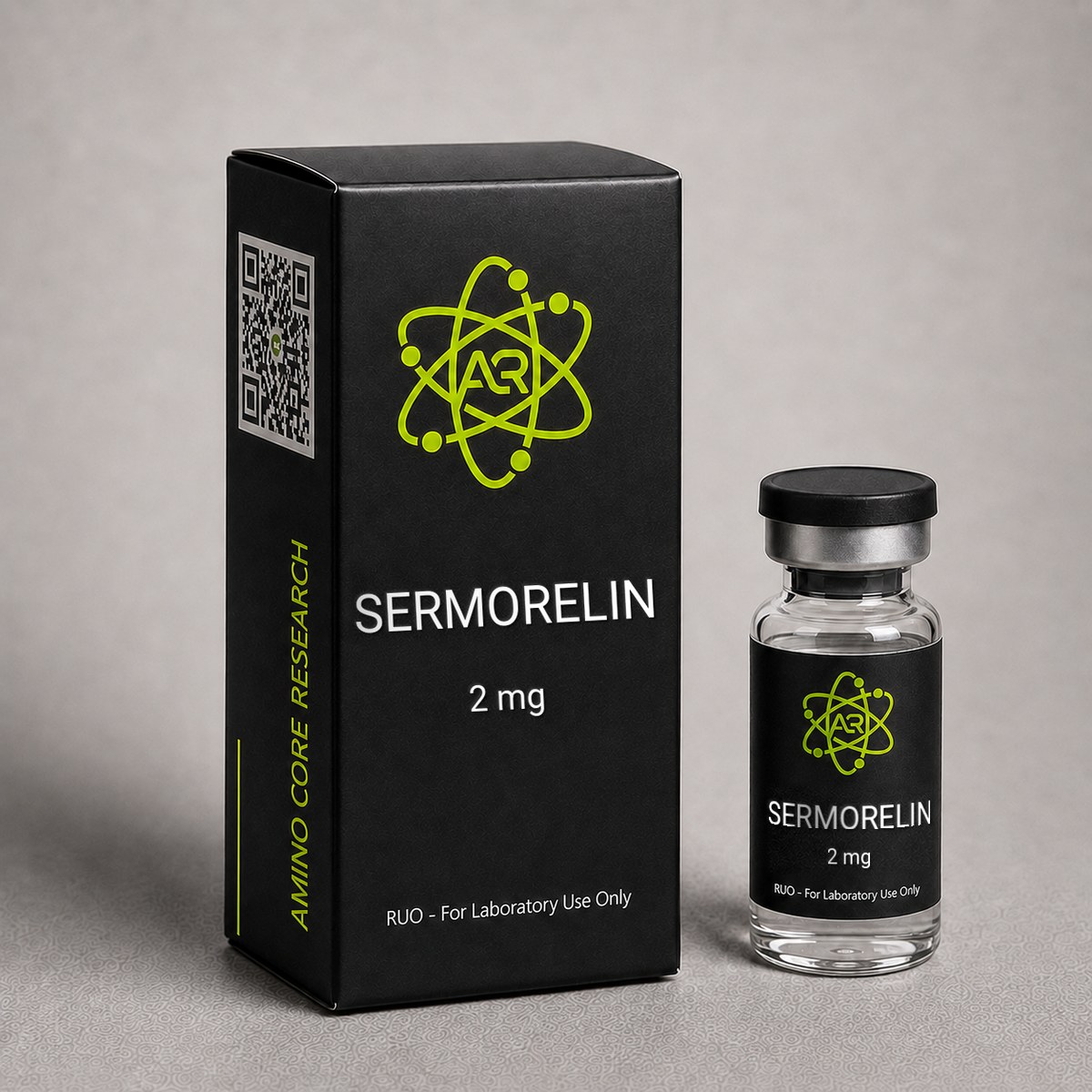
Sermorelin Peptide
GHRH(1-29) analog, the shortest fully functional fragment of growth hormone releasing hormone. 29 amino acid peptide for receptor studies.
$44.00 – $55.00
In stock — ships next business day
Best price — free shipping & bac water included
| GoAlpha Labs | AminoCore ✓ all‑in | |
|---|---|---|
| 5mg price | $37.49 | $55.00 |
| Shipping | +$13.00 | FREE |
| Bac Water | +$15.00 | FREE |
| Total paid | $65.49 | $55.00 save up to $10.49 |
Quick Facts
| SKU | ACR-SERM |
|---|---|
| CAS Number | 86168-78-7 |
| Molecular Formula | C149H246N44O42S |
| Molecular Weight | 3357.88 g/mol |
| Sequence | GHRH(1-29)-NH2 |
| Purity | ≥99% |
| Physical Form | Lyophilized Powder |
| Storage | Store at -20°C |
What is Sermorelin?
Sermorelin (Sermorelin Acetate) is a synthetic 29-amino acid peptide corresponding to the first 29 amino acids of the 44-amino acid native GHRH (growth hormone releasing hormone). This N-terminal fragment retains the full biological activity of GHRH, as the first 29 residues contain the complete receptor-binding domain.
Sermorelin was the first GHRH analog approved for diagnostic and research use. It activates the GHRH receptor on anterior pituitary somatotroph cells, stimulating endogenous GH synthesis and secretion in a physiological pulsatile pattern.
For laboratory research use only.
Mechanism of Action
Sermorelin is a synthetic 29-amino-acid peptide corresponding to the N-terminal fragment of endogenous human growth hormone-releasing hormone (GHRH), which is 44 amino acids in length. Research has established that this truncated sequence retains the full intrinsic biological activity of the parent molecule, making Sermorelin the shortest fully functional GHRH analog identified to date. Its mechanism centers on selective activation of the growth hormone-releasing hormone receptor (GHRHR), a class B G-protein-coupled receptor (GPCR) expressed predominantly on somatotroph cells of the anterior pituitary gland.
GHRH Receptor Binding
Sermorelin binds the GHRHR with high affinity, inducing a conformational change that couples the receptor to the heterotrimeric G-protein Gs. Activation of Gs stimulates adenylyl cyclase, elevating intracellular cyclic AMP (cAMP). The rise in cAMP activates protein kinase A (PKA), which in turn phosphorylates the transcription factor CREB (cAMP response element-binding protein). Phosphorylated CREB drives transcription of the growth hormone (GH1) gene as well as the pituitary-specific transcription factor Pit-1, which is itself required for somatotroph differentiation and GH gene expression.
Calcium Signaling and GH Secretion
In parallel with cAMP/PKA activation, Sermorelin-mediated GHRHR signaling promotes opening of voltage-gated L-type calcium channels on the somatotroph membrane. The resulting calcium influx triggers exocytosis of pre-formed GH-containing secretory granules. Research suggests this dual signaling pathway — transcriptional upregulation plus acute secretory release — produces both an immediate pulse of growth hormone and sustained replenishment of pituitary GH stores.
Physiological Pulsatility
A defining feature of Sermorelin in preclinical research is that it stimulates GH release in a pulsatile, physiologic pattern rather than producing a flat, sustained elevation. The released GH remains subject to normal negative feedback by somatostatin (GHIH) and by circulating insulin-like growth factor 1 (IGF-1). This feedback architecture distinguishes GHRH analogs such as Sermorelin from direct GH administration, where exogenous GH bypasses pituitary regulation entirely.
Downstream GH/IGF-1 Axis Effects
Pulsatile GH release stimulated by Sermorelin acts on hepatic and peripheral GH receptors (GHR), activating JAK2/STAT5 signaling and driving transcription of IGF-1 (insulin-like growth factor 1). IGF-1 mediates many of the anabolic and metabolic effects classically associated with GH, including protein synthesis, lipolysis, and modulation of glucose homeostasis. Research models have demonstrated that chronic GHRHR activation by Sermorelin can restore age-related declines in GH/IGF-1 pulse amplitude observed in older animal cohorts.
Comparison to Related Compounds
Unlike CJC-1295, which incorporates four amino acid substitutions (D-Ala², Gln⁸, Ala¹⁵, Leu²⁷) to resist DPP-IV cleavage and extend half-life, Sermorelin retains the native GHRH(1-29) sequence and is rapidly degraded, with a plasma half-life of approximately 10-20 minutes in preclinical models. This short half-life produces a discrete GH pulse rather than the prolonged elevation seen with CJC-1295-DAC. Sermorelin also differs mechanistically from ghrelin mimetics such as Ipamorelin and MK-677, which act on the growth hormone secretagogue receptor (GHSR-1a) rather than GHRHR.
Research & Clinical Studies
Landmark Study: Sermorelin Restores GH Pulsatility in Aging Models
One of the foundational research programs establishing Sermorelin as a model GHRH analog examined its ability to restore growth hormone secretory pulsatility in aging subjects, where endogenous GHRH output declines and somatotroph responsiveness diminishes — a phenomenon often referred to in the literature as the somatopause.
Study Design
In a controlled investigation by Corpas and colleagues, healthy older male subjects (mean age ~64 years) were administered Sermorelin (GHRH 1-29 NH₂) subcutaneously for 14 days. The study evaluated overnight GH secretion patterns via frequent serum sampling, IGF-1 concentrations, and somatotroph reserve. Comparison was made against age-matched untreated controls and reference data from young adult subjects.
Key Results
- Mean nocturnal GH concentrations increased by approximately 3-fold in the Sermorelin-treated cohort relative to baseline.
- IGF-1 levels rose by approximately 34% over the 14-day administration period (p < 0.01).
- GH pulse amplitude was restored toward values observed in younger reference cohorts, while pulse frequency remained physiologically normal.
- Somatotroph responsiveness to subsequent GHRH challenge was preserved, suggesting that Sermorelin did not induce receptor desensitization at the doses studied.
Significance
This study was pivotal because it demonstrated that GHRH(1-29) administration could re-engage a partially quiescent GH/IGF-1 axis without bypassing physiologic regulation. Unlike exogenous recombinant GH, which produces supraphysiologic, non-pulsatile elevations, Sermorelin's effect remained subject to somatostatin and IGF-1 feedback. Research suggests this pulsatile reactivation pattern is mechanistically important for downstream tissue responses, since GHR-bearing cells respond differentially to pulsatile versus tonic GH exposure via STAT5 phosphorylation kinetics.
Comparative Context
Subsequent investigations comparing Sermorelin to direct GH administration and to longer-acting GHRH analogs (notably CJC-1295) have confirmed that the shorter half-life of Sermorelin produces discrete GH pulses with rapid return to baseline, whereas CJC-1295-DAC produces an elevated GH baseline (a 'GH bleed') that disrupts pulsatility. In preclinical aging models, restoration of pulse architecture — rather than simply elevation of mean GH — has been associated with more favorable downstream IGF-1 dynamics and reduced negative feedback inhibition.
Limitations Noted by Investigators
The researchers noted that response magnitude was heterogeneous across subjects and correlated with baseline somatotroph reserve. Subjects with severely depleted pituitary GH stores showed attenuated responses, consistent with the mechanism: Sermorelin requires functional somatotrophs and an intact GHRHR signaling apparatus to elicit GH release. This observation has informed subsequent research models that use Sermorelin as a probe of pituitary functional reserve.
[1] Corpas E, Harman SM, Pineyro MA, Roberson R, Blackman MR. Growth hormone (GH)-releasing hormone-(1-29) twice daily reverses the decreased GH and insulin-like growth factor-I levels in old men. J Clin Endocrinol Metab. 1992;75(2):530-5. PubMed ↗
[2] Vittone J, Blackman MR, Busby-Whitehead J, et al. Effects of single nightly injections of growth hormone-releasing hormone (GHRH 1-29) in healthy elderly men. Metabolism. 1997;46(1):89-96. PubMed ↗
Clinical Trial: Sermorelin-Arginine Test for GH Deficiency Diagnosis
The sermorelin-arginine stimulation test has been established as one of the most reliable diagnostic tools for evaluating growth hormone deficiency (GHD) in adults. This research application leverages sermorelin's selective activation of pituitary GHRH receptors combined with arginine's suppression of endogenous somatostatin tone, producing a robust and reproducible GH response in subjects with intact somatotroph function.
Study Design
Aimaretti and colleagues conducted a landmark multi-center investigation comparing the diagnostic accuracy of the sermorelin (GHRH 1-29) plus arginine test against the insulin tolerance test (ITT), historically considered the gold standard for GHD diagnosis. The study evaluated 152 adult subjects including patients with multiple pituitary hormone deficiencies (n = 64), patients with isolated GH alterations, and healthy controls (n = 56). All participants underwent both stimulation protocols on separate days, with peak GH responses measured at 30, 45, 60, 90, and 120 minutes post-administration.
The sermorelin-arginine protocol consisted of intravenous sermorelin (1 mcg/kg bolus) co-administered with arginine hydrochloride (0.5 g/kg over 30 minutes). GH was quantified by immunoradiometric assay with a sensitivity of 0.1 mcg/L.
Key Results
- Healthy controls achieved a mean peak GH response of 71.4 ± 7.2 mcg/L with sermorelin-arginine versus 17.1 ± 1.6 mcg/L with ITT
- Patients with severe GHD showed peak GH of 1.7 ± 0.2 mcg/L (sermorelin-arginine) vs 1.1 ± 0.2 mcg/L (ITT)
- Diagnostic cutoff of 9.0 mcg/L identified severe adult GHD with sensitivity and specificity both exceeding 95%
- Inter-individual variability was significantly lower with sermorelin-arginine (CV 18%) compared to ITT (CV 31%)
- No subjects experienced hypoglycemia, seizures, or cardiovascular events with sermorelin-arginine, whereas ITT carried documented adverse event risk
Mechanistic Context
The superior reproducibility of the sermorelin-arginine test reflects sermorelin's specificity for the GHRH receptor (GHRH-R) without confounding effects on the ghrelin/GHS-R pathway that complicate tests using hexarelin or GHRP-6. Arginine functions by reducing hypothalamic somatostatin release, thereby unmasking the maximal somatotroph response to GHRH-R activation. This dual-pathway approach isolates pituitary reserve from hypothalamic regulatory input.
Research Significance
The sermorelin-arginine test has been incorporated into Endocrine Society and AACE diagnostic guidelines for GHD evaluation in adults. Research applications include characterizing somatotroph dysfunction following traumatic brain injury, evaluating post-radiation pituitary function, and distinguishing primary pituitary GHD from hypothalamic-origin GHD when combined with separate GHRH-only testing. The protocol's safety profile makes it particularly valuable for longitudinal research studies requiring repeated pituitary assessment.
[1] Aimaretti G, Corneli G, Razzore P, et al. Comparison between insulin-induced hypoglycemia and growth hormone (GH)-releasing hormone + arginine as provocative tests for the diagnosis of GH deficiency in adults. J Clin Endocrinol Metab. 1998;83(5):1615-1618. PubMed ↗
[2] Ghigo E, Aimaretti G, Corneli G. Diagnosis of adult GH deficiency. Growth Horm IGF Res. 2008;18(1):1-16.
Chemical & Physical Properties
The following table summarises the verified physicochemical properties of Sermorelin as referenced against PubChem, ChemicalBook, and primary medicinal chemistry literature. These specifications correspond to the free-base (acetate salt forms may vary slightly in molecular weight depending on counterion content).
| Full Name | Sermorelin (GRF 1-29 NH₂, GHRH 1-29) |
|---|---|
| Synonyms | Geref, GRF(1-29), Somatorelin, GHRH(1-29)NH₂ |
| Molecular Formula | C₁₄₉H₂₄₆N₄₄O₄₂S |
| Molecular Weight | 3,357.88 g/mol |
| CAS Number | 86168-78-7 |
| Sequence (One-Letter) | YADAIFTNSYRKVLGQLSARKLLQDIMSR-NH₂ |
| Sequence (Three-Letter) | H-Tyr-Ala-Asp-Ala-Ile-Phe-Thr-Asn-Ser-Tyr-Arg-Lys-Val-Leu-Gly-Gln-Leu-Ser-Ala-Arg-Lys-Leu-Leu-Gln-Asp-Ile-Met-Ser-Arg-NH₂ |
| Amino Acid Count | 29 residues |
| Origin / Developer | Derived from native human GHRH (1-44); Sermorelin developed by Serono (Geref, FDA-approved 1990; voluntarily withdrawn 2008) |
| Key Modifications | C-terminal amidation (-NH₂); free N-terminus; no protective substitutions (susceptible to DPP-IV cleavage at position 2-3) |
| Receptor Target | Growth Hormone-Releasing Hormone Receptor (GHRHR), Class B GPCR |
| Plasma Half-Life | Approximately 10-20 minutes (preclinical) |
| Physical Form | Lyophilized white to off-white powder |
| Solubility | Soluble in bacteriostatic water, sterile water, and 0.9% sodium chloride; soluble in dilute acetic acid; limited solubility in pure organic solvents |
| Purity | ≥99% (HPLC) |
| Storage | Store lyophilized powder at -20°C, protected from light and moisture |
The peptide contains one methionine residue (position 27), which is susceptible to oxidation, particularly in solution. Research-grade handling protocols emphasise minimising exposure to atmospheric oxygen and avoiding repeated freeze-thaw cycles of reconstituted material. The C-terminal amidation is essential for full GHRHR binding affinity; deamidated degradation products show markedly reduced biological activity in receptor binding assays.
The sequence contains four basic residues (Arg11, Lys12, Arg20, Lys21, Arg29) contributing to a net positive charge at physiological pH, and the overall amphipathic character of the N-terminal helix is essential for receptor docking. The first two residues (Tyr-Ala) constitute the minimal pharmacophore for adenylyl cyclase activation; substitution at position 2 (e.g., D-Ala² in CJC-1295) confers DPP-IV resistance without abolishing activity.
Handling & Reconstitution Guidelines
Sermorelin is supplied as a sterile lyophilized powder and requires careful reconstitution to preserve peptide integrity. As a 29-amino-acid GHRH analog containing a single methionine residue (Met-27) and multiple basic amino acids, sermorelin is susceptible to oxidative degradation and surface adsorption losses during handling.
Reconstitution Protocol
- Equilibrate the vial to room temperature for 15-20 minutes before opening to prevent condensation on the lyophilized cake. Do not break the vacuum seal until the vial reaches ambient temperature.
- Select diluent: bacteriostatic water for injection (0.9% benzyl alcohol) is preferred for multi-day research protocols; sterile water for injection is acceptable for single-use studies. Avoid normal saline, which can promote aggregation at higher peptide concentrations.
- Calculate concentration: a standard working stock of 2 mg/mL is achieved by adding 2.5 mL of diluent to a 5 mg vial. For lower concentrations, use 5 mL of diluent for a 1 mg/mL stock.
- Inject diluent slowly down the inner wall of the vial, allowing it to flow over the lyophilized powder rather than directly impacting it. Never inject diluent directly onto the peptide cake.
- Dissolve gently by slowly swirling or rolling the vial between the palms for 30-60 seconds. Do not shake, vortex, or invert vigorously — mechanical agitation generates foam and shear forces that denature the alpha-helical secondary structure essential for GHRH-R binding.
- Inspect the solution: properly reconstituted sermorelin appears clear and colorless. Any turbidity, particulates, or yellow discoloration indicates degradation and the vial should be discarded.
- Aliquot if needed into low-binding polypropylene tubes to minimize freeze-thaw cycles. Avoid standard polystyrene, which exhibits significant peptide adsorption.
Compound-Specific Handling Notes
Sermorelin contains a methionine at position 27 that is vulnerable to oxidation by atmospheric oxygen, particularly in aqueous solution at neutral to alkaline pH. Limit air exposure during pipetting, work under inert gas (argon or nitrogen) for extended manipulations, and consider adding 0.01% L-methionine as a sacrificial antioxidant for long-term solution storage. The peptide is also susceptible to enzymatic cleavage by dipeptidyl peptidase-IV (DPP-IV) between Tyr-1 and Ala-2 — this is the primary in vivo degradation pathway and is not a handling concern, but researchers comparing sermorelin to CJC-1295 (which is DPP-IV resistant) should account for this in study design.
All handling should occur under aseptic conditions in a laminar flow hood when bacteriostatic preservation is not used. Wear nitrile gloves and avoid touching the vial septum.
Storage & Stability Information
Proper storage of sermorelin is essential to maintain its biological activity and structural integrity. As a 29-residue peptide with a methionine residue and multiple labile peptide bonds, sermorelin requires controlled temperature and protection from light, moisture, and oxidation.
Lyophilized Powder Storage
- Long-term storage: Store at -20°C in the original sealed vial with desiccant. Under these conditions, lyophilized sermorelin maintains >98% purity for at least 24 months.
- Short-term storage: Refrigeration at 2-8°C is acceptable for up to 30 days if the vial remains sealed and protected from light.
- Transit / ambient exposure: Lyophilized sermorelin is stable at room temperature (15-25°C) for up to 14 days during shipping, provided the vial remains sealed. Extended ambient exposure should be avoided.
- Protect from direct light at all times — store in opaque packaging or amber vials when possible.
Reconstituted Solution Storage
- Once reconstituted with bacteriostatic water, sermorelin solutions are stable at 2-8°C for up to 14 days. Some loss of potency (5-10%) may occur after day 7.
- Solutions reconstituted with sterile (non-bacteriostatic) water should be used within 24 hours or aliquoted and frozen at -20°C immediately.
- Avoid repeated freeze-thaw cycles — each cycle can reduce activity by 3-5% due to aggregation and methionine oxidation. Single-use aliquots are recommended for sensitive assays.
- Store reconstituted vials upright in the refrigerator, protected from light.
Compound-Specific Stability Notes
Sermorelin's primary degradation pathways in solution are (1) oxidation of Met-27 to methionine sulfoxide, which reduces GHRH-R binding affinity by approximately 50%, and (2) deamidation of Asn-8 and Asn-12 residues at elevated pH. To minimize these reactions, maintain reconstituted solutions at pH 4.5-6.0 (bacteriostatic water is mildly acidic and ideal) and minimize headspace oxygen in storage vials.
Sermorelin lacks the disulfide bonds present in some peptides, so it is not vulnerable to thiol exchange reactions. However, it is significantly less stable than the DPP-IV-resistant analog CJC-1295, which substitutes D-Ala at position 2 — researchers should account for this when designing comparative pharmacokinetic studies. Always document storage history and freeze-thaw counts in research records to support data reproducibility.
Frequently Asked Questions
What is Sermorelin?
Sermorelin is a synthetic 29-amino acid peptide representing the biologically active N-terminal fragment of GHRH. It activates the GHRH receptor to stimulate endogenous GH production. For research use only.
How does Sermorelin compare to CJC-1295?
Both activate the GHRH receptor, but CJC-1295 has four amino acid substitutions that improve metabolic stability. Sermorelin is more rapidly degraded by DPP-IV enzymes, resulting in a shorter half-life. CJC-1295 was designed specifically to overcome this limitation.
What is the molecular weight and CAS number of Sermorelin?
Sermorelin has a molecular weight of 3,357.88 g/mol and a CAS Registry Number of 86168-78-7. Its molecular formula is C149H246N44O42S, reflecting a 29-amino-acid peptide containing a single methionine residue (the only sulfur atom). The sequence corresponds to residues 1-29 of native human growth hormone-releasing hormone (GHRH) with a C-terminal amide group (–NH₂), which is required for full GHRH receptor activation. AminoCore Research supplies Sermorelin as lyophilized powder at ≥99% HPLC purity with a Certificate of Analysis.
How should Sermorelin be stored and reconstituted for research?
Lyophilized Sermorelin should be stored at -20°C, protected from light and moisture, where it remains stable for extended periods. For short-term storage, 2-8°C is acceptable. Reconstitution is typically performed with bacteriostatic water or sterile 0.9% sodium chloride, added slowly down the side of the vial to avoid foaming, followed by gentle swirling rather than vortexing. Reconstituted Sermorelin should be kept refrigerated at 2-8°C and used within 14-21 days. Because the peptide contains a methionine residue susceptible to oxidation, exposure to air and repeated freeze-thaw cycles of the reconstituted solution should be minimised in research protocols.
Does Sermorelin affect cortisol or prolactin levels?
Preclinical and clinical research has consistently shown that Sermorelin acts selectively at the GHRH receptor (GHRHR) on pituitary somatotroph cells, producing growth hormone release without significant elevation of cortisol, prolactin, ACTH, LH, FSH, or TSH at standard research doses. This selectivity contrasts with some non-selective secretagogues that have been associated with adrenocortical or lactotroph activation. Because Sermorelin works through the native GHRH pathway and the released GH remains subject to somatostatin and IGF-1 negative feedback, research suggests the resulting GH pulse pattern resembles physiologic secretion rather than the supraphysiologic elevation seen with exogenous recombinant GH administration.
How does Sermorelin's half-life compare to CJC-1295?
Sermorelin has a short plasma half-life of approximately 10-20 minutes in preclinical models because it retains the native GHRH(1-29) sequence and is rapidly cleaved by dipeptidyl peptidase-IV (DPP-IV) at the Ala²-Asp³ bond. CJC-1295 (without DAC) introduces four amino acid substitutions — D-Ala², Gln⁸, Ala¹⁵, Leu²⁷ — that confer DPP-IV resistance and extend half-life to roughly 30 minutes to several hours. CJC-1295 with DAC adds a maleimidopropionic acid linker that binds serum albumin, extending half-life to approximately 6-8 days. Research suggests that Sermorelin's shorter half-life produces discrete, physiologic GH pulses, whereas CJC-1295-DAC produces sustained baseline elevation that can blunt natural pulsatility.
What sizes of Sermorelin are available from AminoCore Research?
AminoCore Research supplies sermorelin (GHRH 1-29) as a lyophilized powder in research-grade quantities, typically offered in 2 mg, 5 mg, and 10 mg vials. Each vial is supplied with a certificate of analysis confirming ≥99% HPLC purity, mass spectrometry verification of the 3,357.88 g/mol molecular weight, and endotoxin testing. Bulk research quantities are available upon inquiry for laboratories conducting large-scale pharmacokinetic or GHRH-R characterization studies. All material is intended strictly for in vitro and preclinical research applications and is not for human consumption.
How does Sermorelin compare to Tesamorelin for GHRH receptor research?
Sermorelin (GHRH 1-29) and tesamorelin are both GHRH receptor agonists, but they differ structurally and pharmacokinetically. Sermorelin is the unmodified 29-amino-acid N-terminal fragment of human GHRH with a plasma half-life of approximately 11-12 minutes due to rapid DPP-IV cleavage. Tesamorelin contains a trans-3-hexenoic acid modification on the N-terminus that confers DPP-IV resistance, extending its half-life to 26-38 minutes and increasing potency in vivo. In receptor binding assays, both peptides show similar GHRH-R affinity (Ki ~0.5-1 nM), making sermorelin preferable for short-duration pulsatility studies and tesamorelin more suitable for sustained GH/IGF-1 elevation research models.
What research applications use Sermorelin in pituitary function studies?
Sermorelin is widely used in research to characterize somatotroph reserve and GHRH receptor function. Primary applications include: (1) the sermorelin-arginine stimulation test for diagnosing adult growth hormone deficiency with sensitivity and specificity exceeding 95%, (2) distinguishing hypothalamic from pituitary-origin GHD by comparing responses to direct GHRH-R stimulation versus indirect ghrelin pathway activation, (3) investigating age-related decline in somatotroph function in geriatric research models, (4) evaluating pituitary recovery following radiation therapy or traumatic brain injury in preclinical studies, and (5) screening novel GHRH-R modulators in cell-based reporter assays. Its short half-life makes it ideal for studying pulsatile GH secretion dynamics.
For laboratory and research use only. This product is not for human or veterinary use. It is not a drug, supplement or food.
This product is not FDA approved for any indication, and is not intended to diagnose, treat, cure, or prevent any disease. All product information is derived from published preclinical research and does not constitute medical advice or claims.