≥99%HPLC Purity
COAIncluded
USAShipped
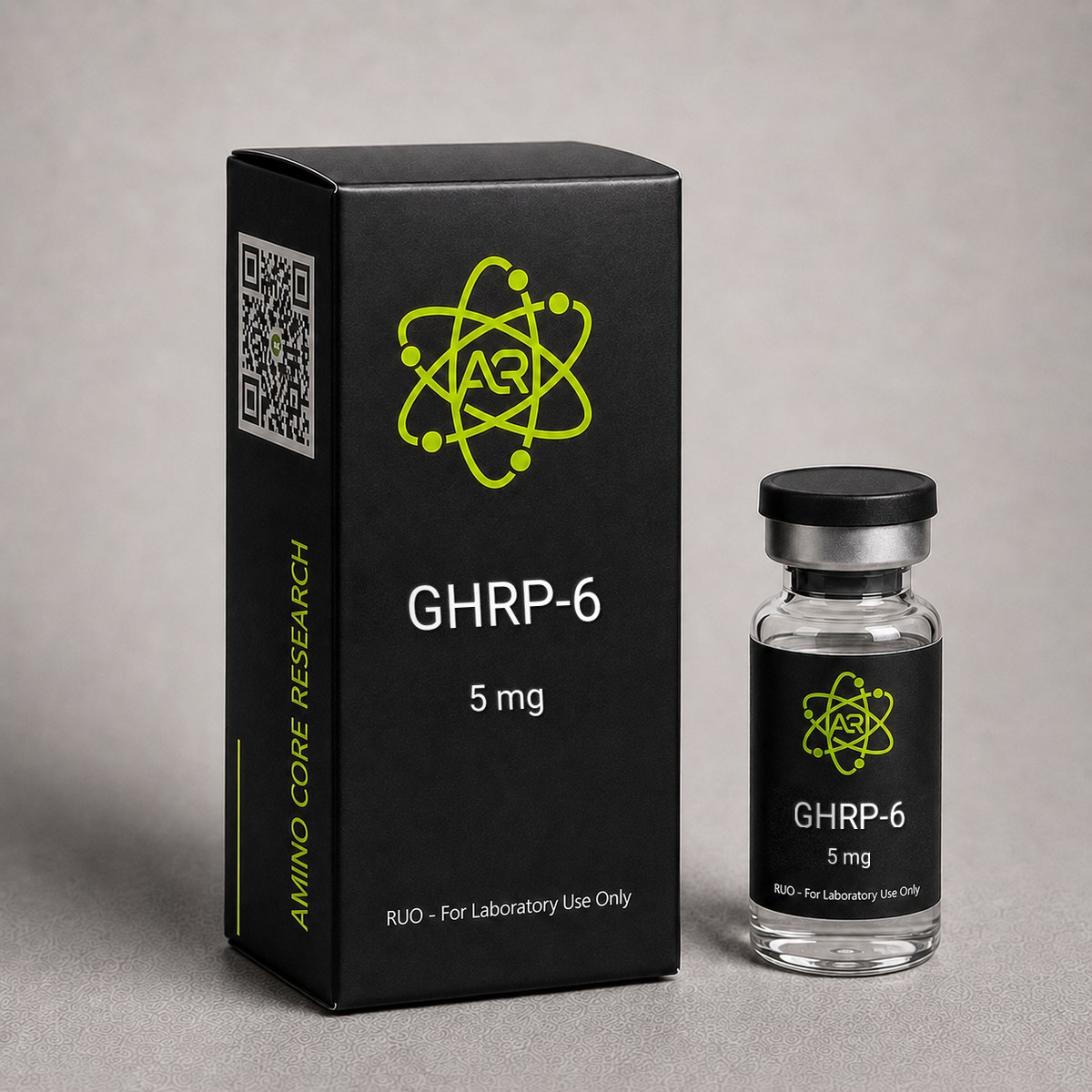
GHRP-6 Peptide
Growth Hormone Releasing Peptide-6 is a synthetic hexapeptide GHS-R1a agonist. One of the earliest characterized growth hormone secretagogues.
$32.00 – $56.00
In stock — ships next business day
Quick Facts
| SKU | ACR-GHRP6 |
|---|---|
| CAS Number | 87616-84-0 |
| Molecular Formula | C46H56N12O6 |
| Molecular Weight | 873.01 g/mol |
| Sequence | His-D-Trp-Ala-Trp-D-Phe-Lys-NH2 |
| Purity | ≥99% |
| Physical Form | Lyophilized Powder |
| Storage | Store at -20°C |
What is GHRP-6?
GHRP-6 (Growth Hormone Releasing Peptide-6) is a synthetic hexapeptide (His-D-Trp-Ala-Trp-D-Phe-Lys-NH2) that acts as a potent growth hormone secretagogue. It was one of the first synthetic peptides identified to stimulate GH release through the GHS-R1a (ghrelin) receptor.
GHRP-6 activates the ghrelin receptor independently of the GHRH pathway. Published research has documented its GH-releasing potency and its additional effects on appetite stimulation and cortisol/prolactin modulation, which distinguish it from more selective GHS compounds like Ipamorelin.
For laboratory research use only.
Mechanism of Action
GHRP-6 (Growth Hormone Releasing Peptide-6) is a synthetic hexapeptide (His-D-Trp-Ala-Trp-D-Phe-Lys-NH2) that functions as a selective agonist of the growth hormone secretagogue receptor type 1a (GHS-R1a). This G-protein coupled receptor was later identified as the endogenous receptor for ghrelin, making GHRP-6 one of the foundational tools in the discovery of the ghrelin/GHS-R signaling axis.
GHS-R1a Activation
Upon binding to GHS-R1a in the anterior pituitary and hypothalamus, GHRP-6 triggers Gq-coupled signaling, activating phospholipase C (PLC), which hydrolyzes phosphatidylinositol 4,5-bisphosphate (PIP2) into inositol trisphosphate (IP3) and diacylglycerol (DAG). The resulting increase in intracellular calcium drives somatotroph depolarization and growth hormone (GH) release. Reported EC50 values for GHRP-6 at GHS-R1a are in the low nanomolar range (~10 nM in heterologous expression systems).
Dual-Site Action: Pituitary and Hypothalamus
Unlike GHRH, which acts primarily on pituitary somatotrophs via the GHRH receptor (Gs/cAMP), GHRP-6 acts at two anatomical sites: it directly stimulates pituitary GH release and it activates hypothalamic neurons that suppress somatostatin tone while amplifying endogenous GHRH release. This dual mechanism produces synergistic GH pulses when GHRP-6 is co-administered with GHRH analogs such as CJC-1295 or sermorelin, an effect first characterized by Bowers and colleagues.
Appetite and Orexigenic Signaling
GHRP-6 robustly stimulates food intake in preclinical models through activation of GHS-R1a on neuropeptide Y (NPY) and agouti-related peptide (AgRP) neurons in the arcuate nucleus of the hypothalamus. This orexigenic signature distinguishes GHRP-6 from later-generation analogs such as ipamorelin, which were engineered to minimize appetite stimulation.
Secondary Effects on Cortisol and Prolactin
At supraphysiological doses, GHRP-6 produces modest increases in adrenocorticotropic hormone (ACTH), cortisol, and prolactin. These off-target effects are smaller than those of GHRP-2 and substantially larger than those of ipamorelin, which is essentially silent at the HPA axis in research models.
Research & Clinical Studies
Discovery and Characterization of GHS-R1a Using GHRP-6
The 1996 landmark paper by Howard et al., published in Science, used GHRP-6 as the pharmacological probe to clone and characterize the orphan G-protein coupled receptor that became known as GHS-R1a. This receptor was subsequently identified as the endogenous target of ghrelin in 1999, fundamentally reshaping understanding of GH regulation, appetite, and energy balance.
Study Design
- Expression cloning approach using a swine pituitary cDNA library
- Functional readout: aequorin-based calcium mobilization in HEK293 cells transfected with candidate receptors
- GHRP-6 used as the reference ligand for receptor identification and Bmax determination
Key Findings
- Identified a 366-amino-acid GPCR with seven transmembrane domains, expressed predominantly in the anterior pituitary and hypothalamus
- GHRP-6 produced concentration-dependent calcium mobilization with an EC50 of approximately 1-10 nM
- Receptor expression was confirmed in human, rat, and porcine pituitary tissue
- Provided the molecular framework for the subsequent identification of ghrelin (Kojima et al., 1999) as the endogenous ligand
Research Context
This study is foundational because it established that GHRPs do not act through the GHRH receptor — a long-standing question after GHRP-6 was first synthesized by Bowers in 1984. The discovery of GHS-R1a opened an entirely new field of ghrelin biology, including its roles in appetite, gastric motility, glucose homeostasis, and reward signaling.
[1] Howard AD, Feighner SD, Cully DF, et al. A receptor in pituitary and hypothalamus that functions in growth hormone release. Science. 1996;273(5277):974-977. PubMed ↗
[2] Kojima M, Hosoda H, Date Y, et al. Ghrelin is a growth-hormone-releasing acylated peptide from stomach. Nature. 1999;402(6762):656-660. PubMed ↗
GHRP-6 Synergy with GHRH on Growth Hormone Release
Bowers and colleagues demonstrated that GHRP-6 and GHRH act through distinct but complementary pathways, producing markedly synergistic GH release when co-administered. This work established the rationale for combining GHRPs with GHRH analogs in research protocols.
Study Design
- Healthy adult human subjects (research setting)
- IV bolus comparison of GHRH alone, GHRP-6 alone, and the combination
- Serial GH sampling over 120 minutes
Key Results
- GHRH alone produced a peak GH response of approximately 10-20 ng/mL
- GHRP-6 alone produced a peak GH response of approximately 20-40 ng/mL
- GHRH + GHRP-6 in combination produced a peak GH response exceeding 80-100 ng/mL — a clearly supra-additive (synergistic) response
- The combination was effective even in older subjects with reduced baseline GH pulsatility
Mechanistic Interpretation
The synergy arises because GHRH activates Gs/cAMP signaling in pituitary somatotrophs while GHRP-6 activates Gq/PLC signaling at the same cells, in addition to suppressing somatostatin tone at the hypothalamic level. The two converging signals amplify GH exocytosis beyond what either ligand achieves alone. This finding underpins the widespread use of GHRP/GHRH combinations (e.g., GHRP-6 + sermorelin, ipamorelin + CJC-1295) in subsequent secretagogue research.
[1] Bowers CY, Reynolds GA, Durham D, Barrera CM, Pezzoli SS, Thorner MO. Growth hormone (GH)-releasing peptide stimulates GH release in normal men and acts synergistically with GH-releasing hormone. J Clin Endocrinol Metab. 1990;70(4):975-982. PubMed ↗
GHRP-6 Effects on Cardiac Tissue in Preclinical Ischemia Models
Beyond its canonical role as a growth hormone secretagogue, GHRP-6 has been investigated extensively in preclinical models of cardiac injury and ischemia-reperfusion. These studies have helped characterize the existence of a non-pituitary GHS receptor family, often referred to as CD36 or alternative ghrelin receptor splice variants, expressed in cardiomyocytes and vascular endothelium.
Study Design
In a series of experiments using isolated rat hearts and in vivo rodent infarction models, researchers administered GHRP-6 either prior to or following induced ischemic insult. Typical protocols involved Langendorff-perfused hearts subjected to 30 minutes of global ischemia followed by 60-120 minutes of reperfusion, with GHRP-6 perfused at concentrations ranging from 10 nM to 1 µM. In vivo studies used subcutaneous administration of 100-400 µg/kg in rodent models of myocardial infarction induced by left anterior descending coronary artery ligation.
Key Findings
- Infarct size reduction of 30-50% was observed in GHRP-6-pretreated hearts compared with vehicle controls in ex vivo models.
- Improved post-ischemic recovery of left ventricular developed pressure and reduced end-diastolic pressure during reperfusion.
- Attenuation of apoptotic markers including reduced caspase-3 activation and decreased TUNEL-positive cardiomyocytes in peri-infarct tissue.
- Preservation of mitochondrial membrane potential and reduced cytochrome c release.
- Effects were observed independently of growth hormone elevation, suggesting direct receptor-mediated cardioprotection through CD36 and non-pituitary GHS-R isoforms.
Mechanistic Insights
The cardioprotective effects of GHRP-6 have been linked to activation of PI3K/Akt signaling, upregulation of anti-apoptotic Bcl-2 family proteins, and modulation of inflammatory cytokine release in infarcted tissue. Some investigators have observed reductions in TNF-α and IL-6 in peri-infarct regions. The implication of CD36 as an alternative GHRP-6 binding site distinguishes this hexapeptide from more selective ghrelin mimetics such as ipamorelin, which lack appreciable cardiac activity in equivalent models.
Research Context
These findings positioned GHRP-6 as a tool compound for exploring receptor-mediated cardioprotection independent of the somatotropic axis. Subsequent work has extended these observations to models of doxorubicin-induced cardiotoxicity and isoproterenol-induced cardiac remodeling, where GHRP-6 administration reduced fibrosis markers and preserved ejection fraction in rodent cohorts. The compound remains a frequently cited reference ligand in studies probing the non-classical actions of growth hormone secretagogues on cardiovascular tissue.
[1] Bodart V, Febbraio M, Demers A, et al. CD36 mediates the cardiovascular action of growth hormone-releasing peptides in the heart. Circulation Research. 2002;90(8):844-849. PubMed ↗
[2] Berlanga J, Cibrian D, Guevara L, et al. Growth-hormone-releasing peptide 6 (GHRP6) prevents oxidant cytotoxicity and reduces myocardial necrosis in a model of acute myocardial infarction. Clinical Science. 2007;112(4):241-250.
Chemical & Physical Properties
The following table summarizes the verified physicochemical and structural properties of GHRP-6 as confirmed through PubChem and primary literature sources. These data are essential for laboratory handling, reconstitution calculations, and analytical verification by HPLC or mass spectrometry.
| Full Name | Growth Hormone Releasing Peptide-6 |
|---|---|
| Synonyms | GHRP-6, Growth Hormone Releasing Hexapeptide, SKF-110679, His-D-Trp-Ala-Trp-D-Phe-Lys-NH2 |
| Molecular Formula | C₄₆H₅₆N₁₂O₆ |
| Molecular Weight | 873.01 g/mol |
| CAS Number | 87616-84-0 |
| PubChem CID | 9919253 |
| Sequence | H-His-D-Trp-Ala-Trp-D-Phe-Lys-NH₂ |
| Amino Acid Count | 6 (hexapeptide) |
| Key Modifications | C-terminal amidation; incorporation of D-Trp at position 2 and D-Phe at position 5 to confer enzymatic stability |
| Origin / Developer | Originally synthesized by researchers building on met-enkephalin analog work; characterized extensively by Bowers and colleagues in the late 1980s |
| Classification | Synthetic growth hormone secretagogue; GHS-R1a agonist; ghrelin mimetic |
| Physical Form | Lyophilized white to off-white powder |
| Solubility | Soluble in bacteriostatic water, sterile water, and 0.9% sodium chloride; moderately soluble in acetic acid solutions; limited solubility in pure DMSO |
| Purity | ≥99% by HPLC |
| Storage (lyophilized) | -20°C long-term; 2-8°C short-term |
| Appearance Post-Reconstitution | Clear, colorless solution free of particulates |
The presence of two D-amino acid substitutions (D-Trp² and D-Phe⁵) is critical to the compound's resistance to proteolytic degradation by gastrointestinal and serum peptidases relative to all-L-amino acid analogs. The C-terminal lysine amide contributes to receptor binding affinity at GHS-R1a, while the histidine N-terminus and tryptophan residues are important for ghrelin-like receptor engagement. Researchers performing analytical verification typically observe a [M+H]⁺ peak at m/z 873.5 by ESI-MS, with characteristic UV absorbance at 280 nm reflecting the two tryptophan residues.
Handling & Reconstitution Guidelines
Proper handling and reconstitution of GHRP-6 are essential for preserving peptide integrity and ensuring reproducible results in research applications. The following protocol reflects standard laboratory practice for lyophilized hexapeptides containing tryptophan residues, which are susceptible to oxidation and light-induced degradation.
Reconstitution Protocol
- Equilibrate the vial to room temperature for 20-30 minutes before opening to prevent atmospheric moisture condensation on the lyophilized powder.
- Gently tap the vial to ensure all peptide powder is settled at the bottom prior to opening.
- Select the reconstitution solvent. Bacteriostatic water (0.9% benzyl alcohol) is preferred for multi-use vials; sterile water or 0.9% saline are suitable for single-use preparations. Avoid pure DMSO.
- Calculate target concentration. A common working concentration is 5 mg/mL: add 1.0 mL of solvent to a 5 mg vial. For 2 mg vials, 1.0 mL yields 2 mg/mL.
- Add solvent slowly down the inner wall of the vial using a sterile syringe; do not inject directly onto the lyophilized cake.
- Swirl gently to dissolve. Do not shake or vortex — mechanical agitation can denature the peptide and introduce foaming.
- Allow 2-5 minutes for complete dissolution. The solution should appear clear and colorless.
- Inspect for particulates. Any cloudiness or visible particles indicate incomplete dissolution or potential contamination.
Concentration Reference
- 5 mg vial + 1.0 mL solvent = 5 mg/mL (5,000 µg/mL)
- 5 mg vial + 2.0 mL solvent = 2.5 mg/mL (2,500 µg/mL)
- 2 mg vial + 1.0 mL solvent = 2 mg/mL (2,000 µg/mL)
Compound-Specific Handling Notes
GHRP-6 contains two tryptophan residues that are particularly susceptible to oxidative degradation when exposed to ambient light, elevated temperatures, or oxidizing solvent contaminants. Researchers should minimize exposure of reconstituted solutions to direct light and avoid repeated freeze-thaw cycles. Working aliquots should be prepared in amber or foil-wrapped vials when extended bench time is anticipated.
The peptide is acid-sensitive at extremes of pH; reconstitution solvents should remain near neutral pH (6.5-7.5). Avoid contact with strong acids, bases, or oxidizing agents. When transferring solutions, use low-protein-binding pipette tips to minimize peptide adsorption losses, particularly at sub-micromolar working concentrations.
All handling should be performed under aseptic conditions in a laminar flow hood when sterility is required. Document reconstitution date, solvent lot, and concentration on the vial label. This compound is intended strictly for in vitro and preclinical research use only.
Frequently Asked Questions
What is GHRP-6?
GHRP-6 is a synthetic hexapeptide GH secretagogue that activates the GHS-R1a (ghrelin) receptor. It stimulates GH release and also affects appetite, cortisol, and prolactin — making it less selective than Ipamorelin. For research use only.
How does GHRP-6 compare to GHRP-2?
Both are hexapeptide GHS-R1a agonists, but GHRP-2 shows higher GH-releasing potency and somewhat greater selectivity. GHRP-6 produces more pronounced appetite stimulation through ghrelin pathway activation. Both stimulate cortisol and prolactin to a greater extent than Ipamorelin.
What is the molecular weight and CAS number of GHRP-6?
GHRP-6 has a molecular weight of 873.01 g/mol and a molecular formula of C46H56N12O6. Its CAS registry number is 87616-84-0. The peptide consists of six amino acid residues with the sequence His-D-Trp-Ala-Trp-D-Phe-Lys-NH2, featuring a C-terminal amidation and two D-amino acid substitutions (D-Trp at position 2 and D-Phe at position 5) that confer enzymatic stability and high GHS-R1a affinity. AminoCore Research supplies GHRP-6 as a lyophilized powder at ≥99% HPLC purity with a certificate of analysis.
How does GHRP-6 compare to ipamorelin?
Both GHRP-6 and ipamorelin are GHS-R1a agonists that stimulate growth hormone release, but their selectivity profiles differ substantially. GHRP-6 (1984, Bowers) is one of the earliest characterized growth hormone secretagogues and produces strong GH release alongside notable orexigenic (appetite-stimulating) signaling and modest increases in cortisol, ACTH, and prolactin at higher doses. Ipamorelin (1998) was specifically engineered for GHS-R1a selectivity and is essentially silent at the HPA axis, producing minimal cortisol or prolactin elevation and little to no appetite stimulation. GHRP-6 is therefore favored in research models studying ghrelin/orexigenic signaling, while ipamorelin is preferred when isolated GH-axis activation is desired.
Why does GHRP-6 stimulate appetite in research models?
GHRP-6 stimulates appetite because GHS-R1a — its primary target — is the same receptor activated by endogenous ghrelin, the body's principal orexigenic hormone. Activation of GHS-R1a on neuropeptide Y (NPY) and agouti-related peptide (AgRP) neurons in the hypothalamic arcuate nucleus increases food-seeking behavior and caloric intake in rodent models. This orexigenic property made GHRP-6 a key pharmacological tool in the discovery of ghrelin biology in the late 1990s. Research has shown dose-dependent increases in food intake within 30-60 minutes of administration in preclinical studies.
How should GHRP-6 be stored?
Lyophilized GHRP-6 should be stored at -20°C for long-term stability, where it remains stable for 24+ months when kept dry and protected from light. Short-term storage at 2-8°C is acceptable for several weeks, and brief exposure to room temperature during transit does not compromise integrity. Once reconstituted in bacteriostatic or sterile water, GHRP-6 should be refrigerated at 2-8°C and used within approximately 14-21 days. Repeated freeze-thaw cycles of reconstituted solution should be avoided, as the tryptophan residues are susceptible to oxidative degradation. Always protect both lyophilized and reconstituted material from direct light.
What sizes of GHRP-6 are available from AminoCore Research?
AminoCore Research offers GHRP-6 in standard research quantities, typically 5 mg and 10 mg lyophilized vials at ≥99% HPLC purity. Each vial ships with a Certificate of Analysis documenting purity, mass spectrometry confirmation, and lot-specific data. Bulk research quantities may be available upon request for laboratory programs requiring larger volumes. All material is sold strictly for in vitro and preclinical research use and is not intended for human or veterinary application.
Does GHRP-6 affect cortisol or prolactin levels in research models?
Published research indicates GHRP-6 produces minimal elevations in cortisol and prolactin in most preclinical models, particularly when compared with earlier secretagogues such as GHRP-2 at equivalent doses. However, GHRP-6 is not as selective as ipamorelin, which shows essentially no cortisol or prolactin response. Investigators studying pure somatotropic axis effects often select ipamorelin to avoid confounding adrenocortical signals, while GHRP-6 remains useful in studies probing combined GH and appetite pathways via the GHS-R1a and CD36 receptors.
What is the half-life of GHRP-6 in preclinical studies?
GHRP-6 has a relatively short plasma half-life of approximately 20-30 minutes in rodent and primate models following subcutaneous administration, with growth hormone pulse duration typically lasting 60-120 minutes post-dose. The compound's D-amino acid substitutions at positions 2 and 5 provide enhanced enzymatic stability relative to all-L-amino acid analogs, but the hexapeptide structure still undergoes rapid renal and hepatic clearance. This short pharmacokinetic profile is consistent with pulsatile GH-releasing activity observed in published secretagogue studies.
How does GHRP-6 interact with CD36 receptors outside the pituitary?
Research has identified CD36, a scavenger receptor expressed on cardiomyocytes, endothelial cells, and macrophages, as an alternative binding site for GHRP-6 independent of the canonical GHS-R1a receptor. Bodart and colleagues demonstrated that GHRP-6 binding to CD36 mediates cardiovascular effects including coronary perfusion modulation and cardioprotection in ischemia-reperfusion models. This non-pituitary activity distinguishes GHRP-6 from more selective ghrelin mimetics and explains observations of GH-independent cardiac and metabolic effects in preclinical literature.
For laboratory and research use only. This product is not for human or veterinary use. It is not a drug, supplement or food.
This product is not FDA approved for any indication, and is not intended to diagnose, treat, cure, or prevent any disease. All product information is derived from published preclinical research and does not constitute medical advice or claims.