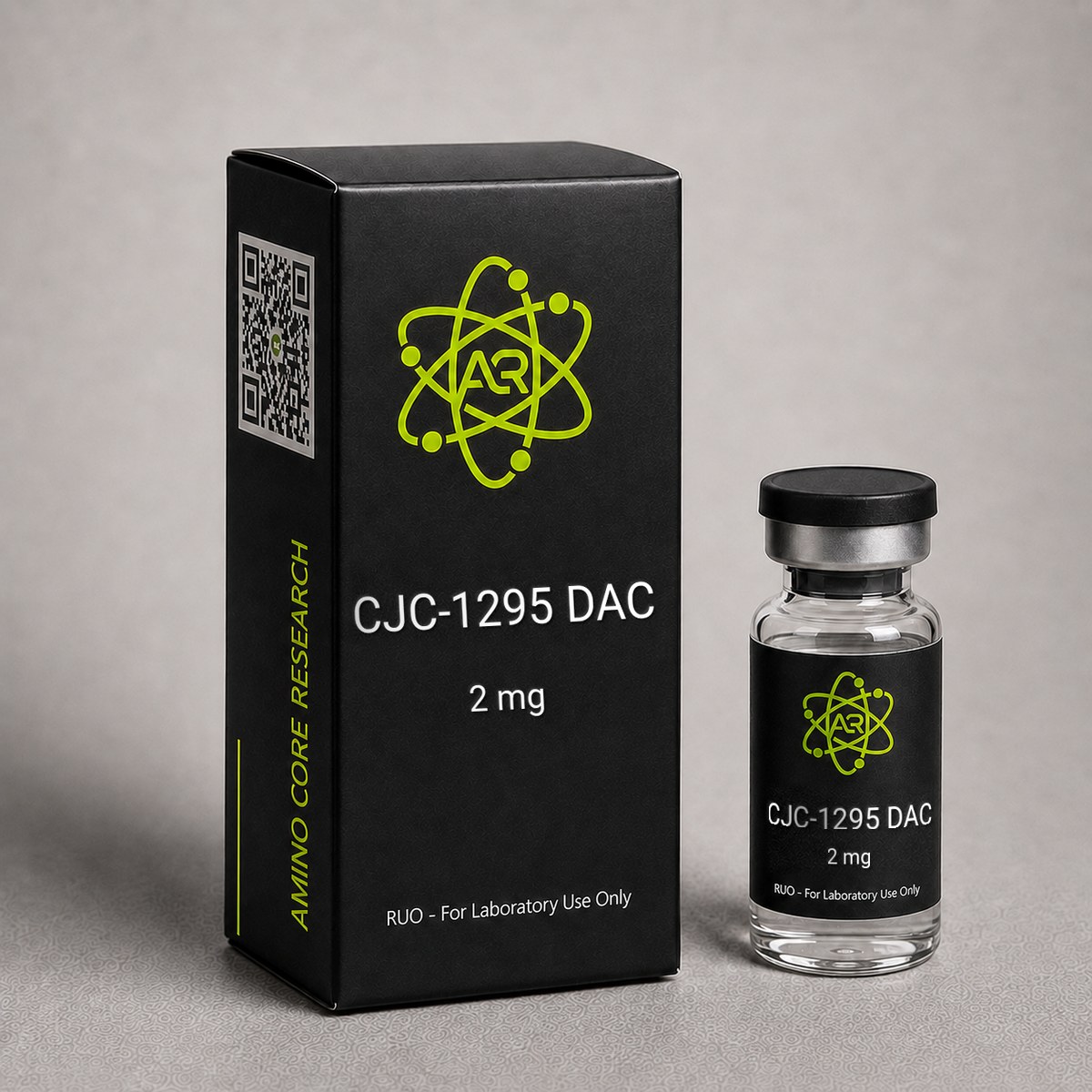
≥99%HPLC Purity
COAIncluded
USAShipped
CJC-1295 DAC Peptide
CJC-1295 DAC (DAC:GRF) is a 30-amino acid GHRH(1-29) analog conjugated to a maleimidopropionyl-lysine Drug Affinity Complex that covalently binds serum albumin, extending its half-life to approximately 8 days. Used in growth hormone axis research to investigate sustained GHRH receptor activation and pulsatile GH/IGF-1 secretion.
Research Reference
This page is a research monograph. CJC-1295 DAC is documented here for reference — structure, mechanism and published literature — and is not offered for sale.
Browse compounds available for research purchase · Read the research library
Quick Facts
| SKU | ACR-CJC1295D |
|---|---|
| CAS Number | 863288-34-0 |
| Molecular Formula | C165H269N47O46 |
| Molecular Weight | 3647.16 g/mol |
| Sequence | Tyr-D-Ala-Asp-Ala-Ile-Phe-Thr-Gln-Ser-Tyr-Arg-Lys-Val-Leu-Ala-Gln-Leu-Ser-Ala-Arg-Lys-Leu-Leu-Gln-Asp-Ile-Leu-Ser-Arg-Lys(MPA)-NH2 |
| Purity | ≥99% |
| Physical Form | Lyophilized Powder |
| Storage | Store at -20°C |
What is CJC-1295 DAC?
CJC-1295 DAC (Drug Affinity Complex) is a synthetic analog of growth hormone-releasing hormone (GHRH) with a DAC modification that extends its half-life to approximately 6-8 days. This prolonged duration enables sustained elevation of growth hormone (GH) and insulin-like growth factor 1 (IGF-1) levels, making it a key compound in endocrine research.
The DAC modification binds to serum albumin via a reactive chemical group, significantly reducing renal clearance and enabling less frequent dosing protocols in research settings compared to CJC-1295 without DAC (Modified GRF 1-29).
Mechanism of Action
CJC-1295 DAC acts as a GHRH analog, binding to the GHRH receptor (GHRHR) on anterior pituitary somatotroph cells. This triggers a signaling cascade via the cAMP/PKA pathway, stimulating the synthesis and pulsatile release of growth hormone.
The DAC moiety consists of a maleimidopropionic acid (MPA) linker conjugated to lysine, which undergoes a Michael reaction with Cys34 on albumin. This albumin binding reduces proteolytic degradation and renal filtration, extending the peptide's functional half-life from ~30 minutes (without DAC) to approximately 6-8 days.
Research & Clinical Studies
CJC-1295 DAC and Growth Hormone Research
In preclinical and early clinical studies, CJC-1295 DAC demonstrated dose-dependent increases in GH secretion. A 2006 study by Teichman et al. found that a single subcutaneous injection of CJC-1295 resulted in sustained GH elevation for 6+ days, with IGF-1 levels remaining elevated for up to 14 days.
The study reported mean GH levels increased 2-10 fold above baseline, with peak IGF-1 increases of 1.5-3 fold depending on dosage. The compound maintained the natural pulsatile pattern of GH secretion rather than producing a continuous, non-physiological elevation.
[1] Teichman SL et al. Prolonged stimulation of growth hormone (GH) and insulin-like growth factor I secretion by CJC-1295. J Clin Endocrinol Metab. 2006;91(3):799-805. PubMed ↗
Phase 1 Pharmacokinetics: Half-Life Extension via Albumin Binding
The landmark Phase 1 study by Teichman and colleagues (2006) established the pharmacokinetic profile of CJC-1295 DAC (then designated CJC-1295) in healthy human volunteers, providing the foundational data that distinguishes this analog from native GHRH and modified GHRH(1-29) peptides such as Sermorelin and tesamorelin.
Study Design:
- Randomized, double-blind, placebo-controlled, ascending single-dose trial
- Subjects: 21 healthy adult volunteers
- Doses: 30, 60, 125, and 250 μg/kg subcutaneous CJC-1295 DAC
- Endpoints: serum CJC-1295 concentration, GH, and IGF-1 over 28 days post-dose
Key Pharmacokinetic Findings:
- Mean terminal half-life of ~5.8 to 8.1 days, vastly exceeding the <30-minute half-life of native GHRH
- Detectable serum levels persisted up to 28 days at higher doses
- Mean GH levels increased 2-10 fold and remained elevated for 6 days
- IGF-1 levels increased 1.5-3 fold above baseline and remained elevated for 9-11 days post single dose
- No significant change in prolactin, cortisol, or other pituitary hormones, confirming GHRH-receptor selectivity
The extended half-life is mechanistically attributable to the maleimidopropionyl-lysine DAC moiety, which forms a covalent thioether bond with cysteine-34 of circulating serum albumin. This bioconjugation strategy shields the peptide from dipeptidyl peptidase-IV (DPP-IV) cleavage and renal filtration, properties that severely limit native GHRH and unmodified GHRH(1-29) (Sermorelin), which has a half-life of only 11-12 minutes. A subsequent multiple-dose study (Teichman et al., 2006) demonstrated that weekly or bi-weekly dosing produced sustained 1.5- to 3-fold elevations in IGF-1 over multi-week dosing periods, confirming that DAC enables practical chronic-dose research paradigms not feasible with shorter-acting GHRH analogs.
[1] Teichman SL, Neale A, Lawrence B, Gagnon C, Castaigne JP, Frohman LA. Prolonged stimulation of growth hormone (GH) and insulin-like growth factor I secretion by CJC-1295, a long-acting analog of GH-releasing hormone, in healthy adults. J Clin Endocrinol Metab. 2006;91(3):799-805. PubMed ↗
Comparative Study: CJC-1295 DAC vs. GHRH and Sermorelin
A pharmacological comparison study by Ionescu and Frohman (2006) directly evaluated CJC-1295 DAC against native GHRH and exercise-induced GH stimulation in healthy male volunteers, characterizing how DAC-mediated half-life extension alters the GH secretory profile.
Study Design:
- Crossover design in healthy adult males
- Compared single-dose CJC-1295 DAC (60 μg/kg SC) with intravenous GHRH (1 μg/kg) and acute exercise stimulus
- Frequent serum sampling for GH pulse analysis over 7 days
Key Findings:
- CJC-1295 DAC produced a sustained 7.5-fold increase in mean GH levels at 24 hours and a 2-fold increase persisting at day 7
- Crucially, pulsatile GH secretion was preserved rather than collapsed into a tonic plateau — pulse amplitude increased while pulse frequency remained physiologic
- GH trough levels rose, but pulses remained discrete, contrasting with concerns of pituitary desensitization
- IGF-1 elevation was sustained for >6 days from a single subcutaneous dose
Comparison Summary:
- Native GHRH: half-life <10 minutes, requires continuous infusion or repeated bolus dosing
- Sermorelin (GHRH 1-29): half-life ~12 minutes, daily dosing required
- CJC-1295 (no DAC, modified GHRH 1-29): half-life ~30 minutes — improved DPP-IV resistance only
- CJC-1295 DAC: half-life ~8 days, weekly dosing feasible, preserves pulsatility
These data established CJC-1295 DAC as a research tool uniquely suited to investigate chronic GHRH-receptor agonism in long-duration animal and clinical studies, where short-acting analogs are pharmacokinetically impractical. Subsequent rodent and primate work has utilized this profile to study sustained somatotroph stimulation, IGF-1-mediated tissue effects, and feedback dynamics within the GH/IGF-1 axis.
[1] Ionescu M, Frohman LA. Pulsatile secretion of growth hormone (GH) persists during continuous stimulation by CJC-1295, a long-acting GH-releasing hormone analog. J Clin Endocrinol Metab. 2006;91(12):4792-4797. PubMed ↗
[2] Alba M, Fintini D, Sagazio A, Lawrence B, Castaigne JP, Frohman LA, Salvatori R. Once-daily administration of CJC-1295, a long-acting growth hormone-releasing hormone (GHRH) analog, normalizes growth in the GHRH knockout mouse. Am J Physiol Endocrinol Metab. 2006;291(6):E1290-E1294. PubMed ↗
Preclinical Research: GHRH Knockout Mouse Growth Restoration
Alba and colleagues (2006) used the GHRH knockout (GHRH-KO) mouse model to evaluate whether CJC-1295 DAC could functionally substitute for endogenous GHRH and restore normal somatic growth — a stringent test of GHRH-receptor agonism in vivo.
Study Design:
- Subjects: GHRH-KO mice (homozygous null for the GHRH gene), which exhibit severe pituitary somatotroph hypoplasia and dwarfism
- Intervention: once-daily subcutaneous CJC-1295 DAC vs. saline vehicle from weaning through adulthood
- Outcome measures: body weight, body length, organ weights, pituitary GH content, serum IGF-1
Key Results:
- Body weight in CJC-1295 DAC-treated GHRH-KO mice was restored to levels not significantly different from wild-type littermates
- Body length normalized after sustained dosing
- Pituitary GH content and somatotroph population recovered toward wild-type levels, demonstrating trophic action on somatotroph proliferation
- Serum IGF-1 normalized to wild-type range
- Once-daily dosing was sufficient — consistent with the multi-day pharmacokinetic profile
This study is mechanistically significant because it confirms that CJC-1295 DAC engages the pituitary GHRH receptor (GHRHR) with sufficient potency and duration to fully replicate endogenous GHRH function — including the trophic effects on somatotroph mass that distinguish GHRH-axis agonists from direct GH replacement. The model also validates CJC-1295 DAC as a research tool for investigating GHRH-axis development, somatotroph biology, and long-term IGF-1-mediated tissue effects in genetically defined backgrounds. Together with the human PK/PD data, these preclinical findings inform the broader use of CJC-1295 DAC in laboratory studies of growth hormone insufficiency models, aging-related somatopause, and tissue regeneration paradigms.
[1] Alba M, Fintini D, Sagazio A, Lawrence B, Castaigne JP, Frohman LA, Salvatori R. Once-daily administration of CJC-1295, a long-acting growth hormone-releasing hormone (GHRH) analog, normalizes growth in the GHRH knockout mouse. Am J Physiol Endocrinol Metab. 2006;291(6):E1290-E1294. PubMed ↗
Chemical & Physical Properties
CJC-1295 DAC is a synthetic analog of growth hormone-releasing hormone (GHRH), engineered to combine the truncated bioactive GHRH(1-29) sequence with four amino acid substitutions and a C-terminal maleimidopropionic acid (MPA) linker that forms a Drug Affinity Complex (DAC) with circulating serum albumin. This rational design extends the in vivo half-life from minutes (native GHRH) to multiple days in preclinical models.
Primary structure: Tyr-D-Ala-Asp-Ala-Ile-Phe-Thr-Gln-Ser-Tyr-Arg-Lys-Val-Leu-Ala-Gln-Leu-Ser-Ala-Arg-Lys-Leu-Leu-Gln-Asp-Ile-Leu-Ser-Arg-Lys(MPA)-NH2. The four key substitutions relative to native GHRH(1-29) are D-Ala²(resistance to DPP-IV cleavage), Gln⁸ (resistance to asparagine deamidation/cleavage by trypsin-like proteases), Ala¹⁵ (enhanced amphipathic α-helix stability), and Leu²⁷ (resistance to oxidation of the native Met residue). The C-terminal lysine carries the MPA group, whose maleimide reacts selectively with the free thiol of Cys-34 on human serum albumin, generating a covalent thioether bond and albumin-bound depot.
Physical and chemical parameters:
- Molecular formula: C₁₆₅H₂₆₉N₄₇O₄₆
- Molecular weight: ~3647.28 g/mol (monoisotopic mass ~3644.0 Da)
- CAS number: 863288-34-0
- Appearance: White to off-white lyophilized powder
- Purity: ≥99% by reverse-phase HPLC (typical research-grade specification)
- Net charge at pH 7.0: approximately +2 to +3, due to multiple Arg/Lys residues partially offset by Asp residues
- Isoelectric point (pI): ~9.7 (predicted)
- Solubility: Soluble in sterile water, bacteriostatic water, and dilute acetic acid; limited solubility in non-polar organic solvents
- C-terminus: Amidated (-NH2), enhancing receptor recognition and proteolytic stability
Structural and pharmacological context: The peptide adopts an amphipathic α-helical conformation across residues 6-29, which is critical for binding the GHRH receptor (GHRH-R), a class B G-protein-coupled receptor expressed on anterior pituitary somatotrophs. Receptor activation engages Gαs, elevating intracellular cAMP and stimulating pulsatile growth hormone release in preclinical models. The MPA-mediated albumin conjugation does not abolish receptor binding because albumin-bound peptide can still engage GHRH-R, though with altered pharmacokinetics — the depot effect prolongs systemic exposure and shifts pulsatile GH secretion toward more sustained release patterns in animal studies (Teichman et al., 2006).
Analytical characterization: Quality control of research-grade material typically includes RP-HPLC for purity and identity, ESI- or MALDI-mass spectrometry for intact-mass confirmation, amino acid analysis or sequencing for primary structure verification, and tests for water content (Karl Fischer), residual TFA (counter-ion), and bacterial endotoxin. The presence of an intact, reactive maleimide can be verified by Ellman's assay following reaction with a thiol-containing probe such as cysteine or glutathione.
Research applications: CJC-1295 DAC is used in vitro and in preclinical animal models to study GHRH-R signaling, somatotroph axis regulation, IGF-1 dynamics, and albumin-conjugation pharmacokinetic strategies. This material is supplied for laboratory research use only and is not intended for human or veterinary administration.
Handling & Reconstitution
Proper reconstitution of CJC-1295 DAC is critical for preserving structural integrity, maleimide reactivity, and analytical performance in downstream research applications. The 30-amino acid peptide is supplied lyophilized and must be solubilized prior to use under conditions that minimize mechanical shear, oxidative exposure, and pH excursions.
Recommended diluent: Bacteriostatic water for injection (0.9% benzyl alcohol in sterile water) is the standard reconstitution medium for research handling, providing antimicrobial protection during the multi-day post-reconstitution window. Sterile water for injection or 0.9% sodium chloride may also be used, but these lack preservatives and require shorter use windows. Avoid alkaline buffers, as elevated pH accelerates hydrolysis of the maleimidopropionic acid linker to the inert maleamic acid form, which abolishes the DAC mechanism of albumin conjugation.
Step-by-step procedure:
- Equilibrate: Remove the lyophilized vial from -20°C storage and allow it to reach room temperature (15-20 minutes) before opening. Cold vials accumulate atmospheric moisture on the lyophilate, which can cause clumping and incomplete dissolution.
- Sanitize: Wipe the rubber septum of both the peptide vial and diluent vial with 70% isopropanol and allow to air-dry.
- Calculate volume: Choose a reconstitution volume that yields a convenient working concentration (commonly 1-2 mg/mL). For a 2 mg vial reconstituted with 2 mL diluent, the resulting concentration is 1 mg/mL.
- Inject slowly: Using a sterile syringe, draw the diluent and inject it slowly down the inner wall of the vial. Direct injection onto the lyophilate cake produces foaming, mechanical shear, and aggregation.
- Dissolve passively: Allow the vial to stand undisturbed for 5-10 minutes. Gently swirl — do NOT shake or vortex. Shear forces can disrupt the peptide's secondary structure and degrade the reactive maleimide group.
- Inspect: The final solution should be clear, colorless, and free of visible particulates. Cloudiness, fibrils, or color indicates aggregation or contamination; discard the vial.
Concentration verification: For quantitative research, confirm post-reconstitution concentration by UV absorbance (A280, using ε calculated from Tyr/Trp content) or by RP-HPLC against a reference standard. Mass spectrometry can confirm intact-mass identity and detect early hydrolysis of the MPA linker (mass shift of +18 Da).
Handling precautions: Wear nitrile gloves, lab coat, and safety eyewear. Work in a clean laminar-flow hood when sterility is required for cell culture or in vitro receptor binding studies. Use low-protein-binding polypropylene tubes for aliquoting, as the amphipathic peptide can adsorb to high-binding surfaces at low concentrations, leading to underestimation of the true working concentration. CJC-1295 DAC is intended strictly for in vitro laboratory research and is not approved for human or animal administration.
Storage & Stability
CJC-1295 DAC (Drug Affinity Complex) requires careful storage to preserve its structural integrity and the integrity of the maleimidopropionic acid (MPA) linker that mediates albumin conjugation. The peptide is supplied as a lyophilized powder, which is the most stable physical form for long-term storage. Lyophilization removes bulk water and reduces hydrolytic and oxidative degradation pathways that can compromise the 30-residue sequence, the C-terminal amide, and the reactive maleimide functionality responsible for the extended half-life.
Long-term storage (lyophilized): Store the sealed vial at -20°C or colder for periods up to 24 months. For extended archival storage exceeding 12 months, -80°C is preferable, as lower temperatures further suppress residual moisture-driven hydrolysis of peptide bonds (notably Asp-Gly and Asn-Xaa motifs) and Met/Trp oxidation. Keep vials desiccated and protected from light, which can promote photo-oxidation of aromatic residues (Tyr, Phe) within the GHRH(1-29) backbone.
Short-term storage prior to reconstitution: Brief storage at 2-8°C (up to several weeks) is acceptable provided the vial remains sealed and desiccated. Always allow the vial to equilibrate to room temperature before opening to prevent atmospheric moisture from condensing onto the lyophilate, which can accelerate degradation and impair reconstitution behavior.
Post-reconstitution storage: Once dissolved in bacteriostatic water (0.9% benzyl alcohol) or sterile water, store the solution at 2-8°C and use within approximately 21 days when bacteriostatic diluent is employed. With non-preserved sterile water, the working window is substantially shorter (typically 24-72 hours) due to the absence of antimicrobial protection. Reconstituted solutions should remain clear; any visible precipitate, cloudiness, or color change indicates aggregation or degradation and the material should be discarded.
Stability considerations specific to CJC-1295 DAC:
- Maleimide reactivity: The MPA group is electrophilic and slowly hydrolyzes to a non-reactive maleamic acid at neutral to alkaline pH. Storage at acidic to neutral pH in lyophilized form maximizes preservation of the maleimide moiety, which is essential for in vivo albumin conjugation.
- Freeze-thaw avoidance: Repeated freeze-thaw cycles of reconstituted solution induce aggregation and loss of bioactivity. Aliquoting into single-use research volumes before freezing minimizes this issue.
- Light protection: Use amber vials or wrap in foil to mitigate photodegradation.
- Adsorption: At low concentrations, the peptide can adsorb to glass and plastic surfaces. Use low-binding polypropylene tubes and avoid extensive dilution prior to use.
For analytical confirmation of stability over time, RP-HPLC and mass spectrometry are recommended to monitor parent peak integrity, maleimide hydrolysis, oxidation products, and aggregate formation. This material is intended for in vitro laboratory research use only and is not for human or veterinary administration.
Frequently Asked Questions
What is the difference between CJC-1295 DAC and CJC-1295 without DAC?
CJC-1295 DAC includes a Drug Affinity Complex that binds to serum albumin, extending its half-life to 6-8 days versus ~30 minutes for CJC-1295 without DAC (Modified GRF 1-29). This means DAC version provides sustained GH elevation while the non-DAC version produces shorter, more physiological GH pulses.
What is the purity of your CJC-1295 DAC?
Our CJC-1295 DAC is manufactured to ≥99% purity, verified through third-party HPLC and mass spectrometry analysis. A Certificate of Analysis (COA) is included with every order.
How should CJC-1295 DAC be stored?
Lyophilized: -20°C for up to 24 months. Reconstituted: 2-8°C for up to 21 days. Protect from light and avoid freeze-thaw cycles.
What sizes are available?
CJC-1295 DAC is available in 2mg and 5mg lyophilized vials, suitable for various research protocol durations.
What is the molecular weight and CAS number of CJC-1295 DAC?
CJC-1295 DAC has a molecular weight of approximately 3647.16 g/mol and CAS number 863288-34-0. The molecular formula is C165H269N47O46. The peptide consists of a 30-amino acid modified GHRH(1-29) sequence (with D-Ala2, Gln8, Ala15, and Leu27 substitutions) terminated by a lysine bearing a maleimidopropionyl (MPA) Drug Affinity Complex moiety. The C-terminus is amidated. The MPA group is responsible for covalent conjugation to cysteine-34 of serum albumin, which is the structural basis for the extended ~8-day half-life that defines this peptide pharmacologically.
How long is the half-life of CJC-1295 DAC in research models?
Phase 1 human pharmacokinetic studies reported a terminal half-life of approximately 5.8 to 8.1 days following a single subcutaneous dose, with detectable serum levels persisting up to 28 days at higher doses (Teichman et al., 2006). This is in stark contrast to native GHRH (half-life under 10 minutes), Sermorelin/GHRH(1-29) (~12 minutes), and CJC-1295 without DAC (~30 minutes). The extended half-life results from covalent thioether-bond conjugation of the MPA-DAC moiety to Cys34 of circulating serum albumin, which protects the peptide from DPP-IV proteolysis and renal clearance.
Does CJC-1295 DAC preserve pulsatile growth hormone secretion?
Research data from Ionescu and Frohman (2006) demonstrate that CJC-1295 DAC preserves the pulsatile pattern of growth hormone secretion despite producing sustained GHRH-receptor activation. In healthy volunteers, mean GH levels rose 7.5-fold at 24 hours post-dose, but discrete GH pulses remained — pulse amplitude increased while pulse frequency stayed physiologic, with elevated trough levels. This contrasts with the theoretical concern that continuous GHRHR agonism would collapse pulsatility into a tonic plateau, and supports the use of CJC-1295 DAC in research investigating chronic GHRH-axis stimulation without abolishing endogenous somatotroph rhythmicity.
How does CJC-1295 DAC compare to Ipamorelin or MK-677 mechanistically?
CJC-1295 DAC and Ipamorelin/MK-677 act on distinct but complementary nodes of the growth hormone axis. CJC-1295 DAC is a long-acting agonist of the GHRH receptor (GHRHR) on pituitary somatotrophs, mimicking hypothalamic GHRH. Ipamorelin and MK-677 are agonists of the growth hormone secretagogue receptor (GHSR-1a, the ghrelin receptor), mimicking ghrelin. Co-stimulation of both receptors produces synergistic GH release in research models because the two pathways converge on different intracellular signals (cAMP/PKA for GHRHR; PLC/IP3/Ca²⁺ for GHSR-1a). MK-677 is orally bioavailable with a ~24-hour half-life, while CJC-1295 DAC requires subcutaneous administration but offers a multi-day half-life. The compounds are frequently studied together in GH-axis pharmacology research.
For laboratory and research use only. This product is not for human or veterinary use. It is not a drug, supplement or food.
This product is not FDA approved for any indication, and is not intended to diagnose, treat, cure, or prevent any disease. All product information is derived from published preclinical research and does not constitute medical advice or claims.