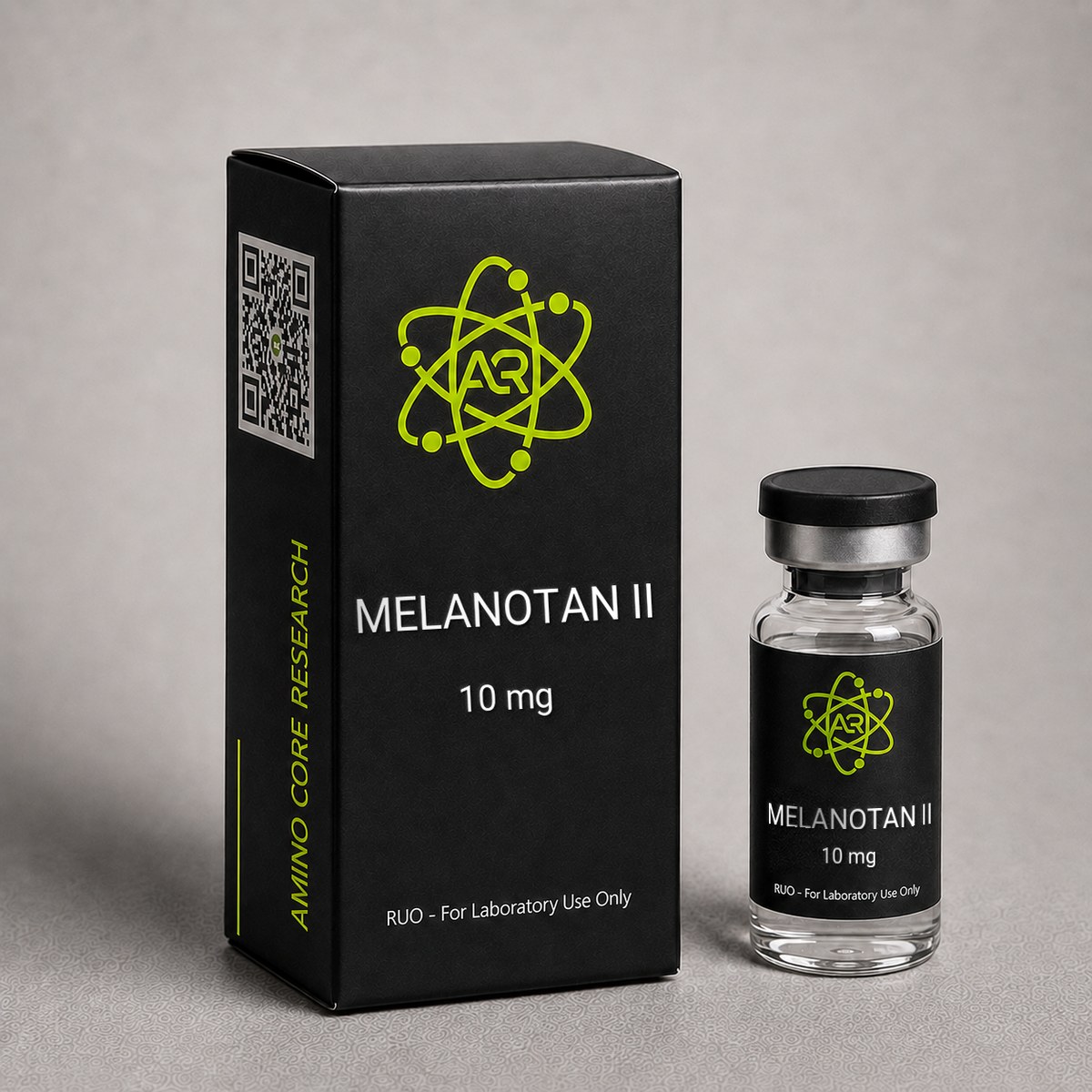
≥99%HPLC Purity
COAIncluded
USAShipped
Melanotan II (MT-2) Peptide
Cyclic heptapeptide analog of alpha-MSH targeting melanocortin receptors MC1R through MC5R. Originally developed at University of Arizona for melanogenesis research. Non-selective melanocortin agonist studied for tanning response, sexual function, appetite modulation, and immune regulation.
Research Reference
This page is a research monograph. Melanotan II (MT-2) is documented here for reference — structure, mechanism and published literature — and is not offered for sale.
Browse compounds available for research purchase · Read the research library
Best price — free shipping & bac water included
| Simple Peptide | AminoCore ✓ all‑in | |
|---|---|---|
| 10mg price | $38.00 | $55.00 |
| Shipping | +$13.00 | FREE |
| Bac Water | +$30.00 | FREE |
| Total paid | $81.00 | $55.00 save up to $26.00 |
Quick Facts
| SKU | ACR-MT2 |
|---|---|
| CAS Number | 121062-08-6 |
| Molecular Formula | C50H69N15O9 |
| Molecular Weight | 1024.18 g/mol |
| Sequence | Ac-Nle-cyclo[Asp-His-D-Phe-Arg-Trp-Lys]-NH2 |
| Purity | ≥99% |
| Physical Form | Lyophilized Powder |
| Storage | Store at -20°C |
What is Melanotan II (MT-2)?
Melanotan II (MT-2, MT2) is a synthetic cyclic heptapeptide with the sequence Ac-Nle-cyclo[Asp-His-D-Phe-Arg-Trp-Lys]-NH₂, molecular weight 1,024.18 g/mol, and CAS number 121062-08-6. Developed at the University of Arizona by Dr. Victor Hruby in the late 1980s, MT-2 is a non-selective agonist of melanocortin receptors MC1R through MC5R (except MC2R).
MT-2 was originally designed to induce melanogenesis (tanning) as a potential protective strategy against UV-induced skin cancer. However, its broad melanocortin receptor activity produces multiple effects: skin darkening (MC1R), sexual arousal (MC3R/MC4R), appetite suppression (MC4R), and immune modulation (MC1R/MC3R). This multifunctional profile has made MT-2 one of the most widely studied melanocortin peptides in preclinical research.
MT-2 is the parent compound from which PT-141 (Bremelanotide) was derived by converting the C-terminal amide to a free acid — eliminating melanogenesis while preserving sexual function effects.
Mechanism of Action
Melanotan II is a non-selective melanocortin receptor agonist with activity at multiple receptor subtypes:
MC1R (Melanogenesis): The primary tanning receptor on melanocytes. MT-2 binding activates cAMP/PKA → MITF → tyrosinase cascade, increasing eumelanin production. This produces darkening of skin, hair, and nevi without UV exposure. MC1R activation also provides photoprotective and anti-inflammatory effects in skin.
MC3R (Energy Homeostasis): Expressed in hypothalamus and peripheral tissues. MC3R regulates energy partitioning between lean and fat tissue, feeding behavior, and cardiovascular function. MT-2 activates MC3R, contributing to its anti-obesity and cardiovascular effects in animal models.
MC4R (Appetite/Sexual Function): The critical receptor for both appetite suppression (hypothalamic POMC/CART neuron activation) and sexual arousal (PVN oxytocin/dopamine release). MT-2 is a potent MC4R agonist — this is the receptor responsible for the sexual function effects that led to development of PT-141.
MC5R (Exocrine Glands): Regulates sebaceous gland secretion and pheromone production. Less studied but contributes to MT-2 peripheral effects.
The cyclic structure of MT-2 confers resistance to enzymatic degradation compared to linear alpha-MSH, resulting in a much longer duration of action (hours vs minutes).
Research & Clinical Studies
MT-2 and Melanogenesis/Tanning Research
The landmark Phase I trial by Dorr et al. (1996) established MT-2 melanogenic efficacy in humans:
- Subcutaneous MT-2 administration (0.01-0.025 mg/kg) produced significant skin darkening within 5 days
- Melanin increase was measurable by reflectance spectrophotometry across all skin phototypes
- Tanning occurred without UV exposure — confirming direct melanocyte activation
- The tanning response was dose-dependent and persisted for 2-3 weeks after discontinuation
- Darker-skinned subjects (Fitzpatrick III-IV) showed more pronounced responses than fair-skinned (I-II)
The UV-independent melanogenesis is pharmacologically significant because eumelanin provides natural photoprotection (UV absorption, free radical scavenging) without the DNA damage associated with UV tanning.
[1] Dorr RT et al. Evaluation of melanotan-II, a superpotent cyclic melanotropic peptide in a pilot phase-I clinical study. Life Sci. 1996;58(20):1777-1784. PubMed ↗
MT-2 and Sexual Function Research
MT-2 unexpectedly produced penile erections during Phase I melanogenesis trials — a finding that redirected significant research effort toward melanocortin-based sexual function therapeutics.
- 9 of 10 male subjects in early trials reported spontaneous erections post-injection
- The erectogenic effect was mediated through MC4R activation in the hypothalamic paraventricular nucleus (PVN)
- MC4R activation triggers oxytocin and dopamine release in descending pathways to spinal erection centers
- This central mechanism is fundamentally different from PDE5 inhibitors (sildenafil), which act peripherally
This discovery led directly to the development of PT-141 (Bremelanotide) — a modified MT-2 analog with the C-terminal amide converted to free acid, reducing MC1R melanogenesis while preserving MC3R/MC4R sexual function. PT-141 was FDA-approved as Vyleesi in 2019 for HSDD.
[1] Wessells H et al. Melanocortin receptor agonists, penile erection, and sexual motivation: human studies with Melanotan II. Int J Impot Res. 2000;12 Suppl 4:S74-79. PubMed ↗
MT-2 and Appetite/Obesity Research
MC4R is the primary melanocortin receptor for appetite regulation. MT-2 MC4R agonism produces:
- Significant appetite suppression in animal models (30-50% food intake reduction)
- Preferential reduction of fat mass over lean mass in DIO mice
- Effects mediated through hypothalamic POMC/CART neuron activation and AgRP/NPY neuron inhibition
- MC4R loss-of-function mutations are the most common monogenic cause of human obesity (4-6% of severe obesity cases)
The anti-obesity effect of MC4R agonism has been clinically validated: setmelanotide (Imcivree), a selective MC4R agonist derived from the same melanocortin research lineage as MT-2, was FDA-approved in 2020 for genetic obesity due to POMC, PCSK1, or LEPR deficiency.
Chemical & Physical Properties
Melanotan II (MT-2) is a synthetic, conformationally constrained cyclic heptapeptide analog of the endogenous melanocortin α-MSH (α-melanocyte-stimulating hormone). It was designed at the University of Arizona by Victor Hruby, Mac Hadley, and colleagues in the late 1980s as part of a structure-activity program aimed at producing a metabolically stable, high-affinity melanocortin receptor agonist for use as a research probe in pigmentation and energy-balance biology (Al-Obeidi et al., 1989; Hruby et al., 1995).
| Full Name | Melanotan II (MT-2, MT-II) |
|---|---|
| Sequence | Ac-Nle-cyclo[Asp-His-D-Phe-Arg-Trp-Lys]-NH₂ |
| Molecular Formula | C₅₀H₆₉N₁₅O₉ |
| Molecular Weight | 1,024.18 g/mol (monoisotopic 1,023.54) |
| CAS Number | 121062-08-6 |
| Structure | Cyclic heptapeptide; 23-membered lactam macrocycle between Asp side-chain carboxyl and Lys ε-amine |
| Non-natural residues | Nle4 (L-norleucine), D-Phe7 (D-phenylalanine) |
| N-/C-termini | N-acetyl; C-terminal primary amide (-NH₂) |
| Net charge (pH 7.4) | +2 (Arg, His partially protonated; Lys engaged in lactam) |
| Isoelectric point (calc.) | ~9.8 |
| Solubility | Freely soluble in water and BAC water (>10 mg/mL); soluble in DMSO; sparingly soluble in non-polar solvents |
| UV absorbance | λmax ~280 nm (Trp indole); ε280 ≈ 5,500 M⁻¹cm⁻¹ |
| Receptor targets | Non-selective agonist at MC1R, MC3R, MC4R, MC5R; minimal activity at MC2R (ACTH receptor) |
| Reported potency | Sub-nanomolar to low-nanomolar EC₅₀ at MC1R, MC3R, MC4R, MC5R in cAMP accumulation assays |
| Pharmacophore | His-D-Phe-Arg-Trp core (the conserved melanocortin tetrapeptide motif), rigidified within the lactam ring |
| Developer | University of Arizona (Hruby, Hadley, Castrucci, Al-Obeidi) |
| Appearance | White to off-white lyophilized powder |
| Purity specification | ≥99% by RP-HPLC; identity confirmed by ESI-MS |
| Typical impurities | Trp-oxidized species (+16 Da), ring-opened linear peptide, TFA counter-ion residues |
Structural rationale: Native α-MSH (Ac-Ser-Tyr-Ser-Met-Glu-His-Phe-Arg-Trp-Gly-Lys-Pro-Val-NH₂) is rapidly degraded in biological matrices. The MT-2 design retains only the conserved His-Phe-Arg-Trp pharmacophore plus flanking residues required for receptor docking, with three critical modifications: (1) Met→Nle to eliminate sulfur oxidation, (2) L-Phe→D-Phe to lock the β-turn geometry and resist chymotryptic cleavage, and (3) cyclization through an Asp-Lys lactam bridge to enforce the bioactive conformation predicted by molecular dynamics. These changes collectively yield a peptide with markedly higher proteolytic stability and broad nanomolar agonism across MC receptors (Hadley & Dorr, 2006).
Physicochemical handling notes: The compound is hygroscopic in lyophilized form and should be equilibrated to room temperature before opening. In aqueous solution it is most stable between pH 5 and 7; strongly alkaline conditions accelerate Asp/Asn-type rearrangements and hydrolysis of the lactam bridge. The Trp residue dominates UV absorbance and provides a convenient handle for concentration determination by A280 measurement. MT-2 is supplied strictly as a reference compound for in vitro and non-human in vivo research applications.
Handling & Reconstitution Guidelines
Reconstitution solvent: Bacteriostatic water for injection (0.9% benzyl alcohol) is the standard diluent for laboratory research preparations of MT-2. Sterile water without preservative is acceptable for single-use experiments but provides no antimicrobial protection for multi-day studies. Phosphate-buffered saline (pH 7.2–7.4) is also compatible and may be preferred for receptor-binding or in vitro pharmacology experiments where ionic strength matters. MT-2 is highly water-soluble (>10 mg/mL) owing to the basic Arg, His, and Lys residues that confer a net positive charge at physiological pH.
Reconstitution technique: Direct the diluent stream slowly down the inner wall of the vial rather than onto the lyophilized cake. Avoid vigorous shaking, which can introduce micro-bubbles and shear stress at the air-water interface; gentle swirling for 30–60 seconds is typically sufficient. The cyclic, low-molecular-weight (1,024 Da) structure dissolves rapidly into a clear, colorless solution. Any visible particulate, cloudiness, or yellow tint suggests degradation or contamination and the lot should be re-evaluated by HPLC.
Concentration planning: Common working concentrations:
- 10 mg vial + 1 mL BAC water = 10 mg/mL (0.1 mL = 1 mg)
- 10 mg vial + 2 mL BAC water = 5 mg/mL (0.1 mL = 0.5 mg)
- 20 mg vial + 2 mL BAC water = 10 mg/mL (0.1 mL = 1 mg)
- For nanomolar in vitro work, prepare a 1 mM stock (1.024 mg/mL) and serially dilute in assay buffer containing 0.1% BSA to minimize adsorption.
Photoprotection: Tryptophan at position 9 (within the cyclic ring) carries an indole chromophore that absorbs in the UV-A/UV-B range and can undergo photo-oxidation to N-formylkynurenine and kynurenine derivatives. Reconstituted solution should be stored in amber glass, foil-wrapped vials, or in an opaque refrigerated drawer. Brief room-light exposure during pipetting is acceptable, but extended bench exposure (>1 hour) under fluorescent lighting should be avoided.
Adsorption and labware: Like other cationic peptides, MT-2 can adsorb to glass and untreated plastic surfaces at low concentrations (<1 µM). For receptor pharmacology experiments, low-protein-binding polypropylene tubes and pipette tips are recommended. Adding carrier protein (0.1% BSA) or a non-ionic surfactant (0.01% Tween-20) to dilute working solutions further reduces surface losses.
Stability advantage of the cyclic scaffold: The Asp-Lys lactam bridge introduced by Hruby and colleagues constrains the peptide into the bioactive β-turn conformation and dramatically increases resistance to serum and tissue proteases relative to linear α-MSH or ACTH(1-13) fragments (Sawyer et al., 1980; Al-Obeidi et al., 1989). Combined with the N-acetyl cap, the C-terminal carboxamide, the Nle4 substitution that removes oxidation-prone methionine, and the D-Phe7 inversion that disfavors chymotryptic cleavage, MT-2 exhibits a substantially longer functional half-life in vitro than its native counterparts, which is one reason it has remained a widely used reference melanocortin agonist in pharmacology.
Documentation: Label each reconstituted vial with peptide identity, concentration, diluent, date of reconstitution, and initials. Maintain a reconstitution log linked to the certificate of analysis lot number for traceability.
Storage & Stability
Lyophilized powder: When stored desiccated at -20°C or below, sealed Melanotan II retains >98% purity for 24+ months in HPLC stability studies. At 2-8°C (standard refrigeration), the lyophilized form remains stable for at least 6 months with negligible degradation. Short-term ambient exposure during transit (up to 30 days at <25°C) is generally well-tolerated due to the inherent stability of the cyclic backbone, though prolonged thermal cycling should be avoided to prevent moisture ingress and hydrolysis.
Reconstituted solution: Following reconstitution in bacteriostatic water (0.9% benzyl alcohol), MT-2 should be stored at 2-8°C and used within approximately 28 days, after which preservative efficacy and peptide integrity may decline. Solutions should be protected from direct light because the indole side chain of tryptophan (Trp9) is susceptible to photo-oxidation, generating kynurenine-type degradants that can be detected by characteristic UV/fluorescence shifts. Aliquoting into amber vials or wrapping vials in foil is recommended for extended cold storage.
Freeze-thaw considerations: Repeated freeze-thaw cycles of reconstituted MT-2 are not recommended. Each cycle introduces mechanical and osmotic stress that can promote aggregation at the lactam bridge region and incremental hydrolysis at the amide bonds. If long-term storage of solution is required, single-use aliquots stored at -20°C or -80°C in low-binding polypropylene tubes are preferable to repeated thawing of a single stock.
Structural basis for stability: The 23-membered lactam macrocycle formed between the Asp side chain and the Lys ε-amine confers conformational rigidity that mimics the bioactive β-turn of α-MSH (Hruby et al., 1987). This constraint, combined with the N-terminal acetyl cap and C-terminal primary amide, blocks the canonical recognition sites of aminopeptidases (which require a free α-amine) and carboxypeptidases (which require a free carboxylate). Substitution of Met4 with norleucine (Nle) further eliminates the methionine sulfur, removing a major oxidation liability seen in native α-MSH and ACTH fragments. The D-Phe7 inversion additionally disfavors chymotryptic cleavage at that position.
Quality control indicators: Researchers should monitor stability by analytical RP-HPLC (C18, gradient acetonitrile/0.1% TFA) for purity and ESI-MS for the expected [M+H]+ at m/z 1025.2. Common degradation signals include the appearance of a +16 Da species (Trp oxidation to oxindolylalanine or N-formylkynurenine), ring-opened linear peptide (hydrolysis of the lactam), and aggregation peaks at higher molecular weight. A loss of the characteristic Trp absorbance at 280 nm relative to the peptide bond absorbance at 220 nm is a sensitive indicator of photodamage.
Handling environment: Maintain laboratory humidity below 40% when opening lyophilized vials to limit hygroscopic uptake. Pre-equilibrate sealed vials to room temperature before opening to prevent condensation that can locally hydrolyze peptide near the stopper. For shipment, validated cold-chain or qualified ambient-stable packaging with temperature loggers is preferred for research material crossing extended transit times.
Frequently Asked Questions
What is MT2 peptide?
MT2 (Melanotan II) is a cyclic heptapeptide melanocortin receptor agonist. It activates MC1R (tanning), MC3R/MC4R (sexual function, appetite), and MC5R (exocrine glands). Originally developed at University of Arizona for UV-independent melanogenesis research. MW 1,024.18, CAS 121062-08-6.
What is the difference between Melanotan 1 and Melanotan 2?
Melanotan I (afamelanotide) is a linear 13-amino acid peptide selective for MC1R — it causes tanning only, without significant sexual function or appetite effects. Melanotan II is a cyclic 7-amino acid peptide that activates MC1-5R non-selectively — it causes tanning PLUS sexual arousal, appetite suppression, and other effects. MT-1 is more targeted; MT-2 is broader.
How is MT-2 related to PT-141 (Bremelanotide)?
PT-141 was derived directly from MT-2 by converting the C-terminal amide (-NH₂) to a free acid (-OH). This single modification eliminated MC1R melanogenesis (no tanning) while preserving MC3R/MC4R sexual function activity. PT-141/Bremelanotide was FDA-approved in 2019 as Vyleesi for HSDD.
What is the molecular weight and CAS of MT-2?
Melanotan II has MW 1,024.18 g/mol, molecular formula C₅₀H₆₉N₁₅O₉, and CAS number 121062-08-6. It is a cyclic heptapeptide with a lactam bridge between Asp and Lys residues, with Nle and D-Phe non-natural amino acids.
Does MT-2 peptide require UV exposure to work?
No. MT-2 activates melanocytes directly via MC1R, producing eumelanin without UV radiation. However, research shows UV exposure synergistically enhances the melanogenic response — MT-2 primes the melanocytes, and UV triggers additional melanin production on top of the baseline increase.
What sizes of Melanotan II are available?
Melanotan II is available in 10mg and 20mg lyophilized vials at ≥99% HPLC-verified purity. Certificate of Analysis included with every order. The cyclic peptide structure provides excellent shelf stability.
Is MT-2 banned by WADA?
Melanotan II is not specifically listed on the WADA prohibited list, but melanocortin receptor agonists may fall under the S2 (Peptide Hormones) or S0 (Non-approved Substances) categories depending on jurisdiction and application. Always verify current WADA status for competitive research contexts.
For laboratory and research use only. This product is not for human or veterinary use. It is not a drug, supplement or food.
This product is not FDA approved for any indication, and is not intended to diagnose, treat, cure, or prevent any disease. All product information is derived from published preclinical research and does not constitute medical advice or claims.