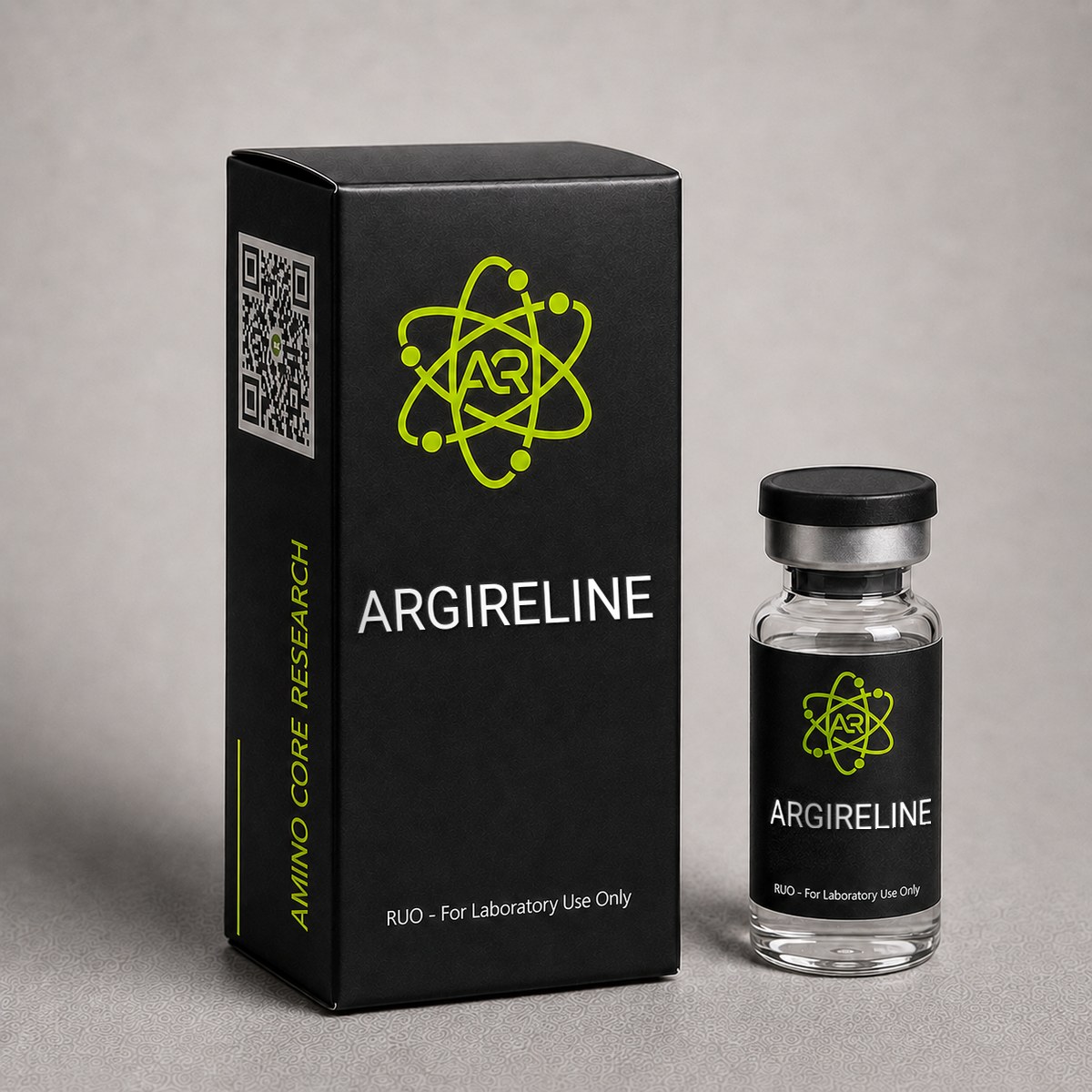
≥99%HPLC Purity
COAIncluded
USAShipped
Argireline (Acetyl Hexapeptide-3) Peptide
Acetyl hexapeptide-3 targeting the SNARE complex (SNAP-25 analog). Researched for reducing neurotransmitter release at the neuromuscular junction in cosmetic dermal studies.
Research Reference
This page is a research monograph. Argireline (Acetyl Hexapeptide-3) is documented here for reference — structure, mechanism and published literature — and is not offered for sale.
Browse compounds available for research purchase · Read the research library
Quick Facts
| SKU | ARG-001 |
|---|---|
| CAS Number | 616204-22-9 |
| Molecular Formula | C₃₄H₆₀N₁₄O₁₂S |
| Molecular Weight | 888.98 g/mol |
| Sequence | Ac-EEMQRR-NH₂ |
| Purity | ≥99% |
| Physical Form | Lyophilized Powder |
| Storage | Store at -20°C |
What is Argireline?
Argireline (Acetyl Hexapeptide-3) targets the SNARE complex by competing with SNAP-25. In clinical studies by Lipotec, a 10% Argireline solution reduced wrinkle depth by up to 30% after 30 days. It prevents synaptic vesicle docking without causing muscle atrophy.
Mechanism of Action
Argireline (acetyl hexapeptide-3, also designated acetyl hexapeptide-8 in INCI nomenclature) is a synthetic hexapeptide with the sequence Ac-Glu-Glu-Met-Gln-Arg-Arg-NH2. Its design is based on the N-terminal domain of synaptosomal-associated protein 25 (SNAP-25), a core component of the SNARE (soluble N-ethylmaleimide-sensitive factor attachment protein receptor) complex that mediates calcium-dependent exocytosis of neurotransmitter-containing vesicles at presynaptic terminals.
SNARE Complex Competitive Inhibition
The SNARE complex consists of three principal proteins: SNAP-25, syntaxin-1, and vesicle-associated membrane protein (VAMP/synaptobrevin). Assembly of these proteins into a four-helix bundle drives membrane fusion and release of acetylcholine into the synaptic cleft. Argireline is hypothesized to mimic the N-terminal region of SNAP-25 and competitively interfere with proper SNARE complex assembly. In preclinical models, this competitive interference has been associated with destabilization of the ternary SNARE complex and a reduction in catecholamine and acetylcholine release from chromaffin and neuronal cells [1].
Reduction of Neurotransmitter Release at the Neuromuscular Junction
At the neuromuscular junction, acetylcholine binding to nicotinic receptors on muscle fibers triggers contraction. In cosmetic dermatology research models, repeated contraction of facial mimetic muscles (particularly orbicularis oculi, corrugator, and frontalis) is associated with formation of dynamic expression lines. Research suggests that topical application of argireline-containing formulations may attenuate the magnitude of these contractions by reducing presynaptic acetylcholine release, in a mechanistically distinct pathway from botulinum neurotoxin type A (BoNT/A), which enzymatically cleaves SNAP-25 rather than competing with it [2].
Comparison to Botulinum Toxin Mechanism
BoNT/A is a 150 kDa zinc metalloprotease that, after internalization into the presynaptic terminal, cleaves SNAP-25 between residues Gln197 and Arg198, irreversibly disabling the SNARE complex for the lifetime of the protein (~3 months). Argireline, by contrast, is a small (888.98 Da) hexapeptide that is proposed to act via non-enzymatic, reversible competitive inhibition. This distinction is critical for research interpretation: argireline effects in dermal models are generally smaller in magnitude, slower in onset, and dependent on continuous topical application.
Secondary Pathways Under Investigation
Beyond SNARE interference, exploratory studies have examined whether argireline modulates catecholamine release in adrenal chromaffin cells and whether it influences expression of matrix metalloproteinases or collagen-related genes in fibroblast culture. These secondary mechanisms remain less well characterized but are of interest for understanding the full pharmacological profile of the peptide in dermal research contexts.
Research & Clinical Studies
Topical Efficacy Study: Wrinkle Depth Reduction in Human Volunteers
A randomized, placebo-controlled clinical study conducted by Wang et al. (2013) evaluated the cosmetic effect of argireline in Chinese female volunteers presenting with periorbital wrinkles. This trial is one of the most frequently cited references for argireline cosmetic research.
Study Design
- Subjects: 60 healthy female volunteers, age 30-60 years
- Treatment: 10% argireline-containing emulsion vs placebo emulsion
- Application: Twice daily to periorbital region
- Duration: 28 days
- Endpoints: Silicone replica analysis, optical profilometry, subject self-assessment
Key Results
- Statistically significant reduction in wrinkle depth in the argireline group versus placebo (p < 0.05)
- Wrinkle parameters (Ra, Rz, Rmax) improved by approximately 16-27% across measured indices
- No adverse cutaneous reactions reported in either group
- Subject self-assessment confirmed perceived improvement in fine line appearance
Mechanistic Interpretation
The investigators interpreted the wrinkle-depth reductions as consistent with diminished contraction amplitude of underlying mimetic musculature, in line with the SNARE-interference hypothesis. However, the authors noted that the relatively modest effect size, compared with intramuscular botulinum toxin, reflects both the peptide's reversible mechanism and the limited percutaneous penetration of a hydrophilic hexapeptide through intact stratum corneum [1].
Foundational In Vitro Data
The original characterization study by Blanes-Mira et al. (2002) demonstrated in bovine chromaffin cell culture that argireline inhibited catecholamine release in a dose-dependent manner, with effects observable at micromolar concentrations. The same study reported that in vivo topical application in a murine model resulted in attenuation of frontalis contraction relative to vehicle control. These foundational data established the rationale for subsequent dermal cosmetic research [2].
Context Within the Cosmetic Peptide Literature
Argireline is frequently compared in the literature with other neurotransmitter-modulating cosmetic peptides such as Syn-Ake (dipeptide diaminobutyroyl benzylamide diacetate, a waglerin-1 mimetic acting on nicotinic acetylcholine receptors) and pentapeptide-18 (Leuphasyl, an enkephalin analog acting on presynaptic opioid receptors). Combination formulations exploring additive or synergistic effects across these distinct pathways are an active area of investigation in cosmetic peptide research.
[1] Wang Y, Wang M, Xiao S, Pan P, Li P, Huo J. The anti-wrinkle efficacy of argireline, a synthetic hexapeptide, in Chinese subjects: a randomized, placebo-controlled study. Am J Clin Dermatol. 2013;14(2):147-153. PubMed ↗
[2] Blanes-Mira C, Clemente J, Jodas G, et al. A synthetic hexapeptide (Argireline) with antiwrinkle activity. Int J Cosmet Sci. 2002;24(5):303-310. PubMed ↗
Comparative Penetration Study: Argireline vs Botulinum Toxin Mechanism Analogy
One of the most cited investigations of acetyl hexapeptide-3 was conducted by Blanes-Mira and colleagues (2002), who first characterized the peptide's ability to mimic the N-terminal domain of SNAP-25 and competitively inhibit SNARE complex assembly in vitro. This foundational study established the biochemical rationale that later underpinned all topical cosmetic research applications of Argireline.
Study Design
The investigators synthesized the hexapeptide Ac-Glu-Glu-Met-Gln-Arg-Arg-NH2 and evaluated its ability to compete with native SNAP-25 for binding to the SNARE ternary complex (syntaxin-1A, VAMP-2, SNAP-25) using in vitro biochemical assays. Catecholamine release from bovine chromaffin cells was measured following depolarization with potassium chloride, with and without peptide pre-incubation. Topical efficacy was then assessed in a separate human cohort applying a 10% Argireline solution twice daily for 30 days, with wrinkle depth quantified by silicone replica analysis.
Key Findings
- Acetyl hexapeptide-3 inhibited catecholamine release in chromaffin cells with potency comparable to botulinum neurotoxin A in the same assay system, though through a fundamentally different (competitive, non-proteolytic) mechanism.
- The peptide destabilized the SNARE complex by occupying the SNAP-25 binding interface, preventing vesicle docking at the plasma membrane.
- Topical application produced a ~30% reduction in wrinkle depth in the periorbital region after 30 days of twice-daily application.
- No skin irritation or sensitization was observed at the tested concentration.
Mechanistic Comparison to Botulinum Toxin
While botulinum toxin A is a 150 kDa protein that enzymatically cleaves SNAP-25 to permanently disable the SNARE complex, Argireline is a small 889 Da peptide that reversibly competes for the same binding region. This distinction is mechanistically important: Argireline produces a transient, dose-dependent attenuation of SNARE assembly rather than irreversible proteolysis. The clinical implication, supported by subsequent topical research, is a milder cosmetic effect with no risk of neuromuscular paralysis, which makes the peptide attractive for non-injectable formulations.
Context and Significance
This study provided the first proof-of-concept that a short synthetic peptide could mimic the regulatory domain of SNAP-25 with biologically meaningful potency. It has since been cited in over 200 follow-up publications spanning cosmetic chemistry, neurobiology, and peptide drug delivery. The work also established the standard 10% topical concentration that became the de facto benchmark for subsequent Argireline cosmetic studies.
[1] Blanes-Mira C, Clemente J, Jodas G, et al. A synthetic hexapeptide (Argireline) with antiwrinkle activity. Int J Cosmet Sci. 2002;24(5):303-310. PubMed ↗
Composition & Components
AminoCore Research supplies Argireline as the single-active hexapeptide acetyl hexapeptide-3 (INCI: acetyl hexapeptide-8) at research-grade purity. Although argireline is frequently incorporated into multi-ingredient cosmetic formulations alongside complementary peptides, the AminoCore product specification refers to the isolated peptide itself. The table below documents the principal component and commonly co-formulated reference peptides researchers may encounter in the cosmetic peptide literature.
| Component | Role / Target | Molecular Weight | CAS Number |
|---|---|---|---|
| Acetyl Hexapeptide-3 (Argireline) Ac-Glu-Glu-Met-Gln-Arg-Arg-NH2 | SNAP-25 N-terminal mimic; competitive SNARE complex inhibitor | 888.98 g/mol | 616204-22-9 |
| Commonly Referenced Co-Formulated Peptides (not included in this product) | |||
| Pentapeptide-18 (Leuphasyl) Tyr-D-Ala-Gly-Phe-Leu | Enkephalin analog; presynaptic opioid receptor modulator | 568.66 g/mol | 64963-01-5 |
| Dipeptide Diaminobutyroyl Benzylamide Diacetate (Syn-Ake) | Waglerin-1 mimetic; nicotinic acetylcholine receptor antagonist | ~434 g/mol (base) | 823202-99-9 |
| Palmitoyl Pentapeptide-4 (Matrixyl) Pal-KTTKS | Collagen synthesis stimulator (TGF-β pathway) | 802.06 g/mol | 214047-00-4 |
| Palmitoyl Tripeptide-1 (pal-GHK) | Collagen and glycosaminoglycan synthesis | 578.83 g/mol | 147732-56-7 |
Physical & Analytical Specifications (Argireline Active)
| Field | Value |
|---|---|
| Full Name | Acetyl Hexapeptide-3 / Acetyl Hexapeptide-8 |
| Synonyms | Argireline, SNAP-8 precursor, Ac-EEMQRR-NH2 |
| Molecular Formula | C34H60N14O12S |
| Molecular Weight | 888.98 g/mol |
| CAS Number | 616204-22-9 |
| Sequence | Ac-Glu-Glu-Met-Gln-Arg-Arg-NH2 (N-acetylated, C-terminal amide) |
| Amino Acid Count | 6 |
| Key Modifications | N-terminal acetylation; C-terminal amidation |
| Origin / Developer | Lipotec S.A. (Spain), early 2000s |
| Physical Form | Lyophilized white to off-white powder |
| Solubility | Soluble in water and aqueous buffers; hydrophilic |
| Purity | ≥99% (HPLC) |
Note on methionine: The internal methionine residue at position 3 makes argireline potentially susceptible to oxidation. Formulations and reconstituted stocks should be protected from prolonged exposure to atmospheric oxygen and strong oxidants to maintain peptide integrity during research use.
Handling & Reconstitution Guidelines
Argireline (acetyl hexapeptide-3) is supplied as a lyophilized white powder and is highly water-soluble due to its short length and polar arginine/glutamate residues. Unlike larger peptides, Argireline is relatively robust in solution but should still be handled under careful temperature and pH control to preserve N-terminal acetylation and the C-terminal amide.
Recommended Reconstitution Protocol
- Allow the lyophilized vial to equilibrate to room temperature for 20-30 minutes before opening. This prevents condensation of atmospheric moisture inside the vial.
- Centrifuge the closed vial briefly (or tap firmly) to ensure all powder settles at the bottom.
- Slowly add the chosen solvent down the inside wall of the vial. Bacteriostatic water, sterile water for injection, or deionized water are all suitable. For topical research formulations, a propylene glycol/water mixture (30:70) is commonly used to mimic cosmetic vehicles.
- Do not inject solvent directly onto the powder cake.
- Gently swirl the vial — do not shake or vortex. Swirl for 30-60 seconds until fully dissolved.
- The solution should appear clear and colorless. Any cloudiness suggests precipitation or contamination.
Concentration Calculation
A typical research stock concentration is 10 mg/mL (e.g., 50 mg powder reconstituted in 5 mL solvent). This matches the 10% w/v concentration used in the majority of published topical efficacy studies. For lower-concentration screening assays, dilute the 10 mg/mL stock with sterile aqueous buffer immediately before use.
Compound-Specific Notes
- The methionine residue is susceptible to oxidation. Avoid prolonged exposure to atmospheric oxygen, hydrogen peroxide, or strong oxidizing co-formulants.
- The C-terminal amide and N-terminal acetyl group are stable across pH 4-7. Avoid strongly basic conditions (pH > 9), which can promote deamidation of glutamine.
- Argireline is non-chiral-sensitive in handling but should be protected from prolonged direct light.
- Use polypropylene or low-binding tubes for dilutions to minimize peptide adsorption to plasticware.
All reconstitution and dilution work should be performed under aseptic conditions in a clean laboratory setting. This material is intended strictly for in vitro research and is not for human or veterinary use.
Storage & Stability Information
Argireline (acetyl hexapeptide-3) exhibits good chemical stability relative to many longer peptides, primarily due to its short sequence, N-terminal acetylation, and C-terminal amidation. These end-group modifications protect against exopeptidase degradation and reduce the risk of N-terminal cyclization. Nonetheless, proper storage is essential for preserving research-grade integrity across the product's shelf life.
Lyophilized Powder Storage
- Long-term storage: -20°C in a sealed, desiccated container. Under these conditions, the lyophilized peptide is stable for at least 24 months with negligible degradation.
- Short-term storage (up to 4 weeks): 2-8°C in the original sealed vial. Acceptable for active research use.
- Transit / room temperature: Stable for 1-2 weeks at ambient temperature during shipping, provided the vial remains sealed and protected from light and humidity.
Reconstituted Solution Storage
- 2-8°C: Stable for up to 14 days in sterile aqueous solution.
- -20°C: Stable for up to 3 months. Aliquot before freezing to minimize freeze-thaw cycles.
- Freeze-thaw cycles: Limit to no more than 3-5 cycles. Each cycle introduces minor degradation through ice-crystal-induced denaturation and oxidation.
Compound-Specific Stability Notes
- Methionine oxidation: The single methionine residue is the most vulnerable site. Storage under inert atmosphere (argon or nitrogen) for long-term archival samples is recommended where feasible.
- Light sensitivity: Use amber vials or store in the dark to prevent UV-induced oxidative damage.
- Hygroscopicity: The lyophilized powder is mildly hygroscopic. Always re-seal vials promptly and store with desiccant.
- pH stability: Most stable at pH 5-7. Avoid prolonged storage at extreme pH.
For best reproducibility across research replicates, prepare working aliquots immediately after reconstitution and store frozen until the day of use.
Frequently Asked Questions
How effective is Argireline vs Botox?
Argireline reduces wrinkle depth by ~30% topically vs ~80% for injectable Botox. Argireline is non-invasive, reversible within hours, and acts at the SNARE level while Botox cleaves SNAP-25 irreversibly for 3-6 months.
What is Argireline (acetyl hexapeptide-3)?
Argireline is a synthetic hexapeptide with the sequence Ac-Glu-Glu-Met-Gln-Arg-Arg-NH2, molecular weight 888.98 g/mol, and CAS number 616204-22-9. It was developed by Lipotec in the early 2000s and is structurally modeled on the N-terminal region of SNAP-25, a component of the SNARE complex involved in synaptic vesicle fusion. In cosmetic peptide research, argireline is studied for its proposed ability to competitively interfere with SNARE complex assembly and reduce acetylcholine release at the neuromuscular junction. It is widely used in topical formulation studies investigating attenuation of dynamic expression lines.
What is the molecular weight and CAS number of Argireline?
Argireline (acetyl hexapeptide-3) has a molecular formula of C34H60N14O12S, a molecular weight of 888.98 g/mol, and CAS Registry Number 616204-22-9. Its full sequence is Ac-Glu-Glu-Met-Gln-Arg-Arg-NH2, comprising six amino acids with an N-terminal acetyl group and a C-terminal amide. The peptide is hydrophilic, freely soluble in water and aqueous buffers, and supplied by AminoCore Research as a lyophilized powder at ≥99% HPLC purity for cosmetic peptide research applications.
How should Argireline be stored and reconstituted?
Lyophilized Argireline should be stored at -20°C for long-term stability and protected from light, moisture, and atmospheric oxygen due to the oxidation-sensitive methionine residue at position 3. For reconstitution, bacteriostatic water or sterile water for injection is typically used at a concentration of 1-10 mg/mL for research stock solutions. The vial should be allowed to reach room temperature before opening, and solvent should be added gently down the inner wall — never directly onto the lyophilized cake — to minimize foaming. Avoid vortexing; gentle swirling preserves peptide integrity. Reconstituted stocks should be stored at 2-8°C and used within 7-14 days.
How does Argireline compare to botulinum toxin (Botox)?
Argireline and botulinum toxin type A (BoNT/A) both target the SNARE complex but through fundamentally different mechanisms. BoNT/A is a 150 kDa zinc metalloprotease that enzymatically cleaves SNAP-25 at the Gln197-Arg198 bond, irreversibly disabling neurotransmitter release for the lifetime of the cleaved protein (approximately 3 months). Argireline, in contrast, is a small 888.98 Da hexapeptide proposed to act as a reversible competitive inhibitor of SNARE complex assembly by mimicking the SNAP-25 N-terminus. As a result, research models show argireline produces smaller-magnitude, slower-onset effects that depend on continuous topical application, whereas BoNT/A is administered intramuscularly and produces pronounced, long-lasting effects.
Does Argireline really work topically given its molecular size?
Argireline has a molecular weight of approximately 889 Da, which places it near the upper boundary of peptides considered capable of crossing the stratum corneum, though penetration efficiency is modest. Published topical studies using 10% w/v formulations have reported wrinkle depth reductions of approximately 17-30% after 28-30 days of twice-daily application. Penetration is enhanced when the peptide is delivered in vehicles containing propylene glycol, liposomes, or other dermal carriers. AminoCore Research supplies Argireline in lyophilized form for in vitro and ex vivo research; transdermal delivery efficiency depends entirely on the formulation vehicle used by the researcher.
What is the recommended research concentration for Argireline?
The benchmark concentration in the published literature is 10% w/v (100 mg/mL) for topical cosmetic efficacy studies, established by Blanes-Mira et al. in 2002 and replicated in subsequent investigations. For in vitro mechanistic studies of SNARE complex inhibition, concentrations in the micromolar to low millimolar range are typical. AminoCore Research recommends preparing a 10 mg/mL stock solution in sterile aqueous buffer and diluting as required. All concentrations should be selected based on the specific research endpoint and validated assay protocol.
Is Argireline stable in cosmetic formulation vehicles?
Argireline shows good stability in aqueous and mildly hydrophilic vehicles at pH 5-7, which encompasses most cosmetic emulsion systems. The N-terminal acetylation and C-terminal amidation protect against exopeptidase attack and N-terminal cyclization. The primary stability concern in formulation research is oxidation of the methionine residue, which can be mitigated by including antioxidants such as tocopherol or ascorbic acid derivatives. Strongly alkaline vehicles (pH > 9) and formulations containing peroxides should be avoided in stability studies.
What sizes of Argireline are available from AminoCore Research?
AminoCore Research offers Argireline (acetyl hexapeptide-3) in standard research quantities, typically 50 mg and 100 mg lyophilized vials at ≥99% HPLC purity. Each lot is accompanied by a Certificate of Analysis documenting peptide identity, purity, and mass spectrometry confirmation. Larger bulk quantities may be available on request for formulation development and high-throughput screening programs. All material is supplied strictly for in vitro laboratory research and is not intended for human, veterinary, or clinical use.
For laboratory and research use only. This product is not for human or veterinary use. It is not a drug, supplement or food.
This product is not FDA approved for any indication, and is not intended to diagnose, treat, cure, or prevent any disease. All product information is derived from published preclinical research and does not constitute medical advice or claims.