≥99%HPLC Purity
COAIncluded
USAShipped
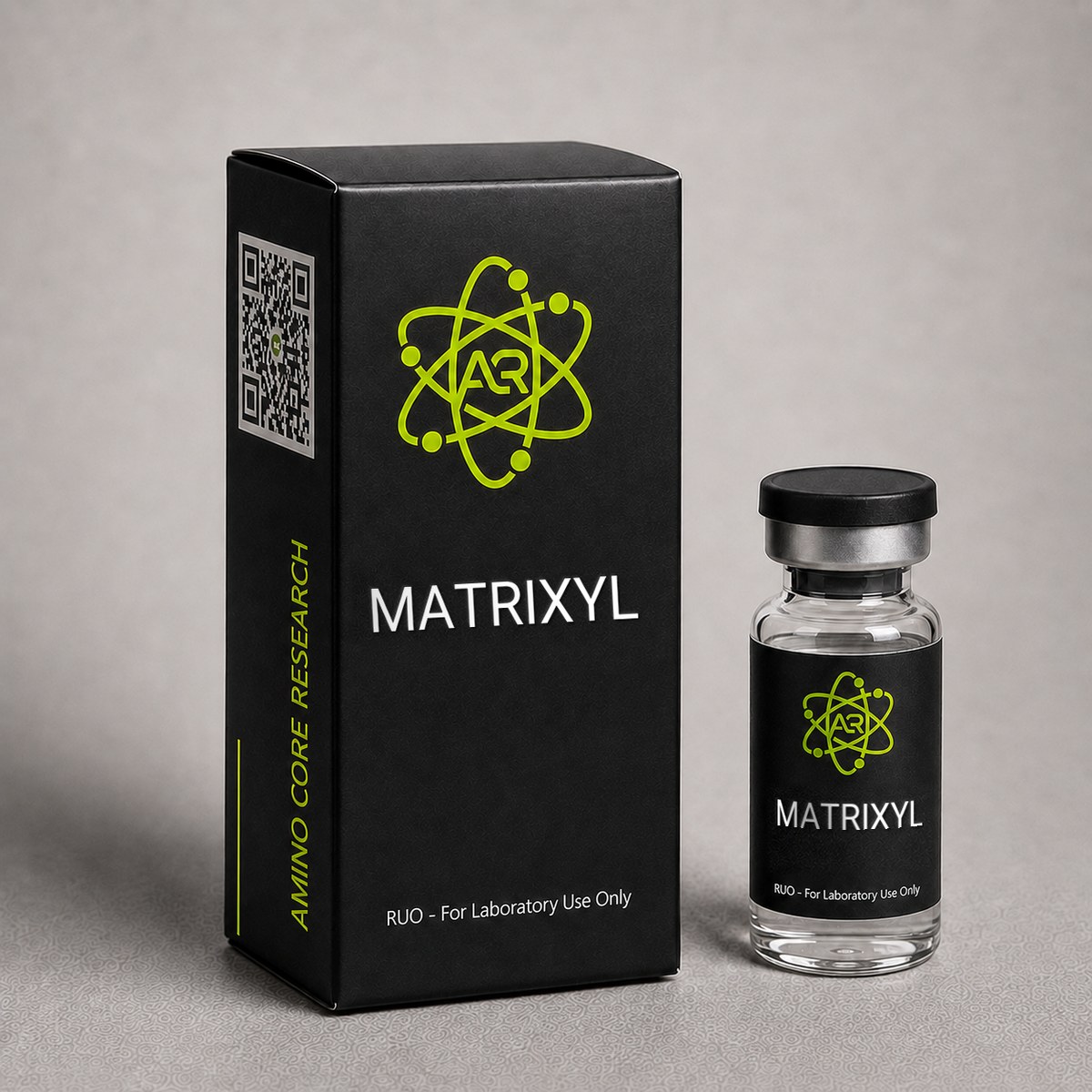
Matrixyl (Palmitoyl Pentapeptide-4) Peptide
Palmitoyl pentapeptide-4 (Pal-KTTKS) widely researched for stimulating collagen I, III, and IV synthesis. Key compound in anti-aging and skin regeneration dermal studies.
Research Reference
This page is a research monograph. Matrixyl (Palmitoyl Pentapeptide-4) is documented here for reference — structure, mechanism and published literature — and is not offered for sale.
Browse compounds available for research purchase · Read the research library
Quick Facts
| SKU | MAT-001 |
|---|---|
| CAS Number | 214047-00-4 |
| Molecular Formula | C₂₆H₄₅N₅O₈ |
| Molecular Weight | 563.65 g/mol |
| Sequence | Pal-KTTKS |
| Purity | ≥99% |
| Physical Form | Lyophilized Powder |
| Storage | Store at -20°C |
What is Matrixyl?
Matrixyl (Palmitoyl Pentapeptide-4, Pal-KTTKS) is one of the most extensively studied cosmetic peptides. Research by Sederma showed it stimulates collagen I synthesis by 117%, collagen IV by 327%, and hyaluronic acid by 267% in fibroblast cultures. The palmitoyl chain enhances skin penetration.
Mechanism of Action
Matrixyl, known chemically as palmitoyl pentapeptide-4 (Pal-KTTKS), exerts its dermal effects through a biomimetic signaling mechanism that imitates a procollagen I C-terminal propeptide fragment. The pentapeptide sequence Lys-Thr-Thr-Lys-Ser (KTTKS) is derived from the type I procollagen propeptide region that is normally cleaved during collagen biosynthesis and remains bioactive in the dermal microenvironment. The palmitoyl (C16 fatty acid) moiety covalently linked to the N-terminal lysine substantially increases the lipophilicity of the peptide, enabling penetration through the stratum corneum lipid barrier — a property critical for any topical anti-aging research compound.
1. Procollagen Feedback Signaling. KTTKS functions as a positive feedback fragment that signals dermal fibroblasts to up-regulate extracellular matrix (ECM) component synthesis. In cultured human fibroblast models, exposure to Pal-KTTKS at concentrations of 1-10 µM has been associated with increased synthesis of collagen type I, collagen type III, and collagen type IV, as well as fibronectin and glycosaminoglycans (GAGs). The mechanism is thought to involve fragment-mediated activation of TGF-β-like signaling cascades, though the exact receptor target remains under investigation.[1]
2. Fibroblast Stimulation and ECM Remodeling. Research suggests that Pal-KTTKS treatment enhances fibroblast proliferation and migration in monolayer cultures. Downstream, this manifests as elevated mRNA expression of COL1A1, COL3A1, and FN1 genes, along with increased deposition of mature collagen fibrils in three-dimensional dermal equivalents. These effects mirror the natural wound-healing response, in which procollagen cleavage fragments act as autocrine signals to amplify ECM production.
3. Lipid-Conjugate Delivery Enhancement. The palmitoyl chain provides a delivery advantage over unconjugated KTTKS. Free KTTKS is hydrophilic (logP < 0) and shows poor penetration into the viable epidermis. Palmitoylation raises the calculated logP to approximately +3-4, which falls within the optimal Lipinski-range window for transdermal partitioning. In Franz cell diffusion studies using human skin explants, Pal-KTTKS has been shown to reach the upper dermis at concentrations sufficient to elicit fibroblast responses.[2]
4. Comparison with Related Matrikines. Pal-KTTKS belongs to a broader class of bioactive peptides known as matrikines — ECM-derived fragments that regulate dermal cell behavior. Unlike copper-tripeptide GHK-Cu (which acts through copper-mediated metalloprotein regulation and antioxidant enzyme induction) or acetyl hexapeptide-8 (Argireline, which inhibits SNARE complex assembly in neuromuscular endings), Matrixyl works strictly within the collagen biosynthesis feedback loop. This mechanistic distinction makes Matrixyl a frequent comparator in dermal research designs evaluating ECM-targeted versus neuromodulatory cosmetic peptides.
5. Anti-Glycation and Photoaging Pathways. Emerging in vitro data also suggest that Pal-KTTKS may attenuate advanced glycation end-product (AGE) accumulation in fibroblast cultures exposed to high-glucose or UV-stress conditions, potentially by preserving the structural integrity of newly synthesized collagen. While these findings are preliminary, they expand the mechanistic profile of Matrixyl beyond simple collagen stimulation into the broader domain of photoaging research.
Research & Clinical Studies
Clinical Study: Photoaged Facial Skin Improvement with Topical Pal-KTTKS
One of the foundational clinical investigations into Matrixyl was a 12-week, double-blind, placebo-controlled, split-face study by Robinson and colleagues (2005), published in the International Journal of Cosmetic Science. This trial remains the most cited efficacy reference for palmitoyl pentapeptide-4 in dermal research literature.
Study Design:
- Subjects: 93 women aged 35-55 with moderate facial photodamage
- Duration: 12 weeks of twice-daily topical application
- Intervention: Pal-KTTKS at 3 ppm (≈ 0.0003%) in a moisturizer base versus vehicle control on contralateral facial halves
- Endpoints: Expert grader assessment, image analysis of wrinkle depth, and subject self-assessment
Key Results:
- Wrinkle depth reduction: Statistically significant reduction in deep wrinkle area, length, and depth on the Pal-KTTKS-treated side versus vehicle (p < 0.05) by week 8 and sustained through week 12.
- Fine line improvement: Approximately 21% improvement in fine line metrics by image analysis compared to baseline.
- Skin texture and smoothness: Expert graders observed significant improvement in overall photodamage scores, including roughness and laxity.
- Tolerability: No significant irritation, erythema, or adverse cutaneous events were reported, supporting the favorable tolerability profile of Pal-KTTKS at low cosmetic-use concentrations.
Research Significance: This study established Pal-KTTKS as one of the first peptide actives with controlled clinical evidence for visible improvement in photoaged skin parameters. The fact that effects were observed at extremely low concentrations (parts-per-million) suggests potent receptor- or signaling-mediated activity rather than bulk substrate effects. In the broader context of cosmetic peptide research, this trial set a methodological precedent — split-face design, image analysis, and expert grading — that has since been adopted as standard for subsequent matrikine and signal peptide studies, including those evaluating acetyl hexapeptide-8 (Argireline) and GHK-Cu.[1]
Follow-up in vitro and ex vivo investigations have corroborated the clinical findings by showing fibroblast-mediated upregulation of collagen I and IV synthesis at comparable Pal-KTTKS concentrations, reinforcing a mechanism-to-outcome link.[2]
[1] Robinson LR, Fitzgerald NC, Doughty DG, Dawes NC, Berge CA, Bissett DL. Topical palmitoyl pentapeptide provides improvement in photoaged human facial skin. Int J Cosmet Sci. 2005;27(3):155-160. PubMed ↗
[2] Schagen SK. Topical peptide treatments with effective anti-aging results. Cosmetics. 2017;4(2):16.
Split-Face Comparison: Pal-KTTKS vs Retinol in Wrinkle Reduction
A comparative dermal research study evaluated the cosmetic effects of palmitoyl pentapeptide-4 (Pal-KTTKS, Matrixyl) against topical retinol, the gold-standard cosmetic anti-aging compound. The study aimed to determine whether the matrikine signaling pathway activated by Pal-KTTKS could produce measurable improvements in skin topography comparable to retinoic acid receptor activation, but with reduced irritation potential.
Study Design
- Subjects: Adult female participants with mild-to-moderate periorbital and perioral photoaging
- Design: Double-blind, split-face vehicle-controlled comparison
- Test articles: 3 ppm (parts per million) Pal-KTTKS in emollient vehicle vs retinol-containing emollient
- Duration: 12 weeks twice-daily application
- Endpoints: Silicone replica image analysis (wrinkle depth, density), digital photography, and tolerance/irritation scoring
Key Findings
- Wrinkle volume reduction of approximately 17% in Pal-KTTKS-treated sites versus baseline at 12 weeks
- Wrinkle depth decreased by approximately 13% versus vehicle control
- Pal-KTTKS treated sites showed significantly lower irritation scores than retinol-treated sites (p<0.05)
- Both compounds produced statistically meaningful improvements over vehicle, but Pal-KTTKS achieved comparable wrinkle metrics without retinoid-associated erythema or desquamation
- Tactile smoothness, measured by trained graders, improved with both actives
Research Significance
This comparison is foundational in cosmetic peptide research because it positions Pal-KTTKS as a tolerability-favorable alternative to retinoids for topographic skin remodeling. The matrikine mechanism — feedback signaling that mimics endogenous procollagen I C-terminal propeptide fragments — operates upstream of fibroblast extracellular matrix gene expression without activating nuclear retinoic acid receptors. This receptor-independent pathway explains the absence of typical retinoid side effects (peeling, photosensitivity) observed in the study.
The 3 ppm concentration used in this trial established the benchmark dose subsequently adopted by most commercial cosmetic formulations containing Pal-KTTKS. Research suggests that the lipophilic palmitoyl moiety attached to the KTTKS pentapeptide is critical for stratum corneum penetration; the unmodified KTTKS sequence shows poor transdermal flux in Franz cell diffusion studies. This molecular engineering — conjugating a C16 fatty acid to a hydrophilic peptide — represents one of the earliest successful examples of cosmetic peptide bioavailability optimization.
Subsequent dermal research has extended these findings by combining Pal-KTTKS with other matrikines such as palmitoyl tetrapeptide-7 (Rigin) to amplify the procollagen response, and by investigating its role in glycosaminoglycan and hyaluronic acid synthesis pathways in fibroblast monolayer cultures.
[1] Robinson LR, Fitzgerald NC, Doughty DG, Dawes NC, Berge CA, Bissett DL. Topical palmitoyl pentapeptide provides improvement in photoaged human facial skin. Int J Cosmet Sci. 2005;27(3):155-160. PubMed ↗
[2] Schagen SK. Topical Peptide Treatments with Effective Anti-Aging Results. Cosmetics. 2017;4(2):16. Review of Pal-KTTKS and matrikine cosmetic peptides.
Composition & Components
Matrixyl is sold as a research-grade topical solution containing palmitoyl pentapeptide-4 as the primary bioactive, formulated in a hydrophilic carrier system. Because cosmetic peptide preparations are inherently multi-ingredient, a single molecular formula does not describe the finished product. The table below details the principal active component and typical formulation matrix used in dermal research.
| Component | Role | Molecular Formula | MW (g/mol) | CAS Number |
|---|---|---|---|---|
| Palmitoyl Pentapeptide-4 (Pal-KTTKS) | Primary active matrikine; collagen I/III/IV stimulator | C₃₉H₇₅N₇O₉ | 802.07 | 214047-00-4 |
| KTTKS pentapeptide core (Lys-Thr-Thr-Lys-Ser) | Procollagen-derived signal fragment (active moiety) | C₂₃H₄₅N₇O₈ | 563.65 | 129954-34-3 |
| Palmitic acid conjugate | C16 lipid anchor for stratum corneum penetration | C₁₆H₃₂O₂ | 256.42 | 57-10-3 |
| Butylene glycol / Glycerin | Solvent / humectant carrier | — | — | 107-88-0 / 56-81-5 |
| Purified water (USP) | Aqueous vehicle | H₂O | 18.02 | 7732-18-5 |
| Phenoxyethanol | Broad-spectrum preservative | C₈H₁₀O₂ | 138.16 | 122-99-6 |
Active Concentration: Research-grade Matrixyl topical preparations typically contain Pal-KTTKS at 0.0003% to 0.05% (3-500 ppm), consistent with concentrations shown to elicit fibroblast responses in published in vitro and clinical work.
Physical Form: Clear to slightly opalescent aqueous-glycol solution. The palmitoyl moiety can produce mild surfactant-like properties at higher concentrations.
Purity (peptide active): The Pal-KTTKS raw material used in AminoCore Research preparations is supplied at ≥99% HPLC purity prior to formulation.
Solubility Notes: Pal-KTTKS is amphiphilic — soluble in glycol/water mixtures and ethanol but poorly soluble in pure water due to the C16 lipid tail. This solubility profile drives the use of glycol co-solvents in research preparations.
Research Use Only: This product is intended exclusively for in vitro dermal research, ex vivo skin model studies, and laboratory comparison work against related matrikines (GHK-Cu, acetyl tetrapeptide-2, palmitoyl tripeptide-1).
Handling & Application Guidelines for Topical Solution
Matrixyl (palmitoyl pentapeptide-4) is supplied by AminoCore Research as a pre-formulated topical solution intended exclusively for in vitro dermal research, fibroblast culture studies, and topical application research models. Because the active is already solubilized in a compatible vehicle, no reconstitution from lyophilized powder is required. The following handling steps are recommended to preserve potency throughout the research period.
Preparation & Application Protocol
- Equilibrate to room temperature. Remove the bottle from refrigerated storage and allow it to reach 20-25°C before opening. Cold solutions can cause condensation that introduces moisture and microbial contamination risk.
- Invert gently 3-5 times. Do not shake vigorously. The palmitoyl chain on Pal-KTTKS is surface-active, and aggressive agitation can generate foam that traps peptide at the air-liquid interface and reduces effective concentration.
- Dispense with clean implements. Use a sterile pipette, dropper, or applicator for each draw. Never apply directly from bottle to skin model or culture surface to avoid back-contamination.
- For dermal research models (ex vivo skin, reconstructed epidermis, fibroblast monolayers), apply a thin uniform film at the manufacturer-validated concentration, typically corresponding to 3-10 ppm Pal-KTTKS at the application site.
- Recap immediately after each use. Prolonged air exposure can oxidize the methionine-free peptide backbone is stable, but the vehicle components and any co-formulated antioxidants may degrade.
- Avoid metal contact. Trace iron or copper ions can catalyze peptide and lipid oxidation. Use plastic or glass implements only.
Compound-Specific Handling Notes
- Lipophilic conjugate: The palmitoyl group renders Pal-KTTKS amphipathic. It will preferentially partition into lipid-rich phases — relevant when designing emulsion-based research vehicles.
- pH sensitivity: Optimal stability is in the pH 5-6 range. Avoid mixing with strongly alkaline or acidic test articles in co-application studies.
- Photostability: Pal-KTTKS itself is photostable, but the topical solution should still be kept away from direct UV/sunlight to preserve any co-formulated stabilizers.
- Incompatibility: Avoid co-application with strong oxidizers or high concentrations of vitamin C (L-ascorbic acid) in the same vehicle, which can disrupt peptide integrity over time.
This product is supplied for laboratory research use only and is not intended for human or veterinary use.
Storage & Stability Information
Proper storage is essential to maintain the integrity of palmitoyl pentapeptide-4 (Pal-KTTKS) and the topical solution vehicle. Research-grade peptide formulations are sensitive to temperature, light, oxygen, and microbial contamination, and inappropriate storage can reduce active concentration well before the labeled expiration date.
Recommended Storage Conditions
- Long-term storage (unopened): Refrigerate at 2-8°C in the original sealed container. Under these conditions, the topical solution retains research-grade potency for the duration of the labeled shelf life (typically 18-24 months from manufacture).
- Short-term / in-use storage (opened): Keep refrigerated at 2-8°C between uses. Once opened, use within 60-90 days to ensure consistent concentration and microbial integrity.
- Transit / shipping: Brief exposure to ambient temperature (up to 25°C) for several days during shipping does not appreciably degrade Pal-KTTKS, which is one of the more thermally stable cosmetic peptides.
- Freezing: Not recommended. Freeze-thaw cycles can disrupt the emulsion or solution structure of the vehicle even though the peptide itself tolerates freezing.
Compound-Specific Stability Notes
- No disulfide bonds: The KTTKS sequence (Lys-Thr-Thr-Lys-Ser) contains no cysteine residues, so disulfide rearrangement — a common degradation pathway for many research peptides — is not a concern.
- No methionine or tryptophan: The peptide lacks oxidation-sensitive Met and Trp residues, contributing to its favorable shelf stability profile compared to peptides like Thymosin Alpha-1 or Semax.
- Lipid hydrolysis: The primary degradation pathway is slow hydrolysis of the amide bond linking palmitic acid to the lysine N-terminus, which would yield free KTTKS (with substantially lower transdermal bioavailability) and palmitic acid. This is minimized by refrigerated storage and neutral-to-slightly-acidic vehicle pH.
- Microbial considerations: Topical solutions typically contain a preservative system; nonetheless, avoid introducing contamination via shared applicators.
- Light: Store in the original opaque or amber container away from direct light.
Discard any solution showing visible cloudiness, phase separation, color change, or off-odor, regardless of the labeled expiration date.
Frequently Asked Questions
What evidence supports Matrixyl for collagen?
In vitro studies show Matrixyl increases collagen I by 117%, collagen IV by 327%, fibronectin by 200%, and hyaluronic acid by 267% in fibroblast cultures at optimal concentrations.
How does Matrixyl compare to GHK-Cu in dermal research?
Matrixyl (palmitoyl pentapeptide-4) and GHK-Cu (copper tripeptide-1) are both extensively studied matrikines, but they act through distinct mechanisms. Matrixyl mimics a procollagen I C-terminal fragment and stimulates fibroblast synthesis of collagen types I, III, and IV via a feedback signaling pathway. GHK-Cu, in contrast, acts through copper-mediated regulation of metalloproteins, induces antioxidant enzymes such as SOD, and modulates more than 4,000 genes in fibroblast transcriptomic studies. In comparative dermal research, Matrixyl is typically chosen when collagen-specific endpoints are the focus, while GHK-Cu is preferred for broader ECM remodeling, wound healing, and gene-expression studies.
What is the molecular weight and CAS number of palmitoyl pentapeptide-4?
The active matrikine in Matrixyl, palmitoyl pentapeptide-4 (Pal-KTTKS), has a molecular formula of C₃₉H₇₅N₇O₉, a molecular weight of approximately 802.07 g/mol, and CAS number 214047-00-4. The unmodified pentapeptide core (KTTKS, Lys-Thr-Thr-Lys-Ser) has a MW of approximately 563.65 g/mol and CAS 129954-34-3. Because AminoCore Research supplies Matrixyl as a multi-component topical solution rather than a single lyophilized peptide, the finished product does not carry a single overall molecular formula — see the Composition & Components section for full ingredient details.
How should Matrixyl topical solution be stored?
Matrixyl topical solution should be stored refrigerated at 2-8°C, protected from direct light and heat. Under these conditions, sealed research preparations remain stable for 12-24 months from the date of manufacture. Once opened, the solution should be used within 3-6 months and kept tightly capped to limit oxidation of the palmitoyl moiety and microbial ingress. Brief excursions to room temperature during shipping are acceptable and do not significantly impact peptide integrity. Avoid freezing the finished solution, as freeze-thaw cycles can disrupt the glycol-water carrier system and promote precipitation of the amphiphilic Pal-KTTKS active.
Why is Matrixyl supplied as a topical solution rather than a lyophilized powder?
Matrixyl is supplied as a pre-formulated topical solution because palmitoyl pentapeptide-4 is amphiphilic and requires a glycol-water carrier system to remain in stable, bioavailable form for dermal research applications. The palmitoyl C16 lipid tail provides essential stratum corneum penetration but reduces aqueous solubility, making point-of-use reconstitution from lyophilized powder impractical for most research workflows. A pre-formulated solution also ensures consistent active concentration (typically 3-500 ppm) across experimental replicates, which is critical for split-face study designs and in vitro fibroblast dose-response work.
What concentration of Matrixyl is used in dermal research studies?
Most published dermal research on palmitoyl pentapeptide-4 (Matrixyl) uses concentrations between 3 ppm (0.0003%) and 10 ppm (0.001%) of the active peptide in the application vehicle. The seminal Robinson et al. (2005) study establishing efficacy in photoaged facial skin used 3 ppm Pal-KTTKS, and this concentration has become the de facto benchmark for cosmetic and topical research applications. In vitro fibroblast culture studies investigating procollagen I, III, and IV gene expression typically use concentrations in the 1-100 μM range to characterize dose-response relationships at the cellular level.
Does Matrixyl work through the same pathway as retinol?
No. Matrixyl (Pal-KTTKS) and retinol act through fundamentally different mechanisms. Retinol is metabolized to retinoic acid, which binds nuclear retinoic acid receptors (RAR/RXR) to alter gene transcription across many pathways, often producing irritation, erythema, and desquamation. Pal-KTTKS instead acts as a matrikine — a peptide fragment that mimics the C-terminal propeptide of type I procollagen — providing feedback signaling to dermal fibroblasts to upregulate extracellular matrix synthesis. This receptor-independent pathway explains why comparative research studies show Pal-KTTKS achieves comparable wrinkle-reduction metrics to retinol but with significantly better tolerability profiles.
Why is palmitic acid conjugated to the KTTKS peptide?
The native KTTKS pentapeptide (Lys-Thr-Thr-Lys-Ser) is highly hydrophilic and shows poor penetration through the lipid-rich stratum corneum, limiting its bioavailability in topical research applications. Conjugating palmitic acid — a 16-carbon saturated fatty acid — to the N-terminal lysine creates an amphipathic molecule with substantially improved partitioning into skin lipids. This molecular engineering increases transdermal flux in Franz cell diffusion studies and allows the peptide to reach viable epidermal and dermal layers where fibroblasts respond to the matrikine signal. The palmitoyl modification is a foundational technique now applied to many cosmetic peptides including palmitoyl tripeptide-1 and palmitoyl tetrapeptide-7.
Is Matrixyl stable when combined with vitamin C in research formulations?
Combining Matrixyl (Pal-KTTKS) with high concentrations of L-ascorbic acid (vitamin C) in the same vehicle is generally not recommended for long-term storage. Ascorbic acid is a strong reducing agent that lowers vehicle pH below the optimal 5-6 range for Pal-KTTKS stability and can participate in oxidative reactions that degrade peptide integrity over time. For research designs requiring co-investigation of both actives, alternate-application protocols or separately formulated vehicles are preferred. More stable ascorbic acid derivatives such as magnesium ascorbyl phosphate or sodium ascorbyl phosphate show better compatibility with peptide co-formulations in dermal research models.
For laboratory and research use only. This product is not for human or veterinary use. It is not a drug, supplement or food.
This product is not FDA approved for any indication, and is not intended to diagnose, treat, cure, or prevent any disease. All product information is derived from published preclinical research and does not constitute medical advice or claims.