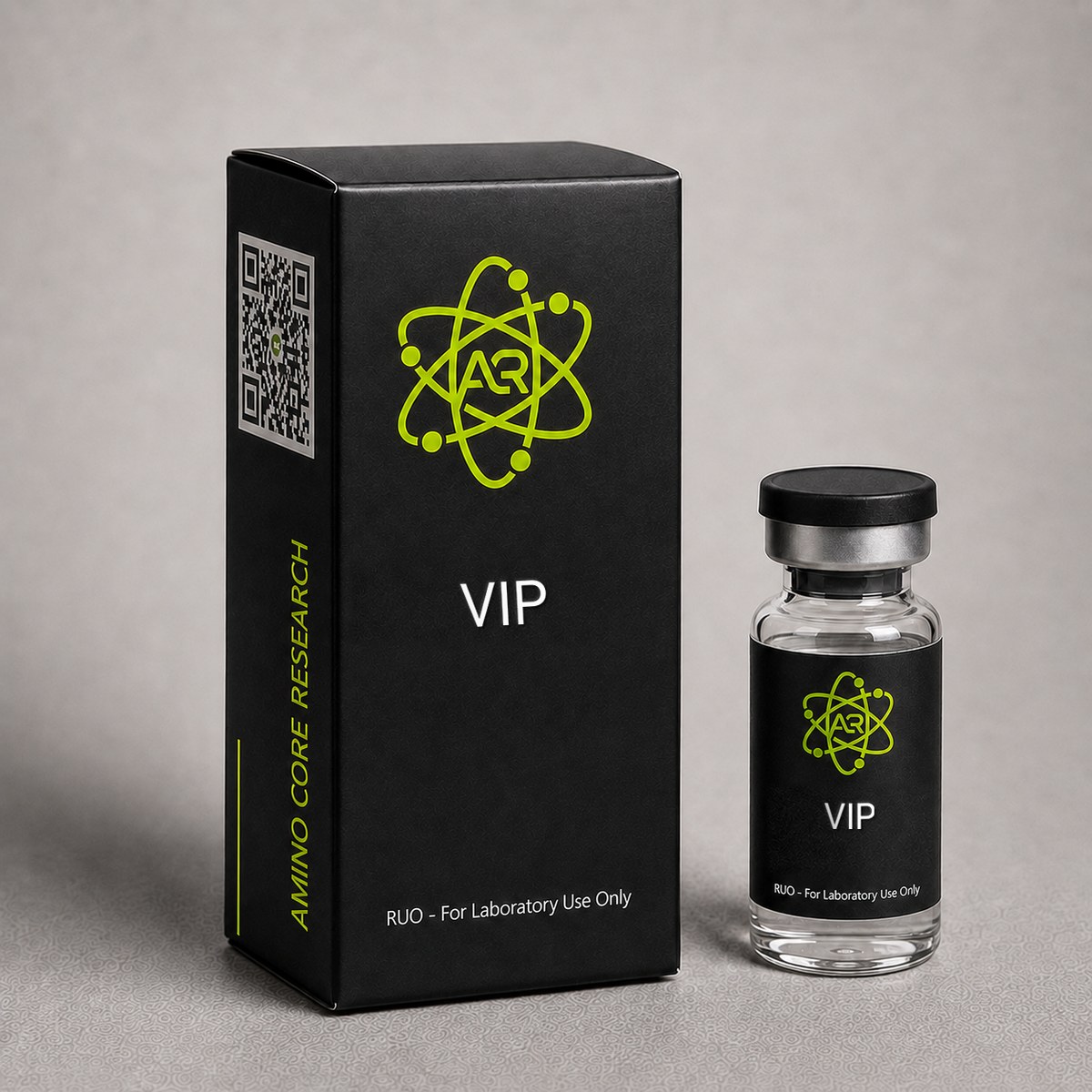
≥99%HPLC Purity
COAIncluded
USAShipped
VIP (Vasoactive Intestinal Peptide)
28-amino acid neuropeptide with pleiotropic functions across immune, nervous, and gastrointestinal systems. Activates VPAC1 and VPAC2 receptors (class B GPCRs) to regulate inflammation, circadian rhythm, neuroprotection, bronchodilation, and gut motility. One of the most multi-functional endogenous peptides known.
Research Reference
This page is a research monograph. VIP (Vasoactive Intestinal Peptide) is documented here for reference — structure, mechanism and published literature — and is not offered for sale.
Browse compounds available for research purchase · Read the research library
Quick Facts
| SKU | ACR-VIP |
|---|---|
| CAS Number | 37221-79-7 |
| Molecular Formula | C147H237N43O44S |
| Molecular Weight | 3,326.83 g/mol |
| Sequence | His-Ser-Asp-Ala-Val-Phe-Thr-Asp-Asn-Tyr-Thr-Arg-Leu-Arg-Lys-Gln-Met-Ala-Val-Lys-Lys-Tyr-Leu-Asn-Ser-Ile-Leu-Asn-NH2 |
| Purity | ≥99% |
| Physical Form | Lyophilized Powder |
| Storage | Store at -20°C |
What is Vasoactive Intestinal Peptide (VIP)?
Vasoactive Intestinal Peptide (VIP) is an endogenous 28-amino acid neuropeptide with the sequence HSDAVFTDNYTRLRKQMAVKKYLNSILN-NH₂, molecular weight 3,326.83 g/mol, and CAS number 37221-79-7. First isolated from porcine duodenum by Said and Mutt in 1970, VIP is now recognized as one of the most widely distributed and functionally diverse neuropeptides in the human body.
VIP is expressed throughout the central and peripheral nervous systems, the gastrointestinal tract, the respiratory system, and immune tissues. It acts through two G protein-coupled receptors — VPAC1 (widely distributed) and VPAC2 (more restricted to CNS, pancreas, and immune cells) — both coupling to Gs and activating adenylyl cyclase/cAMP signaling.
In recent years, VIP has gained significant research attention for its potent anti-inflammatory properties, neuroprotective effects, and role in mold/biotoxin illness (Chronic Inflammatory Response Syndrome, CIRS). Dr. Ritchie Shoemaker's CIRS protocol uses VIP as a final-step treatment for persistent inflammation, bringing widespread awareness to this previously underappreciated neuropeptide.
Mechanism of Action
VPAC1 Receptor (widely distributed): VIP binds VPAC1 with Kd ≈ 1 nM, activating Gs → adenylyl cyclase → cAMP → PKA. VPAC1 is expressed on immune cells (T-cells, macrophages, dendritic cells), neurons, epithelial cells, and vascular smooth muscle. Activation produces: vasodilation, bronchodilation, anti-inflammatory cytokine shift (IL-10 up, TNF-α/IL-6 down), and neuroprotection.
VPAC2 Receptor (restricted): Expressed primarily in the suprachiasmatic nucleus (SCN, circadian pacemaker), pancreatic beta cells, and specific immune cell subsets. VPAC2 activation regulates circadian gene expression (Per1, Per2), glucose-stimulated insulin secretion, and Th2 immune polarization.
Anti-Inflammatory Cascade: VIP is one of the most potent endogenous anti-inflammatory peptides known. It inhibits NF-κB activation in macrophages, shifts Th1→Th2 balance, promotes regulatory T-cell (Treg) differentiation, reduces costimulatory molecule expression on antigen-presenting cells, and inhibits NLRP3 inflammasome activation. This broad anti-inflammatory profile explains its efficacy in autoimmune and chronic inflammatory disease models.
Research & Clinical Studies
VIP and CIRS/Biotoxin Illness Research
VIP gained widespread clinical research attention through Dr. Ritchie Shoemaker's work on Chronic Inflammatory Response Syndrome (CIRS) — a multi-system inflammatory condition triggered by biotoxin exposure (mold, Lyme, cyanobacteria). VIP is used as the final step in the Shoemaker Protocol after other interventions fail to normalize inflammatory markers.
Key findings in CIRS research:
- VIP nasal spray (50 mcg 4x daily) normalized elevated TGF-β1, MMP-9, MSH, and VEGF levels in CIRS patients
- Resolved persistent cognitive symptoms ("brain fog") in 90%+ of treated patients
- Improved pulmonary function (elevated PASP normalized)
- Restored quality of life measures in treatment-refractory CIRS cases
- Mechanism: VIP reverses the chronic inflammatory cascade by resetting cytokine balance and restoring regulatory immune function
[1] Shoemaker RC et al. Vasoactive intestinal polypeptide (VIP) corrects chronic inflammatory response syndrome (CIRS) acquired following exposure to water-damaged buildings. Health. 2013;5(3):396-401.
VIP and Neuroprotection Research
VIP has demonstrated potent neuroprotective effects across multiple neurodegenerative and neuroinflammatory models:
- Alzheimer's disease: VIP protected hippocampal neurons from amyloid-beta toxicity, reduced microglial activation, and improved cognitive performance in transgenic AD mice
- Parkinson's disease: Protected dopaminergic neurons from MPTP-induced death, preserved striatal dopamine levels
- Multiple sclerosis: Reduced demyelination and inflammatory infiltration in EAE (experimental autoimmune encephalomyelitis) model — the gold-standard MS model
- Traumatic brain injury: Reduced cerebral edema, inflammatory cytokines, and neuronal apoptosis in TBI models
The neuroprotective mechanism involves both direct neuronal survival signaling (cAMP/PKA → CREB → BDNF) and indirect protection via suppression of neuroinflammation (microglial NF-κB inhibition).
[1] Dejda A et al. Neuroprotective potential of three neuropeptides PACAP, VIP and PHI. Pharmacol Rep. 2005;57(3):307-320. PubMed ↗
VIP and Pulmonary/Respiratory Research
VIP is a potent bronchodilator and pulmonary vasodilator with anti-inflammatory properties in the airways:
- Bronchodilation: VIP relaxes airway smooth muscle via cAMP-mediated inhibition of myosin light chain kinase, with potency comparable to beta-2 agonists
- Pulmonary hypertension: VIP reduces pulmonary artery pressure (PASP) by activating VPAC1 on pulmonary vascular smooth muscle. CIRS patients with elevated PASP showed normalization with intranasal VIP
- Asthma: VIP reduces airway hyperresponsiveness, mucus hypersecretion, and eosinophilic infiltration in allergic asthma models
- Lung inflammation: Suppresses alveolar macrophage activation and reduces acute lung injury severity
VIP and Gastrointestinal Research
As its name implies, VIP was originally discovered for its gastrointestinal effects. It is one of the primary non-adrenergic, non-cholinergic (NANC) neurotransmitters in the enteric nervous system:
- Secretion: VIP stimulates water and electrolyte secretion in the intestinal epithelium (the cause of VIPoma-associated watery diarrhea)
- Motility: Relaxes GI smooth muscle, reducing contractile amplitude and frequency (prokinetic in sphincters, inhibitory in circular muscle)
- Mucosal protection: Enhances mucosal blood flow and mucus production, protecting against NSAID-induced and stress-related mucosal damage
- Inflammatory bowel disease: VIP reduces colonic inflammation in both DSS-colitis and TNBS-colitis models (Th1-mediated IBD models), decreasing tissue damage scores and inflammatory infiltration
[1] Abad C et al. Therapeutic effects of vasoactive intestinal peptide in the trinitrobenzene sulfonic acid mice model of Crohn disease. Gastroenterology. 2003;124(4):961-971. PubMed ↗
VIP and Circadian Rhythm Research
Vasoactive intestinal peptide is the principal neuropeptide governing intercellular synchronization within the suprachiasmatic nucleus (SCN) of the hypothalamus, the master circadian pacemaker in mammals. Approximately 10% of SCN neurons express VIP, and their projections to VPAC2 (VIPR2)-expressing neighbors generate the network-level coupling required to translate noisy single-cell oscillations into a coherent ~24-hour rhythm that organizes sleep-wake cycles, core body temperature, hormone secretion, and peripheral clock alignment.
- Genetic loss-of-function models: Mice lacking VIP (Vip-/-) or its receptor VPAC2 (Vipr2-/-) show severely fragmented locomotor rhythms, reduced amplitude of clock-gene oscillation (Per1, Per2, Bmal1), advanced sleep onset, and a substantial proportion of behaviorally arrhythmic animals under constant darkness (Aton et al., Nat Neurosci 2005).
- Network resynchronization: Application of exogenous VIP to desynchronized SCN slice cultures restores phase coherence across the neuronal population within approximately 24 hours, an effect mediated by VPAC2-coupled cAMP/PKA signaling and downstream CREB-dependent transcription of Per1.
- Phase-shifting properties: VIP produces phase-dependent shifts of the SCN molecular clock that mimic the phase response curve to light, supporting its role as a key relay of photic and non-photic entrainment cues.
- Sleep architecture: In rodent EEG studies, VIP infusion into the SCN region modulates NREM and REM distribution, and VIP-deficient animals show reduced consolidation of sleep bouts.
- Peripheral clock coupling: Through autonomic and humoral outputs of the SCN, VIP indirectly synchronizes peripheral oscillators in liver, adipose tissue, and immune cells, linking central rhythm generation to systemic metabolism and inflammation.
Mechanistically, VPAC2 activation on SCN neurons elevates intracellular cAMP, activates PKA, and induces rapid CREB phosphorylation, which drives transcription of the immediate-early clock gene Per1 — the molecular step that resets cellular phase. VIP release itself follows a circadian pattern, peaking during the subjective day, which creates a self-organizing feedback architecture across the SCN network. Computational models (Webb, Taylor, Welsh and colleagues) demonstrate that without VIP-VPAC2 coupling, the SCN behaves as a population of independent damped oscillators rather than a synchronized pacemaker.
Translational and preclinical investigations have explored VIP analogs and VPAC2 agonists in models of circadian disruption associated with aging, shift work, jet lag, and neurodegeneration. SCN VIP neurons are among the populations affected early in Alzheimer-type pathology, paralleling the sleep-wake fragmentation seen in these patients, and rodent studies suggest that bolstering VIP-VPAC2 signaling can partially rescue circadian amplitude in aged animals.
Within the context of investigational research into chronic inflammatory response syndromes, normalization of disrupted sleep architecture observed after VIP administration has been hypothesized to reflect restoration of SCN coupling, though direct mechanistic evidence in humans remains limited and is an active area of preclinical investigation.
This body of work establishes VIP-VPAC2 signaling as one of the most extensively characterized peptidergic systems in chronobiology and a foundational tool compound for in vitro and in vivo circadian research.
[1] Aton SJ, Colwell CS, Harmar AJ, Waschek J, Herzog ED. Vasoactive intestinal polypeptide mediates circadian rhythmicity and synchrony in mammalian clock neurons. Nat Neurosci. 2005;8(4):476-483. PubMed ↗
Chemical & Physical Properties
| Full Name | Vasoactive Intestinal Peptide (VIP) |
|---|---|
| Sequence | His-Ser-Asp-Ala-Val-Phe-Thr-Asp-Asn-Tyr-Thr-Arg-Leu-Arg-Lys-Gln-Met-Ala-Val-Lys-Lys-Tyr-Leu-Asn-Ser-Ile-Leu-Asn-NH₂ |
| Molecular Formula | C₁₄₇H₂₃₇N₄₃O₄₄S |
| Molecular Weight | 3,326.83 g/mol |
| CAS Number | 37221-79-7 |
| Amino Acids | 28 |
| C-terminus | Amidated (-NH₂) |
| Receptors | VPAC1 (Kd ≈ 1 nM) and VPAC2 (Kd ≈ 1 nM) |
| Signal Pathway | Gs → adenylyl cyclase → cAMP → PKA |
| Half-life | ~1-2 minutes in plasma (rapid DPP-IV degradation) |
| Purity | ≥99% HPLC |
Handling & Reconstitution Guidelines
Reconstitution procedure: Remove the lyophilized VIP vial from cold storage and allow it to equilibrate to room temperature for 15-20 minutes before opening to prevent condensation onto the peptide cake. Wipe the rubber septum with 70% isopropanol and allow to air-dry. Using a sterile syringe, draw the appropriate volume of bacteriostatic water (0.9% benzyl alcohol) or preservative-free sterile saline and inject slowly down the inner wall of the vial — never directly onto the peptide cake, which can cause localized denaturation through mechanical shear and rapid osmotic stress. VIP, despite its 28-residue length, typically enters solution within 3-5 minutes. Gently roll or invert the vial; do not vortex or shake vigorously, as foaming exposes the peptide to air-water interface stress that accelerates oxidation of Met17 and promotes aggregation.
Standard concentrations:
- 5 mg vial + 1.0 mL diluent = 5 mg/mL (5,000 mcg/mL)
- 5 mg vial + 2.5 mL diluent = 2 mg/mL (2,000 mcg/mL)
- 5 mg vial + 5.0 mL diluent = 1 mg/mL (1,000 mcg/mL)
Intranasal research preparations: For nasal delivery protocols used in chronic inflammatory response syndrome (CIRS) research models, VIP is typically formulated in preservative-free sterile saline at concentrations calibrated to deliver approximately 50 mcg per actuation in a 100 microliter spray volume. Compounding-grade preparation requires sterile technique, and the intranasal route is preferred in these investigational contexts because it partially bypasses extensive first-pass enzymatic degradation and provides direct access to olfactory and trigeminal pathways implicated in central peptide distribution.
Pharmacokinetic considerations: Native VIP has an exceptionally short plasma half-life of approximately 1-2 minutes due to rapid proteolysis by dipeptidyl peptidase-IV (DPP-IV), neprilysin (NEP/CD10), and other endopeptidases that cleave at the N-terminal His1-Ser2 and internal Lys-X bonds. This pharmacokinetic profile is the primary reason that systemic IV infusion has limited utility in research models and why intranasal, subcutaneous depot, and analog-stabilized approaches dominate the literature. Investigators studying receptor-level pharmacology in vitro should account for rapid degradation by including DPP-IV inhibitors (e.g., diprotin A, sitagliptin) in cell culture media when sustained receptor occupancy is required.
Oxidation control: Methionine 17 is the most labile residue. Practical measures to limit oxidation include: minimizing the time the reconstituted vial is exposed to room air, using amber or foil-wrapped storage containers, avoiding metal ion contamination (which catalyzes Met oxidation), and refraining from sonication. If solutions appear yellow or develop turbidity, they should be discarded.
Adsorption to surfaces: Like many amphipathic neuropeptides, VIP can adsorb to glass and polypropylene surfaces, particularly at low concentrations (<10 mcg/mL). For dilute working solutions, low-bind polypropylene tubes or addition of carrier protein (0.1% BSA) where compatible with downstream assays is recommended to maintain accurate effective concentrations.
Sterility and aseptic technique: All reconstitution and aliquoting steps should be performed in a laminar flow hood or with rigorous aseptic technique. Bacteriostatic water is appropriate for multi-use storage at 2-8°C up to 14 days; sterile water or saline aliquots intended for cell culture or sensitive in vivo work should be used within 24-48 hours of reconstitution.
Documentation: Record reconstitution date, diluent type, final concentration, and storage location on each vial to ensure experimental reproducibility and adherence to good research practice.
Storage & Stability
Lyophilized powder: When stored desiccated at -20°C in sealed, moisture-protected vials, lyophilized VIP retains chemical and conformational integrity for approximately 24 months. Short-term storage at 2-8°C is acceptable for up to 6 months provided the vial remains sealed and protected from humidity cycling. For extended archival storage exceeding 24 months, -80°C is preferred to minimize slow deamidation of asparagine and glutamine residues, which proceeds even in the solid state at higher temperatures.
Reconstituted solution: Following reconstitution in bacteriostatic water (0.9% benzyl alcohol) or preservative-free sterile saline, VIP solutions should be stored at 2-8°C and used within 14 days for maximal peptide integrity. Solutions must be protected from direct light at all times to limit photo-oxidation of the methionine residue at position 17 (Met17), a well-characterized vulnerability of VIP and PACAP-family peptides. Amber glass vials or foil-wrapped containers are recommended.
Aliquoting strategy: Because VIP is a 28-residue peptide containing multiple oxidation- and deamidation-prone residues (Met17, Asn9, Asn24, Gln16), repeated freeze-thaw cycles and repeated needle-puncture air exposure accelerate degradation. Investigators are encouraged to aliquot reconstituted material into single-use sterile cryovials immediately after reconstitution and flash-freeze at -80°C. Under these conditions, frozen aliquots remain analytically stable for several months when characterized by RP-HPLC and LC-MS. Avoid repeated freeze-thaw of any single aliquot; discard after first use.
Buffer and pH considerations: VIP exhibits optimal solution stability between pH 4.5 and pH 6.5. Strongly alkaline conditions promote both Met17 oxidation and Asp/Asn isomerization to iso-aspartate, which can substantially alter receptor binding to VPAC1 and VPAC2. For research applications requiring physiological pH, freshly prepared solutions in PBS or HEPES-buffered saline should be used within hours rather than days.
Visible signs of degradation: Cloudiness, particulate formation, yellow discoloration, or precipitate at the vial bottom indicate aggregation or hydrolytic breakdown — such material should not be used for quantitative research. Clear, colorless solutions are expected throughout the stability window.
Shipping and receipt: VIP is shipped lyophilized with cold packs. Upon receipt, transfer immediately to -20°C or -80°C storage. Brief exposure (24-48 h) to ambient temperatures during shipping does not appreciably degrade lyophilized material due to the absence of free water, but reconstitution should not occur until cold-chain storage has been re-established.
Analytical QC recommendations: Laboratories conducting long-term studies are advised to re-verify peptide purity by analytical RP-HPLC and MALDI-TOF or ESI-MS at intervals, particularly before pivotal experiments. Documented Met17 sulfoxide formation (+16 Da mass shift) is the most common indicator of oxidative degradation and can be partially mitigated by including trace antioxidants such as 0.01% methionine or ascorbate in storage buffers, though such additives must be controlled for in downstream assays.
Note: VIP is inherently more degradation-prone than smaller peptides due to its length (28 residues), methionine content, and multiple amide side chains. Disciplined cold-chain handling, light protection, and single-use aliquoting are the single most important determinants of reproducible experimental outcomes.
Frequently Asked Questions
What is VIP used for in CIRS research?
In Dr. Shoemaker's CIRS protocol, VIP nasal spray (50 mcg 4x daily) is the final treatment step for patients with persistent inflammation after other interventions. It normalizes elevated inflammatory markers (TGF-β1, MMP-9, VEGF, C4a) and resolves cognitive symptoms in >90% of treatment-refractory CIRS cases.
What receptors does VIP activate?
VIP activates two class B GPCRs: VPAC1 (widely distributed — immune cells, neurons, epithelium, vasculature) and VPAC2 (restricted to SCN, pancreas, specific immune cells). Both couple to Gs → cAMP → PKA. VPAC1 mediates most anti-inflammatory and vasodilatory effects.
How is VIP administered in research?
VIP is most commonly administered intranasally in clinical research (as in CIRS protocols) because: it bypasses the ~1-2 minute plasma half-life limitation, achieves direct CNS delivery via olfactory mucosa, and avoids GI degradation. Injectable (SC, IV) routes are used in acute preclinical studies.
Why does VIP have such a short half-life?
VIP is rapidly degraded by dipeptidyl peptidase IV (DPP-IV) and neutral endopeptidase (NEP) in plasma, giving it a half-life of only 1-2 minutes intravenously. This is why intranasal delivery (bypassing systemic degradation) is the preferred research route for chronic protocols.
What is the difference between VIP and PACAP?
VIP and PACAP share 68% sequence homology and both activate VPAC1/VPAC2 receptors. However, PACAP also activates PAC1 receptor (VIP does not). PACAP is more potent for neuroprotection; VIP is more potent for anti-inflammation and has better characterized clinical CIRS data.
Is VIP the same as VIPoma peptide?
Yes — VIPomas are tumors that overproduce VIP, causing Verner-Morrison syndrome (watery diarrhea, hypokalemia, achlorhydria). This was actually how VIP's GI secretory function was first characterized clinically. At therapeutic research doses, VIP does not cause the extreme secretory effects seen in VIPoma.
What is the molecular weight and CAS of VIP?
VIP has molecular weight 3,326.83 g/mol, molecular formula C₁₄₇H₂₃₇N₄₃O₄₄S, and CAS number 37221-79-7. It is a 28-amino acid neuropeptide with a C-terminal amide group essential for receptor binding.
For laboratory and research use only. This product is not for human or veterinary use. It is not a drug, supplement or food.
This product is not FDA approved for any indication, and is not intended to diagnose, treat, cure, or prevent any disease. All product information is derived from published preclinical research and does not constitute medical advice or claims.