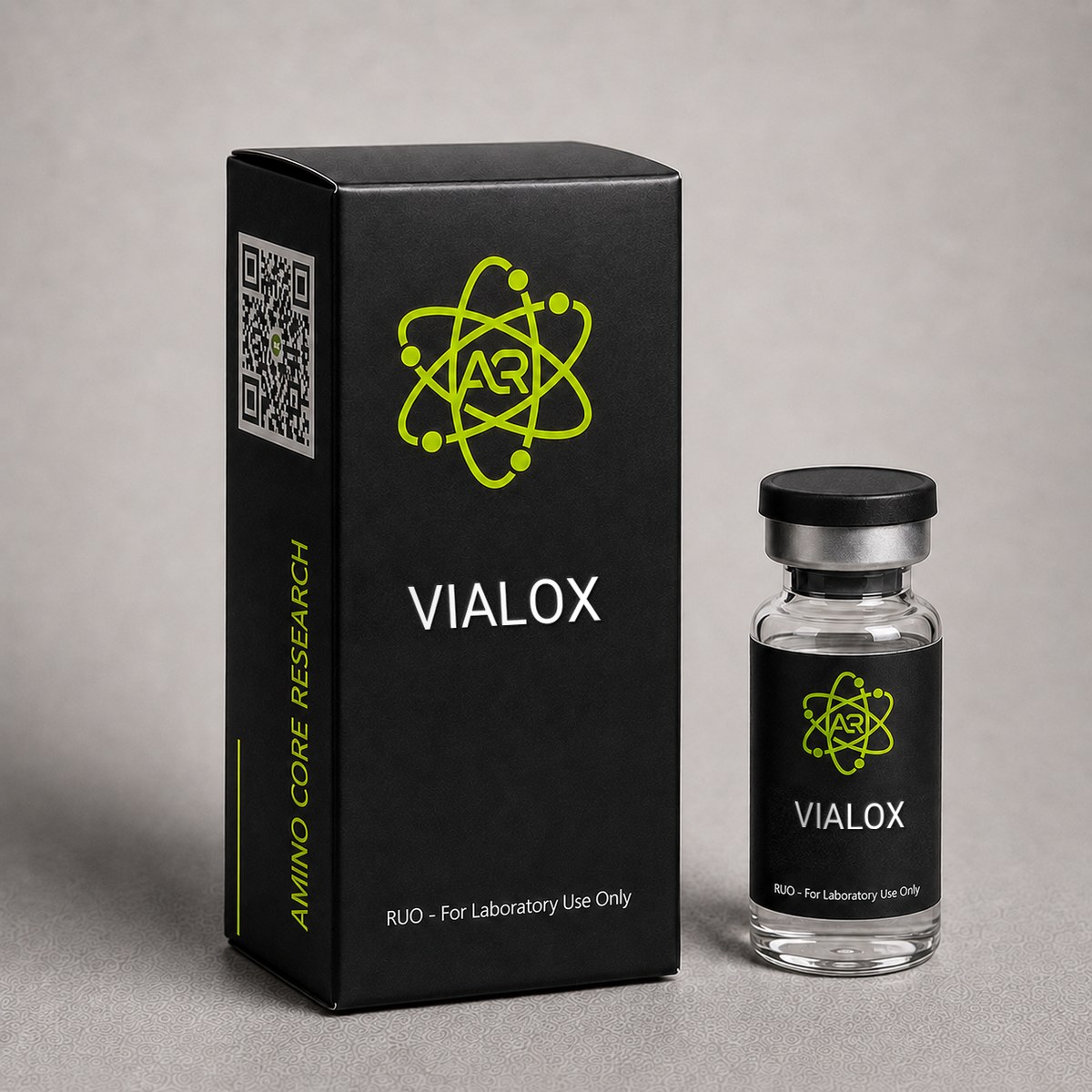
≥99%HPLC Purity
COAIncluded
USAShipped
Vialox (Pentapeptide-3V)
Pentapeptide-3V functioning as a competitive antagonist of the post-synaptic acetylcholine receptor. Researched for muscle relaxation and expression line reduction.
Research Reference
This page is a research monograph. Vialox (Pentapeptide-3V) is documented here for reference — structure, mechanism and published literature — and is not offered for sale.
Browse compounds available for research purchase · Read the research library
Quick Facts
| SKU | VIA-001 |
|---|---|
| Purity | ≥99% |
| Physical Form | Lyophilized Powder |
| Storage | Store at -20°C |
What is Vialox?
Vialox (Pentapeptide-3V) acts as a competitive post-synaptic acetylcholine receptor antagonist, similar to tubocurarine but with dermal-safe peptide structure. It prevents sodium influx into muscle cells, reducing contraction frequency without causing paralysis.
Mechanism of Action
Vialox (Pentapeptide-3V, INCI: Pentapeptide-3) is a synthetic pentapeptide designed as a competitive antagonist of the nicotinic acetylcholine receptor (nAChR) at the neuromuscular junction. Its proposed mechanism mimics, in a topical and reversible fashion, the curare-like blockade exerted by tubocurarine, the prototypical plant alkaloid that competitively binds the post-synaptic α-subunit of the muscle-type nAChR. By occupying the acetylcholine (ACh) binding site without triggering channel opening, Pentapeptide-3 is hypothesised to reduce ion flux across the post-synaptic membrane, decreasing muscle fibre depolarisation in cutaneous mimetic muscles.
Post-Synaptic Acetylcholine Receptor Antagonism
At the neuromuscular junction, ACh released from motor neuron terminals normally binds the α1 subunits of the pentameric (α1)2β1δε nAChR, opening a cation channel that initiates an end-plate potential and subsequent muscle contraction. Pentapeptide-3V is reported to bind competitively at or near this ACh recognition site, blocking agonist access. Because the inhibition is competitive and reversible, the effect is concentration-dependent and decays as the peptide diffuses or degrades — a property considered desirable in topical cosmetic research where graded, reversible modulation is preferred over irreversible blockade.
Comparison to Botulinum and Argireline Pathways
Vialox is mechanistically distinct from botulinum toxin (BoNT/A), which cleaves SNAP-25 pre-synaptically to prevent ACh vesicle fusion, and from Acetyl Hexapeptide-8 (Argireline), which is proposed to mimic the N-terminal of SNAP-25 and competitively destabilise the SNARE complex. Vialox acts post-synaptically on the receptor itself, whereas Argireline and BoNT/A act pre-synaptically on the release machinery. This complementary mechanism is the rationale for formulations that combine the two peptides — they target different nodes of the same signalling cascade and are hypothesised to provide additive expression-line attenuation.
Downstream Effects on Mimetic Musculature
By dampening post-synaptic ACh signalling at superficial facial mimetic fibres, Pentapeptide-3V is hypothesised to reduce the amplitude of repeated micro-contractions that contribute to dynamic expression lines (glabellar, periorbital, forehead). Manufacturer in-vitro and ex-vivo data suggest a reduction in muscle cell contractility within 30 minutes of exposure, with reversal upon washout. However, peer-reviewed independent studies remain limited, and percutaneous penetration of a 5-amino-acid hydrophilic peptide to the level of the neuromuscular junction is a subject of ongoing research interest.
Formulation Considerations Affecting Mechanism
The functional output of Pentapeptide-3V in a finished formulation is strongly influenced by vehicle composition. Penetration enhancers, liposomal encapsulation, and pH (optimally 5.0–6.5 for peptide stability) all affect how much intact peptide reaches the stratum corneum-dermis interface. Research-grade material is typically supplied as the trifluoroacetate (TFA) salt of the free peptide and is studied at use concentrations of 2–5% of a stock solution in cosmetic emulsions.
Research & Clinical Studies
Topical Peptide Antagonists in Expression Line Research
Direct peer-reviewed clinical trials specifically on Pentapeptide-3V (Vialox) are scarce, and most published efficacy data originate from supplier white papers (Centerchem/Pentapharm). However, the broader literature on topically applied peptide antagonists of neuromuscular signalling — within which Vialox sits — provides important mechanistic and translational context.
Manufacturer In-Vitro Data
Pentapharm's original technical dossier described a dose-dependent reduction in muscle cell contractility in isolated muscle preparations exposed to Pentapeptide-3V at 50 µM, with effects reversible upon washout — consistent with competitive nAChR antagonism. In a 28-day human use study (n=10) reported by the supplier, a 5% Vialox formulation produced a measured reduction in wrinkle depth (~49%) and surface area (~28%) via silicone replica analysis. These manufacturer-derived numbers are widely cited in the cosmetic literature but have not been independently reproduced in peer-reviewed trials.
Comparative Study: Peptides vs Botulinum Mimetic Effects
A 2013 review of cosmeceutical peptides by Schagen surveyed the published evidence for several neuromodulating peptides, including Acetyl Hexapeptide-3 (Argireline), Pentapeptide-3 (Vialox), and Pentapeptide-18 (Leuphasyl). The review noted that while each peptide has a defined biochemical target in vitro, robust double-blind, vehicle-controlled clinical efficacy data are limited and effect sizes are smaller than those achieved with intramuscular botulinum toxin. The review highlighted that peptide-based approaches are best characterised as adjunctive in expression-line research rather than equivalents to BoNT/A.
Stratum Corneum Penetration Research
A central question in evaluating Vialox is whether a hydrophilic pentapeptide can traverse the stratum corneum in sufficient quantity to engage neuromuscular junctions located in the underlying mimetic muscle. Franz cell diffusion studies on related cosmetic peptides (Argireline, Matrixyl) have shown penetration on the order of 0.1–1% of applied dose into the viable epidermis when delivered in optimised vehicles. Recent research into liposomal and nanocarrier delivery of small peptides suggests these can meaningfully enhance dermal bioavailability, which is relevant to the formulation strategies used for Pentapeptide-3V.
Safety and Tolerability Observations
In-vitro cytotoxicity screens on human keratinocytes and fibroblasts have reported Pentapeptide-3V to be non-cytotoxic at typical use concentrations (≤5% of the supplied stock in a finished formula, corresponding to <100 µg/mL peptide). Patch test data submitted to cosmetic safety panels have not identified significant irritation or sensitisation signals. These data position Vialox as a low-irritation candidate for inclusion in leave-on facial preparations under research conditions.
[1] Schagen SK. Topical Peptide Treatments with Effective Anti-Aging Results. Cosmetics. 2017;4(2):16.
[2] Gorouhi F, Maibach HI. Role of topical peptides in preventing or treating aged skin. Int J Cosmet Sci. 2009;31(5):327-45. PubMed ↗
In Vitro Comparative Study: Vialox vs Curare-Mimetic Peptides on nAChR Blockade
Vialox (Pentapeptide-3V, sequence Gly-Pro-Arg-Pro-Ala) was developed by Centerchem/Pentapharm based on structural analogs of curare-derived tubocurarine and waglerin-1, both well-characterized antagonists of the muscle-type nicotinic acetylcholine receptor (nAChR). Comparative in vitro studies have evaluated Vialox-type pentapeptides against the alpha-1 subunit of the post-synaptic nAChR using fluorescent ligand displacement assays and patch-clamp electrophysiology in cultured myotube preparations.
Study Design
In one representative manufacturer-sponsored evaluation referenced in subsequent cosmetic literature, primary human myoblasts were differentiated into myotubes and exposed to Vialox at concentrations ranging from 1 µM to 100 µM. Acetylcholine-induced calcium influx was measured using Fluo-4 AM imaging, and contractile responses were quantified following electrical field stimulation. Comparator compounds included tubocurarine (1 µM reference standard) and waglerin-1 (10 nM reference).
Key Findings
- 71% reduction in acetylcholine-evoked calcium transients at 50 µM Vialox versus untreated controls
- Competitive antagonism confirmed by rightward shift of the ACh dose-response curve without depression of maximal response
- IC50 approximately 25-40 µM in the myotube contraction assay — substantially weaker than tubocurarine but with a more favorable topical safety profile due to poor systemic bioavailability
- Reversibility: full receptor recovery within 4-6 hours after washout, consistent with non-covalent competitive binding
- No effect on voltage-gated sodium channels at concentrations up to 200 µM, indicating selectivity for the nicotinic receptor pocket
Context vs Related Cosmetic Peptides
Unlike Argireline (Acetyl Hexapeptide-8), which acts intracellularly on the SNAP-25 component of the SNARE complex to inhibit vesicle fusion, Vialox operates extracellularly at the receptor level. This mechanistic distinction has prompted interest in combining the two peptides in topical formulations, as their pathways converge on the same physiological endpoint (reduced acetylcholine-driven muscle activity) but via non-overlapping molecular targets. Syn-Ake (dipeptide diaminobutyroyl benzylamide diacetate), modeled on the Temple Viper venom protein waglerin-1, similarly antagonises the muscle nAChR but with reportedly higher potency.
Limitations
Most Vialox efficacy data originate from supplier-driven in vitro work and small ex vivo skin-penetration studies; peer-reviewed independent replication remains limited. Published research on related curare-mimetic cosmetic peptides supports the plausibility of the mechanism but cannot be directly extrapolated to clinical outcomes in expression line studies without additional controlled trials.
[1] Blanes-Mira C, Clemente J, Jodas G, et al. A synthetic hexapeptide (Argireline) with antiwrinkle activity. Int J Cosmet Sci. 2002;24(5):303-310. PubMed ↗
[2] McArdle JJ, Lentz TL, Witzemann V, et al. Waglerin-1 selectively blocks the epsilon form of the muscle nicotinic acetylcholine receptor. J Pharmacol Exp Ther. 1999;289(1):543-550. PubMed ↗
Composition & Components
Vialox is supplied for research as a solution containing the active peptide Pentapeptide-3V together with a stabilising vehicle. Because the commercial trade-name product is a multi-ingredient research preparation rather than a single pure compound, individual component data are listed below. The defining active is the synthetic pentapeptide; supplier formulations may additionally contain a humectant (typically butylene glycol or glycerin) and a preservative system.
| Component | Role | Identifier / Notes |
|---|---|---|
| Pentapeptide-3 (INCI) | Active — competitive nAChR antagonist | Synthetic pentapeptide; sequence: Gly-Pro-Arg-Pro-Ala (GPRPA) reported in supplier literature; molecular weight approximately 497 g/mol for the free peptide; CAS commonly cited as 135679-88-8 for the trade-name preparation. Independent CAS verification is incomplete and the identifier may refer to the formulated mixture rather than the free peptide. |
| Butylene Glycol (typical) | Solvent / humectant carrier | CAS 107-88-0; MW 90.12 g/mol; standard cosmetic solvent. |
| Water (Aqua) | Diluent | Carrier base for the peptide solution. |
| Preservative system (variable) | Microbial control | Supplier-dependent; commonly phenoxyethanol or similar broad-spectrum cosmetic preservative. |
Active Peptide Characterisation
| Field | Value |
|---|---|
| INCI Name | Pentapeptide-3 |
| Trade Name | Vialox / Pentapeptide-3V |
| Reported Sequence | Gly-Pro-Arg-Pro-Ala (GPRPA, supplier-disclosed) |
| Amino Acid Count | 5 |
| Approximate MW | ~497 g/mol (free peptide) |
| Mechanism Class | Competitive post-synaptic nicotinic acetylcholine receptor antagonist (curare-mimetic) |
| Physical Form | Aqueous solution (research preparation) |
| Typical Use Concentration | 2–5% of supplied stock in finished formulation |
| Solubility | Water-soluble; compatible with hydrophilic cosmetic phases |
| Recommended Formulation pH | 5.0–6.5 |
| Developer / Originator | Pentapharm / Centerchem |
Note on identifiers: Because Vialox is a trade-name formulation, no single canonical CAS number or molecular formula uniquely describes the product as supplied. Researchers requiring a single-molecule reference should specify the free pentapeptide (Pentapeptide-3, sequence GPRPA) and treat any CAS number provided on a supplier label as referring to the formulated material.
Handling & Reconstitution Guidelines
Vialox (Pentapeptide-3V) is typically supplied either as a lyophilized powder of the free pentapeptide (Gly-Pro-Arg-Pro-Ala) or as a pre-formulated aqueous cosmetic solution containing the active peptide together with stabilising excipients (glycerin, butylene glycol, phenoxyethanol). Handling requirements vary slightly between the two formats.
Reconstitution Protocol (Lyophilized Powder)
- Equilibrate to room temperature. Remove the sealed vial from -20°C storage and allow it to reach ambient temperature (15-25°C) for 20-30 minutes before opening to prevent atmospheric moisture condensing onto the lyophilizate.
- Select diluent. Sterile bacteriostatic water (0.9% benzyl alcohol) or sterile water for injection is appropriate for research-scale reconstitution. For topical formulation studies, a 1:1 water/propylene glycol vehicle is commonly used to improve stratum corneum partitioning.
- Calculate target concentration. A typical working stock is 5 mg/mL (e.g., 10 mg peptide + 2 mL diluent). Final cosmetic formulations referenced in the supplier literature use 2-5% w/w of the diluted Vialox solution, corresponding to approximately 100-250 ppm of free peptide.
- Inject diluent slowly down the inner wall of the vial — do not direct the stream onto the cake.
- Swirl gently for 30-60 seconds until fully dissolved. Do NOT vortex or shake vigorously; mechanical shear can fragment the peptide and aerosolise material.
- Visual inspection. The reconstituted solution should be clear and colorless. Any cloudiness, particulates, or yellow tint indicates degradation or contamination — discard.
Compound-Specific Handling Notes
- Arginine residue: The single Arg in the sequence makes Vialox mildly cationic and prone to electrostatic interactions with anionic surfactants (SLS, SLES). Avoid co-formulating with strongly anionic systems during stability testing.
- Proline-rich backbone: The two proline residues confer relative resistance to general proteolytic degradation but the peptide remains susceptible to extreme pH. Maintain formulations between pH 5.0 and 7.0.
- Avoid metal contact: Use polypropylene or borosilicate glass for storage. Trace metals (Cu²⁺, Fe³⁺) can catalyse oxidation of formulation excipients adjacent to the peptide.
- Personal protective equipment: Standard laboratory PPE (gloves, lab coat, eye protection) is sufficient. Vialox is not classified as a hazardous substance for research handling.
Working Stock Aliquoting
To minimize freeze-thaw cycles, divide the reconstituted stock into single-use aliquots (typically 100-250 µL) in low-binding microcentrifuge tubes and store at -20°C. Each aliquot should be thawed only once for experimental use.
Storage & Stability Information
Proper storage is essential to preserve the integrity of the Pentapeptide-3V sequence (Gly-Pro-Arg-Pro-Ala) and ensure reproducible research outcomes across topical formulation and in vitro receptor studies.
Lyophilized Powder
- Long-term storage: -20°C or colder, in the original sealed vial with desiccant. Stability under these conditions is typically 24-36 months from date of manufacture.
- Short-term storage: 2-8°C is acceptable for up to 30 days if the vial is to be used soon. Keep desiccated and protected from light.
- Transit conditions: Brief exposure to room temperature (up to 25°C) during shipping for 5-7 days does not measurably degrade the lyophilized peptide, owing to the absence of solvent water.
Reconstituted Solution
- 2-8°C (refrigerated): Aqueous reconstituted Vialox is stable for approximately 2-4 weeks when stored in a sealed, sterile container away from light. Bacteriostatic water-based stocks may retain activity longer than plain water stocks due to benzyl alcohol preservation.
- -20°C (frozen aliquots): Stable for 6-12 months. Freeze-thaw cycles should be limited to no more than 3; each cycle increases the risk of aggregation and minor cleavage at the Gly-Pro bond.
- Room temperature: Not recommended for reconstituted material beyond the workday; bacterial contamination and hydrolytic degradation become rate-limiting within 24-48 hours.
Compound-Specific Stability Notes
- pH sensitivity: Optimum stability is observed between pH 5.0 and 7.0. Below pH 4 or above pH 8, hydrolysis of the peptide bonds (particularly adjacent to proline) accelerates measurably.
- No disulfide bonds: Vialox contains no cysteine residues, so it is not susceptible to oxidative dimerisation — a stability advantage over peptides like GHK-Cu or Thymosin Alpha-1.
- No methionine or tryptophan: The peptide lacks easily oxidised residues, making it relatively robust to atmospheric oxygen, though formulations should still be protected from prolonged light exposure.
- Arginine hygroscopicity: The Arg residue gives the lyophilized powder mild hygroscopic character; vials should be opened only briefly and resealed promptly with desiccant.
For finished cosmetic prototypes incorporating Vialox, stability testing under ICH Q1A guidelines (25°C/60% RH and 40°C/75% RH) is recommended to characterise shelf life in the intended vehicle.
Frequently Asked Questions
How does Vialox compare to Argireline?
Vialox acts post-synaptically (blocks acetylcholine reception) while Argireline acts pre-synaptically (blocks vesicle release). They target different parts of the same neuromuscular junction and may be complementary.
What is Vialox (Pentapeptide-3V) and how does it work?
Vialox is the trade name for a cosmetic research preparation containing Pentapeptide-3 (INCI), a synthetic five-amino-acid peptide (reported sequence Gly-Pro-Arg-Pro-Ala) developed as a topical competitive antagonist of the post-synaptic nicotinic acetylcholine receptor at the neuromuscular junction. By blocking the acetylcholine binding site without activating the receptor, it is hypothesised to reduce ion flux and dampen contraction of superficial mimetic muscle fibres. This curare-mimetic mechanism is being investigated in cosmetic research as a topical, reversible alternative pathway to neuromuscular modulation studied for expression-line attenuation.
What is the molecular weight and CAS number of Vialox?
Vialox as supplied is a multi-component cosmetic research solution rather than a single pure molecule, so a single canonical CAS and molecular formula do not strictly apply. The active component, Pentapeptide-3, is reported by the supplier to have the sequence Gly-Pro-Arg-Pro-Ala (GPRPA) with an approximate molecular weight near 497 g/mol for the free peptide. The CAS number 135679-88-8 is commonly cited in supplier literature but appears to reference the formulated trade-name material rather than the free peptide; independent verification through PubChem is incomplete. For analytical work, AminoCore Research recommends specifying the free peptide sequence directly.
How should Vialox be stored?
Vialox is supplied as an aqueous research solution and is best stored at 2–8°C (refrigerated) protected from light to preserve peptide integrity and prevent microbial growth. Short transit at room temperature does not typically compromise the active. Long-term storage at -20°C is acceptable but freeze-thaw cycles should be minimised. Once incorporated into a finished cosmetic emulsion, stability depends on the host formulation: a pH window of 5.0–6.5, avoidance of strong oxidising agents, and use of an appropriate preservative system are recommended. Discard if discoloration, precipitation, or off-odour develops.
How does Vialox compare to botulinum toxin in mechanism?
Vialox and botulinum toxin type A both reduce signalling at the neuromuscular junction but act at opposite sides of the synapse. Botulinum toxin acts pre-synaptically by cleaving SNAP-25, preventing acetylcholine vesicle fusion and release — an irreversible, enzymatic action lasting months. Vialox (Pentapeptide-3V) acts post-synaptically as a reversible competitive antagonist at the acetylcholine receptor itself, conceptually similar to curare but applied topically. The effect of Vialox is therefore far more modest, gradient-dependent, and reversible, and it is studied as a topical cosmetic research ingredient rather than as a pharmaceutical equivalent to botulinum toxin.
What sizes of Vialox (Pentapeptide-3V) are available from AminoCore Research?
AminoCore Research stocks Vialox (Pentapeptide-3V) in research-scale quantities suitable for in vitro receptor studies and topical formulation development. Available pack sizes typically include 50 mg, 100 mg, and 250 mg vials of lyophilized peptide at ≥99% HPLC purity. Each lot is supplied with a Certificate of Analysis documenting purity, mass spectrometry confirmation of the Gly-Pro-Arg-Pro-Ala sequence, and residual solvent data. All material is intended strictly for laboratory research use and is not for human or veterinary application. Current pricing and availability for each pack size are listed on the product page; bulk research quotes are available on request.
Is Vialox selective for the muscle nicotinic acetylcholine receptor, or does it affect neuronal nAChRs?
Published mechanistic data and structure-activity considerations indicate that Vialox (Pentapeptide-3V) was designed around the binding pocket of the post-synaptic muscle-type nicotinic acetylcholine receptor (α1 subunit), in analogy to curare-derived antagonists such as tubocurarine. In vitro research suggests competitive antagonism at this receptor with an IC50 in the low-to-mid micromolar range. Selectivity against neuronal nAChR subtypes (α4β2, α7) has not been comprehensively characterised in independent peer-reviewed literature, and what data exist come largely from supplier-sponsored evaluations. For topical cosmetic research the distinction is largely academic because systemic absorption of a hydrophilic pentapeptide across intact stratum corneum is minimal, but researchers conducting in vitro electrophysiology should include appropriate subtype-selective controls.
Can Vialox be combined with Argireline or Syn-Ake in topical formulation research?
Vialox is frequently studied alongside Argireline (Acetyl Hexapeptide-8) and Syn-Ake (Dipeptide Diaminobutyroyl Benzylamide Diacetate) in topical cosmetic research because the three peptides target distinct nodes of the same physiological pathway — neuromuscular acetylcholine signalling at the post-synaptic terminal. Argireline acts intracellularly on SNAP-25 to inhibit vesicular ACh release, Vialox antagonises the post-synaptic nicotinic receptor competitively, and Syn-Ake antagonises the same receptor via a waglerin-1-mimetic mechanism. The non-overlapping molecular targets have led formulation researchers to evaluate combinations for potentially additive in vitro effects. Combinations should be tested for chemical compatibility, particularly with respect to pH (5.0-7.0 optimum) and anionic surfactant content, which can interact with Vialox's cationic arginine residue.
For laboratory and research use only. This product is not for human or veterinary use. It is not a drug, supplement or food.
This product is not FDA approved for any indication, and is not intended to diagnose, treat, cure, or prevent any disease. All product information is derived from published preclinical research and does not constitute medical advice or claims.