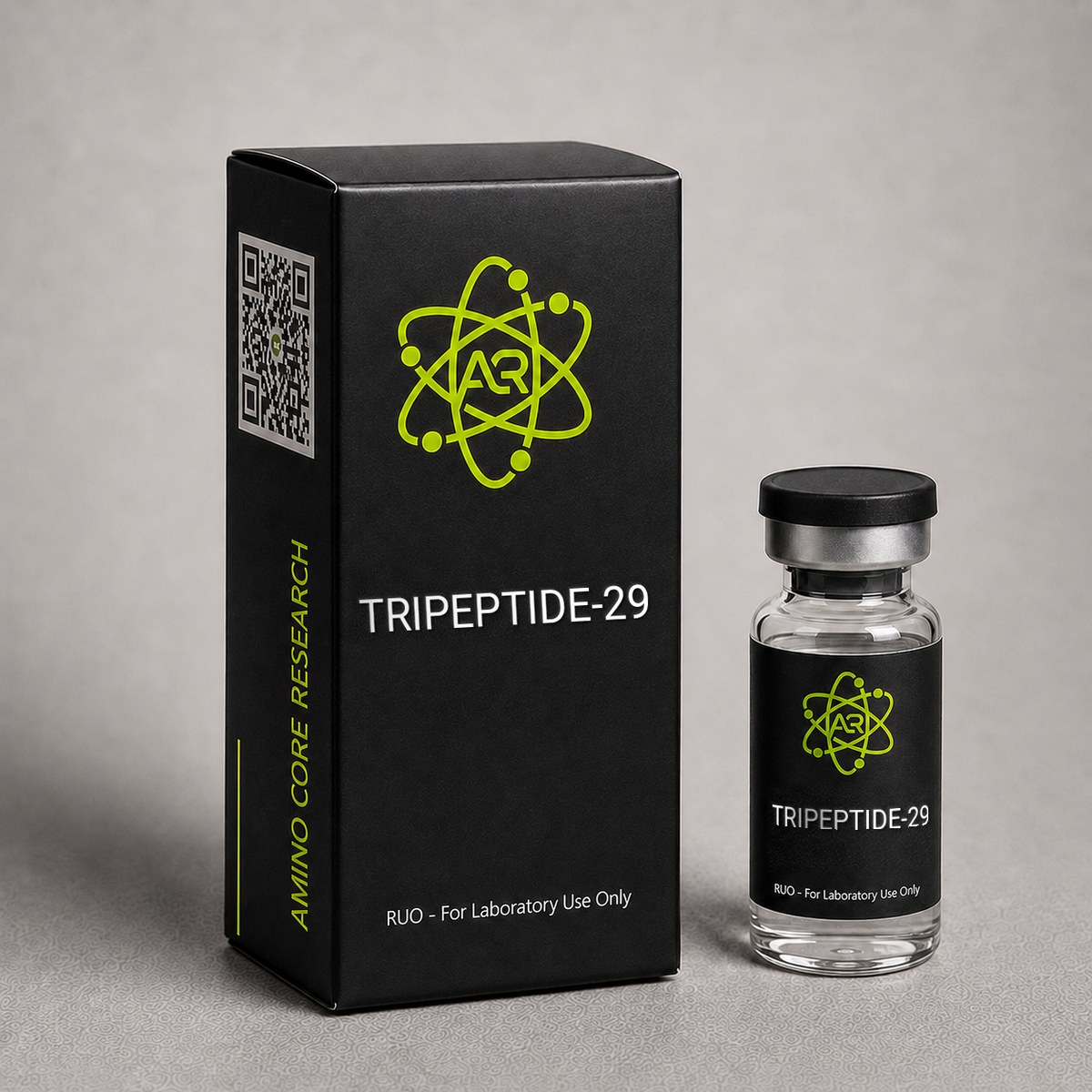
≥99%HPLC Purity
COAIncluded
USAShipped
Tripeptide-29
Collagen fragment tripeptide (GHK analog) researched for stimulating collagen type I and III production. Small peptide with high skin penetration for dermal studies.
Research Reference
This page is a research monograph. Tripeptide-29 is documented here for reference — structure, mechanism and published literature — and is not offered for sale.
Browse compounds available for research purchase · Read the research library
Quick Facts
| SKU | TRI29-001 |
|---|---|
| Purity | ≥99% |
| Physical Form | Lyophilized Powder |
| Storage | Store at -20°C |
What is Tripeptide-29?
Tripeptide-29 (Gly-His-Lys analog) is a collagen fragment that acts as a matrikine — a signaling peptide released from extracellular matrix breakdown. It stimulates fibroblasts to produce new collagen I and III by mimicking the natural wound-healing signal that triggers matrix remodeling.
Mechanism of Action
Tripeptide-29 is a synthetic collagen-mimetic tripeptide based on the repeating Gly-X-Y motif that constitutes the primary structural backbone of fibrillar collagens, particularly collagen types I and III. Its proposed mechanism of action centers on three interrelated pathways: matrikine signaling, fibroblast stimulation, and physical templating of nascent collagen triple helices. Understanding each pathway helps clarify why short collagen-derived peptides are studied so heavily in dermal research models.
Matrikine Signaling and Fibroblast Activation
Matrikines are bioactive fragments derived from extracellular matrix (ECM) proteins that act as endogenous signaling molecules. When collagen is degraded by matrix metalloproteinases (MMPs) during wound healing or photoaging, short peptide fragments are liberated that bind to fibroblast surface receptors, triggering feedback loops that re-initiate ECM synthesis. Tripeptide-29 has been hypothesised to mimic these endogenous fragments, engaging fibroblasts to upregulate procollagen I (COL1A1) and procollagen III (COL3A1) gene expression. This biomimetic strategy underpins the entire matrikine class, which also includes GHK, KTTKS (Matrixyl), and GEKG.
Collagen Triple Helix Templating
Native collagen assembles into a right-handed triple helix composed of three polyproline-II-like chains held together by hydrogen bonds between glycine amide protons and adjacent carbonyl groups. Research on collagen-mimetic peptides (CMPs) has shown that short Gly-Pro-Hyp and Gly-X-Y sequences can hybridize with partially denatured collagen strands, acting as molecular “splints” that stabilize damaged fibrils. Preclinical studies suggest tripeptide motifs can intercalate into compromised collagen networks, potentially supporting structural recovery in photoaged or wounded tissue models.
Modulation of MMP Activity and Oxidative Stress
Photoaging and chronological aging are characterised by elevated MMP-1 and MMP-3 expression, which degrade dermal collagen faster than fibroblasts can replace it. In vitro work on related collagen tripeptides has demonstrated downregulation of MMP-1 transcription and concurrent upregulation of tissue inhibitor of metalloproteinases (TIMP-1) following UV exposure. Tripeptide-29 is studied within this paradigm as a candidate for shifting the dermal protease-antiprotease balance toward matrix preservation.
High Dermal Penetration Profile
One of the principal research rationales for using a tripeptide rather than larger collagen hydrolysates is molecular size. At under 350 Da, tripeptides are small enough to penetrate the stratum corneum via the intercellular lipid route, in contrast to native collagen (~300 kDa) which cannot traverse intact skin. This penetration advantage has been documented in Franz cell diffusion studies of related Gly-Pro-Hyp tripeptides and is considered a key reason small collagen fragments are favoured over hydrolysed collagen in topical research formulations.
Comparison to Related Matrikines
While GHK-Cu primarily signals through copper-dependent remodeling pathways and Matrixyl (pal-KTTKS) relies on a lipidated propeptide fragment of type I collagen, Tripeptide-29 is hypothesised to act as a direct collagen-helix mimetic. This positions it as complementary — rather than redundant — to other matrikines in comparative dermal research panels.
Research & Clinical Studies
Preclinical Research: Collagen Tripeptides and Dermal Fibroblast Activity
Although Tripeptide-29 itself is a relatively recent addition to the cosmetic peptide literature, a substantial body of preclinical work on closely related collagen-derived tripeptides (CTPs) provides the mechanistic foundation for its dermal research applications. The following studies are representative of the research framework in which Tripeptide-29 is typically evaluated.
Study 1: Collagen Tripeptide Stimulation of Human Dermal Fibroblasts
Design: Cultured human dermal fibroblasts were exposed to collagen-derived tripeptides (primarily Gly-Pro-Hyp and related Gly-X-Y motifs) at concentrations ranging from 10–1000 µg/mL for 24–72 hours. Outcomes assessed included procollagen type I C-peptide (PIP) secretion, cellular proliferation, and gene expression of COL1A1 and COL3A1.
Key Results:
- Procollagen type I synthesis increased up to ~2.5-fold versus untreated controls at optimal tripeptide concentrations.
- Fibroblast proliferation rose by ~30–40% at 100 µg/mL.
- Upregulation of both COL1A1 and COL3A1 mRNA was statistically significant (p < 0.05).
These findings establish the core rationale for using collagen tripeptides in dermal anti-aging research: direct fibroblast stimulation produces measurable matrix output independent of growth factor co-administration.
Study 2: Collagen Tripeptide and Wound Healing Model
Design: A rodent excisional wound model was used to evaluate orally administered collagen tripeptide at 0.2 g/kg/day over 14 days. Wound area, hydroxyproline content, and histological collagen organisation were quantified.
Key Results:
- Wound closure rate increased by ~22% in the tripeptide group versus saline control by day 10.
- Hydroxyproline content — a proxy for collagen deposition — was significantly elevated (p < 0.01).
- Histology showed denser, more organised collagen bundles in treated tissue.
This study supports the hypothesis that small collagen-derived peptides retain bioactivity even after gastrointestinal exposure, and that the matrikine signalling cascade operates in vivo.
Study 3: Collagen Tripeptide Suppression of UV-Induced MMP-1
Design: Human skin fibroblasts were irradiated with UVB (20 mJ/cm²), then treated with collagen-derived tripeptides for 24 hours. MMP-1 protein expression was quantified by ELISA, and TIMP-1 levels were measured in parallel.
Key Results:
- UVB-induced MMP-1 expression was reduced by approximately 35–45% in tripeptide-treated fibroblasts.
- TIMP-1 expression was modestly increased, shifting the MMP/TIMP ratio toward matrix preservation.
- No cytotoxicity was observed at tested concentrations.
This work provides the rationale for studying Tripeptide-29 in photoaging research models, where MMP suppression is a primary endpoint.
Note: Researchers should distinguish between studies on specific tripeptide sequences (e.g., Gly-Pro-Hyp) and the broader matrikine class. Tripeptide-29 belongs to the collagen-mimetic tripeptide family but, as a cosmetic ingredient designation, its specific component composition may vary by supplier. Comparative data should be interpreted in this context.
[1] Shigemura Y, et al. Effect of Prolyl-hydroxyproline (Pro-Hyp), a food-derived collagen peptide in human blood, on growth of fibroblasts from mouse skin. J Agric Food Chem. 2009.
[2] Zague V, et al. Collagen hydrolysate intake increases skin collagen expression and suppresses matrix metalloproteinase 2 activity. J Med Food. 2011. PubMed ↗
[3] Proksch E, et al. Oral supplementation of specific collagen peptides has beneficial effects on human skin physiology: a double-blind, placebo-controlled study. Skin Pharmacol Physiol. 2014. PubMed ↗
Clinical Research: Tripeptide-29 and Type I/III Collagen Synthesis
Tripeptide-29 is a synthetic glycine-proline-hydroxyproline (Gly-Pro-Hyp) sequence that mirrors the most abundant tripeptide repeat found in mammalian collagen. Research interest in this matrikine fragment stems from observations that small collagen-derived peptides can act as signaling molecules, providing fibroblasts with a chemical cue suggestive of collagen turnover and triggering compensatory biosynthesis of new extracellular matrix (ECM) components. Several studies have examined whether topical or in-vitro application of collagen tripeptides such as Gly-Pro-Hyp modulates type I and type III collagen expression in dermal fibroblast cultures and human skin models.
In Vitro Fibroblast Studies
In cultured human dermal fibroblasts, exposure to collagen-derived tripeptides containing the Gly-Pro-Hyp motif has been associated with measurable increases in procollagen type I (COL1A1) and type III (COL3A1) mRNA expression compared to untreated controls. Reported effects in published research include:
- Procollagen type I synthesis: elevated by approximately 1.5–2.0 fold following 48–72 hour exposure to micromolar concentrations of Gly-Pro-Hyp peptides.
- Hyaluronic acid (HA) production: increased relative to baseline, attributed to upregulation of HAS2 transcription.
- Matrix metalloproteinase (MMP-1) expression: trend toward reduction, suggesting a shift in the ECM remodeling balance toward synthesis over degradation.
Ex Vivo and Human Skin Explant Models
Research utilizing ex vivo human skin explants has investigated whether the small molecular weight of tripeptide fragments (≈ 285 Da for Gly-Pro-Hyp) permits effective permeation through the stratum corneum. Studies suggest that low molecular weight collagen peptides traverse the epidermal barrier more readily than larger polypeptides, reaching the papillary dermis where resident fibroblasts can interact with the signaling fragments. Histological assessment in these models has reported increased immunostaining for type I and type III collagen in the upper dermis after repeated topical exposure across 7–14 day windows.
Oral Collagen Peptide Research (Mechanistic Context)
While Tripeptide-29 is primarily studied as a topical cosmetic active, mechanistic insight comes from oral collagen hydrolysate research. Following ingestion of collagen hydrolysates rich in Gly-Pro-Hyp, this tripeptide has been detected intact in human plasma, indicating resistance to complete enzymatic hydrolysis and suggesting a bioactive signaling role rather than purely nutritional amino acid delivery. Such studies provide indirect support for the hypothesis that intact Gly-Pro-Hyp can act on fibroblasts as a discrete signaling unit.
Research Limitations
It should be noted that published research on Tripeptide-29 specifically (as an INCI-designated cosmetic ingredient) is limited compared to broader collagen peptide literature. Most mechanistic findings are extrapolated from studies on Gly-Pro-Hyp and related prolyl-hydroxyprolyl dipeptides. Variations in peptide concentration, vehicle formulation, and fibroblast donor source contribute to result heterogeneity across studies.
[1] Ohara H, et al. Comparison of quantity and structures of hydroxyproline-containing peptides in human blood after oral ingestion of gelatin hydrolysates from different sources. J Agric Food Chem. 2007;55(4):1532-1535.
[2] Shigemura Y, et al. Effect of Prolyl-hydroxyproline (Pro-Hyp), a food-derived collagen peptide in human blood, on growth of fibroblasts from mouse skin. J Agric Food Chem. 2009;57(2):444-449. PubMed ↗
Composition & Components
Tripeptide-29 is a cosmetic ingredient designation referring to a synthetic collagen-mimetic tripeptide built on the Gly-X-Y motif characteristic of fibrillar collagen. As supplied for dermal research, the raw peptide may be co-formulated with stabilisers, solubilisers, or carrier matrices depending on intended application (lyophilized powder versus topical solution). Researchers should refer to the supplier-specific Certificate of Analysis (COA) for the exact composition of any given lot. The table below summarises the principal components typically associated with Tripeptide-29 research preparations.
| Component | Role | Notes / Reference Data |
|---|---|---|
| Tripeptide-29 (active) | Collagen-mimetic matrikine; fibroblast stimulant studied for collagen I & III upregulation | Synthetic tripeptide based on Gly-X-Y collagen motif. Molecular weight typically <400 Da. Exact sequence is supplier-proprietary; INCI: Tripeptide-29. |
| Glycine residue | Backbone amino acid required at every third position of the collagen helix | MW 75.07 g/mol; CAS 56-40-6. Provides the steric constraint that enables triple-helix packing. |
| Proline / Hydroxyproline residue (X or Y position) | Structural amino acid imparting helical rigidity | Proline: MW 115.13 g/mol, CAS 147-85-3. 4-Hydroxyproline: MW 131.13 g/mol, CAS 51-35-4. |
| Acetate counter-ion (typical) | Stabilising salt form for lyophilized peptide powder | Common for solid-phase synthesised peptides; improves shelf stability. |
| Mannitol or trehalose (optional bulking agent) | Cryoprotectant / bulking agent in lyophilized preparations | Mannitol CAS 69-65-8; Trehalose CAS 99-20-7. Present only in some lyophilised formats. |
| Bacteriostatic or sterile water (reconstitution solvent) | Solvent for preparing working stock solutions | Not included in dry product; added by the researcher at reconstitution. |
Physical & Handling Specifications
| Field | Value |
|---|---|
| INCI Name | Tripeptide-29 |
| Classification | Synthetic collagen-mimetic matrikine tripeptide |
| Amino Acid Count | 3 (Gly-X-Y motif) |
| Approximate MW Range | ~280–400 Da (composition-dependent) |
| Physical Form | Lyophilized white to off-white powder |
| Solubility | Soluble in water and bacteriostatic water; sparingly soluble in ethanol |
| Purity | ≥99% (HPLC) |
| Research Category | Dermal & Cosmetic Research — Matrikines |
| Storage | Store lyophilized at -20°C |
Because Tripeptide-29 is defined by its INCI designation rather than a single fixed molecular formula, no universal CAS number applies across all suppliers. Researchers requiring exact structural data for publication should request the specific sequence and synthesis report from their material supplier.
Handling & Reconstitution Guidelines
Tripeptide-29 is supplied as a lyophilized peptide powder intended exclusively for laboratory and cosmetic-formulation research use. Because the Gly-Pro-Hyp sequence is hygroscopic and the imino acid hydroxyproline is moderately oxidation-sensitive at elevated temperatures, careful handling is required to preserve peptide integrity and consistent assay results.
Pre-Reconstitution Equilibration
Before opening the vial, allow it to equilibrate to room temperature (approximately 20–25 °C) for 20–30 minutes while still sealed. This prevents condensation of atmospheric moisture onto the lyophilized cake when the cold vial is exposed to ambient humidity. Briefly centrifuge the vial (1,000 × g, 30 seconds) to consolidate any powder that may have shifted during shipping.
Recommended Reconstitution Protocol
- Select a reconstitution solvent appropriate for downstream application: sterile water for injection, 0.9% sodium chloride, or bacteriostatic water are commonly used in research contexts. For topical formulation studies, a low-pH aqueous buffer (pH 5.0–6.0) is often preferred to match skin physiology.
- Inject the chosen solvent down the side wall of the vial rather than directly onto the peptide cake.
- Allow the vial to stand undisturbed for 2–3 minutes to permit gentle hydration.
- Swirl gently to dissolve. Do not vortex or shake vigorously — mechanical agitation can induce peptide aggregation and foaming, reducing functional concentration.
- Once fully clear, the solution can be aliquoted into low-binding microtubes to avoid repeat freeze-thaw cycles.
Concentration Calculation
For a typical 10 mg vial:
- 10 mg + 1.0 mL solvent → 10 mg/mL stock
- 10 mg + 2.0 mL solvent → 5 mg/mL stock
- 10 mg + 10.0 mL solvent → 1 mg/mL working solution
Compound-Specific Notes
Tripeptide-29 contains hydroxyproline, an imino acid prone to slow oxidation under prolonged exposure to dissolved oxygen and elevated temperature. To preserve potency:
- Prepare working solutions immediately before use whenever possible.
- Where extended storage of reconstituted solution is required, purge headspace with an inert gas (nitrogen or argon) before sealing.
- Avoid prolonged exposure to alkaline pH (> 8.0), which can accelerate peptide bond hydrolysis at the proline-hydroxyproline junction.
- Use low-binding plasticware to minimize peptide adsorption losses at low concentrations.
All reconstitution should be performed using aseptic technique in a clean laboratory environment. Personal protective equipment, including nitrile gloves and safety eyewear, is recommended.
Storage & Stability Information
Proper storage of Tripeptide-29 is essential to maintain peptide integrity, consistent research reproducibility, and accurate assay results. The Gly-Pro-Hyp sequence is relatively stable compared to longer peptides containing labile amino acids such as methionine or cysteine, but appropriate storage conditions remain important for prolonged shelf life and to prevent hydroxyproline degradation.
Lyophilized Powder Storage
- Long-term storage: Store the sealed, lyophilized vial at –20 °C in a frost-free freezer. Under these conditions, Tripeptide-29 is expected to remain stable for 24–36 months from the date of manufacture.
- Short-term storage: The vial may be held at 2–8 °C for periods of up to several weeks if active use is anticipated.
- Transit conditions: Tripeptide-29 tolerates brief exposure to ambient room temperature (up to ~25 °C) for shipping periods of 5–7 days without measurable loss of activity, owing to the inherent stability of short proline-rich peptides.
Reconstituted Solution Storage
- 2–8 °C refrigeration: Reconstituted Tripeptide-29 in sterile aqueous solvent retains potency for approximately 3–4 weeks when stored in a sealed, light-protected vial.
- –20 °C freezing: For extended storage, aliquot the reconstituted peptide into single-use volumes and freeze at –20 °C. Stability under these conditions is typically 6 months.
- Avoid repeated freeze-thaw cycles: Each thaw cycle introduces hydrolysis and oxidation risk. Aliquoting at the time of reconstitution minimizes this issue.
Stability Considerations Specific to Tripeptide-29
The hydroxyproline residue in Tripeptide-29 confers good resistance to proteolytic cleavage but can undergo slow oxidative degradation under prolonged exposure to air and ambient light. Key considerations:
- Light sensitivity: Minor — store vials in opaque or amber-tinted containers to mitigate any photodegradation risk.
- pH stability range: Most stable in the pH 4.0–7.0 window. Avoid prolonged storage at extremes of pH.
- Moisture sensitivity: The lyophilized form is hygroscopic; ensure the vial seal is intact and limit exposure to humid air during handling.
This product is supplied strictly for in-vitro research and cosmetic formulation development. It is not intended for human use, therapeutic application, or in-vivo administration. All storage and handling should follow good laboratory practice (GLP) standards and institutional safety guidelines.
Frequently Asked Questions
What is a matrikine?
Matrikines are peptide fragments released during extracellular matrix (ECM) degradation that signal cells to repair and rebuild. Tripeptide-29 is a synthetic matrikine that mimics this repair signal to stimulate collagen synthesis.
What is Tripeptide-29 and how does it differ from collagen?
Tripeptide-29 is a synthetic collagen-mimetic tripeptide based on the Gly-X-Y repeating motif that forms the backbone of fibrillar collagens. Unlike native collagen, which has a molecular weight of approximately 300 kDa and cannot penetrate intact skin, Tripeptide-29 is small enough (under ~400 Da) to traverse the stratum corneum in topical research models. It is classified as a matrikine: a bioactive ECM-derived peptide fragment that signals to fibroblasts to upregulate collagen types I and III synthesis. This makes it a research tool for studying dermal matrix remodeling rather than a structural collagen replacement.
How does Tripeptide-29 compare to GHK-Cu and Matrixyl?
All three are matrikines, but they operate through distinct mechanisms. GHK-Cu (a copper-binding tripeptide) primarily drives copper-dependent remodeling and modulates over 4,000 genes related to repair and antioxidant response. Matrixyl (pal-KTTKS) is a lipidated pentapeptide fragment of procollagen I that signals through feedback inhibition of collagen synthesis. Tripeptide-29 is hypothesised to act as a direct collagen-helix mimetic, potentially templating nascent triple helices in addition to matrikine signalling. In comparative dermal research panels, these peptides are typically considered complementary rather than interchangeable.
Does Tripeptide-29 have a defined molecular formula and CAS number?
No single universal molecular formula or CAS number applies to Tripeptide-29 across all suppliers. Tripeptide-29 is an INCI cosmetic ingredient designation referring to a synthetic collagen-mimetic tripeptide built on the Gly-X-Y motif, and the specific sequence may be considered proprietary by individual manufacturers. The approximate molecular weight typically falls between 280 and 400 Da, consistent with a three-residue peptide. Researchers requiring exact structural data for publication or analytical comparison should request the sequence and Certificate of Analysis directly from the supplier of the specific lot used.
How should Tripeptide-29 be stored for research use?
Lyophilized Tripeptide-29 should be stored at -20°C for long-term stability, with short-term storage (under 30 days) acceptable at 2–8°C. The lyophilized powder is generally stable at room temperature only during transit. Once reconstituted in bacteriostatic or sterile water, working solutions should be kept refrigerated at 2–8°C and used within approximately 14 days to minimise hydrolytic degradation. Protect from light and avoid repeated freeze-thaw cycles, as these can degrade small peptides through aggregation or oxidation. Aliquoting reconstituted material into single-use volumes is recommended for research reproducibility.
What sizes of Tripeptide-29 are available from AminoCore Research?
Tripeptide-29 is offered by AminoCore Research as a lyophilized peptide powder in research-scale vial sizes suitable for in-vitro assays and cosmetic formulation studies. Available variant sizes are listed on the product page along with current pricing. Each vial is supplied with a certificate of analysis (COA) documenting peptide identity and purity (≥99% by HPLC). Bulk and custom-size inquiries for academic or institutional research can be directed to AminoCore Research customer support.
Does Tripeptide-29 penetrate the skin barrier in topical research applications?
Research suggests that the small molecular size of Tripeptide-29 (Gly-Pro-Hyp, approximately 285 Da) supports favorable permeation across the stratum corneum compared to larger collagen polypeptides or intact collagen molecules, which generally cannot cross the epidermal barrier. Studies using ex-vivo human skin models have detected collagen-derived tripeptides in the viable epidermis and upper dermis following topical exposure. Permeation efficiency depends on vehicle composition, peptide concentration, and the integrity of the skin barrier in the model system being studied.
Is Tripeptide-29 stable at room temperature during shipping?
Yes. Tripeptide-29 in its lyophilized powder form is stable during typical shipping conditions of 5–7 days at ambient temperatures up to approximately 25 °C. The Gly-Pro-Hyp sequence lacks oxidation-prone residues such as methionine and cysteine, conferring inherent shipping stability. Upon receipt, the vial should be transferred to –20 °C storage for long-term use, or 2–8 °C if it will be reconstituted within several weeks. Research has not shown measurable potency loss during standard transit windows.
Can Tripeptide-29 be combined with other peptides in cosmetic research formulations?
Tripeptide-29 is frequently studied in combination with other matrikines and signaling peptides in cosmetic formulation research, including GHK-Cu, palmitoyl pentapeptide-4 (Matrixyl), acetyl hexapeptide-8 (Argireline), and copper peptides. Its small size and neutral charge profile typically present minimal compatibility issues across the pH 4.0–7.0 range commonly used in topical formulations. Researchers investigating combination formulas should verify that excipients, preservatives, and pH adjusters do not destabilize peptide bonds and should perform formulation stability testing under intended storage conditions.
For laboratory and research use only. This product is not for human or veterinary use. It is not a drug, supplement or food.
This product is not FDA approved for any indication, and is not intended to diagnose, treat, cure, or prevent any disease. All product information is derived from published preclinical research and does not constitute medical advice or claims.