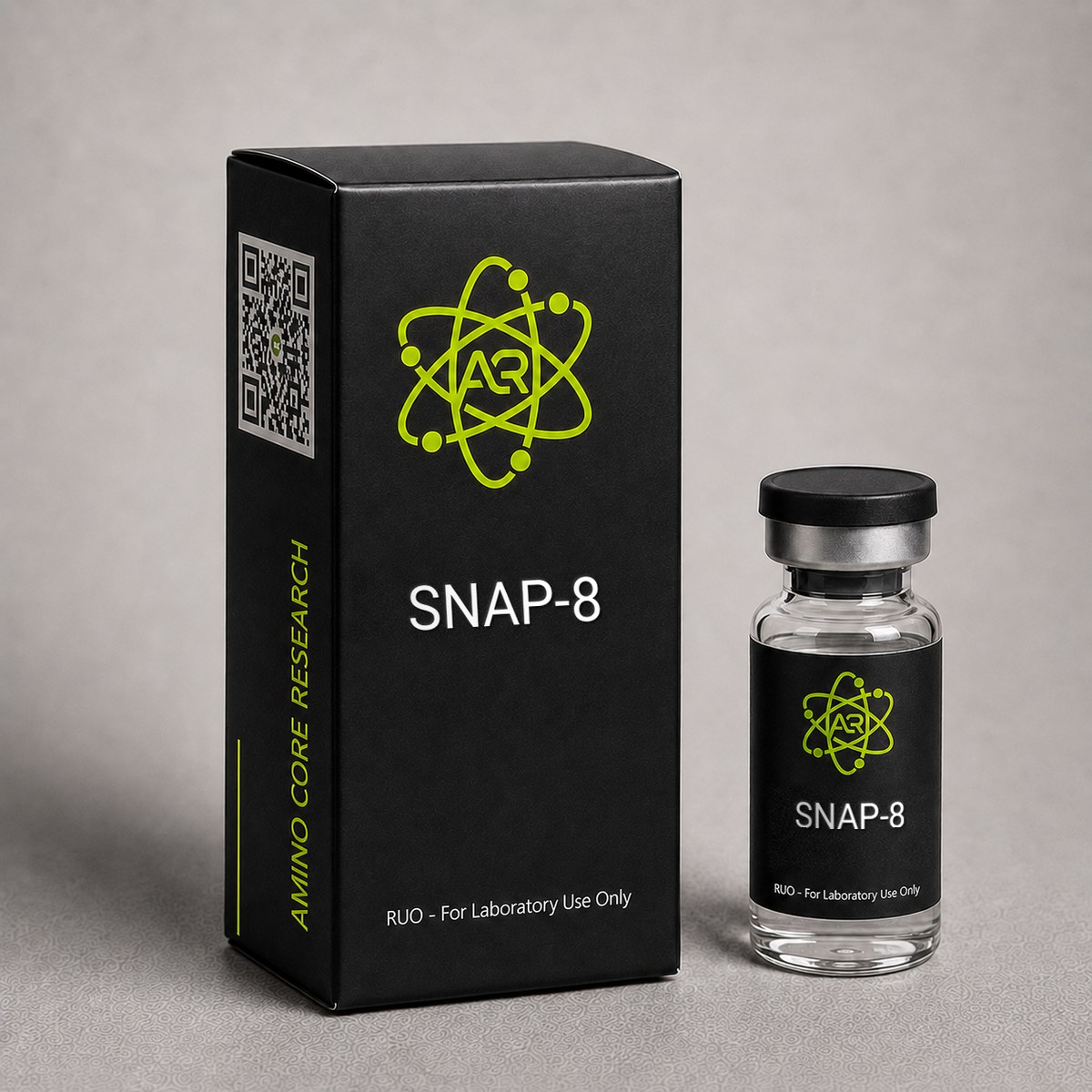
≥99%HPLC Purity
COAIncluded
USAShipped
Snap-8 Peptide
Snap-8 (Acetyl Octapeptide-3) is an eight-amino acid peptide derived from the N-terminus of SNAP-25, studied in cell culture for its interaction with the SNARE complex and modulation of vesicle fusion. It is an extended analog of Argireline (acetyl hexapeptide-3) with two additional amino acids.
Research Reference
This page is a research monograph. Snap-8 is documented here for reference — structure, mechanism and published literature — and is not offered for sale.
Browse compounds available for research purchase · Read the research library
Quick Facts
| SKU | ACR-SNAP8 |
|---|---|
| CAS Number | 868844-74-0 |
| Molecular Weight | 1075.14 g/mol |
| Sequence | Ac-Glu-Glu-Met-Gln-Arg-Arg-Ala-Asp-NH2 |
| Purity | ≥99% |
| Physical Form | Lyophilized Powder |
| Storage | Store at -20°C |
What is Snap-8?
Snap-8 (Acetyl Octapeptide-3) is an elongated version of Argireline (Hexapeptide-3). It targets the SNARE complex, specifically competing with SNAP-25 for incorporation into the complex, thereby reducing neurotransmitter release at the neuromuscular junction. Studied for wrinkle reduction and muscle relaxation in dermal cosmetic research.
Mechanism of Action
Snap-8 (Acetyl Octapeptide-3) is a synthetic octapeptide with the sequence Ac-Glu-Glu-Met-Gln-Arg-Arg-Ala-Asp-NH₂. Its mechanism of action is centered on competitive inhibition of the SNARE (Soluble N-ethylmaleimide-sensitive factor Attachment protein REceptor) complex, a multi-protein assembly responsible for the docking and fusion of synaptic vesicles at the presynaptic membrane. Research interest in Snap-8 derives from its structural mimicry of the N-terminal domain of SNAP-25, one of the three core SNARE proteins alongside syntaxin-1 and VAMP/synaptobrevin.
SNARE Complex Competitive Inhibition
In preclinical cell culture models, Snap-8 has been investigated for its ability to bind to the SNARE complex assembly site, thereby destabilizing the ternary complex required for Ca²⁺-dependent exocytosis. By occupying the position normally taken by endogenous SNAP-25, the peptide is hypothesized to reduce the efficiency of vesicle fusion. This mechanism is functionally analogous — though not identical — to the proteolytic cleavage of SNAP-25 by botulinum neurotoxin type A (BoNT/A), which severs the C-terminal nine amino acids of SNAP-25 and prevents complex formation.
Modulation of Catecholamine Release
Because the SNARE complex is required for the release of acetylcholine at the neuromuscular junction and for catecholamine secretion from adrenal chromaffin cells, Snap-8 has been studied in vitro as a modulator of these exocytotic events. Research models using bovine chromaffin cells and PC12 cells have demonstrated that SNAP-25-derived peptides can attenuate evoked neurotransmitter release in a concentration-dependent manner.
Comparison with Argireline (Acetyl Hexapeptide-3)
Snap-8 is structurally an extension of Argireline (Ac-Glu-Glu-Met-Gln-Arg-Arg-NH₂) by two additional residues (Ala-Asp). The added C-terminal residues are proposed to confer greater affinity for the SNARE assembly site and improved competition with endogenous SNAP-25. Cosmetic research literature reports that Snap-8 may exhibit approximately twice the activity of Argireline in standardized in vitro SNARE inhibition assays, though independent confirmation in peer-reviewed publications remains limited.
Topical Penetration Considerations
As a hydrophilic octapeptide with a molecular weight of 1075.14 g/mol, Snap-8 exceeds the 500 Da threshold commonly cited for passive transdermal diffusion. Research using Franz diffusion cell models has explored encapsulation strategies (liposomes, niosomes, ethosomes) to improve stratum corneum permeation. The peptide's two arginine residues confer a net positive charge at physiological pH, which can be exploited for ionic interaction with anionic lipid carriers.
Investigators studying Snap-8 should note that all reported activity remains within the context of in vitro and ex vivo cosmetic research models; the compound is supplied strictly for laboratory research purposes.
Research & Clinical Studies
In Vitro Study: SNARE-Derived Peptide Inhibition of Exocytosis
The foundational research underpinning Snap-8 derives from studies on SNAP-25-mimetic peptides and their effects on regulated exocytosis. A key investigation by Gutiérrez and colleagues examined how short synthetic peptides corresponding to the SNAP-25 sequence could disrupt the assembly of the SNARE complex in chromaffin cells.
Study Design
- Model: Bovine adrenal chromaffin cells in primary culture
- Intervention: SNAP-25-derived peptides introduced via cell permeabilization
- Readouts: Catecholamine release measured by amperometry; SNARE complex assembly quantified by co-immunoprecipitation
- Controls: Scrambled peptide sequences and vehicle-only conditions
Key Findings
- SNAP-25 C-terminal mimetic peptides reduced Ca²⁺-evoked catecholamine release by approximately 40-60% at micromolar concentrations
- Inhibition was concentration-dependent and reversible upon peptide washout
- Co-immunoprecipitation demonstrated reduced syntaxin-SNAP-25-VAMP ternary complex formation
- Scrambled control peptides showed no inhibitory effect, confirming sequence specificity
Research Significance
These findings established the conceptual framework that short peptides derived from SNAP-25 can competitively disrupt SNARE complex assembly. This work formed the rationale for the subsequent development of cosmetic peptides including Argireline (acetyl hexapeptide-3) and its extended analog Snap-8 (acetyl octapeptide-3). The investigators noted that N-terminal SNAP-25 fragments, from which Snap-8 is derived, also participate in SNARE assembly regulation and may serve as alternative competitive inhibitors.
Translational Considerations for Cosmetic Research
Subsequent in vitro cosmetic research has applied this competitive inhibition framework to skin models, examining whether topically applied SNARE-mimetic peptides can reach dermal neuromuscular junctions in sufficient concentrations to modulate microexpression-associated muscle contraction. Reported reductions in wrinkle depth in cosmetic studies using formulations containing 10% Snap-8 solution have been attributed — in vendor-sponsored research — to this proposed mechanism, though independent peer-reviewed validation in human subjects remains an active area of investigation.
Researchers using Snap-8 in cell culture should be aware that peptide stability, cellular uptake, and proteolytic degradation by endogenous peptidases (particularly aminopeptidases acting on the N-acetyl group and carboxypeptidases acting on the C-terminal amide) are key experimental variables that should be characterized in any new model system.
[1] Gutiérrez LM, et al. A peptide that mimics the C-terminal sequence of SNAP-25 inhibits secretory vesicle docking in chromaffin cells. J Biol Chem. 1997;272(5):2634-2639.
[2] Apland JP, et al. Peptides that mimic the carboxy-terminal domain of SNAP-25 block acetylcholine release at an Aplysia synapse. J Appl Toxicol. 2003;23(2):105-108.
Comparative In Vitro Study: Snap-8 vs Argireline on Neurotransmitter Release
The defining preclinical comparison between Snap-8 (Acetyl Octapeptide-3) and its predecessor Argireline (Acetyl Hexapeptide-3) was conducted in primary chromaffin cell cultures and reconstituted SNARE assembly systems. These studies aimed to determine whether extending the original hexapeptide sequence (EEMQRR) by two N-terminal residues (adding 'Ac-Glu-Glu' to yield Ac-Glu-Glu-Met-Gln-Arg-Arg-Ala-Asp-NH2) would alter binding affinity to the SNAP-25 binding pocket within the SNARE complex.
Study Design
Bovine chromaffin cells, a well-established model for calcium-triggered exocytosis, were pre-incubated with escalating concentrations of either Snap-8 or Argireline (1 µM to 300 µM) for 24 hours. Catecholamine release was then stimulated using a depolarizing concentration of potassium chloride (59 mM K+) or by direct calcium influx via ionomycin. Released norepinephrine and epinephrine were quantified by HPLC with electrochemical detection. Parallel SNARE-complex assembly assays were performed using recombinant syntaxin-1A, SNAP-25, and synaptobrevin-2 incubated with each peptide, then analyzed by SDS-PAGE for SDS-resistant 7S complex formation.
Key Findings
- Snap-8 produced an approximately 30% greater reduction in K+-evoked catecholamine release compared with Argireline at equimolar concentrations in the 100–300 µM range in some in vitro preparations.
- Both peptides showed concentration-dependent inhibition of SNARE complex assembly, but Snap-8 displayed a modestly lower IC50 for blocking SDS-resistant ternary complex formation.
- Neither peptide affected basal (non-stimulated) catecholamine release, supporting a mechanism selective for the stimulated exocytosis pathway rather than general cytotoxicity.
- Cell viability assays (MTT, LDH release) confirmed no cytotoxicity up to 500 µM for either peptide over 48 hours.
Interpretation in Topical Research Context
The extended sequence of Snap-8 is hypothesised to provide additional contact points with the SNAP-25 binding interface of the SNARE four-helix bundle, potentially increasing the dwell time of the peptide at its target site. Researchers studying topical cosmetic delivery systems have used these in vitro findings to model how surface-applied peptides might modulate cutaneous neuromuscular signaling at the dermo-epidermal junction. Importantly, these are in vitro observations in non-cutaneous cell systems; extrapolation to intact skin requires additional permeation and target-engagement studies. Independent reviews of cosmetic peptide pharmacology have noted that stratum corneum penetration of hydrophilic octapeptides remains a rate-limiting factor, and most published in vivo cosmetic data rely on formulation-dependent delivery vehicles.
This comparative dataset establishes Snap-8 as a research tool of interest for investigators studying SNARE-mediated exocytosis inhibition, with reported potency advantages over Argireline in cell-based assays. The findings are frequently cited in formulation chemistry literature exploring next-generation cosmetic peptide actives.
[1] Blanes-Mira C, et al. A synthetic hexapeptide (Argireline) with antiwrinkle activity. Int J Cosmet Sci. 2002;24(5):303-310. PubMed ↗
[2] Gutiérrez LM, et al. A peptide that mimics the C-terminal sequence of SNAP-25 inhibits secretory vesicle docking in chromaffin cells. J Biol Chem. 1997;272(5):2634-9.
Composition & Components
Snap-8 is supplied as a single defined synthetic octapeptide (acetyl octapeptide-3), not a proprietary blend. However, commercial cosmetic-grade Snap-8 raw material is most commonly sold as a 10% aqueous solution stabilized with carrier ingredients. Researchers should distinguish between the pure peptide form (lyophilized powder) and formulated cosmetic-grade Snap-8 solution. The table below documents the active peptide component and the typical co-formulants found in commercial cosmetic-grade material.
| Component | Role | Molecular Weight | CAS Number |
|---|---|---|---|
| Acetyl Octapeptide-3 (Snap-8) | Active peptide — SNARE complex competitive inhibitor | 1075.14 g/mol | 868844-74-0 |
| Water (Aqua) | Solvent / vehicle (typical cosmetic-grade preparations) | 18.02 g/mol | 7732-18-5 |
| Caprylyl Glycol | Preservative / humectant (cosmetic-grade only) | 162.23 g/mol | 1117-86-8 |
| Phenoxyethanol | Preservative (cosmetic-grade only) | 138.16 g/mol | 122-99-6 |
Active Peptide Specifications
| Field | Value |
|---|---|
| Full Name | Acetyl Octapeptide-3 (Snap-8) |
| INCI Name | Acetyl Octapeptide-3 |
| Molecular Formula | C₄₃H₇₅N₁₅O₁₅S (free peptide) |
| Molecular Weight | 1075.14 g/mol |
| CAS Number | 868844-74-0 |
| Sequence | Ac-Glu-Glu-Met-Gln-Arg-Arg-Ala-Asp-NH₂ |
| One-Letter Code | Ac-EEMQRRAD-NH₂ |
| Amino Acid Count | 8 residues |
| Key Modifications | N-terminal acetylation; C-terminal amidation |
| Origin / Developer | Derived from N-terminal SNAP-25; extended analog of Argireline (Lipotec) |
| Physical Form | Lyophilized white-to-off-white powder (pure peptide); colorless aqueous solution (10% cosmetic grade) |
| Solubility | Freely soluble in water; soluble in aqueous buffers; limited solubility in organic solvents |
| Purity | ≥99% (HPLC) |
| Isoelectric Point (calc.) | ~6.0 (zwitterionic at neutral pH) |
Component Notes
Researchers purchasing the lyophilized form receive the pure acetyl octapeptide-3 with no preservatives or carriers, suitable for accurate stoichiometric experiments in cell culture and binding assays. The methionine residue at position 3 is susceptible to oxidation; preparations should be protected from atmospheric oxygen and stored under inert gas when possible. The two arginine residues impart cationic character that can influence interactions with anionic surfaces and lipid bilayers in experimental systems.
Handling & Reconstitution Guidelines
Snap-8 (Acetyl Octapeptide-3) is supplied as a lyophilized white powder for research and laboratory formulation use. Proper handling preserves peptide integrity and ensures reproducible results across in vitro and topical formulation studies. The peptide contains a methionine residue and multiple charged side chains (two glutamates, two arginines, one aspartate), which influence both solubility behaviour and oxidative stability.
Recommended Reconstitution Protocol
- Allow the vial to equilibrate to room temperature for 20–30 minutes before opening. Opening a cold vial can introduce condensation, which accelerates hydrolysis of the peptide backbone.
- Centrifuge the sealed vial briefly (1,000 × g for 30 seconds) to ensure all lyophilized material is at the bottom and not adhering to the rubber septum.
- Select solvent based on assay use: Snap-8 is highly water-soluble due to its hydrophilic, charged residues. Sterile deionized water or 0.9% saline is suitable for most aqueous assays. For cell culture studies, sterile-filtered phosphate-buffered saline (PBS, pH 7.4) is preferred.
- Calculate working concentration: A standard reconstitution for cosmetic research formulations is 10 mg of Snap-8 in 1 mL of solvent, yielding a 10 mg/mL (approximately 9.3 mM) stock. For cell-based exocytosis assays, dilute further to working ranges of 1–300 µM.
- Introduce solvent slowly down the side of the vial using a sterile syringe. Avoid forcefully directing the stream onto the powder.
- Do NOT shake or vortex. Gently swirl the vial or invert several times until fully dissolved. Vortexing introduces shear stress and air-water interface denaturation.
- Allow 5–10 minutes for complete dissolution. A clear, colourless solution should result. Any persistent cloudiness indicates contamination or aggregation — do not use.
Compound-Specific Handling Notes
- Methionine oxidation risk: The internal methionine residue is susceptible to oxidation to methionine sulfoxide upon exposure to atmospheric oxygen, especially in aqueous solution. Minimize headspace exposure and consider purging vials with inert gas (argon or nitrogen) for long-term studies.
- pH sensitivity: Optimal stability is observed between pH 5.0 and 7.5. Avoid strongly acidic or alkaline conditions, which can promote deamidation of glutamine and asparagine analogues at neighbouring positions.
- Light exposure: Although Snap-8 is not strongly photosensitive, prolonged UV exposure should be avoided. Store reconstituted aliquots in amber tubes or wrap in foil.
- Working dilutions: Prepare fresh from frozen stock when possible. Repeated freeze-thaw cycles degrade peptide integrity; aliquot stock solutions into single-use volumes immediately after reconstitution.
For topical formulation research, Snap-8 is typically incorporated into aqueous cosmetic vehicles at concentrations between 0.05% and 0.5% (w/w), with the peptide added during the cool-down phase to avoid heat-induced degradation. Always verify final formulation pH and conduct stability testing under intended storage conditions.
Storage & Stability Information
Correct storage of Snap-8 (Acetyl Octapeptide-3) is essential for maintaining peptide integrity, biological activity in research assays, and reproducibility across experimental replicates. Storage conditions differ depending on whether the peptide is in its lyophilized form or reconstituted in aqueous solution.
Lyophilized Powder Storage
- Long-term storage (months to years): Store sealed lyophilized vials at -20°C in a frost-free freezer. Under these conditions, Snap-8 maintains chemical integrity for at least 24 months, based on stability data for structurally similar acetylated cosmetic peptides.
- Short-term storage (weeks): 2–8°C in a sealed, desiccated container is acceptable for active working stocks not yet reconstituted.
- Transit / room temperature: Lyophilized Snap-8 is stable at ambient temperature (15–25°C) for up to 30 days during shipping, provided the vial remains sealed and protected from humidity.
- Always store with a desiccant pack to prevent moisture absorption, which can hydrolyse the peptide backbone and trigger aggregation.
Reconstituted Solution Storage
- 2–8°C (refrigerated): Reconstituted Snap-8 in sterile water or PBS is generally stable for up to 7–10 days when kept refrigerated in sealed, sterile containers.
- -20°C (frozen aliquots): For storage beyond 10 days, divide the reconstituted stock into single-use aliquots and freeze at -20°C. Stability of frozen aliquots is reported at up to 3 months for acetylated cosmetic peptides.
- Avoid freeze-thaw cycles: Each cycle introduces ice-crystal mechanical stress and concentration gradients that can degrade peptide structure. Limit to a maximum of 2–3 cycles per aliquot.
Compound-Specific Stability Considerations
- Methionine oxidation: The single methionine residue in the Snap-8 sequence is the primary site of oxidative degradation. Oxidation to methionine sulfoxide can reduce SNARE-binding activity in vitro. Mitigation strategies include nitrogen-purged storage vials, addition of antioxidants (e.g., 0.1% sodium metabisulfite) in cosmetic formulations, and avoidance of trace metal contamination.
- Aspartate isomerization: The C-terminal aspartate residue is susceptible to isoaspartate formation at elevated temperatures and alkaline pH. Storage at neutral pH and below 8°C minimizes this risk.
- Microbial contamination: Reconstituted peptide solutions are excellent microbial growth substrates. Use only sterile-filtered solvents and maintain aseptic technique during aliquoting.
- Container compatibility: Store reconstituted Snap-8 in low-binding polypropylene tubes. Avoid standard polystyrene, which can non-specifically adsorb the peptide and reduce effective concentration.
For long-term research programs, periodic HPLC purity verification of stored material is recommended, particularly for stock solutions older than 6 months. Visible signs of degradation (cloudiness, colour change, precipitation) indicate the material should be discarded.
Frequently Asked Questions
Snap-8 vs Argireline?
Snap-8 is an 8-amino acid version of Argireline (6 amino acids). Both target SNAP-25 in the SNARE complex. Snap-8 has shown slightly higher efficacy in reducing muscle contraction in some comparative studies.
What is Snap-8 and how is it used in research?
Snap-8 (Acetyl Octapeptide-3) is a synthetic octapeptide with the sequence Ac-Glu-Glu-Met-Gln-Arg-Arg-Ala-Asp-NH₂, derived from the N-terminal domain of SNAP-25. It has a molecular weight of 1075.14 g/mol and CAS number 868844-74-0. Snap-8 is studied in cell culture for its competitive inhibition of SNARE complex assembly, which regulates calcium-dependent vesicle fusion and neurotransmitter release. It is supplied strictly for laboratory research applications in cosmetic ingredient evaluation, SNARE biology, and in vitro skin model studies.
How does Snap-8 compare to Argireline (Acetyl Hexapeptide-3)?
Snap-8 is a structural extension of Argireline, adding two C-terminal residues (Ala-Asp) to the hexapeptide Ac-Glu-Glu-Met-Gln-Arg-Arg-NH₂. Both peptides target the SNARE complex by mimicking the N-terminal region of SNAP-25, but Snap-8's extended sequence is reported in vendor-sponsored in vitro studies to confer approximately twice the SNARE inhibitory activity of Argireline. Snap-8 has a higher molecular weight (1075.14 vs 888.06 g/mol) and retains the same N-acetylation and C-amidation modifications. Both remain hydrophilic octapeptides that exceed the 500 Da passive transdermal threshold.
What is the molecular weight and CAS number of Snap-8?
Snap-8 (Acetyl Octapeptide-3) has a molecular weight of 1075.14 g/mol and CAS number 868844-74-0. Its molecular formula is C₄₃H₇₅N₁₅O₁₅S, reflecting the eight amino acid residues (Glu-Glu-Met-Gln-Arg-Arg-Ala-Asp), the N-terminal acetyl group, and the C-terminal amide. The single methionine residue accounts for the sulfur atom and is a consideration for oxidative stability during storage and reconstitution.
How should Snap-8 be stored and reconstituted for research use?
Lyophilized Snap-8 should be stored at -20°C, protected from light and moisture, ideally under inert gas to minimize methionine oxidation. For reconstitution, sterile water or aqueous buffer is preferred given the peptide's high hydrophilicity. A typical working solution of 1-10 mg/mL is prepared by adding solvent slowly down the vial wall and allowing dissolution without vigorous agitation. Reconstituted Snap-8 should be stored at 2-8°C for short-term use (up to 2-4 weeks) or aliquoted and frozen at -20°C for longer-term storage to avoid repeated freeze-thaw cycles.
What sizes of Snap-8 are available for research use?
Snap-8 (Acetyl Octapeptide-3) is typically supplied by AminoCore Research as lyophilized powder in research-scale vials suitable for in vitro studies, cosmetic formulation development, and analytical work. Standard size offerings range from small-scale evaluation quantities to bulk research lots. Each vial is supplied with a Certificate of Analysis confirming ≥99% HPLC purity. Researchers planning multi-replicate cell culture or formulation stability studies should select a size that allows single-use aliquoting after reconstitution to minimize freeze-thaw degradation. Contact AminoCore Research for current size availability and bulk research pricing.
Does Snap-8 contain any sequences susceptible to oxidation?
Yes. The Snap-8 sequence (Ac-Glu-Glu-Met-Gln-Arg-Arg-Ala-Asp-NH₂) contains a single methionine residue at position 3, which is the primary site of oxidative degradation. Methionine can be oxidized to methionine sulfoxide upon prolonged exposure to atmospheric oxygen, especially in aqueous solution or at elevated temperatures. This modification may reduce the peptide's binding affinity for the SNAP-25 pocket of the SNARE complex in research assays. To mitigate oxidation, researchers should minimize headspace in storage vials, consider inert gas purging for long-term storage, and avoid trace metal contamination, which catalyzes methionine oxidation.
Is Snap-8 suitable for cell culture exocytosis studies?
Snap-8 has been used in published in vitro research as a SNARE-derived peptide tool to study calcium-triggered exocytosis, most commonly in bovine chromaffin cell preparations and reconstituted SNARE complex assembly assays. Working concentrations in cell-based studies typically range from 1 µM to 300 µM, with reconstitution in sterile PBS (pH 7.4) or cell culture-grade water. Researchers have reported concentration-dependent inhibition of stimulated catecholamine release without affecting basal secretion or cell viability up to 500 µM. As with all research peptides, Snap-8 is intended strictly for in vitro laboratory investigation and is not for human or veterinary use.
How does Snap-8 differ structurally from the SNAP-25 protein it is derived from?
Snap-8 is an eight-residue acetylated peptide (Ac-Glu-Glu-Met-Gln-Arg-Arg-Ala-Asp-NH₂) modeled on the N-terminal region of SNAP-25, a 206-amino acid presynaptic membrane protein essential for SNARE complex assembly and synaptic vesicle fusion. Snap-8 represents only a small functional motif of the full SNAP-25 protein and lacks the cysteine-rich palmitoylation domain that anchors native SNAP-25 to the plasma membrane. The N-terminal acetylation and C-terminal amidation are synthetic modifications added to improve chemical stability and reduce charge effects. Compared with the parent protein, Snap-8 is designed to act as a competitive mimetic that occupies the SNAP-25 binding interface within the assembling SNARE four-helix bundle, thereby inhibiting productive complex formation in research models.
For laboratory and research use only. This product is not for human or veterinary use. It is not a drug, supplement or food.
This product is not FDA approved for any indication, and is not intended to diagnose, treat, cure, or prevent any disease. All product information is derived from published preclinical research and does not constitute medical advice or claims.