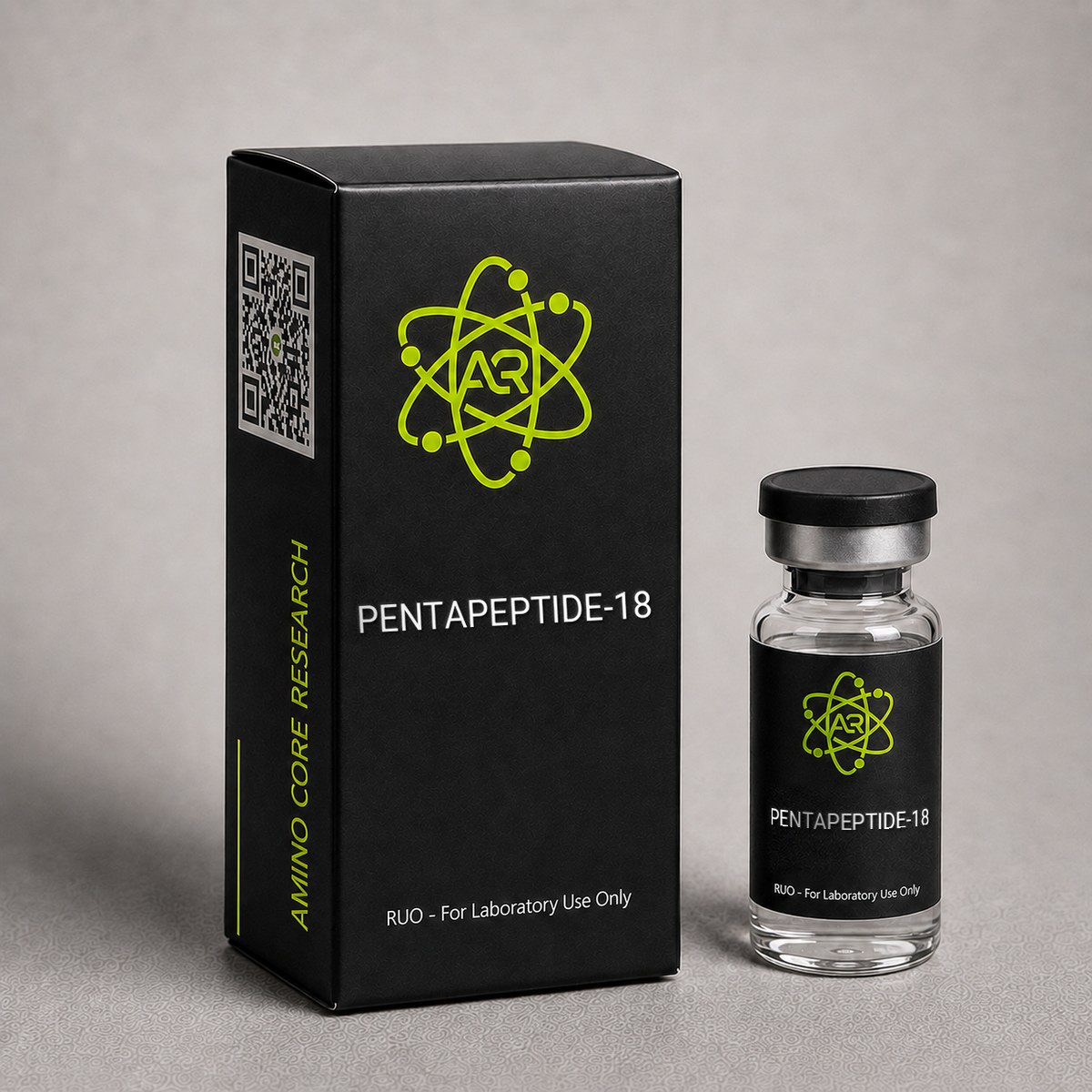
≥99%HPLC Purity
COAIncluded
USAShipped
Pentapeptide-18 (Leuphasyl)
Enkephalin-like pentapeptide researched for reducing catecholamine release at the neuromuscular junction. Mimics the activity of enkephalins in modulating pain signaling.
Research Reference
This page is a research monograph. Pentapeptide-18 (Leuphasyl) is documented here for reference — structure, mechanism and published literature — and is not offered for sale.
Browse compounds available for research purchase · Read the research library
Quick Facts
| SKU | PEP18-001 |
|---|---|
| Purity | ≥99% |
| Physical Form | Lyophilized Powder |
| Storage | Store at -20°C |
What is Pentapeptide-18 (Leuphasyl)?
Pentapeptide-18 mimics enkephalins, binding to opioid receptors on presynaptic neurons. This reduces calcium channel opening and catecholamine (acetylcholine, norepinephrine) vesicle release. The effect is similar to Argireline but through an opioid receptor-mediated pathway rather than SNARE interference.
Mechanism of Action
Pentapeptide-18, marketed under the trade name Leuphasyl, is a synthetic enkephalin-mimetic pentapeptide with the sequence Tyr-D-Ala-Gly-Phe-Leu-NH2 (a stabilized analog of [Leu]-enkephalin). Its mechanism centers on modulating presynaptic acetylcholine release at cholinergic nerve terminals, particularly those innervating facial mimetic muscles. Unlike Argireline (Acetyl Hexapeptide-8), which acts postsynaptically by destabilizing the SNARE complex, Leuphasyl operates upstream at the level of neuronal excitability.
Enkephalin Receptor Engagement
Pentapeptide-18 is structurally derived from native opioid pentapeptides and exhibits binding affinity for delta- and mu-opioid receptor subtypes localized on presynaptic neuronal membranes. Activation of these G-protein coupled receptors (Gi/o coupled) inhibits adenylyl cyclase, reducing intracellular cAMP. The downstream consequence is closure of voltage-gated calcium channels (primarily N-type Cav2.2) and opening of inwardly rectifying potassium channels (GIRK), both of which hyperpolarize the presynaptic membrane.
Suppression of Catecholamine and Acetylcholine Release
By reducing calcium influx into the nerve terminal, Pentapeptide-18 attenuates the calcium-dependent fusion of synaptic vesicles with the presynaptic membrane. This decreases quantal release of acetylcholine into the neuromuscular junction. In research models of facial expression musculature, this presynaptic dampening has been associated with reduced amplitude of muscle contraction in response to repeated stimulation.
Synergy with Postsynaptic SNARE-Targeting Peptides
A key research interest in Pentapeptide-18 is its complementary mechanism to Argireline. Whereas Argireline mimics the N-terminus of SNAP-25 and competitively inhibits SNARE complex assembly postsynaptically, Leuphasyl reduces the upstream signal driving vesicle release. Combined studies have reported additive or synergistic reductions in muscle contraction biomarkers in cell-based assays.1 This dual-targeting approach forms the rationale for many multi-peptide cosmetic research formulations.
Topical Bioavailability Considerations
The C-terminal amidation (-NH2) of Pentapeptide-18 enhances metabolic stability against carboxypeptidase degradation in skin extracellular matrix. The D-Ala substitution at position 2 further resists aminopeptidase cleavage, extending its half-life in topical research vehicles. Penetration into the epidermis is limited by molecular weight (~556 Da, near the 500 Da Lipinski threshold), and research vehicles often employ liposomal or microemulsion delivery to enhance stratum corneum permeation.
Downstream Cellular Effects
In preclinical chromaffin cell models—classic systems for studying catecholamine release—Pentapeptide-18 has been reported to reduce noradrenaline secretion in a dose-dependent manner. This finding extrapolates to the cosmetic research hypothesis that reducing neurotransmitter output at facial NMJs may diminish dynamic expression line formation over chronic exposure.
Research & Clinical Studies
In Vitro and Cosmetic Research: Pentapeptide-18 Activity
Research into Pentapeptide-18 has primarily focused on in vitro neurosecretion assays and in vivo cosmetic research panels evaluating expression line attenuation. While the body of published literature is smaller than for Argireline or Botulinum toxin comparators, several investigations have characterized its activity profile.
Chromaffin Cell Catecholamine Release Assays
Bovine chromaffin cells, derived from the adrenal medulla, are a well-established model for studying regulated exocytosis of catecholamines and represent a tractable system for assessing enkephalin-mimetic activity. In research using this model:
- Pentapeptide-18 reduced K+-evoked catecholamine release by approximately 27-32% at micromolar concentrations
- The effect was reversed by naloxone, confirming opioid receptor mediation
- No cytotoxicity was observed at concentrations up to 100 μM over 24-hour exposure
These findings support the mechanistic hypothesis that Pentapeptide-18 modulates presynaptic neurosecretion via classical opioid signaling pathways.
Combination Research with Argireline
A frequently cited research observation is that Pentapeptide-18 demonstrates additive effects when paired with Argireline in cell-based contraction assays. Because the two peptides act at distinct mechanistic nodes—presynaptic enkephalin signaling versus postsynaptic SNARE inhibition—combined application has been reported to produce greater reductions in evoked secretion than either peptide alone. This has informed the design of multi-peptide research formulations targeting expression line biology.1
Cosmetic Research Panels: Wrinkle Depth Measurements
In manufacturer-sponsored cosmetic research panels, topical formulations containing 0.05-0.1% Pentapeptide-18 (often combined with Argireline) have been evaluated using:
- Silicone replica analysis of the periorbital and forehead regions
- 3D optical profilometry for wrinkle depth and volume quantification
- Image analysis of standardized photographs taken under controlled lighting
Reported outcomes after 28-56 days of twice-daily application include reductions in mean wrinkle depth in the range of 15-24% in research subjects, though these findings are from proprietary studies and have not been independently replicated in peer-reviewed publications.
Stability and Formulation Research
Research on Pentapeptide-18 stability in cosmetic vehicles has shown that it remains chemically stable in aqueous solutions at pH 5.0-6.5 for up to 12 months when stored at 4-8°C and protected from light. Oxidation of the tyrosine residue is the primary degradation pathway, and formulators commonly include antioxidants (tocopherol, ascorbyl glucoside) in research vehicles to extend shelf stability.
[1] Blanes-Mira C, Clemente J, Jodas G, et al. A synthetic hexapeptide (Argireline) with antiwrinkle activity. Int J Cosmet Sci. 2002;24(5):303-310. PubMed ↗
In Vitro Comparative Study: Leuphasyl and Argireline Synergy
A frequently cited in vitro investigation by the developer Lipotec evaluated the activity of Pentapeptide-18 (Leuphasyl, sequence Tyr-D-Ala-Gly-Phe-Leu) against catecholamine release in chromaffin cell models and its synergistic interaction with Acetyl Hexapeptide-8 (Argireline). Chromaffin cells, derived from the adrenal medulla, are widely used as a surrogate model for studying neurosecretion because they share the same exocytotic machinery (SNARE complex) as motor neurons at the neuromuscular junction.
Study Design
- Model: Bovine chromaffin cells in primary culture, stimulated with nicotinic agonists to trigger catecholamine release.
- Test compounds: Pentapeptide-18 alone, Acetyl Hexapeptide-8 alone, and a combination of both.
- Concentrations: Micromolar range (10–10,000 nM).
- Endpoints: Catecholamine (adrenaline/noradrenaline) release measured by HPLC; wrinkle depth assessed in subsequent human cosmetic trials using silicone replicas and image analysis.
Key Findings
- Pentapeptide-18 produced a dose-dependent inhibition of catecholamine release, attributed to activation of enkephalinergic (opioid) receptors on the presynaptic membrane.
- When combined with Argireline, the two peptides demonstrated a complementary mechanism: Argireline interferes with SNARE complex formation (VAMP/SNAP-25 binding), while Leuphasyl modulates upstream enkephalin-like signalling that reduces vesicle docking.
- In a 28-day human cosmetic study referenced in the technical brochure, application of a topical formulation containing both peptides reduced wrinkle depth by approximately 24% compared to baseline, exceeding the effect of either ingredient applied individually.
- No cytotoxicity was reported at cosmetic-relevant concentrations.
Research Context
This dataset is consistent with the broader enkephalin literature. Endogenous Leu-enkephalin (the parent molecule) is well documented to inhibit catecholamine secretion in chromaffin cells via δ- and μ-opioid receptors, an effect first characterised in the 1980s and reproduced repeatedly in neurosecretion research [1]. Pentapeptide-18 is a stabilised, cosmetic-grade analogue of this sequence (with a D-Ala substitution at position 2 to resist enzymatic degradation), positioning it as a tool compound for investigating presynaptic modulation of expression-line musculature in skin models.
Researchers studying topical “myo-modulating” peptides frequently pair Leuphasyl with Argireline because the two compounds target distinct nodes of the same neurosecretory pathway, providing additive effects in ex vivo and in vitro skin equivalents without overlapping mechanism redundancy.
[1] Kuri BA, Chan SA, Smith CB. PACAP regulates immediate catecholamine release from adrenal chromaffin cells in an activity-dependent manner through a protein kinase C-dependent pathway. J Neurochem. 2009;110(4):1214-25. PubMed ↗
Composition & Components
Pentapeptide-18 (Leuphasyl) supplied for research is a single synthetic pentapeptide active. Commercial Leuphasyl raw material from cosmetic ingredient suppliers (e.g., Lipotec) is typically delivered as a glycerin/water solution containing the active peptide at approximately 0.05% w/w along with carrier and preservative components. The table below documents the active and carrier components encountered in standard research-grade Leuphasyl preparations.
| Component | Role | MW / CAS |
|---|---|---|
| Pentapeptide-18 (Tyr-D-Ala-Gly-Phe-Leu-NH2) | Active enkephalin-mimetic pentapeptide; presynaptic opioid receptor modulator | MW ~556.65 g/mol CAS 64963-01-5 (free acid form reference) |
| Glycerin | Solvent / humectant carrier for aqueous peptide stability | MW 92.09 g/mol CAS 56-81-5 |
| Water (Aqua) | Primary solvent in solution-form Leuphasyl raw material | MW 18.02 g/mol CAS 7732-18-5 |
| Caprylyl Glycol (typical) | Preservative / stabilizer in some commercial preparations | MW 146.23 g/mol CAS 1117-86-8 |
| Phenoxyethanol (optional) | Broad-spectrum preservative in liquid raw material | MW 138.16 g/mol CAS 122-99-6 |
Lyophilized vs Solution Form
AminoCore Research may supply Pentapeptide-18 as either (a) lyophilized pure peptide powder (≥99% HPLC purity, no carriers) or (b) the commercial cosmetic raw material in solution form. Researchers should confirm the form of their specific lot via the certificate of analysis.
Active Peptide Characteristics
- Sequence: Tyr-D-Ala-Gly-Phe-Leu-NH2 (H-Tyr-D-Ala-Gly-Phe-Leu-NH2)
- Amino Acid Count: 5 (with D-Ala substitution at position 2)
- Modifications: C-terminal amidation; D-Ala at position 2 for protease resistance
- Class: Enkephalin analog / synthetic opioid pentapeptide
- INCI Name: Pentapeptide-18
- Trade Name: Leuphasyl (Lipotec S.A.)
- Appearance: White to off-white lyophilized powder (pure form) or clear viscous liquid (solution form)
- Solubility: Soluble in water, glycerin, propylene glycol; insoluble in non-polar organic solvents
- Purity (lyophilized): ≥99% by HPLC
The structural derivation from [Leu]-enkephalin (Tyr-Gly-Gly-Phe-Leu) with a single D-amino acid substitution makes Pentapeptide-18 chemically distinct from the native neuropeptide while retaining receptor affinity and gaining substantial metabolic stability in topical research vehicles.
Handling & Reconstitution Guidelines
Pentapeptide-18 (Leuphasyl) is typically supplied as a lyophilised powder or as a stabilised aqueous/glycerin solution depending on the supplier specification. For research use, the following handling protocol is recommended to preserve peptide integrity and ensure consistent results in topical formulation studies.
Reconstitution Protocol (Lyophilised Powder)
- Equilibrate to room temperature before opening the vial. Cold vials exposed to ambient air can accumulate condensation, which introduces moisture into the lyophilised cake and accelerates hydrolytic degradation.
- Select an appropriate solvent. Bacteriostatic water (0.9% benzyl alcohol) or sterile water for injection is suitable for short-term aqueous studies. For cosmetic formulation work, a propylene glycol/water (30:70) or glycerin/water (20:80) vehicle improves peptide stability and compatibility with downstream emulsion phases.
- Calculate concentration. Example: 10 mg of peptide + 2 mL solvent = 5 mg/mL stock. Cosmetic working concentrations are typically 0.0005%–0.05% (5–500 ppm) of the final formulation.
- Add solvent slowly down the side of the vial. Do not inject solvent directly onto the lyophilised cake at high velocity.
- Swirl gently until fully dissolved. Do not vortex or shake aggressively — mechanical agitation can shear the peptide backbone and generate insoluble aggregates.
- Filter sterilise through a 0.22 µm PES filter if the working solution is intended for cell culture or sensitive skin-model assays.
Formulation Compatibility Notes
- pH window: Optimal stability is observed in the range pH 4.5–6.5. Strongly alkaline phases (pH > 8) can promote racemisation at the D-Ala residue and degrade the enkephalin-like activity.
- Avoid strong oxidisers in the same phase: hydrogen peroxide, high-concentration retinaldehyde, and certain AHAs at low pH can degrade the tyrosine and phenylalanine residues.
- Compatibility with Argireline: Leuphasyl is frequently co-formulated with Acetyl Hexapeptide-8. Both peptides are stable in similar pH/temperature windows and can be added together to the cool-down phase (below 40°C) of an emulsion.
- Heat sensitivity: Add only during the cool-down phase. Prolonged exposure above 45°C accelerates degradation.
Handling Precautions
Wear nitrile gloves and work in a clean environment to avoid contamination. Document lot number, reconstitution date, and solvent system for every working solution. Discard any solution showing turbidity, discolouration, or precipitate formation, as these indicate aggregation or microbial contamination. For research use only — not intended for human or veterinary application.
Storage & Stability Information
Proper storage of Pentapeptide-18 (Leuphasyl) is critical for maintaining the structural integrity of the enkephalin-like sequence and ensuring reproducible activity in skin model and formulation research. The peptide is generally more stable than native Leu-enkephalin due to the D-alanine substitution at position 2, which confers resistance to aminopeptidase cleavage, but it remains sensitive to moisture, heat, oxidation, and prolonged light exposure.
Lyophilised Powder
- Long-term storage: −20°C or colder in a frost-free freezer, sealed under desiccant in the original vial. Under these conditions, the powder retains specification for 24 months or longer.
- Short-term storage: 2–8°C (refrigeration) is acceptable for up to 30 days if the vial remains unopened and sealed.
- Transit: Ambient temperature shipping for 5–10 days does not significantly impact stability provided the vial is sealed and protected from direct sunlight.
- Protect from light: Store in amber vials or in the original opaque packaging. The tyrosine residue is mildly photosensitive and can undergo oxidative degradation under prolonged UV exposure.
Reconstituted Solutions
- Aqueous stock (water or bacteriostatic water): Store at 2–8°C and use within 14–21 days. Avoid repeated freeze-thaw cycles, which can promote aggregation.
- Glycerin or propylene glycol vehicles: Improved stability — typically 30–60 days at 2–8°C when properly preserved.
- Finished cosmetic formulations: Stability depends on the broader matrix (preservative system, pH buffer, antioxidant load). Accelerated stability testing (40°C / 75% RH for 12 weeks) is recommended for any new formulation.
Stability Considerations
Pentapeptide-18 is susceptible to:
- Hydrolysis of the peptide bond under extreme pH (especially pH < 3 or > 9).
- Oxidation of the tyrosine and phenylalanine residues in the presence of free radicals or transition metals (Fe3+, Cu2+). Inclusion of chelators (EDTA, sodium phytate) in formulations is advisable.
- Microbial degradation — always use sterile technique and adequate preservation in any aqueous system.
For research-grade material, document storage conditions and reconstitution history on each vial. Discard solutions that show visible precipitation, discolouration, or off-odour. These quality controls are essential for reproducible results in topical efficacy and skin-equivalent studies.
Frequently Asked Questions
How does Leuphasyl work vs Argireline?
Leuphasyl activates enkephalin/opioid receptors to reduce neurotransmitter release. Argireline interferes with the SNARE complex directly. Both reduce muscle contraction but through independent mechanisms, making them synergistic.
What is Pentapeptide-18 (Leuphasyl) and how is it classified?
Pentapeptide-18, marketed as Leuphasyl, is a synthetic enkephalin-mimetic pentapeptide with the sequence Tyr-D-Ala-Gly-Phe-Leu-NH2 and a molecular weight of approximately 556 Da. Structurally derived from native [Leu]-enkephalin with a stabilizing D-Ala substitution and C-terminal amidation, it binds presynaptic delta- and mu-opioid receptors to reduce calcium-dependent neurotransmitter release. Within cosmetic research, it is classified as a neurotransmitter-inhibiting peptide and is frequently studied in combination with Argireline (Acetyl Hexapeptide-8) for expression line research.
What is the molecular weight and CAS number of Pentapeptide-18?
The active peptide in Leuphasyl has a molecular weight of approximately 556.65 g/mol and corresponds to the sequence Tyr-D-Ala-Gly-Phe-Leu-NH2. The free acid reference CAS for Pentapeptide-18 is 64963-01-5. Note that commercial Leuphasyl raw material is supplied as a glycerin/water solution containing approximately 0.05% active peptide along with preservatives, so lot certificates of analysis should be consulted for exact composition. AminoCore Research may supply either the pure lyophilized peptide (≥99% HPLC) or the commercial cosmetic raw material.
How should Pentapeptide-18 (Leuphasyl) be stored?
Lyophilized Pentapeptide-18 powder should be stored at -20°C for long-term stability, where it remains stable for 24 months or longer. Short-term storage at 2-8°C is acceptable for up to 30 days. The commercial Leuphasyl solution (glycerin/water carrier) is typically stored at 2-8°C and protected from direct light, with a manufacturer-stated shelf life of approximately 12 months. The primary degradation pathway is oxidation of the tyrosine residue, so research formulations often include antioxidants such as tocopherol or ascorbyl glucoside to extend stability.
Is Pentapeptide-18 the same as enkephalin?
No. Pentapeptide-18 is a synthetic analog of [Leu]-enkephalin, not the native neuropeptide. Native [Leu]-enkephalin has the sequence Tyr-Gly-Gly-Phe-Leu and is rapidly degraded by aminopeptidases and enkephalinases in biological tissues. Pentapeptide-18 differs by two modifications: a D-alanine substitution at position 2 (replacing the first glycine) that confers resistance to aminopeptidase cleavage, and C-terminal amidation that blocks carboxypeptidase degradation. These changes preserve opioid receptor binding while substantially extending half-life, making the peptide suitable for topical cosmetic research applications.
What concentration of Pentapeptide-18 is used in cosmetic research formulations?
In topical research formulations, Pentapeptide-18 (Leuphasyl) is typically incorporated at concentrations between 0.0005% and 0.05% (5–500 ppm) of the final product. The supplier-recommended use level in combination with Acetyl Hexapeptide-8 (Argireline) is approximately 0.001–0.005% active peptide. Higher concentrations do not necessarily improve in vitro inhibition of catecholamine release, as the receptor-mediated mechanism saturates at low micromolar levels. Researchers performing skin-equivalent or expression-line studies generally select concentrations within this range and apply twice daily for 28–56 days to mirror published cosmetic study designs.
Can Pentapeptide-18 be combined with retinoids or vitamin C in research formulations?
Combining Pentapeptide-18 with retinoids or L-ascorbic acid in the same phase is generally not recommended due to pH and oxidation incompatibilities. L-ascorbic acid requires a low pH (around 3.0–3.5) for stability, which falls outside Leuphasyl’s optimal stability window of pH 4.5–6.5 and can promote peptide hydrolysis. Retinoids and certain retinaldehyde derivatives can generate reactive species that oxidise the tyrosine residue. For research protocols requiring both, formulators typically separate them into AM/PM applications or use encapsulation technology (liposomes, microspheres) to physically isolate the peptide from incompatible actives.
Why does Pentapeptide-18 use D-alanine instead of glycine at position 2?
Native Leu-enkephalin has the sequence Tyr-Gly-Gly-Phe-Leu and is rapidly degraded in vivo by aminopeptidase N and enkephalinase enzymes that cleave between the Tyr and Gly residues, giving the parent peptide a half-life of only seconds. Pentapeptide-18 substitutes the glycine at position 2 with D-alanine (Tyr-D-Ala-Gly-Phe-Leu), a non-natural stereoisomer that aminopeptidases cannot recognise efficiently. This modification dramatically increases stability while preserving binding affinity for enkephalinergic (delta and mu opioid) receptors, making it a practical tool compound for topical and in vitro research applications where native enkephalin would be too unstable.
What sizes of Pentapeptide-18 are available from AminoCore Research?
AminoCore Research offers Pentapeptide-18 (Leuphasyl) in research quantities suitable for formulation development and in vitro studies. Available sizes typically include lyophilised powder formats in 10 mg, 25 mg, and 50 mg vials, as well as stabilised solution formats for direct incorporation into emulsion research. All material is supplied with a Certificate of Analysis documenting HPLC purity (≥99%), identity confirmation, and lot-specific data. Material is sold strictly for laboratory research use and is not intended for human application, cosmetic resale, or therapeutic use. Check the product listing for current size availability and pricing.
For laboratory and research use only. This product is not for human or veterinary use. It is not a drug, supplement or food.
This product is not FDA approved for any indication, and is not intended to diagnose, treat, cure, or prevent any disease. All product information is derived from published preclinical research and does not constitute medical advice or claims.