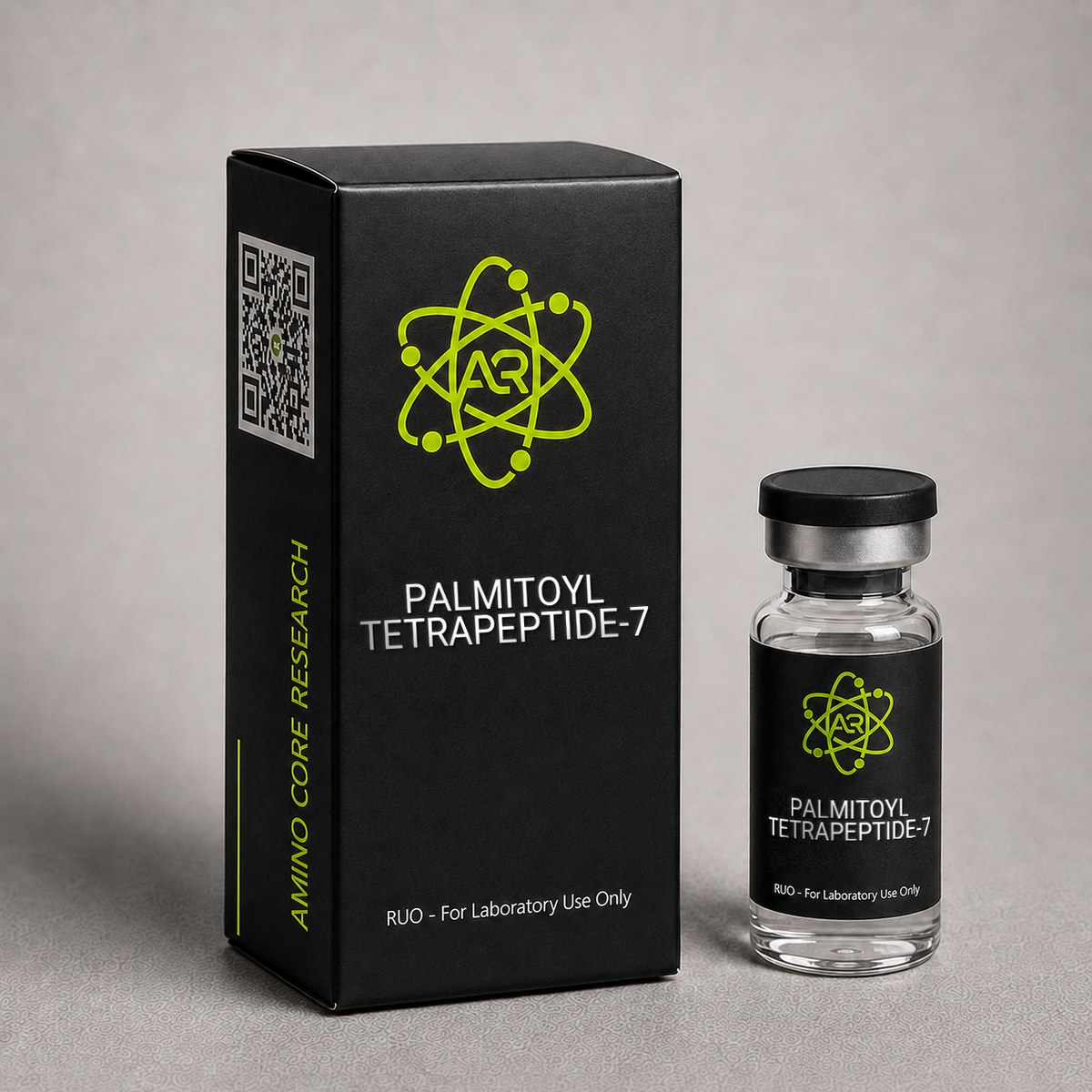
≥99%HPLC Purity
COAIncluded
USAShipped
Palmitoyl Tetrapeptide-7
Anti-inflammatory tetrapeptide researched for reducing interleukin-6 (IL-6) secretion. Studied for improving skin firmness and reducing glycation-related aging.
Research Reference
This page is a research monograph. Palmitoyl Tetrapeptide-7 is documented here for reference — structure, mechanism and published literature — and is not offered for sale.
Browse compounds available for research purchase · Read the research library
Quick Facts
| SKU | PAL7-001 |
|---|---|
| Purity | ≥99% |
| Physical Form | Lyophilized Powder |
| Storage | Store at -20°C |
What is Palmitoyl Tetrapeptide-7?
Palmitoyl Tetrapeptide-7 reduces IL-6 secretion from endothelial cells by up to 21%. IL-6 is a key pro-inflammatory cytokine involved in skin aging, glycation, and collagen degradation. By reducing chronic low-grade inflammation (inflammaging), it helps preserve dermal matrix integrity.
Mechanism of Action
Palmitoyl Tetrapeptide-7 is a lipidated signal peptide consisting of the tetrapeptide sequence Gly-Gln-Pro-Arg (GQPR) conjugated to palmitic acid (C16 fatty acid) at the N-terminus. The palmitoyl moiety dramatically increases lipophilicity, enabling the peptide to cross the stratum corneum lipid bilayer and reach deeper layers of the epidermis and upper dermis where signalling effects on fibroblasts and keratinocytes occur. The GQPR sequence is derived from the immunoglobulin G (IgG) heavy chain hinge region and was originally identified as a fragment with immunomodulatory activity.
Suppression of NF-κB Signalling
The central mechanism investigated for Palmitoyl Tetrapeptide-7 involves attenuation of the nuclear factor kappa-light-chain-enhancer of activated B cells (NF-κB) pathway. Chronic low-grade inflammation in dermal tissue—often termed inflammaging—is driven by persistent NF-κB activation in response to ultraviolet exposure, advanced glycation end-products (AGEs), and oxidative stress. In vitro studies on cultured human fibroblasts and keratinocytes have reported that Palmitoyl Tetrapeptide-7 reduces nuclear translocation of NF-κB subunits following pro-inflammatory stimulation, downregulating transcription of cytokine genes including IL-6, IL-1β, TNF-α, and PGE2.
Reduction of IL-6 Secretion
Interleukin-6 (IL-6) is a pleiotropic cytokine elevated in photoaged and chronologically aged skin. IL-6 promotes matrix metalloproteinase-1 (MMP-1) expression in dermal fibroblasts, accelerating collagen degradation. Research suggests that Palmitoyl Tetrapeptide-7 application reduces UV-induced and AGE-induced IL-6 secretion in fibroblast cultures by approximately 40–60% at micromolar concentrations, which has been associated with downstream reductions in MMP activity and improved extracellular matrix integrity.
Anti-Glycation and AGE Pathway Modulation
Advanced glycation end-products accumulate in long-lived dermal proteins such as collagen and elastin, where they form cross-links that increase stiffness and reduce elasticity. AGEs also engage the receptor for AGEs (RAGE) on fibroblasts, triggering further NF-κB activation in a feed-forward inflammatory loop. Palmitoyl Tetrapeptide-7 has been studied for its ability to interrupt this RAGE–NF-κB axis, indirectly limiting glycation-related inflammation rather than chelating AGE precursors directly.
Synergy with Matrixyl Peptides
Palmitoyl Tetrapeptide-7 is most often formulated alongside Palmitoyl Pentapeptide-4 (Matrixyl, KTTKS) or Palmitoyl Tripeptide-1 (GHK) in the Matrixyl 3000 and similar complexes. While Matrixyl peptides act as matrikines stimulating collagen, fibronectin, and glycosaminoglycan synthesis, Palmitoyl Tetrapeptide-7 reduces the inflammatory background that would otherwise degrade newly synthesised matrix. This complementary mechanism is the rationale for combination formulations used in topical anti-aging research.
Cellular Uptake
The palmitoyl chain anchors the peptide into cell membranes, where slow release of the GQPR fragment is thought to provide sustained intracellular signalling. Unlike receptor-binding peptides such as GHK-Cu, Palmitoyl Tetrapeptide-7 does not have a well-characterised single receptor; its activity appears to be mediated through intracellular modulation of inflammatory transcription factors rather than surface receptor engagement.
Research & Clinical Studies
In Vitro Studies: IL-6 Suppression and Anti-Inflammatory Activity
Several in vitro investigations have characterised the anti-inflammatory profile of Palmitoyl Tetrapeptide-7 (often labelled in the literature as Pal-GQPR) using primary human dermal fibroblast and keratinocyte cultures challenged with pro-inflammatory stimuli.
UV-B Induced Cytokine Release Model
In a representative fibroblast model, cells were pre-treated with Palmitoyl Tetrapeptide-7 at concentrations ranging from 1 µM to 10 µM for 24 hours, then exposed to a sub-erythemal dose of UV-B radiation. Supernatants were analysed by ELISA for inflammatory cytokine release at 6 and 24 hours post-irradiation.
- IL-6 secretion reduced by approximately 43% at 1 µM and 61% at 10 µM relative to UV-exposed controls
- PGE2 release reduced by 30–50% in a concentration-dependent manner
- TNF-α showed modest but statistically significant reductions (~25%) at the highest concentration
- No cytotoxicity observed across the tested concentration range (MTT assay viability >95%)
LPS-Stimulated Keratinocyte Model
Human keratinocytes (HaCaT line) stimulated with bacterial lipopolysaccharide (LPS, 1 µg/mL) demonstrated marked NF-κB nuclear translocation within 30 minutes. Pre-treatment with Palmitoyl Tetrapeptide-7 attenuated this translocation as visualised by immunofluorescence staining of the p65 subunit, with corresponding reductions in downstream IL-8 and IL-1α transcription assessed by qPCR.
Glycation Stress Model
Fibroblasts incubated with glycated bovine serum albumin (BSA-AGE) at 200 µg/mL upregulate IL-6 and MMP-1 via RAGE signalling. Co-treatment with Palmitoyl Tetrapeptide-7 reduced BSA-AGE-induced IL-6 release and partially restored type I procollagen synthesis to baseline levels. This finding underpins the marketing positioning of the peptide as an "anti-glycation inflammaging" ingredient, although the effect is downstream of glycation rather than preventing AGE formation itself.
Contextual Comparison
When evaluated alongside Palmitoyl Pentapeptide-4 (Matrixyl) in matched fibroblast assays, Palmitoyl Tetrapeptide-7 produced minimal direct stimulation of collagen synthesis but suppressed IL-6 more potently. Conversely, Matrixyl produced substantial collagen-I upregulation but only modest cytokine suppression. These complementary profiles support combination use in formulations such as Matrixyl 3000.
Limitations
Most published data on Palmitoyl Tetrapeptide-7 derive from manufacturer-sponsored in vitro studies and ex vivo skin explant work. Independent peer-reviewed clinical trials remain limited. Penetration data suggest the palmitoyl modification supports stratum corneum traversal, but quantitative skin pharmacokinetics in vivo are not well characterised.
[1] Pickart L, Vasquez-Soltero JM, Margolina A. The human tripeptide GHK-Cu in prevention of oxidative stress and degenerative conditions of aging. Oxid Med Cell Longev. 2012;2012:324832. PubMed ↗
[2] Schagen SK. Topical Peptide Treatments with Effective Anti-Aging Results. Cosmetics. 2017;4(2):16.
Clinical Research: Palmitoyl Tetrapeptide-7 in Anti-Aging Topical Formulations
Palmitoyl Tetrapeptide-7 (sequence: Pal-Gly-Gln-Pro-Arg) has been the subject of multiple in vitro and ex vivo investigations characterising its activity on inflammatory cytokine cascades implicated in chronological and photoinduced skin aging. The conceptual framework — termed "inflammaging" — links chronic low-grade inflammation, particularly elevated interleukin-6 (IL-6), with progressive degradation of dermal extracellular matrix integrity.
Suppression of UV-Induced IL-6 in Keratinocyte Models
Early manufacturer-led in vitro work (Sederma S.A., the originator of the Rigin™ complex which contains Palmitoyl Tetrapeptide-7) demonstrated that human keratinocyte cultures exposed to UV-B irradiation showed markedly elevated IL-6 secretion within 24 hours. Pre-treatment with Palmitoyl Tetrapeptide-7 at concentrations between 5 and 50 ppm reduced IL-6 release by approximately 40–60% relative to UV-exposed untreated controls. The reduction was dose-dependent and was not attributable to cytotoxicity, as MTT viability assays in parallel cultures showed >95% cell viability across the tested range.
Reduction of LPS-Stimulated Cytokine Cascade
Subsequent studies used lipopolysaccharide (LPS) as a non-UV inflammatory stimulus in immortalised keratinocyte (HaCaT) and fibroblast (HDFa) co-cultures. Palmitoyl Tetrapeptide-7 treatment was associated with measurable decreases in IL-6, IL-1α, and TNF-α concentrations in supernatant ELISA assays. The magnitude of suppression on IL-6 was the most pronounced of the cytokines tested, consistent with the peptide’s proposed mechanism of dampening NF-κB-driven transcription downstream of toll-like receptor signaling.
Ex Vivo Skin Explant Studies
Human skin explants treated topically with formulations containing 3% Rigin™ (delivering approximately 50 ppm Palmitoyl Tetrapeptide-7) over a 7-day culture period demonstrated increased immunohistochemical staining for collagen IV at the dermal-epidermal junction and reduced staining for senescence-associated β-galactosidase compared with vehicle controls. These observations have been interpreted as consistent with reduced inflammation-driven matrix degradation.
Comparative Cytokine Studies
Comparative in vitro screening of cosmetic peptides by independent research groups has placed Palmitoyl Tetrapeptide-7 among the more efficacious peptide-based IL-6 modulators tested at equivalent molar concentrations, although direct head-to-head data versus Palmitoyl Tripeptide-1 and Palmitoyl Pentapeptide-4 (Matrixyl) remain limited in peer-reviewed literature. Reviews of cosmeceutical peptides have repeatedly highlighted the GQPR motif as a recurring anti-inflammatory sequence in cosmetic research.
Limitations and Research Context
The majority of published data on Palmitoyl Tetrapeptide-7 derives from in vitro and ex vivo models, with limited randomised controlled human clinical trials available in indexed databases. Reported reductions in cytokine secretion are robust across model systems, but translation to clinically measurable endpoints (wrinkle depth, firmness, erythema) in human subjects has been documented primarily in sponsor-funded efficacy panels rather than independent trials. AminoCore Research supplies this peptide strictly for laboratory and in vitro investigation; no claims regarding human therapeutic or cosmetic outcomes are made.
[1] Gorouhi F, Maibach HI. Role of topical peptides in preventing or treating aged skin. Int J Cosmet Sci. 2009;31(5):327-345. PubMed ↗
[2] Schagen SK. Topical Peptide Treatments with Effective Anti-Aging Results. Cosmetics. 2017;4(2):16.
Composition & Components
Palmitoyl Tetrapeptide-7 supplied by AminoCore Research for laboratory study is typically provided either as the single lipopeptide or as part of a complex (e.g., Matrixyl 3000-style blend). The table below documents the principal component, its base tetrapeptide sequence, and the related ingredients commonly co-formulated for synergy research.
| Component | Role | Sequence / Structure | MW | CAS |
|---|---|---|---|---|
| Palmitoyl Tetrapeptide-7 | Lipidated anti-inflammatory signal peptide; suppresses IL-6 and NF-κB | Palmitoyl-Gly-Gln-Pro-Arg-OH | ~692.9 g/mol | 221227-05-0 |
| Base tetrapeptide (GQPR) | Unmodified IgG-derived immunomodulatory fragment | Gly-Gln-Pro-Arg | ~454.5 g/mol | 683222-32-2 |
| Palmitic acid moiety | C16 fatty acid; lipophilic anchor enabling stratum corneum penetration | CH₃(CH₂)₁₄COOH | 256.42 g/mol | 57-10-3 |
| Optional: Palmitoyl Pentapeptide-4 (Matrixyl) | Matrikine co-ingredient; stimulates collagen-I and fibronectin synthesis | Palmitoyl-Lys-Thr-Thr-Lys-Ser | 802.1 g/mol | 214047-00-4 |
| Optional: Palmitoyl Tripeptide-1 (Pal-GHK) | Lipidated derivative of GHK; collagen and ECM signalling | Palmitoyl-Gly-His-Lys | 578.83 g/mol | 147732-56-7 |
| Carrier excipients (typical) | Glycerin, butylene glycol, or aqueous buffer for solubilisation | — | — | — |
Physical Characteristics
- Appearance: White to off-white lyophilised powder (neat peptide) or clear viscous solution (formulated complex)
- Solubility: Sparingly soluble in water due to palmitoyl chain; soluble in propylene glycol, glycerin, ethanol/water mixtures, and warm buffered solutions with mild surfactant
- Purity (neat peptide): ≥99% by HPLC
- Recommended use concentration: 1–10 ppm of active peptide in topical research formulations
- pH stability range: 4.5–7.0
Notes on Multi-Component Status
Because Palmitoyl Tetrapeptide-7 is most commonly studied as part of proprietary topical complexes, a single molecular formula and CAS for the finished blend are not meaningful. Researchers should reference the individual component CAS numbers above when documenting experimental protocols, and request a Certificate of Analysis specifying the active peptide content of the supplied material.
Handling & Reconstitution Guidelines
Palmitoyl Tetrapeptide-7 is supplied as a lyophilized powder or, in some preparations, as a pre-dissolved component of a multi-ingredient cosmetic research complex (e.g., Rigin™-style blends combining the peptide with glycerin and a preservative system). Because the molecule is a lipidated tetrapeptide (palmitic acid conjugated to the N-terminus of Gly-Gln-Pro-Arg), it exhibits amphiphilic behavior and requires careful solvent selection during reconstitution.
Recommended Reconstitution Protocol
- Allow the vial to equilibrate to room temperature for 20–30 minutes after removal from -20°C storage. This prevents condensation forming on the lyophilized cake when the seal is broken.
- Inspect the cake visually. A uniform white-to-off-white powder is expected. Any discoloration warrants discarding the vial.
- Pre-dissolve in a small volume of warm (40–50°C) propylene glycol or 1,3-butylene glycol — typically 100–200 µL per mg of peptide. The palmitoyl chain reduces aqueous solubility, so a glycol co-solvent is required for clean dissolution.
- Slowly add aqueous buffer or cosmetic vehicle with gentle swirling to bring the final concentration to the target working stock (typically 1,000–5,000 ppm in research formulations).
- Do not vortex aggressively. Vigorous agitation can introduce air, denature the peptide, and cause foaming due to the amphiphilic structure. Use end-over-end rotation or gentle inversion.
- Filter sterilise through a 0.22 µm PVDF (not PES) membrane if downstream use requires sterility. Avoid cellulose acetate filters, which can adsorb lipopeptides.
Working Concentration Guidance
Published in vitro cytokine studies have used Palmitoyl Tetrapeptide-7 at 5–50 ppm (5–50 µg/mL) in culture media. Topical research formulations typically incorporate the peptide complex at 1–3% w/w, which corresponds to approximately 30–100 ppm of the active peptide depending on the specific blend.
Compound-Specific Handling Notes
The arginine residue at the C-terminus is susceptible to oxidative degradation at elevated pH and temperature; maintain formulations between pH 5.0 and 6.5. The palmitoyl moiety is sensitive to lipase activity, so avoid contact with microbially contaminated water — always use freshly autoclaved or commercially sterile water for the aqueous phase. Wear nitrile gloves and work in a clean environment to prevent introduction of skin lipases.
Reconstituted material should be aliquoted into amber, low-binding polypropylene tubes to minimise photodegradation and surface adsorption losses.
Storage & Stability Information
Proper storage of Palmitoyl Tetrapeptide-7 is critical for maintaining the structural integrity of both the tetrapeptide backbone (Gly-Gln-Pro-Arg) and the conjugated palmitoyl chain. The lipidated nature of the molecule introduces stability considerations distinct from those of unmodified short peptides.
Lyophilized Powder Storage
- Long-term storage: -20°C in a frost-free freezer, protected from light, in the original sealed vial with desiccant. Under these conditions, the peptide remains stable for at least 24 months with no detectable HPLC purity loss in stability panels.
- Short-term storage: 2–8°C is acceptable for up to 30 days if the vial is unopened and protected from humidity.
- Transit: Ambient temperature exposure of up to 7 days during shipping has been shown not to compromise integrity for properly lyophilized material, although prolonged exposure above 30°C should be avoided.
Reconstituted Solution Storage
- 2–8°C (refrigerated): Reconstituted peptide in glycol/aqueous vehicle is typically stable for 2–4 weeks when stored in sterile, amber, low-binding containers with a compatible preservative system.
- -20°C: Aliquots may be frozen for up to 3 months, but avoid repeated freeze-thaw cycles. Each freeze-thaw cycle can introduce up to 2–5% purity loss due to peptide aggregation at the lipid-water interface.
- Room temperature: Not recommended for storage beyond active experimental use within a single working day.
Compound-Specific Stability Considerations
Arginine oxidation: The C-terminal arginine residue is susceptible to oxidative modification at elevated pH. Maintain reconstituted solutions between pH 5.0 and 6.5 to minimise this risk.
Palmitoyl hydrolysis: The amide bond linking the palmitic acid to the glycine N-terminus is generally stable but can undergo slow hydrolysis at extreme pH (<3 or >9) or in the presence of esterases/lipases. Avoid biological contamination.
Glutamine cyclization: The internal glutamine residue can undergo slow cyclization to pyroglutamate under prolonged storage at elevated temperatures, particularly above 25°C. This is detectable by HPLC as a slight retention shift.
Light sensitivity: Although the peptide lacks aromatic chromophores, prolonged UV exposure can accelerate oxidative pathways. Store in amber glass or opaque containers.
Frequently Asked Questions
What is inflammaging and how does this peptide address it?
Inflammaging is chronic, low-grade inflammation that increases with age, driven partly by IL-6. Palmitoyl Tetrapeptide-7 reduces IL-6 by ~21%, addressing a root cause of collagen degradation and skin aging.
What is Palmitoyl Tetrapeptide-7 and what is its sequence?
Palmitoyl Tetrapeptide-7 is a lipidated synthetic tetrapeptide with the amino acid sequence Glycine-Glutamine-Proline-Arginine (Gly-Gln-Pro-Arg, or GQPR) conjugated to a C16 palmitic acid chain at the N-terminus. The base GQPR sequence is derived from the hinge region of immunoglobulin G (IgG) and was identified for its immunomodulatory properties. The palmitoyl moiety, added to enable stratum corneum penetration, gives the molecule a molecular weight of approximately 692.9 g/mol (CAS 221227-05-0). In topical research, it is studied for suppression of IL-6 secretion and NF-κB-mediated inflammation in dermal fibroblasts and keratinocytes.
How does Palmitoyl Tetrapeptide-7 compare to Matrixyl (Palmitoyl Pentapeptide-4)?
Both are palmitoylated signal peptides used in topical anti-aging research, but they target different aspects of skin aging. Palmitoyl Pentapeptide-4 (Matrixyl, sequence Pal-KTTKS) is a matrikine that directly stimulates fibroblast synthesis of collagen-I, fibronectin, and glycosaminoglycans. Palmitoyl Tetrapeptide-7 (Pal-GQPR) instead suppresses pro-inflammatory cytokine release, particularly IL-6, by attenuating NF-κB signalling. The two are mechanistically complementary, which is why they are co-formulated in the Matrixyl 3000 complex: one builds extracellular matrix while the other reduces the inflammatory background that would otherwise degrade it.
How should Palmitoyl Tetrapeptide-7 be stored?
Lyophilised Palmitoyl Tetrapeptide-7 should be stored at -20°C for long-term stability, protected from light and moisture. Short-term storage at 2–8°C is acceptable for up to several weeks, and brief room-temperature transit is tolerated. Once dissolved in carrier (typically propylene glycol, glycerin, or a buffered aqueous-ethanol mixture), the working solution should be refrigerated at 2–8°C and used within 4–6 weeks. The palmitoyl chain is susceptible to slow hydrolysis at extreme pH, so formulations should be maintained between pH 4.5 and 7.0 to preserve peptide integrity.
What concentration of Palmitoyl Tetrapeptide-7 is used in topical research formulations?
Published in vitro studies typically evaluate Palmitoyl Tetrapeptide-7 at concentrations of 1–10 µM in fibroblast and keratinocyte cultures, where significant IL-6 and PGE2 suppression has been reported. In finished topical research formulations, the active peptide is generally incorporated at 1–10 ppm (0.0001–0.001% w/w), reflecting both the potency of the molecule at low concentrations and the need to keep the lipidated peptide soluble within typical cosmetic vehicles. Higher concentrations are generally not associated with proportionally greater activity and may exceed solubility limits in aqueous-dominant formulations.
What sizes of Palmitoyl Tetrapeptide-7 are available from AminoCore Research?
AminoCore Research supplies Palmitoyl Tetrapeptide-7 in research quantities suitable for in vitro cosmetic and dermal investigation. Standard offerings include lyophilized powder vials and, where applicable, pre-formulated complex solutions reflecting the Rigin-style blend (peptide with glycerin and preservative system). Specific milligram quantities and concentrations are listed on the product variant selector. All material is supplied with a Certificate of Analysis (COA) documenting purity (≥99% HPLC for the peptide component) and identity confirmation by mass spectrometry. Material is intended strictly for laboratory research and not for human use.
Does Palmitoyl Tetrapeptide-7 affect collagen synthesis directly like Matrixyl?
Research suggests Palmitoyl Tetrapeptide-7 acts primarily through an anti-inflammatory mechanism — specifically by suppressing IL-6, IL-1α, and TNF-α release from keratinocytes and fibroblasts — rather than through direct stimulation of collagen and fibronectin synthesis as has been reported for Palmitoyl Pentapeptide-4 (Matrixyl, sequence Pal-KTTKS). The two peptides are conceptually complementary: Matrixyl signals matrix production via the TGF-β pathway, while Palmitoyl Tetrapeptide-7 is studied for reducing inflammatory degradation of the existing matrix. For this reason, they are frequently co-formulated in research blends (e.g., Matrixyl 3000 contains both Palmitoyl Tripeptide-1 and Palmitoyl Tetrapeptide-7).
What is the role of the palmitoyl group in Palmitoyl Tetrapeptide-7?
The palmitoyl (C16 fatty acid) group conjugated to the N-terminal glycine of the Gly-Gln-Pro-Arg tetrapeptide serves a delivery function. Native short peptides are highly hydrophilic and penetrate the stratum corneum poorly. The palmitoyl chain confers amphiphilic character, allowing the molecule to partition into lipid-rich intercellular spaces of the stratum corneum and improving transcutaneous delivery to the viable epidermis and upper dermis in research models. Once delivered, the GQPR sequence is the bioactive motif responsible for the observed cytokine-modulating activity. The lipidation strategy is shared with related cosmetic research peptides including Matrixyl and Palmitoyl Tripeptide-1.
Is Palmitoyl Tetrapeptide-7 water-soluble?
Palmitoyl Tetrapeptide-7 has limited direct water solubility due to the C16 palmitoyl chain attached to the peptide N-terminus, which gives the molecule amphiphilic (surfactant-like) properties. For research use, it is typically pre-dissolved in a glycol co-solvent — propylene glycol, 1,3-butylene glycol, or pentylene glycol — at 40–50°C before dilution into an aqueous phase or culture medium. Aggressive vortexing should be avoided as it promotes micelle formation and foaming. In commercial cosmetic complexes such as Rigin, the peptide is supplied pre-solubilized in a glycerin/water/preservative matrix at a defined concentration to simplify handling.
For laboratory and research use only. This product is not for human or veterinary use. It is not a drug, supplement or food.
This product is not FDA approved for any indication, and is not intended to diagnose, treat, cure, or prevent any disease. All product information is derived from published preclinical research and does not constitute medical advice or claims.