
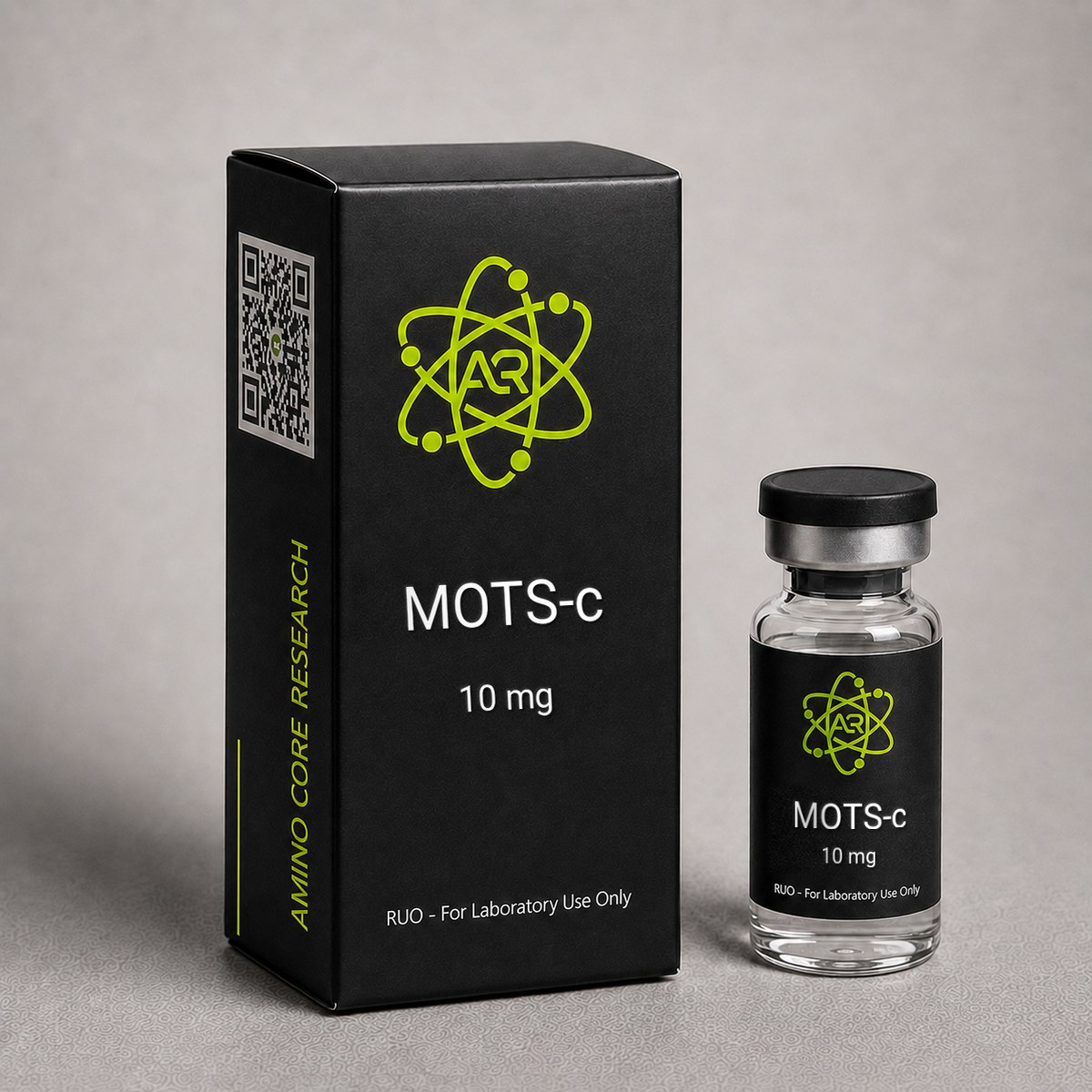
≥99%HPLC Purity
COAIncluded
USAShipped
MOTS-c Peptide
Mitochondria-derived peptide (MDP) encoded by mitochondrial 12S rRNA gene. 16 amino acids activating AMPK and regulating glucose metabolism in skeletal muscle. The first mitochondrial-encoded peptide shown to act as an exercise mimetic with systemic metabolic effects.
$67.50
In stock — ships next business day
Best price — free shipping & bac water included
| Simple Peptide | AminoCore ✓ all‑in | |
|---|---|---|
| 10mg price | $43.00 | $67.50 |
| Shipping | +$13.00 | FREE |
| Bac Water | +$30.00 | FREE |
| Total paid | $86.00 | $67.50 save up to $18.50 |
Quick Facts
| SKU | ACR-MOTSC |
|---|---|
| CAS Number | 1627580-64-6 |
| Molecular Formula | C101H152N28O22S2 |
| Molecular Weight | 2,174.64 g/mol |
| Sequence | MRWQEMGYIFYPRKLR |
| Purity | ≥99% |
| Physical Form | Lyophilized Powder |
| Storage | Store at -20°C |
What is MOTS-c?
MOTS-c (Mitochondrial Open Reading Frame of the 12S rRNA-c) is a 16-amino acid peptide (MRWQEMGYIFYPRKLR) encoded by the mitochondrial genome — specifically by the MT-RNR1 gene within the 12S ribosomal RNA. With molecular weight 2,174.64 g/mol and CAS 1627580-64-6, it was discovered in 2015 by Professor Changhan David Lee at the University of Southern California.
MOTS-c represents a paradigm shift in peptide biology: it is the first mitochondrial-encoded peptide demonstrated to have systemic hormonal effects, functioning as a "mitokine" — a mitochondrial signal that regulates nuclear gene expression and whole-body metabolism. It acts primarily through AMPK activation in skeletal muscle, enhancing glucose uptake and fatty acid oxidation in a manner that mimics the metabolic effects of exercise.
Mechanism of Action
AMPK Activation: MOTS-c activates AMP-activated protein kinase (AMPK) via phosphorylation at Thr172. AMPK is the master metabolic sensor that triggers catabolic pathways (glucose uptake, fatty acid oxidation) while inhibiting anabolic pathways (lipogenesis, gluconeogenesis). This mimics the metabolic effects of exercise at the molecular level.
Nuclear Translocation: Under metabolic stress, MOTS-c translocates from mitochondria to the nucleus where it interacts with AMPK-responsive transcription factors, directly regulating gene expression. This mitochondria-to-nucleus signaling (retrograde signaling) is unique among known peptides.
Folate-Methionine Cycle: MOTS-c inhibits the folate cycle and de novo purine biosynthesis, redirecting cellular metabolism toward AMPK-dependent glucose utilization. This metabolic reprogramming underlies its insulin-sensitizing effects.
Research & Clinical Studies
MOTS-c and Obesity/Insulin Resistance Research
In the landmark 2015 Cell Metabolism study, Lee et al. demonstrated that MOTS-c treatment in diet-induced obese mice:
- Prevented high-fat diet-induced obesity and insulin resistance
- Reduced body weight gain by ~40% compared to controls
- Improved glucose tolerance and insulin sensitivity
- Enhanced skeletal muscle glucose uptake via GLUT4 translocation
- Reduced hepatic lipid accumulation
Importantly, circulating MOTS-c levels decline with age and correlate inversely with insulin resistance, suggesting it may be a biomarker and therapeutic target for metabolic aging.
[1] Lee C et al. The mitochondrial-derived peptide MOTS-c promotes metabolic homeostasis and reduces obesity and insulin resistance. Cell Metab. 2015;21(3):443-454. PubMed ↗
MOTS-c as Exercise Mimetic
MOTS-c has been termed an "exercise mimetic" because it activates the same AMPK-PGC1α pathway engaged by physical exercise. Research shows:
- MOTS-c treatment improves physical performance in aged mice
- Enhances skeletal muscle mitochondrial biogenesis
- Increases beta-oxidation capacity
- The peptide is released into circulation during exercise, suggesting it mediates some exercise benefits
WADA added MOTS-c to its prohibited list in 2023, recognizing its performance-enhancing potential.
MOTS-c and Aging Research
MOTS-c levels decline significantly with age in humans, correlating with insulin resistance and metabolic dysfunction. A 2019 study found circulating MOTS-c was 2.5-fold lower in elderly subjects (ages 70-81) compared to young adults (20-35). Importantly, physical exercise increases MOTS-c secretion from skeletal muscle, suggesting it mediates some of the metabolic benefits of exercise.
In aged mice (24 months), MOTS-c treatment restored physical function to levels comparable to 3-month-old mice, improved glucose tolerance, and reduced body fat percentage. These anti-aging effects were dependent on AMPK activation — AMPK-knockout mice did not respond to MOTS-c.
[1] Reynolds JC et al. MOTS-c is an exercise-induced mitochondrial-encoded regulator of age-dependent physical decline and muscle homeostasis. Nat Commun. 2021;12(1):470. PubMed ↗
MOTS-c and Cardiovascular Research
Emerging research shows MOTS-c has cardiovascular protective effects beyond metabolic regulation. Studies demonstrate: reduced cardiac hypertrophy in pressure-overload models, protection against ischemia-reperfusion injury through AMPK-mediated autophagy, decreased inflammatory cytokine production (TNF-α, IL-6) in cardiac tissue, and improved endothelial function via eNOS upregulation. These cardioprotective effects parallel those seen with exercise training, further supporting the "exercise mimetic" classification.
[1] Li Q et al. MOTS-c and Exercise Restore Cardiac Function by Activating of NRG1-ErbB Signaling in Diabetic Rats. Front Endocrinol. 2022;13:812032.
MOTS-c Genetic Variants and Population Studies
The m.1382A>C Polymorphism: Because MOTS-c is encoded within the mitochondrial 12S rRNA (MT-RNR1) gene, single-nucleotide substitutions in this region can alter the translated peptide sequence. The m.1382A>C variant produces a lysine-to-glutamine substitution at position 14 of MOTS-c (K14Q). This polymorphism is rare to absent in African and European mitochondrial haplogroups but reaches population frequencies of approximately 7-30% across various East Asian populations, including Japanese, Korean, and Northeast Chinese cohorts, reflecting the haplogroup-specific evolutionary history of mitochondrial DNA.
Association with Metabolic Phenotypes: Population genetic studies have linked the K14Q variant to differential metabolic outcomes. In a cross-sectional study of Japanese men, carriers of the m.1382A>C allele displayed altered body mass index trajectories and an elevated risk of type 2 diabetes in sedentary individuals, whereas physically active carriers showed attenuated metabolic risk. This gene-by-environment interaction is consistent with the hypothesis that endogenous K14Q-MOTS-c exhibits reduced bioactivity relative to wild-type peptide, rendering carriers more dependent on exercise-induced compensatory pathways to maintain insulin sensitivity and AMPK tone.
Functional Characterization In Vitro: Biochemical comparison of synthetic K14Q-MOTS-c with wild-type peptide indicates that the lysine-to-glutamine substitution disrupts a positively charged residue within the C-terminal region implicated in nuclear translocation and binding to stress-responsive transcription factors. K14Q-MOTS-c shows reduced capacity to translocate to the nucleus under metabolic stress and diminished induction of antioxidant response element (ARE)-driven gene programs compared with wild-type peptide, providing a mechanistic basis for the population-level associations.
Longevity and Centenarian Cohorts: Despite the metabolic disadvantage observed in younger carriers, the variant has been examined in studies of exceptional longevity. Some analyses suggest enrichment of specific mitochondrial haplogroups in centenarian populations, though the contribution of the m.1382A>C variant specifically remains an area of active investigation and the literature is mixed. The complex relationship illustrates the principle that mitochondrial variants can exhibit antagonistic pleiotropy across the lifespan.
Implications for Translational Research: Population stratification by MT-RNR1 genotype may be relevant to clinical trial design involving MOTS-c-related interventions, as endogenous baseline activity differs between carriers and non-carriers. Pharmacogenomic considerations include the possibility that exogenous wild-type MOTS-c could exert disproportionate effects in K14Q carriers experiencing relative endogenous deficiency.
Broader Mitochondrial-Derived Peptide Context: The K14Q analysis parallels work on humanin variants (e.g., HNS14G) and SHLPs, supporting an emerging framework in which sequence polymorphisms in mitochondrial-derived peptides modulate metabolic resilience and aging trajectories. These studies collectively validate MOTS-c as a physiologically active peptide hormone rather than a translational artifact.
Research Use Only: This summary is provided for scientific reference and does not constitute medical advice or recommendation for human use.
Reference: Fuku N, Pareja-Galeano H, Zempo H, et al. The mitochondrial-derived peptide MOTS-c: a player in exceptional longevity? Aging Cell. 2015;14(6):921-923. PMID: 26289118.
[1] Fuku N, Pareja-Galeano H, Zempo H, et al. The mitochondrial-derived peptide MOTS-c: a player in exceptional longevity? Aging Cell. 2015;14(6):921-923. PubMed ↗
MOTS-c and Skeletal Muscle Metabolic Homeostasis
The landmark 2015 paper by Lee et al. in Cell Metabolism established MOTS-c as the first mitochondrial-derived peptide (MDP) with systemic metabolic regulatory function. The investigators identified a short open reading frame (sORF) within the mitochondrial 12S rRNA gene (MT-RNR1) encoding a 16-amino-acid peptide and characterized its biological activity in cell culture, rodent models, and human plasma.
Study design: C57BL/6 mice were administered MOTS-c (5 mg/kg/day, intraperitoneal) for 7-14 days while fed either standard chow or a high-fat diet (60% kcal from fat). Insulin sensitivity was assessed by glucose tolerance test (GTT) and hyperinsulinemic-euglycemic clamp. Parallel experiments used L6 myotubes and primary myocytes to dissect signaling.
Key findings:
- AMPK activation: MOTS-c increased phospho-AMPKα (Thr172) approximately 2-fold in skeletal muscle within 30 minutes of administration.
- Glucose disposal: Insulin-stimulated glucose uptake in skeletal muscle increased by ~60% in MOTS-c-treated mice on high-fat diet.
- Diet-induced obesity reversal: MOTS-c administration prevented high-fat-diet-induced weight gain and reversed established insulin resistance, reducing fasting glucose and HOMA-IR.
- Folate cycle modulation: Metabolomic profiling revealed MOTS-c targets the folate-methionine cycle, accumulating AICAR endogenously and thereby activating AMPK indirectly.
- Endogenous expression: MOTS-c was detectable in mouse plasma, skeletal muscle, and multiple tissues; circulating levels declined with age.
This study provided foundational evidence that the mitochondrial genome encodes bioactive peptides that act in retrograde fashion to coordinate nuclear and cytoplasmic metabolic responses, repositioning mitochondria as endocrine organs in addition to bioenergetic hubs.
[1] Lee C, Zeng J, Drew BG, et al. The mitochondrial-derived peptide MOTS-c promotes metabolic homeostasis and reduces obesity and insulin resistance. Cell Metabolism. 2015;21(3):443-454. PubMed ↗
MOTS-c Translocation to the Nucleus and Stress-Adaptive Gene Regulation
While MOTS-c was initially characterized as a circulating metabolic regulator, work by Kim et al. (2018) in Cell Metabolism revealed a second mechanism: under metabolic stress, MOTS-c translocates from mitochondria to the nucleus, where it directly modulates nuclear gene expression — a rare example of mitochondrial-to-nuclear protein signaling.
Study design: HEK293 cells, mouse embryonic fibroblasts, and skeletal muscle tissue were exposed to glucose restriction, oxidative stress (paraquat, H₂O₂), or metformin. Subcellular fractionation, immunofluorescence, and ChIP-seq were used to track MOTS-c localization and DNA binding.
Key findings:
- Stress-induced nuclear translocation: Within 4-24 hours of metabolic stress, MOTS-c accumulated in the nucleus in an AMPK-dependent manner.
- Transcription factor co-regulation: Nuclear MOTS-c bound chromatin at antioxidant response element (ARE) sites and co-regulated transcription factors including NRF2, driving expression of stress-protective and metabolic adaptation genes.
- Functional consequence: MOTS-c knockdown impaired the cellular transcriptional response to metabolic stress, increasing reactive oxygen species and reducing viability.
- Conserved retrograde signal: The findings establish MOTS-c as a mitochondrial-encoded transcriptional regulator that integrates bioenergetic status with nuclear gene expression.
This dual cytoplasmic/nuclear mode of action distinguishes MOTS-c from canonical secreted peptide hormones and provides a mechanistic basis for its broad effects on metabolism, inflammation, and cellular resilience observed in subsequent studies.
[1] Kim KH, Son JM, Benayoun BA, Lee C. The mitochondrial-encoded peptide MOTS-c translocates to the nucleus to regulate nuclear gene expression in response to metabolic stress. Cell Metabolism. 2018;28(3):516-524.e7. PubMed ↗
MOTS-c and Skeletal Muscle Aging: Late-Life Exercise Capacity
A 2021 study by Reynolds et al. in Nature Communications directly tested whether exogenous MOTS-c could counteract age-related declines in physical performance, addressing the observation that endogenous MOTS-c levels fall with age in humans and rodents.
Study design: Young (2-month) and aged (22-month) male C57BL/6N mice received MOTS-c (5-15 mg/kg, IP) or vehicle. Outcomes included treadmill running capacity, grip strength, body composition, and skeletal muscle transcriptomics. A separate cohort underwent late-life intervention with MOTS-c + exercise training.
Key findings:
- Restored running capacity: Aged mice receiving MOTS-c ran ~2-fold longer on a treadmill at maximum effort versus vehicle-treated aged controls.
- Improved physical performance: Grip strength and gait metrics improved in MOTS-c-treated aged mice toward young-adult values.
- Healthspan extension: Late-life MOTS-c treatment beginning at 23.5 months increased measures of healthspan including activity and metabolic flexibility, even in mice already exhibiting frailty.
- Muscle transcriptome: RNA-seq showed MOTS-c reversed multiple age-associated transcriptional signatures, particularly genes involved in mitochondrial biogenesis, fatty-acid oxidation, and proteostasis.
- Human relevance: Plasma MOTS-c was significantly lower in older versus younger humans, paralleling rodent findings.
The study positions MOTS-c as a candidate geroprotector with particular promise for sarcopenia and age-related exercise intolerance research, and supports its inclusion in the broader class of mitochondrial-targeted longevity interventions.
[1] Reynolds JC, Lai RW, Woodhead JST, et al. MOTS-c is an exercise-induced mitochondrial-encoded regulator of age-dependent physical decline and muscle homeostasis. Nature Communications. 2021;12(1):470. PubMed ↗
Chemical & Physical Properties
| Sequence | Met-Arg-Trp-Gln-Glu-Met-Gly-Tyr-Ile-Phe-Tyr-Pro-Arg-Lys-Leu-Arg (MRWQEMGYIFYPRKLR) |
|---|---|
| Molecular Formula | C₁₀₁H₁₅₂N₂₈O₂₂S₂ |
| Molecular Weight | 2,174.64 g/mol |
| CAS Number | 1627580-64-6 |
| Amino Acids | 16 |
| Origin | Mitochondrial genome (MT-RNR1 gene, 12S rRNA) |
| Contains | 2× Met (oxidation-sensitive), 2× Tyr, 2× Arg |
| Purity | ≥99% by HPLC |
Handling & Reconstitution
Pre-Reconstitution Preparation: Allow the sealed lyophilized vial to equilibrate to room temperature for 20-30 minutes before opening. Cold vials opened directly from -20°C storage can accumulate atmospheric moisture on the peptide cake, accelerating hydrolytic degradation. Briefly centrifuge the vial at low speed (~1,000 × g for 30 seconds) to consolidate the lyophilized cake at the base, minimizing material loss when the septum is pierced.
Choice of Reconstitution Solvent: Bacteriostatic water for injection (0.9% benzyl alcohol) is the standard solvent for extended working solutions, while sterile water for injection is appropriate when shorter use windows are anticipated. For mass spectrometry or sensitive biophysical applications, ultrapure (Type I, 18.2 MΩ·cm) water is preferred to avoid benzyl alcohol adducts. MOTS-c is moderately hydrophilic and dissolves readily in aqueous solvent without the need for organic co-solvents; however, if precipitation is observed, brief addition of dilute acetic acid (0.1%) typically restores solubility without compromising the peptide.
Technique: Direct the solvent stream slowly along the inner wall of the vial rather than onto the peptide cake itself. This minimizes mechanical disruption and foaming, both of which can denature peptide and create surface-active losses. Allow 5-10 minutes at room temperature for complete dissolution. Gently swirl or invert the vial—do NOT vortex or shake vigorously, as agitation generates micro-bubbles that increase the air-water interface and accelerate methionine oxidation as well as adsorption-related losses.
Concentration Calculation: Reconstitution volume should be selected based on intended working concentration. As an example, dissolving a 5 mg vial in 2 mL of solvent yields a 2.5 mg/mL stock (approximately 1.15 mM based on MW 2174 Da). Verify concentration by UV absorbance at 280 nm if precise quantification is required, using the calculated extinction coefficient derived from the tryptophan and tyrosine content of the sequence.
Oxidation Mitigation: Met1 and Met6 are particularly susceptible to oxidation in solution, forming methionine sulfoxide (+16 Da) that can be detected by LC-MS and is associated with diminished bioactivity in published studies. To minimize oxidation: (1) reconstitute immediately before use when feasible, (2) purge vial headspace with argon or nitrogen prior to sealing, (3) avoid buffers containing trace transition metals, (4) include EDTA (10-50 µM) for long incubations, and (5) protect from light using amber tubes or foil wrapping.
Aliquoting for Storage: For experiments requiring repeated sampling, divide the reconstituted stock into single-use aliquots immediately after reconstitution. Use low-binding polypropylene tubes to minimize adsorption to plastic surfaces, which can be significant for amphipathic peptides at low concentrations. Carrier protein (e.g., 0.1% BSA) may be added for very dilute working solutions to reduce surface losses, provided it does not interfere with downstream assays.
Freeze-Thaw Cycles: Limit aliquots to no more than two freeze-thaw cycles. Each cycle generates ice-crystal interfaces that can locally concentrate solute and promote oxidation. Thaw aliquots on ice and use promptly.
Sterility: Maintain aseptic technique throughout reconstitution. For cell culture applications, post-reconstitution sterile filtration through a low-protein-binding 0.22 µm PES filter is recommended, with the understanding that some peptide may be lost to filter adsorption (typically <5% with PES).
Research Use Only: All handling procedures are intended for in vitro and preclinical laboratory research and do not constitute guidance for human or veterinary administration.
Storage & Stability
Lyophilized Powder Storage: Sealed vials of lyophilized MOTS-c (16-amino-acid mitochondrial-derived peptide, MW ~2174 Da) are stable for up to 24 months when stored at -20°C in a frost-free freezer protected from humidity. For extended archival storage beyond 24 months, -80°C is preferred to minimize gradual deamidation and oxidative degradation. Lyophilized peptide should remain a fluffy white cake; any discoloration, collapse, or evidence of moisture intrusion indicates compromised integrity and the lot should not be used for research.
Reconstituted Solution Storage: Following reconstitution in sterile bacteriostatic or ultrapure water, working solutions should be stored at 2-8°C and used within 14 days for optimal peptide integrity. Stability studies of small mitochondrial peptides in aqueous buffer indicate progressive loss of bioactivity beyond two weeks due to oxidative and hydrolytic degradation pathways. For longer working timelines, single-use aliquots can be stored at -20°C, although freeze-thaw cycles should be strictly limited to no more than two.
Oxidation Susceptibility: The MOTS-c primary sequence (MRWQEMGYIFYPRKLR) contains two methionine residues at positions 1 and 6. Methionine thioether side chains are among the most oxidation-prone moieties in peptide chemistry, readily forming methionine sulfoxide (Met-O) and, under stronger conditions, methionine sulfone. Oxidation at Met1 or Met6 alters the peptide's three-dimensional conformation and is reported in the literature to attenuate its interaction with downstream targets including AMPK signaling intermediates. Researchers performing structure-activity studies should verify peptide integrity by LC-MS prior to functional assays, as oxidized variants will register at +16 or +32 Da.
Light, Oxygen, and Headspace Considerations: Tryptophan (Trp3) is additionally photosensitive and tyrosine (Tyr8) can undergo photo-oxidation. Vials should therefore be stored in amber containers or wrapped in foil and protected from direct laboratory lighting. For long-term storage of valuable lots, headspace purging with argon or nitrogen is strongly recommended to displace molecular oxygen. Septa-sealed vials with minimal headspace volume reduce oxidative surface area at the gas-liquid interface in reconstituted solutions.
pH and Buffer Compatibility: MOTS-c is most stable in slightly acidic to neutral solutions (pH 5.0-7.0). Strongly alkaline conditions accelerate methionine oxidation and asparagine/glutamine deamidation. Avoid buffers containing transition-metal contaminants (Cu²⁺, Fe³⁺), which catalyze methionine oxidation; addition of trace EDTA (10-50 µM) can be used as a metal chelator in extended-incubation experiments without typically interfering with downstream readouts.
Transport: Shipping is performed with insulated cold packs; brief excursions to ambient temperature (≤72 hours) during transit do not measurably degrade lyophilized material, as confirmed by accelerated stability data for comparable mitochondrial-derived peptides. Upon receipt, lyophilized vials should be centrifuged briefly (1,000 × g, 30 seconds) to consolidate the cake at the vial base before opening, minimizing aerosolization and material loss.
Research Use Only: All storage parameters described are intended for in vitro and preclinical laboratory research. This product is not intended for human or veterinary use.
Frequently Asked Questions
What makes MOTS-c unique among peptides?
MOTS-c is the first peptide proven to be encoded by mitochondrial DNA (not nuclear DNA) that has systemic hormonal effects. It functions as a "mitokine" — a mitochondrial signal that regulates whole-body metabolism through AMPK activation and nuclear gene expression modulation.
How does MOTS-c mimic exercise?
MOTS-c activates the AMPK-PGC1α pathway — the same master switch engaged by physical exercise. This increases glucose uptake, fatty acid oxidation, and mitochondrial biogenesis in skeletal muscle without actual physical activity.
Why is MOTS-c banned by WADA?
WADA prohibited MOTS-c in 2023 due to its exercise-mimetic properties. By activating AMPK and enhancing metabolic performance, it provides advantages equivalent to endurance training, meeting WADA criteria for performance enhancement.
Do MOTS-c levels change with aging?
Yes, circulating MOTS-c levels decline significantly with age and correlate inversely with insulin resistance. This decline may contribute to age-related metabolic dysfunction, making MOTS-c a potential biomarker and intervention target for metabolic aging.
How should MOTS-c be stored?
Lyophilized: -20°C for 24 months. Reconstituted: 2-8°C, use within 14 days. Critical: protect from light and oxygen — the two methionine residues are oxidation-prone. Aliquot reconstituted solution to avoid repeated air exposure.
Is MOTS-c the same as other mitochondrial peptides?
MOTS-c is one of several mitochondrial-derived peptides (MDPs) including Humanin and SHLPs. Each is encoded by different mitochondrial genes: MOTS-c by 12S rRNA (MT-RNR1), Humanin by 16S rRNA (MT-RNR2). MOTS-c is metabolic/exercise-focused while Humanin is cytoprotective/anti-apoptotic.
What is MOTS-c and where does it come from?
MOTS-c (Mitochondrial Open Reading frame of the Twelve S rRNA-c) is a 16-amino-acid peptide (MRWQEMGYIFYPRKLR) encoded within the mitochondrial 12S rRNA gene (MT-RNR1) rather than the nuclear genome. It was identified in 2015 by Lee and colleagues at USC and is the prototypical mitochondrial-derived peptide (MDP). Research suggests MOTS-c regulates systemic metabolism by activating AMPK in skeletal muscle, modulating the folate-methionine cycle, and translocating to the nucleus under stress to co-regulate antioxidant and metabolic gene expression. Molecular weight is 2,174.64 g/mol and CAS number is 1627580-64-6.
How does MOTS-c compare to AICAR and SLU-PP-332 as exercise mimetics?
All three compounds converge on AMP-activated protein kinase (AMPK) signaling but engage the pathway through distinct upstream mechanisms. AICAR is a direct AMP-mimetic that allosterically activates AMPK after intracellular conversion to ZMP. SLU-PP-332 is an ERRα/β/γ agonist that drives mitochondrial biogenesis via nuclear receptor signaling. MOTS-c is a mitochondrial-encoded peptide that indirectly activates AMPK by inhibiting the folate cycle and accumulating endogenous AICAR, while also translocating to the nucleus to regulate stress-response genes. In preclinical studies MOTS-c uniquely combines metabolic AMPK activation with retrograde mitochondrial-to-nuclear signaling, distinguishing it from small-molecule mimetics.
What is the molecular weight and CAS number of MOTS-c?
MOTS-c has a molecular formula of C101H152N28O22S2 and a molecular weight of 2,174.64 g/mol. Its CAS Registry Number is 1627580-64-6. The peptide is composed of 16 amino acids with the sequence MRWQEMGYIFYPRKLR, including two methionine residues that are oxidation-sensitive and one tryptophan residue. AminoCore Research supplies MOTS-c at ≥99% HPLC purity as a lyophilized powder, with a Certificate of Analysis available for each lot. The compound is intended strictly for in vitro and laboratory animal research applications.
How should MOTS-c be reconstituted for laboratory research?
Lyophilized MOTS-c should be reconstituted in bacteriostatic water or sterile 0.9% saline. A typical working stock is prepared by adding 1 mL of diluent per 5 mg of peptide, yielding 5 mg/mL. Diluent should be added slowly down the side of the vial; the solution should be swirled gently rather than shaken or vortexed, since vigorous agitation can shear the peptide and accelerate methionine oxidation. Because MOTS-c contains two methionine residues, exposure to oxidizing conditions, prolonged light, and repeated freeze-thaw cycles should be minimized. Aliquot reconstituted peptide and store at -20°C; use within 14-28 days for optimal integrity.
For laboratory and research use only. This product is not for human or veterinary use. It is not a drug, supplement or food.
This product is not FDA approved for any indication, and is not intended to diagnose, treat, cure, or prevent any disease. All product information is derived from published preclinical research and does not constitute medical advice or claims.