≥99%HPLC Purity
COAIncluded
USAShipped
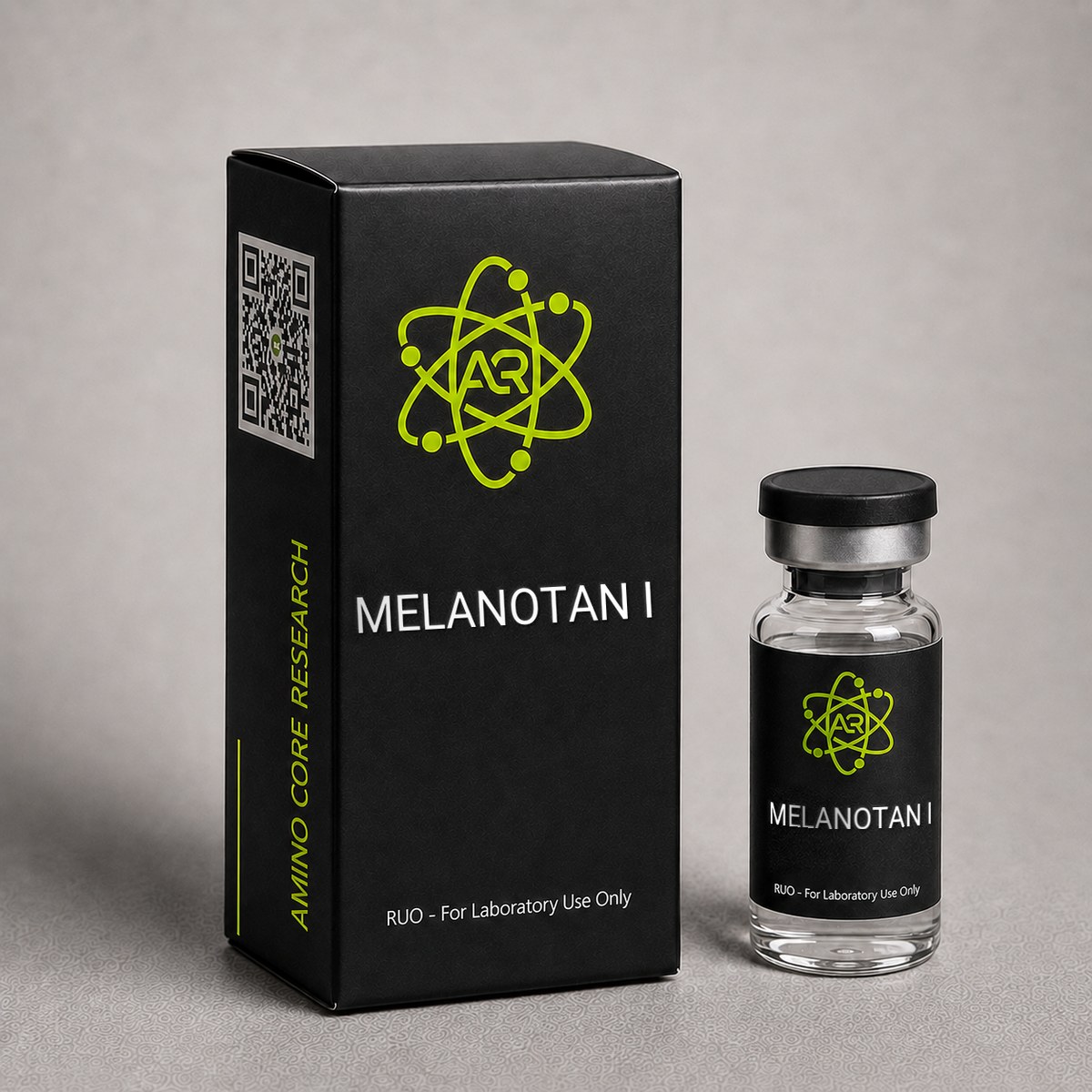
Melanotan I Peptide
Linear alpha-MSH analog peptide (Afamelanotide). Studied for MC1R receptor selectivity and melanocortin pathway research.
$42.00
In stock — ships next business day
Quick Facts
| SKU | ACR-MT1 |
|---|---|
| CAS Number | 75921-69-6 |
| Molecular Weight | 1646.85 g/mol |
| Sequence | [Nle4, D-Phe7]-alpha-MSH |
| Purity | ≥99% |
| Physical Form | Lyophilized Powder |
| Storage | Store at -20°C |
What is Melanotan I?
Melanotan I (afamelanotide, MT-1) is a synthetic analog of alpha-melanocyte-stimulating hormone (α-MSH) with 13 amino acids. Unlike Melanotan II, MT-1 is a linear peptide (not cyclic) and is more selective for the MC1R melanocortin receptor. It has been extensively studied for its role in melanogenesis — the production of melanin pigment in the skin.
Mechanism of Action
Melanotan I binds primarily to MC1R (melanocortin-1 receptor) on melanocytes, activating the cAMP/PKA/CREB signaling cascade. This upregulates MITF (microphthalmia-associated transcription factor), which in turn increases expression of tyrosinase, TRP-1, and TRP-2 — the key enzymes in eumelanin biosynthesis.
The result is increased eumelanin production without requiring UV exposure, a property that has made MT-1 the subject of extensive dermatological and photoprotection research.
Research & Clinical Studies
Clinical Research: Afamelanotide in Erythropoietic Protoporphyria
The most extensively studied clinical application of Melanotan I (afamelanotide) involves erythropoietic protoporphyria (EPP), a rare inherited metabolic disorder characterized by extreme phototoxicity. Landmark Phase 3 trials published in the New England Journal of Medicine evaluated the controlled-release subcutaneous implant formulation of afamelanotide (16 mg) in adult EPP patients.
Phase 3 Trial Design (Langendonk et al., 2015)
The pivotal study enrolled 74 patients in the European cohort and 94 patients in the US cohort, randomized to receive afamelanotide implants every 60 days versus placebo. The European trial administered 5 implants over 270 days, while the US trial administered 3 implants over 180 days. Primary endpoints centered on the number of hours spent in direct sunlight without prodromal symptoms or pain.
Key Results
- European cohort: median time in direct sunlight increased to 6.0 hours in the afamelanotide group versus 0.75 hours in the placebo group (p=0.005)
- US cohort: 69.4 hours of sunlight tolerance over 180 days versus 40.8 hours for placebo (p=0.04)
- Quality of life scores improved significantly in treated participants across both cohorts
- Eumelanin density measured by reflectance spectrophotometry increased in MC1R-responsive skin sites
- No serious adverse events directly attributable to the compound were reported
Mechanism Validation
The trials provided robust validation of MC1R-mediated photoprotection. Afamelanotide's selective activation of MC1R on epidermal melanocytes stimulated eumelanin synthesis, the photoprotective brown-black pigment that absorbs ultraviolet and visible light. Importantly, the photoprotective effect occurred independently of UV exposure, distinguishing it from conventional tanning responses which require DNA damage signaling.
Regulatory and Research Significance
Based on these data, afamelanotide became the first MC1R-targeted melanocortin agonist to receive regulatory approval (EMA 2014, FDA 2019) for EPP. From a research perspective, these trials established the proof-of-concept that selective MC1R agonism produces measurable, durable melanogenic effects in human skin and validated the controlled-release implant as a viable delivery platform for cyclized peptide analogs. The pharmacokinetic profile—plasma levels detectable for approximately 48 hours post-implant with sustained skin pigmentation lasting 60+ days—reflects depot release kinetics rather than the peptide's intrinsic half-life.
[1] Langendonk JG, Balwani M, Anderson KE, et al. Afamelanotide for Erythropoietic Protoporphyria. N Engl J Med. 2015;373(1):48-59. PubMed ↗
[2] Minder EI, Barman-Aksoezen J, Schneider-Yin X. Pharmacokinetics and Pharmacodynamics of Afamelanotide and its Clinical Use in Treating Dermatologic Disorders. Clin Pharmacokinet. 2017;56(8):815-823. PubMed ↗
Phase 2 Trial: Afamelanotide in Solar Urticaria
Solar urticaria is a rare photodermatosis characterized by rapid-onset urticarial lesions following ultraviolet (UV) or visible light exposure. Because afamelanotide (the active linear α-MSH analog also known as Melanotan I, [Nle⁴, D-Phe⁷]-α-MSH) induces eumelanin synthesis via MC1R activation in epidermal melanocytes, it has been investigated as a photoprotective strategy for patients with severe light-triggered disorders. A multicenter open-label trial published by Haylett et al. (2018) examined controlled-release afamelanotide 16 mg subcutaneous implants in adults with confirmed solar urticaria refractory to antihistamines.
Study design:
- Subjects: 5 adults with severe, antihistamine-refractory solar urticaria
- Intervention: 16 mg afamelanotide controlled-release implant administered subcutaneously every 60 days
- Duration: Up to 12 months of repeated dosing
- Endpoints: Minimal urticarial dose (MUD) to UVA, UVB, and visible light; quality of life (DLQI); pigmentation response
Key results:
- Increased MUD: All participants demonstrated measurable increases in the minimal urticarial dose to provocative wavelengths, indicating reduced cutaneous photosensitivity
- Tolerance to ambient sunlight: Patients reported substantially extended periods outdoors without lesion development
- DLQI improvement: Mean Dermatology Life Quality Index scores improved markedly, reflecting reduction in disease burden
- Cutaneous melanin density: Skin melanin measurements rose throughout the dosing cycle, consistent with sustained MC1R-driven eumelanogenesis
- Tolerability: Adverse events were limited to expected pigmentation changes (nevi darkening, facial freckling) and transient nausea
These observations are mechanistically consistent with afamelanotide's role as a selective MC1R agonist driving cAMP-dependent activation of microphthalmia-associated transcription factor (MITF) and downstream tyrosinase expression, increasing eumelanin content in keratinocytes and shielding underlying DNA from reactive oxygen species generated by UVR and visible light. The same controlled-release formulation is approved in the European Union and United States for adult patients with erythropoietic protoporphyria (EPP), and ongoing research is evaluating it across additional light-sensitive conditions including Hailey-Hailey disease, vitiligo, and xeroderma pigmentosum.
Compared with Melanotan II, which is a cyclic non-selective melanocortin agonist with affinity for MC1R, MC3R, MC4R, and MC5R, afamelanotide's linear backbone retains receptor specificity for MC1R. This selectivity is the basis for its preferential pigmentation profile without the appetite, sexual, or cardiovascular effects associated with broader melanocortin activation. For research applications, the trial illustrates that MC1R agonism alone is sufficient to drive a quantifiable melanogenic and photoprotective response in human skin.
Composition & Components
Melanotan I research preparations supplied by AminoCore Research are formulated as single-component cyclized peptide solutions or lyophilized powder. The composition is documented below for research traceability and reconstitution planning.
| Component | Role | MW | CAS |
|---|---|---|---|
| Afamelanotide (Ac-Ser-Tyr-Ser-Nle-Glu-His-D-Phe-Arg-Trp-Gly-Lys-Pro-Val-NH₂) | Active MC1R-selective melanocortin agonist | 1646.85 g/mol | 75921-69-6 |
| Mannitol (typical lyophilization excipient) | Bulking agent / cryoprotectant | 182.17 g/mol | 69-65-8 |
| Acetic acid (residual from synthesis/counterion) | Counterion for acetate salt form | 60.05 g/mol | 64-19-7 |
Structural Notes on the Active Component
Afamelanotide is a linear tridecapeptide structural analog of the endogenous alpha-melanocyte stimulating hormone (α-MSH). Two key modifications distinguish it from native α-MSH:
- Nle⁴ substitution: Norleucine replaces methionine at position 4, eliminating oxidation-prone sulfur and conferring resistance to methionine sulfoxide formation during storage
- D-Phe⁷ substitution: The D-isomer of phenylalanine at position 7 confers resistance to proteolytic degradation, dramatically extending biological half-life relative to native α-MSH (which has a plasma half-life of approximately 2 minutes)
Physical Properties
- Physical form: White to off-white lyophilized powder
- Amino acid count: 13 residues
- C-terminal amidation: Yes (-NH₂)
- N-terminal acetylation: Yes (Ac-)
- Solubility: Soluble in bacteriostatic water, sterile water, 0.9% sodium chloride, and acetic acid (1%)
- Purity (HPLC): ≥99%
- Recommended reconstitution diluent: Bacteriostatic water for injection
Unlike multi-ingredient topical cosmetic formulations, this research preparation contains a single defined active peptide species, allowing precise molar calculations for in vitro receptor binding studies, melanocyte culture experiments, and comparative MC1R pharmacology research.
Handling & Reconstitution Guidelines
Melanotan I (afamelanotide) is supplied as a sterile lyophilized white powder under inert atmosphere. As a 13-residue linear melanocortin analog containing methionine, tryptophan, and an N-terminal acetyl group, it requires careful handling to preserve secondary structure and minimize oxidative degradation. The following protocol reflects standard laboratory practice for research-grade peptide reconstitution.
Recommended Reconstitution Protocol:
- Equilibrate to room temperature. Remove the lyophilized vial from -20°C storage and allow it to reach ambient temperature (approximately 20-30 minutes) before opening. This prevents condensation of atmospheric moisture inside the vial.
- Select reconstitution solvent. Bacteriostatic water for injection (0.9% benzyl alcohol) is the standard diluent for multi-day stability. Sterile water for injection or 0.9% sodium chloride may be used for short-term experiments. For mass-spectrometry validation, dilute acetic acid (0.1%) provides excellent solubility.
- Calculate target concentration. A typical working concentration is 2 mg/mL. For a 10 mg vial, add 5.0 mL of diluent; for a 5 mg vial, add 2.5 mL. Higher concentrations up to 10 mg/mL are readily achievable due to afamelanotide's good aqueous solubility.
- Inject solvent slowly. Direct the stream of diluent against the inner wall of the vial — never directly onto the lyophilized cake. This prevents foaming and protects against shear-induced peptide damage.
- Swirl gently. Rotate the vial in a slow circular motion until the powder is fully dissolved. Do not shake or vortex — agitation can denature the peptide and generate aggregates.
- Inspect. The reconstituted solution should be clear and colorless. Discard if particulates, cloudiness, or yellow discoloration are observed (the latter can indicate methionine sulfoxide or tryptophan degradation).
- Aliquot for storage. Transfer single-use volumes to sterile low-binding polypropylene tubes to minimize freeze-thaw cycles.
Compound-specific handling notes:
- Methionine oxidation risk: Met⁴ in the sequence is susceptible to oxidation. Protect from atmospheric oxygen by storing aliquots under nitrogen or argon when possible, and avoid prolonged exposure to peroxide-containing buffers.
- Tryptophan light sensitivity: Trp⁹ can undergo photo-oxidation. Store and handle in amber tubes or shield from direct light, particularly UV sources.
- N-terminal acetylation: The Ac-Ser N-terminus confers resistance to aminopeptidases, but the C-terminal amide and overall linear backbone still permit chymotryptic cleavage in biological matrices — use protease inhibitors in cell culture supernatant assays.
- Aseptic technique: Always work in a laminar flow hood or with sterile filtered diluents to prevent microbial contamination, especially when using non-bacteriostatic water.
This material is sold strictly for in vitro and preclinical laboratory research. It is not for human or veterinary use, food, or cosmetic application.
Storage & Stability Information
Proper storage of Melanotan I (afamelanotide) is essential for maintaining peptide integrity and ensuring reproducible research outcomes. The Nle⁴ and D-Phe⁷ substitutions provide enhanced stability relative to native α-MSH, but standard peptide handling precautions still apply.
Lyophilized Powder Storage
- Long-term storage: Store at -20°C or colder in a frost-free freezer. Under these conditions, the lyophilized peptide remains stable for 24+ months with negligible degradation
- Short-term storage: 2-8°C (standard refrigeration) is acceptable for up to 30 days when active use is anticipated
- Transit / ambient exposure: The lyophilized form tolerates room temperature (15-25°C) for shipping periods up to 14 days without significant loss of activity, owing to the absence of free water
- Container integrity: Keep vial sealed under inert atmosphere until reconstitution. Avoid repeated temperature cycling
Reconstituted Solution Storage
- Refrigerated (2-8°C): Stable for approximately 28 days when reconstituted with bacteriostatic water containing 0.9% benzyl alcohol
- Sterile water reconstitution: Use within 7 days when stored at 2-8°C due to absence of preservative
- Frozen aliquots (-20°C): Single-use aliquots remain stable 3+ months; avoid freeze-thaw cycles which can promote aggregation
- Room temperature: Not recommended; limit to 24 hours maximum during active experimental use
Compound-Specific Stability Notes
Afamelanotide demonstrates superior chemical stability compared to native α-MSH due to the norleucine-for-methionine substitution at position 4, which eliminates the methionine oxidation pathway that destabilizes the parent hormone. The tryptophan residue at position 9, however, remains susceptible to photo-oxidation. Practical implications:
- Light protection: Store in amber vials or in original light-blocking packaging; minimize fluorescent and UV exposure during handling
- Oxygen exposure: Limit headspace and avoid prolonged exposure to ambient atmosphere in reconstituted form
- pH considerations: Solution stability is optimal at slightly acidic to neutral pH (5.5-7.0); avoid strongly alkaline diluents
- Aggregation monitoring: Inspect solutions visually before use; discard if precipitation, cloudiness, or color change is observed
For research applications requiring long-term reproducibility, preparing single-use frozen aliquots immediately after reconstitution is recommended over repeated withdrawal from a single stock vial.
Frequently Asked Questions
What is the difference between Melanotan I and Melanotan II?
Melanotan I (afamelanotide) is a linear 13-amino acid peptide selective for MC1R. Melanotan II is a cyclic 7-amino acid peptide that activates multiple melanocortin receptors (MC1R, MC3R, MC4R, MC5R), giving it broader effects beyond melanogenesis.
What receptor does Melanotan I target?
Melanotan I primarily targets MC1R (melanocortin-1 receptor) on melanocytes, activating the cAMP signaling pathway to stimulate eumelanin production.
What is the molecular weight and CAS number of Melanotan I?
Melanotan I (afamelanotide) has a molecular weight of 1,646.85 g/mol and a CAS registry number of 75921-69-6. It is a linear 13-amino-acid peptide with the sequence Ac-Ser-Tyr-Ser-Nle-Glu-His-D-Phe-Arg-Trp-Gly-Lys-Pro-Val-NH₂, featuring N-terminal acetylation and C-terminal amidation. The molecule incorporates two non-natural amino acid substitutions—norleucine at position 4 and D-phenylalanine at position 7—that confer enhanced metabolic stability and receptor binding affinity relative to native α-melanocyte stimulating hormone (α-MSH).
How should Melanotan I be reconstituted for research use?
Melanotan I lyophilized powder is typically reconstituted with bacteriostatic water for injection to enable repeated sampling from a single vial. A common working concentration is 10 mg peptide per 1 mL diluent (10 mg/mL). To reconstitute, direct the diluent stream against the vial wall rather than directly onto the peptide cake, then gently swirl—do not shake or vortex, as mechanical agitation can promote peptide aggregation and tryptophan degradation. Allow 2-5 minutes for complete dissolution. The reconstituted solution should appear clear and colorless; discard if precipitation or discoloration is observed.
How should Melanotan I be stored?
Lyophilized Melanotan I should be stored at -20°C for long-term stability (24+ months) and is acceptable at 2-8°C for short-term use (up to 30 days). Once reconstituted, the solution remains stable for approximately 28 days at 2-8°C when bacteriostatic water is used as the diluent, or 7 days with plain sterile water. Protect reconstituted solutions from light to minimize photo-oxidation of the tryptophan residue at position 9. For long-term reproducibility, preparing single-use frozen aliquots at -20°C is preferred over repeated freeze-thaw cycles, which can promote peptide aggregation.
What sizes of Melanotan I are available from AminoCore Research?
AminoCore Research supplies Melanotan I (afamelanotide) in standard research vial sizes typically ranging from 10 mg to 20 mg of lyophilized powder per vial at ≥99% HPLC purity. Each lot is provided with a Certificate of Analysis (COA) documenting purity, mass spectrometry identity confirmation, and acetate counterion content. The product is intended exclusively for in vitro research and laboratory investigation of MC1R pharmacology, melanocortin receptor selectivity studies, and comparative analog research. It is not for human consumption or clinical application.
Is Melanotan I the same as Afamelanotide?
Yes. Melanotan I is the original research designation for the synthetic linear α-melanocyte-stimulating hormone analog [Nle⁴, D-Phe⁷]-α-MSH, which was later assigned the International Nonproprietary Name afamelanotide. Both terms refer to the identical 13-residue acetylated peptide with the sequence Ac-Ser-Tyr-Ser-Nle-Glu-His-D-Phe-Arg-Trp-Gly-Lys-Pro-Val-NH₂, molecular weight 1646.85 g/mol, and CAS number 75921-69-6. Afamelanotide is the name used in clinical literature and regulatory filings (e.g., for the Scenesse® controlled-release implant approved for erythropoietic protoporphyria), while Melanotan I remains common in preclinical and research contexts.
How does Melanotan I selectively activate MC1R over other melanocortin receptors?
Melanotan I retains the linear backbone of native α-MSH but incorporates two key substitutions: norleucine at position 4 (replacing the oxidation-prone methionine of native sequences in some analogs) and D-phenylalanine at position 7 in place of L-Phe. The D-Phe⁷ substitution stabilizes a bioactive conformation that preferentially fits the MC1R binding pocket while reducing affinity for MC3R, MC4R, and MC5R. The linear structure, in contrast to the cyclic Melanotan II, prevents the conformational rigidity that drives Melanotan II's broad melanocortin promiscuity. The result is a research compound used to isolate MC1R-mediated cAMP signaling and eumelanogenesis pathways without confounding effects on appetite (MC4R) or sexual behavior (MC3R/MC4R).
What downstream signaling does MC1R activation trigger in melanocytes?
MC1R is a Gαs-coupled GPCR. Upon Melanotan I binding, MC1R activates adenylyl cyclase, raising intracellular cAMP. Elevated cAMP activates protein kinase A (PKA), which phosphorylates CREB. Phospho-CREB drives transcription of MITF (microphthalmia-associated transcription factor), the master regulator of melanocyte biology. MITF in turn upregulates tyrosinase, TRP-1, and TRP-2 — the enzymes that convert tyrosine into eumelanin within melanosomes. Eumelanin is then transferred to surrounding keratinocytes, increasing epidermal pigment density and providing photoprotection against UV-induced DNA damage. MC1R signaling also engages anti-inflammatory and antioxidant pathways via NF-κB modulation, which is relevant to research in photodermatoses.
For laboratory and research use only. This product is not for human or veterinary use. It is not a drug, supplement or food.
This product is not FDA approved for any indication, and is not intended to diagnose, treat, cure, or prevent any disease. All product information is derived from published preclinical research and does not constitute medical advice or claims.