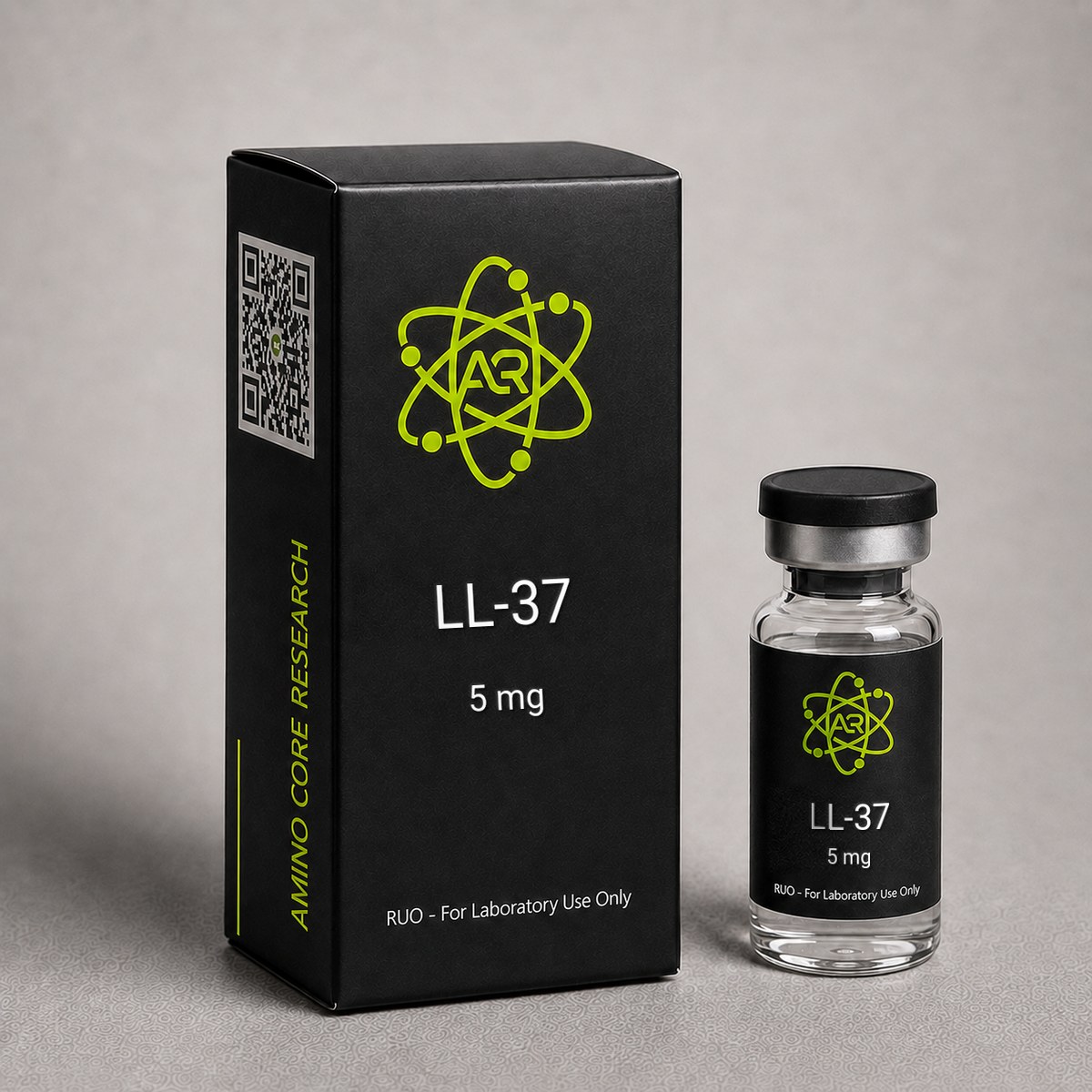
≥99%HPLC Purity
COAIncluded
USAShipped
LL-37 Peptide
Human cathelicidin antimicrobial peptide. A 37-amino acid peptide studied in innate immunity and host defense peptide research.
Research Reference
This page is a research monograph. LL-37 is documented here for reference — structure, mechanism and published literature — and is not offered for sale.
Browse compounds available for research purchase · Read the research library
Quick Facts
| SKU | ACR-LL37 |
|---|---|
| CAS Number | 154947-66-7 |
| Molecular Formula | C205H340N60O53 |
| Molecular Weight | 4493.33 g/mol |
| Sequence | LLGDFFRKSKEKIGKEFKRIVQRIKDFLRNLVPRTES |
| Purity | ≥95% |
| Physical Form | Lyophilized Powder |
| Storage | Store at -20°C |
What is LL-37?
LL-37 is the only human cathelicidin antimicrobial peptide, a 37-amino acid cationic peptide derived from the C-terminus of the 18-kDa hCAP18 precursor protein. Its name reflects its 37-amino acid length and the two leucine residues at its N-terminus.
LL-37 adopts an amphipathic alpha-helical structure that enables it to interact with bacterial membranes. Published research has documented its broad-spectrum antimicrobial activity against gram-positive bacteria, gram-negative bacteria, fungi, and enveloped viruses, as well as its immunomodulatory functions beyond direct antimicrobial action.
For laboratory research use only.
Mechanism of Action
LL-37 is the sole human cathelicidin-derived antimicrobial peptide, generated through proteolytic cleavage of the hCAP-18 precursor by proteinase 3 in neutrophils and by kallikrein 5 and 7 in keratinocytes. The mature 37-residue peptide adopts an amphipathic alpha-helical conformation in the presence of negatively charged membranes, lipopolysaccharide (LPS), or detergent micelles. This structural transition is central to its multifunctional activity in innate immunity research.
Direct Membrane Disruption
The primary antimicrobial mechanism studied in vitro involves electrostatic attraction between LL-37's cationic residues (six lysines and five arginines, net charge +6) and the anionic phospholipid head groups of bacterial membranes. Upon binding, the peptide inserts parallel to the membrane surface via the carpet model, causing membrane thinning, transient pore formation, and ultimately lytic disruption. Activity has been documented against Gram-positive organisms (Staphylococcus aureus), Gram-negative organisms (Escherichia coli, Pseudomonas aeruginosa), mycobacteria, fungi, and enveloped viruses in research models.
LPS Neutralization
LL-37 binds lipid A of bacterial LPS with high affinity, preventing LPS engagement of TLR4/MD-2 complexes on monocytes and macrophages. This neutralization has been studied as a mechanism limiting endotoxin-driven cytokine cascades in sepsis models.
Receptor-Mediated Immunomodulation
Beyond direct microbicidal action, LL-37 functions as a host defense peptide that signals through multiple receptors:
- FPR2 (formyl peptide receptor 2): LL-37 acts as a chemoattractant for neutrophils, monocytes, and T cells via FPR2 coupling to Gαi pathways.
- P2X7 receptor: Engagement modulates IL-1β processing and inflammasome activity in macrophages.
- EGFR transactivation: In keratinocytes, LL-37 transactivates the epidermal growth factor receptor through metalloproteinase-mediated release of HB-EGF, driving migration and re-epithelialization.
- TLR-nucleic acid complexes: LL-37 binds self-DNA and self-RNA, forming complexes that activate TLR9 and TLR7/8 in plasmacytoid dendritic cells — a pathway implicated in psoriasis research.
Downstream Effects
Receptor engagement modulates expression of chemokines (CXCL8, CCL2), promotes angiogenesis through endothelial FPR2 signaling, and influences wound healing pathways. LL-37 also suppresses neutrophil apoptosis and enhances phagocytic clearance of apoptotic cells (efferocytosis) in preclinical studies. In contrast to many antimicrobial peptides that act purely as microbicides, LL-37's dual role as a microbicide and immunomodulator has made it a reference compound in host defense peptide research.
Research & Clinical Studies
Antimicrobial Activity Against Multidrug-Resistant Pathogens
One of the most cited investigations of LL-37's antimicrobial spectrum systematically evaluated minimum inhibitory concentrations (MICs) against a panel of clinical isolates, including multidrug-resistant strains. The study established LL-37 as a broad-spectrum host defense peptide with activity preserved against organisms resistant to conventional antibiotic classes.
Study Design
- Test organisms: Clinical isolates of methicillin-resistant Staphylococcus aureus (MRSA), vancomycin-resistant Enterococcus (VRE), Pseudomonas aeruginosa, Acinetobacter baumannii, and Escherichia coli.
- Methodology: Standard broth microdilution MIC assay, time-kill kinetics, and membrane permeabilization assays using fluorescent dyes.
- Comparators: Conventional antibiotics and structurally related cathelicidin fragments.
Key Results
- MIC values for Gram-negative organisms ranged from 1–8 µg/mL under low-salt conditions.
- Activity against MRSA was retained at 4–16 µg/mL, independent of methicillin resistance status.
- Time-kill curves demonstrated >3-log reduction in viable counts within 30–60 minutes — substantially faster than β-lactam comparators.
- Membrane permeabilization correlated with bactericidal kinetics, supporting the carpet-model mechanism rather than a specific molecular target that would be susceptible to single-point resistance mutations.
Research Context
The rapid, membrane-targeted killing observed in this work has informed continued investigation of LL-37 as a template for antimicrobial peptide design. Salt sensitivity — activity is reduced in physiologic NaCl concentrations — remains a recognized limitation and a focus of ongoing analog research, including stabilized derivatives such as the optimized variant OP-145 and ceragenin mimetics. Comparative work has shown that LL-37 retains activity against biofilm-embedded bacteria where many conventional antibiotics fail, a property attributed to its ability to disrupt extracellular DNA scaffolds in addition to direct cell killing.
[1] Turner J, Cho Y, Dinh NN, Waring AJ, Lehrer RI. Activities of LL-37, a cathelin-associated antimicrobial peptide of human neutrophils. Antimicrob Agents Chemother. 1998;42(9):2206-14. PubMed ↗
[2] Overhage J, et al. Human host defense peptide LL-37 prevents bacterial biofilm formation. Infect Immun. 2008;76(9):4176-82. PubMed ↗
LL-37 in Wound Healing and Re-epithelialization Research
Beyond microbicidal activity, LL-37 has been extensively studied for its role in cutaneous wound repair. A landmark investigation examined LL-37 expression dynamics in human skin wounds and tested the functional consequences of cathelicidin blockade in ex vivo wound models.
Study Design
- Subjects: Human skin biopsies from surgical wounds at days 0, 1, 3, and 7 post-injury; chronic non-healing ulcer biopsies from venous leg ulcer patients.
- Methods: Immunohistochemistry for hCAP-18/LL-37, in situ hybridization, and ex vivo wound healing assays using LL-37 neutralizing antibodies.
- Outcome measures: Re-epithelialization rate, keratinocyte migration, and EGFR phosphorylation.
Key Results
- LL-37 expression was markedly upregulated in epithelium adjacent to acute wounds within 48 hours, peaking at day 3.
- Chronic non-healing ulcers showed absent or reduced LL-37 expression in the wound edge, suggesting a deficiency phenotype.
- Antibody-mediated neutralization of LL-37 in ex vivo wound cultures reduced re-epithelialization by approximately 50%.
- Exogenous LL-37 application restored keratinocyte migration via EGFR transactivation, with phospho-EGFR detectable within 15 minutes of exposure.
Research Context
This work established LL-37 as a non-redundant component of cutaneous wound repair, linking innate immunity to tissue regeneration. Subsequent studies have extended these findings to mucosal wound models, corneal epithelial repair, and intestinal restitution. The dual role — microbicidal defense plus pro-migratory signaling — differentiates LL-37 from classical growth factors and from pure antimicrobial peptides. Follow-up clinical research has explored topical LL-37 in venous leg ulcers, where increased granulation tissue formation has been reported in early-phase studies. Comparative work with related host defense peptides such as human beta-defensin 2 (hBD-2) shows partial functional overlap but distinct receptor utilization, with LL-37 uniquely engaging FPR2 and EGFR pathways.
[1] Heilborn JD, et al. The cathelicidin anti-microbial peptide LL-37 is involved in re-epithelialization of human skin wounds and is lacking in chronic ulcer epithelium. J Invest Dermatol. 2003;120(3):379-89. PubMed ↗
[2] Tokumaru S, et al. Induction of keratinocyte migration via transactivation of the epidermal growth factor receptor by the antimicrobial peptide LL-37. J Immunol. 2005;175(7):4662-8. PubMed ↗
LL-37 Modulation of Innate Immune Responses and Inflammation
Beyond direct antimicrobial activity, LL-37 functions as a multifunctional immunomodulatory peptide that bridges innate and adaptive immunity. A landmark study by Mookherjee et al. characterized LL-37's capacity to modulate Toll-like receptor (TLR) signaling and selectively suppress pro-inflammatory cytokine production while preserving chemokine release, establishing LL-37 as a prototypical host defense peptide rather than a simple antimicrobial.
Study Design
- Model system: Primary human peripheral blood mononuclear cells (PBMCs) and monocyte-derived macrophages
- Stimuli tested: Lipopolysaccharide (LPS, TLR4 ligand), lipoteichoic acid (TLR2), and CpG DNA (TLR9)
- LL-37 concentrations: 1-50 µg/mL across dose-response curves
- Readouts: Cytokine multiplex (TNF-α, IL-6, IL-1β), NF-κB nuclear translocation, transcriptomic profiling
Key Findings
- LL-37 suppressed LPS-induced TNF-α release by 65-80% at 20 µg/mL in human macrophages
- Direct LPS neutralization via high-affinity binding (Kd ~10⁻⁸ M) prevented TLR4 engagement
- Selective induction of chemokines CXCL8 (IL-8), CCL2, and CCL7 at 2-5 fold over baseline, promoting leukocyte recruitment
- Inhibition of NF-κB p65 nuclear translocation while preserving MAPK-dependent chemokine signaling
- Enhanced phagocytic clearance of apoptotic neutrophils (efferocytosis) by macrophages
Mechanistic Insights
LL-37 was shown to engage multiple intracellular targets including the formyl peptide receptor-like 1 (FPRL1/FPR2), purinergic P2X7 receptors, and epidermal growth factor receptor (EGFR) transactivation pathways. This pleiotropic signaling underlies its dual role: dampening excessive inflammation triggered by pathogen-associated molecular patterns (PAMPs) while simultaneously recruiting immune effector cells to sites of infection.
Research Significance
These findings reframed LL-37 from a narrow antimicrobial agent to a central regulator of innate immune homeostasis. The peptide's ability to neutralize endotoxin while preserving chemotactic signaling has informed subsequent research into sepsis models, where dysregulated LL-37 expression correlates with disease severity. Comparative research suggests LL-37's immunomodulatory profile is broader than that of human β-defensins, which exhibit more restricted cytokine modulation.
Reference: Mookherjee N, et al. Modulation of the TLR-mediated inflammatory response by the endogenous human host defense peptide LL-37. J Immunol. 2006.
[1] Mookherjee N, Brown KL, Bowdish DM, et al. Modulation of the TLR-mediated inflammatory response by the endogenous human host defense peptide LL-37. J Immunol. 2006;176(4):2455-2464. PubMed ↗
Chemical & Physical Properties
LL-37 is the sole human cathelicidin-derived antimicrobial peptide, generated by proteolytic cleavage of the hCAP-18 precursor by proteinase 3 in neutrophils and other serine proteases at epithelial surfaces. The peptide exhibits a characteristic amphipathic α-helical secondary structure when interacting with membrane interfaces, which underlies both its antimicrobial and immunomodulatory functions.
| Full Name | LL-37 (Human Cathelicidin Antimicrobial Peptide, CAP-18 fragment 134-170) |
|---|---|
| Synonyms | hCAP-18(134-170), CAMP, Cathelicidin LL-37, FALL-39 (extended form) |
| Molecular Formula | C205H340N60O53 |
| Molecular Weight | 4,493.33 g/mol |
| CAS Number | 154947-66-7 |
| Sequence | LLGDFFRKSKEKIGKEFKRIVQRIKDFLRNLVPRTES |
| Amino Acid Count | 37 residues |
| Net Charge | +6 at physiological pH |
| Isoelectric Point (pI) | ~10.6 |
| Hydrophobic Residues | ~35% (Leu, Phe, Ile, Val) |
| Secondary Structure | Predominantly random coil in aqueous solution; α-helical upon membrane/anionic surface binding |
| Origin / Developer | Endogenous human peptide; cloned and characterized by Gudmundsson et al. (1996), Larrick et al. (1995) |
| Parent Protein | hCAP-18 (encoded by CAMP gene, chromosome 3p21.3) |
| Processing Enzyme | Proteinase 3 (neutrophils); kallikreins 5 and 7 (skin) |
| Physical Form | White lyophilized powder |
| Solubility | Soluble in water, dilute acetic acid (0.01%), or PBS; aggregation may occur at high concentrations in high-salt buffers |
| Purity | ≥99% (HPLC) |
| Storage | -20°C lyophilized, long-term |
The cationic and amphipathic character of LL-37 enables selective interaction with anionic microbial membranes (rich in phosphatidylglycerol and cardiolipin) while sparing zwitterionic mammalian membranes under physiological conditions. The peptide's helicity is induced by lipid binding, anionic glycosaminoglycans, or trifluoroethanol co-solvents, a property frequently exploited in circular dichroism (CD) structural studies. LL-37 is notably resistant to many bacterial proteases but is degraded by host enzymes including cathepsin G and elastase, providing a mechanism for activity regulation in inflamed tissues.
Handling & Reconstitution Guidelines
LL-37 is a cationic amphipathic peptide that requires careful handling to maintain solubility, avoid aggregation, and preserve biological activity. The following protocols reflect best practices established across cathelicidin research literature.
Reconstitution Protocol
- Equilibrate the lyophilized vial to room temperature for 20-30 minutes before opening to prevent moisture condensation on cold peptide.
- Centrifuge briefly (3,000-5,000 rpm for 10-15 seconds) to ensure all powder is collected at the bottom of the vial.
- Select solvent based on downstream application:
- Preferred: Sterile endotoxin-free water or 0.01% acetic acid for stock solutions
- Alternative: 10 mM sodium phosphate buffer (pH 7.4) for short-term experimental use
- Avoid: High-salt buffers (>100 mM NaCl) at high peptide concentrations due to aggregation risk
- Add solvent slowly down the side of the vial. For a 5 mg vial in 1 mL, the resulting concentration is 5 mg/mL (~1.11 mM).
- Allow to dissolve passively for 5-10 minutes; gently swirl or invert. Do not vortex vigorously or shake — mechanical agitation promotes β-sheet aggregation and loss of activity.
- Verify concentration by UV absorbance at 280 nm (LL-37 contains no Trp/Tyr; quantify by BCA assay or amino acid analysis instead).
- Filter sterilize through a low-protein-binding 0.22 µm PVDF filter if required for cell-based assays. Note: significant peptide loss can occur on filters — pre-saturate with carrier or use minimum-volume filters.
- Aliquot immediately into low-binding polypropylene tubes (siliconized or LoBind) in single-use volumes to avoid freeze-thaw cycles.
Compound-Specific Handling Notes
- Container choice matters: LL-37 binds to glass and standard polypropylene. Use low-protein-binding tubes (e.g., Eppendorf LoBind) to minimize peptide loss during storage and dilution.
- Serum proteins (albumin, lipoproteins) sequester LL-37 and can reduce free active concentration in cell culture by 50-90%. Use serum-free or low-serum conditions when quantifying direct effects.
- Avoid repeated freeze-thaw cycles — limit to a maximum of 2-3 cycles for stock solutions.
- Endotoxin-free reagents are essential for immunological assays since LL-37 binds LPS and confounds TLR4 readouts.
Working Dilution Guidance
Typical research concentrations range from 1-50 µg/mL for cellular assays and 0.5-32 µg/mL for antimicrobial MIC determinations. Dilute stock solutions into the final assay buffer immediately before use to limit pre-incubation binding losses.
Frequently Asked Questions
What is LL-37?
LL-37 is the only human cathelicidin — a 37-amino acid cationic antimicrobial peptide derived from the hCAP18 precursor. It forms amphipathic helices that interact with microbial membranes and also has immunomodulatory signaling functions. For research use only.
What is the molecular weight and CAS number of LL-37?
LL-37 has a molecular weight of approximately 4,493.33 g/mol and a CAS number of 154947-66-7. The molecular formula is C205H340N60O53. The peptide consists of 37 amino acids with the sequence LLGDFFRKSKEKIGKEFKRIVQRIKDFLRNLVPRTES and carries a net positive charge of +6 at physiological pH due to six lysine and five arginine residues. AminoCore Research supplies LL-37 at ≥99% HPLC purity as a lyophilized powder for in vitro and preclinical research applications.
How does LL-37 differ from other antimicrobial peptides like defensins?
LL-37 is the only cathelicidin-derived antimicrobial peptide in humans, whereas defensins comprise a separate family with distinct structural features (beta-sheet folds stabilized by disulfide bonds). LL-37 adopts an amphipathic alpha-helical conformation upon membrane contact and uniquely signals through FPR2, P2X7, and EGFR transactivation pathways. Compared to alpha- and beta-defensins, LL-37 shows broader immunomodulatory activity, including chemotaxis, angiogenesis promotion, and keratinocyte migration. Research models also demonstrate that LL-37 binds self-DNA to activate TLR9 in plasmacytoid dendritic cells, a mechanism not shared by classical defensins and implicated in psoriasis pathophysiology.
How should LL-37 be stored and reconstituted for research?
Lyophilized LL-37 should be stored at -20°C for long-term stability and is stable at 2–8°C for short-term storage and during transit. For reconstitution, sterile water or 0.01% acetic acid is commonly used in research protocols, as LL-37 shows improved solubility under mildly acidic conditions. Add diluent slowly down the vial wall and allow the peptide to dissolve without vortexing. Once reconstituted, aliquot and store at -20°C or below; avoid repeated freeze-thaw cycles, which can degrade activity. Reconstituted solutions are typically used within 7–14 days when stored at 2–8°C.
Does LL-37 retain activity in physiological salt conditions?
Research has documented that LL-37's antimicrobial activity is partially salt-sensitive, with reduced potency in 100–150 mM NaCl compared to low-salt buffers. This sensitivity is attributed to electrostatic screening of the cationic peptide's interaction with anionic bacterial membranes. However, LL-37 retains substantial immunomodulatory activity — including FPR2-mediated chemotaxis, LPS neutralization, and EGFR transactivation — under physiologic salt conditions. This has driven research into salt-stable analogs and informed the current view of LL-37 as primarily a host defense peptide whose in vivo role extends well beyond direct microbicidal action.
What sizes of LL-37 are available from AminoCore Research?
AminoCore Research stocks LL-37 in standard research quantities, typically 1 mg, 5 mg, and 10 mg lyophilized vials at ≥99% HPLC purity. Each lot is provided with a Certificate of Analysis (COA) documenting purity, mass confirmation by HPLC-MS, and identity verification. All product is supplied strictly for in vitro laboratory research and is not intended for human or veterinary use. Bulk quantities for larger research programs may be available upon request through institutional inquiry.
Does LL-37 have immunomodulatory effects beyond antimicrobial activity?
Yes — LL-37 is now recognized as a host defense peptide with extensive immunomodulatory functions in addition to its direct antimicrobial activity. Research has shown that LL-37 neutralizes lipopolysaccharide (LPS), suppresses TLR4-driven pro-inflammatory cytokine release (TNF-α, IL-6) by 65-80%, and selectively induces chemokines such as CXCL8/IL-8 to recruit neutrophils. It also signals through formyl peptide receptor FPR2/FPRL1, P2X7, and transactivates EGFR pathways. These pleiotropic activities position LL-37 as a regulator of both innate inflammation and adaptive immune crosstalk.
How is LL-37 generated in the human body?
LL-37 is produced by proteolytic processing of its precursor protein hCAP-18 (encoded by the CAMP gene on chromosome 3p21.3). In neutrophils, the serine protease proteinase 3 cleaves hCAP-18 to release the C-terminal 37-residue peptide upon degranulation. At epithelial surfaces such as skin, kallikreins 5 and 7 carry out analogous processing. Expression is induced by vitamin D3 via vitamin D response elements in the CAMP promoter, by butyrate, and during inflammation, linking nutritional and immune signals to cathelicidin-mediated host defense.
Why does LL-37 require low-protein-binding tubes for handling?
LL-37 is a highly cationic (+6 net charge) amphipathic peptide that readily adsorbs to glass and standard polypropylene surfaces, causing significant loss of active peptide during storage and dilution. Research suggests up to 50% of peptide can be lost to container surfaces in standard tubes. Using low-protein-binding tubes (such as Eppendorf LoBind or siliconized polypropylene) minimizes this adsorption. Similarly, serum proteins like albumin sequester LL-37, so serum-free conditions are recommended when quantifying direct cellular effects to avoid confounding free-peptide concentrations.
For laboratory and research use only. This product is not for human or veterinary use. It is not a drug, supplement or food.
This product is not FDA approved for any indication, and is not intended to diagnose, treat, cure, or prevent any disease. All product information is derived from published preclinical research and does not constitute medical advice or claims.