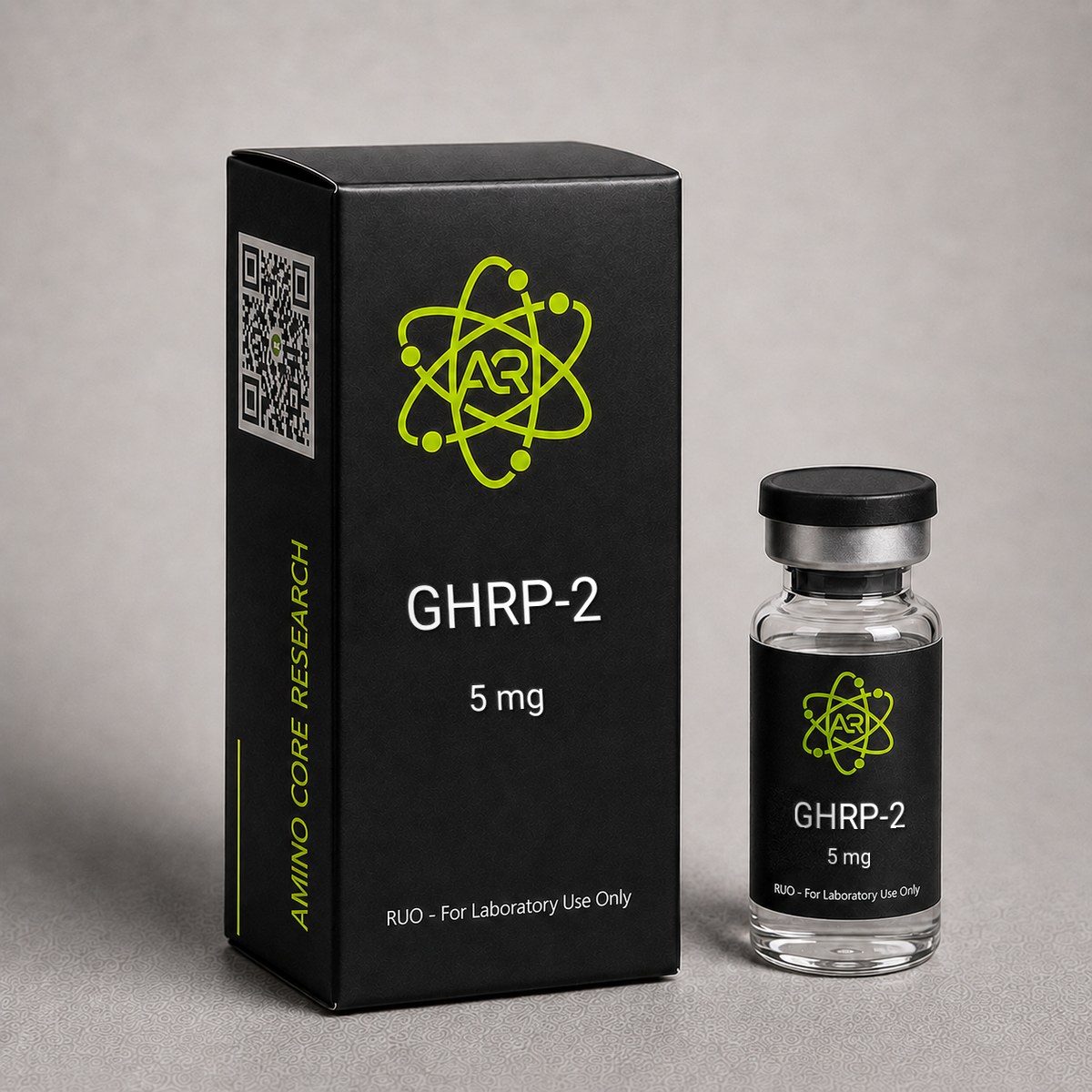
≥99%HPLC Purity
COAIncluded
USAShipped
GHRP-2 Peptide
Growth Hormone Releasing Peptide-2 is a synthetic hexapeptide with documented high receptor affinity for GHS-R1a in published binding studies.
Research Reference
This page is a research monograph. GHRP-2 is documented here for reference — structure, mechanism and published literature — and is not offered for sale.
Browse compounds available for research purchase · Read the research library
Quick Facts
| SKU | ACR-GHRP2 |
|---|---|
| CAS Number | 158861-67-7 |
| Molecular Formula | C45H55N9O6 |
| Molecular Weight | 817.98 g/mol |
| Sequence | D-Ala-D-2-Nal-Ala-Trp-D-Phe-Lys-NH2 |
| Purity | ≥99% |
| Physical Form | Lyophilized Powder |
| Storage | Store at -20°C |
What is GHRP-2?
GHRP-2 (Growth Hormone Releasing Peptide-2, Pralmorelin) is a synthetic hexapeptide (D-Ala-D-2-Nal-Ala-Trp-D-Phe-Lys-NH2) and one of the most potent growth hormone secretagogues in its class. It activates the GHS-R1a (ghrelin) receptor with high affinity.
Published research has documented GHRP-2 as the most potent GHRP analog for GH release on a per-dose basis. It has been studied as a diagnostic tool for GH deficiency assessment due to its reliable and reproducible GH-releasing activity.
For laboratory research use only.
Mechanism of Action
GHRP-2 (Pralmorelin; D-Ala-D-2-Nal-Ala-Trp-D-Phe-Lys-NH2) is a synthetic hexapeptide secretagogue that activates the growth hormone secretagogue receptor type 1a (GHS-R1a), the endogenous receptor for ghrelin. By binding this G-protein coupled receptor, GHRP-2 initiates a cascade of intracellular signaling events that converge on growth hormone (GH) release from anterior pituitary somatotrophs, while also engaging hypothalamic circuits that regulate appetite and energy homeostasis.1
GHS-R1a Receptor Activation
GHS-R1a is a Gq-coupled receptor predominantly expressed in the pituitary and hypothalamic arcuate nucleus. GHRP-2 binds with high affinity, reported in the low nanomolar range (Ki ~1-3 nM in receptor binding assays), and demonstrates greater intrinsic activity at the receptor than first-generation GHRP-6. Receptor activation triggers phospholipase C (PLC) hydrolysis of phosphatidylinositol 4,5-bisphosphate (PIP2) into inositol trisphosphate (IP3) and diacylglycerol (DAG). IP3 mobilizes intracellular calcium stores while DAG activates protein kinase C (PKC), together producing rapid depolarization of somatotroph membranes and exocytotic release of GH-containing secretory vesicles.2
Synergy with Growth Hormone Releasing Hormone (GHRH)
GHRP-2 does not act on the GHRH receptor; rather, the two pathways are complementary. GHRH stimulates cAMP/PKA signaling in somatotrophs, whereas GHRP-2 stimulates the PLC/IP3/Ca2+ pathway. When administered together in research models, GHRH and GHRP-2 produce a synergistic GH release that exceeds the additive effect of either compound alone. This dual-pathway activation underpins the use of GHRP-2 in combination protocols studied in published clinical research on GH-deficient cohorts.
Somatostatin Antagonism
In addition to direct somatotroph activation, GHRP-2 functionally antagonizes the inhibitory tone of somatostatin (SST) at the pituitary level. Research suggests this disinhibition allows for amplified GH pulses even when endogenous SST tone is elevated, such as during the post-prandial state or in older subjects with declining endogenous GH secretion.
Hypothalamic and Orexigenic Effects
GHRP-2 crosses the blood-brain barrier in limited quantities and stimulates GHS-R1a expressed on neuropeptide Y (NPY) and agouti-related peptide (AgRP) neurons of the arcuate nucleus. In preclinical models this orexigenic signaling has been associated with measurable increases in food intake, paralleling the activity of endogenous ghrelin. The magnitude of the appetite effect is generally lower than ghrelin itself due to GHRP-2's shorter plasma half-life (~15-30 minutes).1
Downstream Endocrine Effects
Pulsatile GH release driven by GHRP-2 leads to hepatic IGF-1 production via JAK2/STAT5 signaling at the hepatocyte GH receptor. Research literature has documented dose-dependent rises in serum IGF-1 following repeated GHRP-2 administration in preclinical and clinical investigations, with minimal effects on cortisol or prolactin at standard research doses—a selectivity advantage relative to GHRP-6 and hexarelin noted in comparative studies.
Research & Clinical Studies
Clinical Investigation: GH and IGF-1 Response in Healthy Adults
A landmark clinical research investigation by Bowers and colleagues evaluated the growth hormone and IGF-1 response to GHRP-2 administration in healthy adult subjects, establishing the dose-response profile that has since guided subsequent peptide research.1
Study Design
- Subjects: Healthy adult volunteers across multiple age ranges
- Intervention: Subcutaneous GHRP-2 administration at escalating doses (0.1, 0.3, and 1.0 µg/kg)
- Endpoints: Serum GH peak concentration, area under the curve (AUC), IGF-1 response, and selectivity for the somatotrophic axis (cortisol, prolactin monitoring)
- Comparator: Placebo and GHRH co-administration arms
Key Findings
- GHRP-2 produced a dose-dependent increase in serum GH, with peak concentrations occurring approximately 15-30 minutes post-administration.
- At the 1.0 µg/kg dose, peak GH responses were reported up to 70-90 ng/mL in healthy subjects, exceeding the magnitude observed with GHRP-6 at equivalent molar doses.
- Co-administration with GHRH produced a synergistic GH release roughly 2-3 fold greater than GHRP-2 alone, validating the complementary signaling pathways.
- Cortisol and prolactin elevations were minimal and non-significant at standard research doses, indicating preferential GHS-R1a selectivity.
- Repeated dosing over 7 days produced measurable increases in serum IGF-1, consistent with sustained downstream hepatic GH receptor signaling.
Research Context
This investigation established GHRP-2 as one of the most potent and selective synthetic GH secretagogues among first- and second-generation GHRPs. The reported endocrine selectivity—robust GH release with negligible cortisol/prolactin disturbance—has positioned GHRP-2 as a frequently selected reference compound in growth hormone axis research, including studies of pulsatile GH dynamics, aging-related somatopause, and diagnostic GH provocation testing. Subsequent comparative work consistently identifies GHRP-2 as having higher intrinsic activity than GHRP-6 while maintaining a cleaner selectivity profile than hexarelin.
[1] Bowers CY, Reynolds GA, Durham D, et al. Growth hormone (GH)-releasing peptide stimulates GH release in normal men and acts synergistically with GH-releasing hormone. J Clin Endocrinol Metab. 1990;70(4):975-982. PubMed ↗
Sustained GH/IGF-1 Elevation: 16-Week Subcutaneous Administration Study
One of the most informative chronic-dosing investigations of GHRP-2 examined whether the hexapeptide retains its growth hormone (GH)-releasing efficacy when administered repeatedly over multiple weeks, an important question given concerns about receptor desensitization commonly observed with peptidyl secretagogues. Bowers and colleagues conducted a 16-week study in short-statured children to characterize the durability of pulsatile GH release and downstream IGF-1 elevation following sustained subcutaneous GHRP-2 exposure.[1]
Study Design:
- Subjects: Short-statured prepubertal children with documented GH insufficiency
- Duration: 16 weeks of continuous subcutaneous administration
- Dosing: GHRP-2 administered three times daily via subcutaneous injection
- Endpoints: Serum IGF-1, IGFBP-3, integrated GH secretion, growth velocity
Key Findings:
- +58% increase in mean serum IGF-1 concentrations from baseline, sustained throughout the 16-week period
- IGFBP-3 levels rose in parallel, consistent with hepatic GH receptor activation
- Pulsatile GH release patterns were preserved — no evidence of receptor tachyphylaxis or flattening of the diurnal GH profile
- Growth velocity increased significantly versus pre-treatment baseline
- No clinically significant adverse changes in cortisol or thyroid axis parameters were observed
Mechanistic Implications:
The preservation of pulsatile GH release across 16 weeks is mechanistically distinct from continuous GHRH infusion, which typically causes pituitary desensitization within days. Because GHRP-2 acts through the ghrelin receptor (GHS-R1a) rather than the GHRH receptor, it amplifies endogenous somatotroph pulses without overriding hypothalamic regulatory feedback. This preserves the physiological architecture of GH secretion — an important consideration in preclinical research models examining long-term somatotropic axis modulation.
Comparative Context:
Compared with GHRP-6, which produces similar acute GH responses but causes pronounced appetite stimulation via hypothalamic NPY pathways, GHRP-2 demonstrated a more selective somatotropic effect in this cohort. Compared with Ipamorelin, GHRP-2 produced higher peak GH responses but with a modest, transient elevation in prolactin and ACTH at supraphysiological doses — a selectivity distinction that has informed subsequent research model selection.[2]
The 16-week durability data established GHRP-2 as a useful preclinical tool compound for investigating sustained GH/IGF-1 axis activation in research contexts where preservation of pulsatile secretion is a methodological requirement.
[1] Bowers CY. Growth hormone-releasing peptide (GHRP). Cell Mol Life Sci. 1998;54(12):1316-1329. PubMed ↗
[2] Laferrère B, Abraham C, Russell CD, Bowers CY. Growth hormone releasing peptide-2 (GHRP-2), like ghrelin, increases food intake in healthy men. J Clin Endocrinol Metab. 2005;90(2):611-614. PubMed ↗
Chemical & Physical Properties
The following chemical and physical specifications for GHRP-2 are verified against published peptide chemistry references and PubChem database entries. These properties guide reconstitution calculations, storage decisions, and analytical characterization in research settings.
| Full Name | Growth Hormone Releasing Peptide-2 (GHRP-2) |
|---|---|
| Synonyms | Pralmorelin, KP-102, GPA-748 |
| Molecular Formula | C₄₅H₅₅N₉O₆ |
| Molecular Weight | 817.98 g/mol |
| CAS Number | 158861-67-7 |
| Sequence | D-Ala-D-2-Nal-Ala-Trp-D-Phe-Lys-NH₂ |
| Amino Acid Count | 6 (hexapeptide) |
| Key Modifications | D-amino acid substitutions at positions 1, 2, and 5; C-terminal amidation; unnatural 2-naphthylalanine at position 2 |
| Origin / Developer | Developed by Cyril Y. Bowers and Tulane University collaborators in the early 1990s as a second-generation synthetic GH secretagogue |
| Receptor Target | Growth hormone secretagogue receptor 1a (GHS-R1a; ghrelin receptor) |
| Physical Form | Lyophilized white to off-white powder |
| Solubility | Soluble in bacteriostatic water, sterile water, and 0.9% sodium chloride. Limited solubility in DMSO. Recommended working solutions at 1-5 mg/mL. |
| Purity | ≥99% by HPLC |
| Counterion | Typically supplied as acetate salt |
| Plasma Half-Life | ~15-30 minutes (research literature) |
| Storage | Lyophilized: -20°C long-term. Reconstituted: 2-8°C, use within 14-28 days. |
The D-amino acid substitutions at positions 1, 2, and 5 confer significant proteolytic resistance compared to native L-amino acid sequences, contributing to GHRP-2's improved metabolic stability over endogenous ghrelin fragments. The C-terminal amidation prevents carboxypeptidase degradation, and the unnatural 2-naphthylalanine residue is a critical pharmacophore for high-affinity GHS-R1a binding. These structural features collectively underpin the compound's potency profile observed in published binding and functional assays.
Handling & Reconstitution Guidelines
GHRP-2 is supplied as a sterile lyophilized powder and requires careful reconstitution to preserve hexapeptide integrity. The compound is generally stable to standard laboratory handling, but contains aromatic residues (D-2-methyl-Trp, D-Phe) susceptible to oxidative and photolytic degradation when in solution.
Recommended Reconstitution Protocol:
- Equilibrate the vial: Allow the sealed lyophilized vial to reach room temperature (15-20 minutes) before opening to prevent condensation on the powder.
- Select diluent: Bacteriostatic water for injection (0.9% benzyl alcohol) is the standard diluent for multi-dose research applications. Sterile water for injection may be used for single-use preparations.
- Calculate concentration: For a 5 mg vial reconstituted with 2 mL of diluent, the working concentration is 2.5 mg/mL (2,500 mcg/mL). Adjust diluent volume to achieve the concentration appropriate for the research protocol.
- Inject diluent slowly: Direct the stream of diluent down the inner wall of the vial rather than directly onto the lyophilized powder. This minimizes peptide aggregation and foaming.
- Dissolve gently: Allow the powder to dissolve passively for 30-60 seconds. If undissolved material remains, swirl the vial gently in a circular motion. Do NOT shake or vortex — mechanical agitation introduces shear stress that can fragment the peptide backbone and denature secondary structure.
- Inspect the solution: The reconstituted solution should be clear and colorless. Discard if cloudy, discolored, or containing particulates.
Compound-Specific Handling Notes:
- Protect from light: The D-2-methyl-Trp residue is photosensitive. Store reconstituted vials wrapped in foil or in opaque containers.
- Avoid repeated freeze-thaw: If aliquoting reconstituted solution for long-term storage, prepare single-use aliquots to avoid degradation from repeated temperature cycling.
- Use low-binding labware: Hexapeptides can adsorb to standard polypropylene at low concentrations; use low-binding tubes when preparing dilute working solutions below 100 μg/mL.
- Sterile technique: Wipe the rubber stopper with 70% isopropanol before each puncture and use a fresh sterile needle for each withdrawal to prevent microbial contamination.
For Research Use Only. GHRP-2 is sold for in vitro and laboratory research applications. This product is not intended for human consumption, diagnostic use, or therapeutic administration.
Storage & Stability Information
Proper storage is essential for preserving the structural integrity and biological activity of GHRP-2 across the duration of a research program. The hexapeptide is generally stable under standard cold-chain conditions, but stability differs significantly between the lyophilized and reconstituted states.
Lyophilized Powder Storage:
- Long-term storage: Store sealed lyophilized vials at -20°C in a frost-free freezer. Under these conditions, GHRP-2 retains ≥98% purity for a minimum of 24 months from date of synthesis.
- Short-term storage: Refrigeration at 2-8°C is acceptable for up to 30 days prior to reconstitution.
- Transit conditions: The lyophilized form tolerates brief exposure (≤7 days) to ambient temperatures (15-25°C) during shipping without measurable degradation, consistent with shelf-stability data for related GHS hexapeptides.
- Protect from light and moisture: Keep vials in original sealed packaging until use. Desiccant should remain in shipping containers during storage.
Reconstituted Solution Storage:
- Refrigerated: Once reconstituted, store the solution at 2-8°C. When prepared with bacteriostatic water, the solution remains stable for up to 28 days. When prepared with sterile water, use within 24-48 hours.
- Frozen aliquots: For storage beyond 28 days, divide the reconstituted solution into single-use aliquots and freeze at -20°C or below. Avoid repeated freeze-thaw cycles, which accelerate peptide degradation.
- Do not store at room temperature once reconstituted; aqueous solutions are susceptible to oxidative degradation and microbial growth.
Compound-Specific Stability Considerations:
- Photosensitivity: The D-2-methyl-Trp residue is susceptible to photo-oxidation. Always protect both lyophilized and reconstituted material from direct light.
- No disulfide bonds: Unlike cyclic peptides such as Hexarelin variants, GHRP-2 is a linear hexapeptide without disulfide bridges, which simplifies handling but does not eliminate susceptibility to backbone hydrolysis at pH extremes.
- pH stability: Optimal stability is maintained at neutral pH (6.5-7.5). Avoid exposure to strongly acidic or alkaline conditions.
Adherence to these storage parameters supports reproducible experimental outcomes across longitudinal research studies.
Frequently Asked Questions
What is GHRP-2?
GHRP-2 (Pralmorelin) is a synthetic hexapeptide and one of the most potent GHS-R1a agonists. It reliably stimulates GH release and has been studied as a diagnostic tool for GH deficiency. For research use only.
How does GHRP-2 compare to GHRP-6 and Ipamorelin?
GHRP-2, GHRP-6, and Ipamorelin are all synthetic ghrelin receptor (GHS-R1a) agonists used in growth hormone axis research, but they differ in potency and selectivity. Published comparative research indicates GHRP-2 has higher intrinsic activity at GHS-R1a than GHRP-6, producing larger GH pulses at equivalent molar doses. Unlike GHRP-6, GHRP-2 does not significantly increase appetite at standard research doses. Ipamorelin is the most selective of the three, producing minimal cortisol or prolactin elevation, while GHRP-2 shows intermediate selectivity—greater than GHRP-6 and hexarelin but slightly less clean than Ipamorelin in some studies.
What is the molecular weight and CAS number of GHRP-2?
GHRP-2 has a molecular weight of 817.98 g/mol and a molecular formula of C45H55N9O6. Its CAS registry number is 158861-67-7. The compound is a synthetic hexapeptide with the sequence D-Ala-D-2-Nal-Ala-Trp-D-Phe-Lys-NH2, featuring three D-amino acid substitutions and C-terminal amidation. It is also known as Pralmorelin, KP-102, or GPA-748 in the published literature. AminoCore Research supplies GHRP-2 as a lyophilized acetate salt at ≥99% HPLC purity.
How should GHRP-2 be stored?
Lyophilized GHRP-2 should be stored at -20°C for long-term stability, where research indicates the peptide remains stable for 24+ months. Short-term storage at 2-8°C is acceptable for several months, and brief room-temperature transit (under one week) does not significantly degrade the compound. Once reconstituted in bacteriostatic water, GHRP-2 should be refrigerated at 2-8°C and used within 14-28 days. Avoid repeated freeze-thaw cycles of reconstituted solution, and protect from direct light. The tryptophan residue in the sequence is sensitive to oxidation, so minimize air exposure during handling.
Does GHRP-2 affect cortisol or prolactin levels?
Published clinical research investigations indicate that GHRP-2 administered at standard research doses (0.1-1.0 µg/kg) produces minimal and generally non-significant elevations in cortisol and prolactin. This selectivity profile is superior to GHRP-6 and hexarelin, which can produce more pronounced cortisol increases at equivalent doses. However, GHRP-2 is slightly less selective than Ipamorelin, which is widely considered the cleanest GHS-R1a agonist in this regard. The favorable selectivity makes GHRP-2 a common reference compound in studies isolating somatotrophic axis effects from broader hypothalamic-pituitary-adrenal activation.
What sizes are available for GHRP-2?
AminoCore Research supplies GHRP-2 in multiple vial sizes to accommodate different research protocols. Standard offerings typically include 5 mg and 10 mg lyophilized vials, with bulk quantities available upon request for institutional and multi-site studies. Each vial is supplied as ≥99% HPLC-purity lyophilized powder, sealed under inert atmosphere, with a Certificate of Analysis (COA) available on request. Pricing scales with vial size, with bulk discounts applied automatically at checkout. All material is for in vitro research use only.
Does GHRP-2 stimulate appetite like GHRP-6?
GHRP-2 produces a measurable but substantially weaker orexigenic effect than GHRP-6. Both peptides act on the ghrelin receptor (GHS-R1a), but GHRP-6 binds with higher affinity to hypothalamic NPY/AgRP neurons that drive food intake. A controlled study by Laferrère et al. (2005) demonstrated that GHRP-2 administration increased ad libitum food intake by approximately 35% in healthy men, confirming a real but milder orexigenic signal compared with GHRP-6. This distinction is relevant for researchers selecting a GHS for studies where appetite confounds must be minimized.
What is the half-life of GHRP-2?
GHRP-2 has a relatively short plasma half-life of approximately 15-30 minutes following subcutaneous administration in published pharmacokinetic studies. Peak GH response occurs within 15-30 minutes of dosing, with plasma GH levels typically returning to baseline within 90-120 minutes. The short half-life reflects rapid enzymatic clearance and supports its use in research models requiring discrete, pulsatile GH stimulation rather than tonic somatotropic axis activation. Multi-dose-per-day protocols are commonly employed in preclinical work to maintain elevated 24-hour integrated GH and IGF-1 exposure.
Is GHRP-2 a peptide or small molecule?
GHRP-2 (pralmorelin) is a synthetic hexapeptide composed of six amino acid residues — specifically D-Ala-D-2-methyl-Trp-Ala-Trp-D-Phe-Lys-NH₂. The molecule incorporates non-natural D-amino acids and a 2-methyl-tryptophan modification to confer resistance to proteolytic degradation and improve receptor binding affinity at GHS-R1a. With a molecular weight of 817.98 g/mol and formula C45H55N9O6, it is classified as a peptidyl ghrelin receptor agonist, distinct from non-peptidyl small-molecule GHS such as MK-677 (ibutamoren), which has different pharmacokinetic properties despite acting on the same receptor.
For laboratory and research use only. This product is not for human or veterinary use. It is not a drug, supplement or food.
This product is not FDA approved for any indication, and is not intended to diagnose, treat, cure, or prevent any disease. All product information is derived from published preclinical research and does not constitute medical advice or claims.