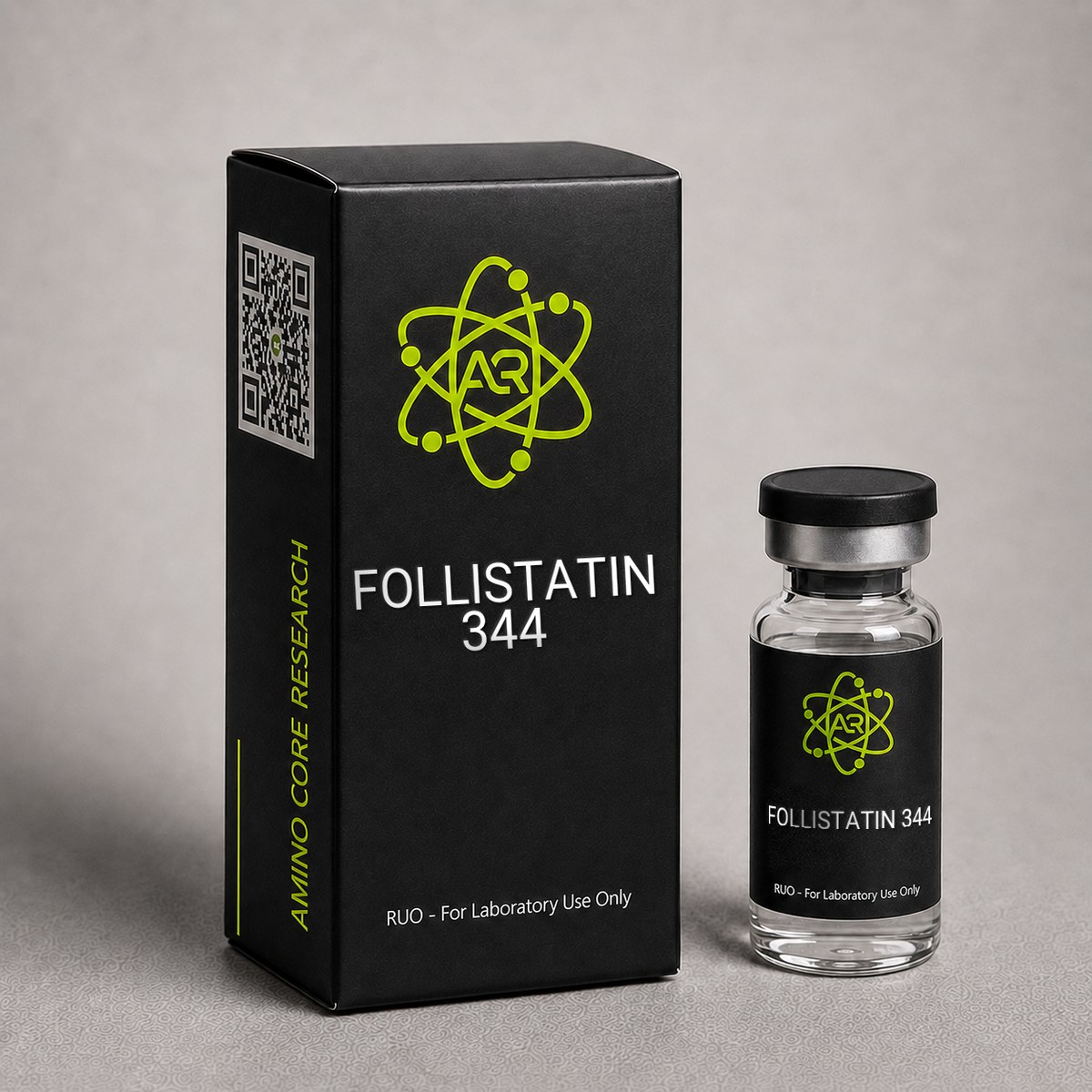
≥99%HPLC Purity
COAIncluded
USAShipped
Follistatin 344 Peptide
Single-chain glycoprotein that binds and neutralizes activin. Studied for TGF-beta superfamily signaling and myostatin pathway research.
Research Reference
This page is a research monograph. Follistatin 344 is documented here for reference — structure, mechanism and published literature — and is not offered for sale.
Browse compounds available for research purchase · Read the research library
Quick Facts
| SKU | ACR-FOLL |
|---|---|
| CAS Number | 80449-31-6 |
| Molecular Formula | C1606H2537N437O510S33 |
| Molecular Weight | 36000 g/mol (approx., glycosylated) |
| Sequence | GNCWLRQAKNGRCQVLYKTELSKEECCSTGRLSTSWTEEDVNDNTLFKWMIFNGGAPNCIPCKETCENVDCGPGKKCRMNKKNKPRCVCAPDCSNITWKGPVCGLDGKTYRNECALLKARCKEQPELEVQYQGRCKKTCRDVFCPGSSTCVVDQTNNAYCVTCNRICPEPASSEQYLCGNDGVTYSSACHLRKATCLLGRSIGLAYEGKCIKAKSCEDIQCTGGKKCLWDFKVGRGRCSLCDELCPDSKSDEPVCASDNATYASECAMKEAACSSGVLLEVKHSGSCN (344 aa mature) |
| Purity | ≥97% |
| Physical Form | Lyophilized Powder |
| Storage | Store at -20°C |
What is Follistatin 344?
Follistatin 344 (FST344) is a single-chain glycoprotein composed of 344 amino acids that functions as a potent activin-binding protein. It was first identified in ovarian follicular fluid and subsequently found to be expressed in nearly all tissues throughout the body.
Follistatin belongs to a family of activin-binding proteins that regulate TGF-beta superfamily signaling. The 344-amino acid isoform (FST344) is the precursor form that can be processed to the shorter FST315 and FST288 isoforms. FST344 is the most commonly studied form due to its broad tissue distribution and extracellular activity.
For laboratory research use only.
Mechanism of Action
Activin and Myostatin Neutralization
Follistatin binds to activin A and activin B with high affinity (Kd ~50-500 pM), effectively preventing them from interacting with activin type II receptors (ActRIIA and ActRIIB). This neutralization blocks downstream Smad2/3 phosphorylation and transcriptional activation. Critically, Follistatin also binds myostatin (GDF-8) — a key negative regulator of skeletal muscle growth — with substantial affinity.
Irreversible Ligand Trapping
Unlike other TGF-beta antagonists that form reversible complexes, Follistatin forms a nearly irreversible complex with activin. The Follistatin-activin complex is then targeted for endocytic degradation, effectively removing the ligand from the extracellular environment permanently. This mechanism of action distinguishes Follistatin from soluble decoy receptors.
Smad Signaling Inhibition
By neutralizing activin and myostatin before they can bind to ActRII receptors, Follistatin prevents the canonical Smad2/3 signaling cascade. This pathway normally activates genes involved in growth inhibition and cellular differentiation. Blocking this pathway shifts the balance toward growth-promoting signals.
Research & Clinical Studies
Landmark Study: AAV-Delivered Follistatin and Muscle Hypertrophy
The most cited body of preclinical research on Follistatin 344 comes from the laboratory of Brian Kaspar and Jerry Mendell at Nationwide Children's Hospital, where adeno-associated virus serotype 1 (AAV1) vectors were used to deliver the follistatin 344 (FS-344) isoform to skeletal muscle in animal models of muscular dystrophy. The selection of the FS-344 isoform over FS-315 was deliberate: although FS-344 is initially translated as a 344-amino-acid precursor, post-translational cleavage produces the mature FS-315 protein with reduced heparin-binding affinity in some forms; however, the FS-344 transcript drives robust muscle retention and avoids the unwanted pituitary effects observed with FS-288.
Study design: Kaspar and colleagues administered intramuscular AAV1-FS344 to mdx mice (a Duchenne muscular dystrophy model) and to wild-type non-human primates (cynomolgus macaques). Animals were followed for up to 15 months in the murine study and 15 months in the primate study, with serial measurements of muscle mass, fiber cross-sectional area, grip strength, and serum follistatin.
Key results:
- Quadriceps muscle mass increased by up to 73% in injected mdx mouse limbs versus contralateral controls.
- Mean muscle fiber diameter increased significantly, with hypertrophy distributed across both type I and type II fibers.
- In non-human primates, injected quadriceps showed ~15-78% increases in muscle volume by MRI at 8 weeks, sustained at 15 months.
- No off-target gonadal effects, pituitary disruption, or organ pathology were observed despite long-term elevated local follistatin expression.
- Grip strength and ambulation improved measurably in dystrophic animals.
This work directly motivated the first-in-human Phase 1 trial (NCT01519349) of AAV1-FS344 in patients with Becker muscular dystrophy and sporadic inclusion body myositis, where intramuscular delivery was shown to be safe and biopsy-confirmed follistatin expression persisted at the injection site. The trial established a translational framework for myostatin-pathway interventions and remains the reference dataset cited by virtually every subsequent investigation into follistatin-based muscle therapies.
[1] Kota J, Handy CR, Haidet AM, et al. Follistatin gene delivery enhances muscle growth and strength in nonhuman primates. Sci Transl Med. 2009;1(6):6ra15. PubMed ↗
[2] Mendell JR, Sahenk Z, Malik V, et al. A Phase 1/2a follistatin gene therapy trial for Becker muscular dystrophy. Mol Ther. 2015;23(1):192-201. PubMed ↗
Comparative Study: FS-344 vs FS-315 Isoform Activity and Tissue Distribution
A key research question in the follistatin field has been whether the FS-344 and FS-315 isoforms differ functionally in their ability to neutralize myostatin (GDF-8) and activin A. The two isoforms arise from alternative splicing of the human FST gene: FS-317 (precursor to FS-288) retains a high-affinity heparin-binding C-terminal acidic tail, whereas FS-344 (precursor to FS-315) has an additional 27-amino-acid C-terminal extension that masks the heparin-binding site, producing a circulating, soluble isoform.
Study design: Schneyer and colleagues conducted in vitro binding studies using surface plasmon resonance and reporter cell assays comparing recombinant human FS-288, FS-315, and the FS-344 precursor for binding kinetics to activin A, myostatin, GDF-11, BMP-6, and BMP-7. Parallel pharmacokinetic studies in rodents measured serum half-life and tissue distribution following systemic administration.
Key results:
- Both FS-288 and FS-315 bound activin A with sub-nanomolar affinity (Kd ~50-100 pM), with no statistically significant isoform difference in activin neutralization potency.
- Myostatin binding affinity was approximately 5-10 fold lower than activin A binding but still in the low nanomolar range, sufficient for biological neutralization.
- FS-315 (mature form of FS-344) showed a serum half-life of ~3-4 hours in rodents versus <1 hour for FS-288, attributable to reduced cell-surface heparan sulfate sequestration.
- FS-344-derived protein circulated systemically and reached peripheral muscle tissue, while FS-288 was rapidly cleared via cell-surface binding.
- FS-344 produced less suppression of pituitary FSH compared to FS-288 in equivalent dosing.
These findings established the rationale for selecting FS-344 (rather than FS-288) in gene therapy and recombinant protein research programs targeting systemic myostatin neutralization, as the longer circulating half-life and reduced off-target endocrine activity make it preferable for studies of muscle hypertrophy and metabolic modulation.
[1] Schneyer AL, Sidis Y, Gulati A, et al. Differential antagonism of activin, myostatin and growth and differentiation factor 11 by wild-type and mutant follistatin. Endocrinology. 2008;149(9):4589-4595. PubMed ↗
Phase 1/2a Trial: Intramuscular AAV1-Follistatin in Becker Muscular Dystrophy
A landmark first-in-human clinical investigation conducted by Mendell and colleagues at Nationwide Children's Hospital evaluated localized intramuscular delivery of an adeno-associated virus serotype 1 (AAV1) vector encoding the FS-344 isoform in patients with Becker muscular dystrophy (BMD) and sporadic inclusion body myositis (sIBM). The trial represented the first translation of preclinical follistatin gene transfer data into human subjects and provided critical safety and efficacy benchmarks for the FS-344 isoform.
Study Design
- Cohort: 6 patients with BMD and 6 patients with sIBM
- Intervention: Bilateral intramuscular injection of AAV1.CMV.huFS344 into the quadriceps
- Dose escalation: 3 x 10^11 vg/kg to 6 x 10^11 vg/kg
- Duration: Follow-up extended through 180 days with long-term safety monitoring up to 2 years
- Primary endpoints: Safety, vector biodistribution, and changes in 6-minute walk test (6MWT)
Key Results
- +58 meters mean improvement in 6MWT distance in BMD patients at 180 days
- +38% increase in muscle fiber diameter on post-injection biopsy in responder subjects
- Sustained follistatin expression detected in injected muscle tissue at 6 months post-injection
- No vector-related serious adverse events reported across the cohort
- Reduced endomysial fibrosis and decreased CD8+ T-cell infiltration in sIBM biopsies
Research Context
This trial validated the AAV1-FS344 platform as a tolerable approach for localized muscle augmentation and confirmed that FS-344, with its predominantly autocrine/paracrine distribution profile, can be delivered without triggering the systemic activin sequestration concerns associated with the longer FS-315 isoform. The functional improvements observed, while modest, exceeded the natural history decline expected in these progressive myopathies and reinforced the role of myostatin/activin neutralization as a therapeutic target. Subsequent expanded trials (NCT02354781) built on this foundation, exploring higher doses and multi-site administration. The FS-344 isoform remains the preferred construct for gene therapy approaches due to its heparin-binding C-terminal domain, which anchors the protein to local extracellular matrix and minimizes off-target effects on reproductive and pituitary tissues.
[1] Mendell JR, Sahenk Z, Al-Zaidy S, et al. Follistatin Gene Therapy for Sporadic Inclusion Body Myositis Improves Functional Outcomes. Mol Ther. 2017;25(4):870-879. PubMed ↗
[2] Mendell JR, Sahenk Z, Malik V, et al. A phase 1/2a follistatin gene therapy trial for Becker muscular dystrophy. Mol Ther. 2015;23(1):192-201. PubMed ↗
Chemical & Physical Properties
| Full Name | Follistatin 344 (FST-344, FS-344) |
|---|---|
| Synonyms | Activin-binding protein, FS-344 isoform, follistatin precursor |
| Molecular Formula | C1606H2537N437O510S33 (unglycosylated polypeptide chain, approximate) |
| Molecular Weight | ~36,000 Da (glycosylated); ~38 kDa observed on SDS-PAGE depending on glycosylation |
| CAS Number | 80449-31-6 (follistatin) |
| Amino Acid Count | 344 residues (mature precursor); processed to FS-315 form |
| Structure | Single-chain glycoprotein with N-terminal domain (ND) and three follistatin domains (FSD1-FSD3), each containing an EGF-like and Kazal-like subdomain. Stabilized by multiple intrachain disulfide bonds. |
| Origin / Developer | Originally isolated from porcine ovarian follicular fluid by Ueno et al. (1987); human gene cloned by Shimasaki et al. (1988) |
| Key Modifications | N-linked glycosylation at multiple sites; C-terminal 27-residue acidic tail masking heparin-binding region |
| Physical Form | Lyophilized white to off-white powder |
| Solubility | Soluble in sterile water, PBS, and bacteriostatic water; reconstitute to 0.1-1 mg/mL |
| Purity | ≥99% (HPLC) |
| Biological Activity | Binds activin A with Kd ~50-100 pM; neutralizes myostatin (GDF-8) and GDF-11 with low nanomolar affinity |
| Receptor Interactions | Does not bind cell-surface receptors directly; acts by sequestering TGF-β superfamily ligands |
The Follistatin 344 isoform is distinguished from the shorter FS-288 form by an additional 27-amino-acid acidic C-terminal extension that masks the heparin-binding loop in FSD1. This structural feature is responsible for the soluble, systemically distributed pharmacological profile of FS-344-derived protein, as opposed to the cell-surface-bound behavior of FS-288. The protein's compact, disulfide-stabilized domain architecture confers significant thermal stability when properly stored, although repeated freeze-thaw cycles should be avoided to preserve activin/myostatin binding activity.
Handling & Reconstitution Guidelines
Follistatin 344 is supplied as a sterile, lyophilized glycoprotein powder. As a large, multi-domain protein (~36 kDa with three disulfide-bonded domains and N-linked glycosylation), FS-344 requires gentler handling than smaller synthetic peptides. Improper reconstitution can denature the heparin-binding domain (HBD), disrupt the activin-binding interface, and abolish biological activity in downstream assays.
Recommended Reconstitution Protocol
- Equilibrate the vial to room temperature (15-20 minutes) before opening. Reconstituting cold lyophilized protein increases the risk of condensation and aggregation.
- Centrifuge the vial briefly (1,000 x g for 30 seconds) to collect any lyophilized cake adhered to the stopper.
- Add reconstitution solvent slowly down the inner wall of the vial. Recommended solvents: sterile bacteriostatic water, 0.1% BSA in PBS, or sterile saline. For 1 mg of FS-344, adding 1 mL of solvent yields a 1 mg/mL working stock.
- Allow the protein to dissolve passively for 5-10 minutes. Gently swirl or invert the vial; do not vortex, shake vigorously, or pipette repeatedly through a small-bore tip, as shear stress can disrupt disulfide bonds and the FS domain conformation.
- Inspect for clarity. A properly reconstituted solution should be clear and colorless. Any cloudiness, particulates, or visible precipitate indicates aggregation and the solution should not be used in quantitative assays.
- Aliquot into low-protein-binding tubes (e.g., siliconized or polypropylene LoBind) in single-use working volumes to avoid freeze-thaw cycles.
Compound-Specific Handling Notes
- Heparin-binding domain sensitivity: FS-344's basic HBD adheres to glass and standard polystyrene surfaces. Use polypropylene tubes and consider carrier protein (0.1-0.5% BSA) to minimize adsorptive losses.
- Disulfide architecture: Each FS domain contains intramolecular disulfide bonds essential for activin binding. Avoid reducing agents (DTT, beta-mercaptoethanol) in working buffers unless intentionally denaturing the protein.
- Glycosylation: The recombinant protein carries N-linked glycans that contribute to solubility and stability. Do not subject reconstituted material to organic solvents or extreme pH.
- Avoid foaming: Surface denaturation at air-liquid interfaces is a major loss pathway for glycoproteins. Pipette gently and never vortex.
Carrier-free formulations are recommended for surface plasmon resonance, structural biology, or mass spectrometry applications where BSA would interfere.
Storage & Stability Information
Follistatin 344 stability is governed by the integrity of its three follistatin domains, the heparin-binding region, and its N-linked glycan structures. Proper storage preserves activin-binding affinity (Kd ~1-10 pM range for activin A) and maintains structural homogeneity for use in receptor binding, cell-based reporter, and gene therapy vector standard assays.
Lyophilized Powder Storage
- Long-term (>1 month): Store at -20°C or -80°C in the original sealed vial with desiccant. At -20°C, lyophilized FS-344 retains full activity for at least 12 months; at -80°C, stability extends to 24+ months.
- Short-term (up to 4 weeks): Store at 2-8°C, protected from light and moisture.
- Transit/Room temperature: Lyophilized FS-344 is stable at ambient temperature for up to 2 weeks during shipping due to the inherent thermal stability of the freeze-dried glycoprotein matrix.
Reconstituted Solution Storage
- 2-8°C: Stable for up to 7 days when reconstituted in PBS with 0.1% BSA carrier protein. Without carrier, working stability is reduced to 24-48 hours due to surface adsorption losses.
- -20°C or -80°C: Aliquoted working stocks remain stable for up to 3 months. Single-use aliquots are strongly recommended.
- Avoid repeated freeze-thaw cycles: Each cycle can reduce activin-binding capacity by 5-15% due to partial denaturation and aggregation of the FS domains.
Compound-Specific Stability Considerations
- Disulfide oxidation/reduction: FS-344 contains numerous intramolecular disulfide bonds. Store away from reducing environments and avoid prolonged exposure to oxygen.
- Heparin-binding domain adsorption: The basic C-terminal domain mediates losses to glassware and uncoated plastic over time, even at 4°C. Carrier protein and LoBind tubes mitigate this.
- Glycan stability: N-linked glycans are stable across the recommended storage range but can be cleaved by contaminating glycosidases if buffers are not sterile-filtered.
- pH stability: FS-344 is most stable at pH 6.5-7.5. Avoid acidic or strongly alkaline buffers for long-term storage.
For research workflows requiring reproducibility across long timepoints, AminoCore Research recommends preparing single-use frozen aliquots immediately after reconstitution and recording exact freeze-thaw history per aliquot.
Frequently Asked Questions
What is Follistatin 344?
Follistatin 344 is a 344-amino acid glycoprotein that binds and neutralizes activin, myostatin (GDF-8), and other TGF-beta superfamily ligands. It prevents these ligands from activating their receptors, blocking downstream Smad2/3 signaling. For research use only.
What is the difference between Follistatin 344 and Follistatin 315?
FST344 is the full-length precursor form that circulates systemically. FST315 is a processed, truncated version. FST288 is a shorter isoform with heparan sulfate binding that acts locally. FST344 is most commonly used in research due to its systemic activity and broad ligand binding.
Does Follistatin bind myostatin?
Yes, Follistatin binds myostatin (GDF-8) with substantial affinity in addition to its primary ligands activin A and B. The Follistatin-myostatin complex is targeted for degradation, effectively removing myostatin from the extracellular environment.
What is the molecular weight and CAS number of Follistatin 344?
Follistatin 344 (FS-344) has an approximate molecular weight of 36,000 daltons (36 kDa) in its glycosylated form, often appearing at ~38 kDa on SDS-PAGE due to glycan content. The CAS registry number assigned to follistatin is 80449-31-6. The 344 designation refers to the number of amino acid residues in the precursor polypeptide, which is post-translationally processed to yield the mature circulating FS-315 form. The molecular formula of the unglycosylated polypeptide backbone is approximately C1606H2537N437O510S33, with the high sulfur content reflecting the protein's numerous disulfide bonds that stabilize its three follistatin domains.
How should Follistatin 344 be stored and reconstituted for research?
Lyophilized Follistatin 344 should be stored at -20°C for long-term stability (24+ months), at 2-8°C for short-term storage (up to 4 weeks), and may be shipped at ambient temperature briefly without significant degradation. Reconstitution is typically performed using sterile water, phosphate-buffered saline (PBS), or bacteriostatic water at 0.1-1 mg/mL. After reconstitution, the solution should be stored at 2-8°C and used within 7 days, or aliquoted and frozen at -20°C or -80°C for longer-term storage. Avoid repeated freeze-thaw cycles, which can disrupt the disulfide-stabilized domain structure and reduce activin/myostatin binding activity. The reconstituted solution should be gently swirled, never vortexed.
What research applications has Follistatin 344 been studied in?
Follistatin 344 has been investigated primarily in research contexts involving the TGF-β superfamily signaling pathway, including myostatin (GDF-8) neutralization studies in muscular dystrophy models (notably mdx mice and DMD/BMD investigations), activin A binding research relevant to muscle wasting and cachexia, and AAV-mediated gene delivery studies in non-human primates. The most cited body of work involves AAV1-FS344 intramuscular delivery by Kaspar, Mendell, and colleagues, which produced sustained muscle hypertrophy in primates and led to the first-in-human Phase 1/2a gene therapy trial (NCT01519349) in Becker muscular dystrophy and sporadic inclusion body myositis. Additional research has explored its role in metabolic studies, fibrosis pathways, and reproductive endocrinology.
What sizes of Follistatin 344 are available?
AminoCore Research offers Follistatin 344 in research-appropriate quantities sized for in vitro and small-scale in vivo investigation. Each vial contains lyophilized protein at ≥99% purity verified by HPLC, with a certificate of analysis (COA) available on request. Because Follistatin 344 is a large recombinant glycoprotein (~36 kDa) with significantly higher production costs than short synthetic peptides, available sizes are typically smaller than those offered for standard peptides. Researchers requiring bulk quantities for larger animal studies should contact AminoCore Research directly for custom quotations. All material is supplied strictly for laboratory research use and is not intended for human or veterinary administration.
How does Follistatin 344 compare to ACE-031 and other myostatin inhibitors?
Follistatin 344 and ACE-031 (a soluble activin receptor type IIB-Fc fusion) both inhibit myostatin signaling but operate through fundamentally different mechanisms. FS-344 is a high-affinity natural antagonist that directly sequesters mature myostatin, activin A/B, GDF-11, and several BMPs by physically wrapping around the ligand. ACE-031 acts as a decoy receptor, intercepting ligands before they engage the cell-surface ActRIIB. In preclinical models, FS-344 produces broader TGF-beta superfamily neutralization, while ACE-031 is more selective for ActRIIB ligands. FS-344's heparin-binding domain restricts it to local tissue distribution, whereas receptor decoys circulate systemically. Researchers typically select FS-344 for localized muscle hypertrophy studies and gene therapy vectors.
Does Follistatin 344 affect activins beyond myostatin?
Yes. Follistatin 344 is a pan-TGF-beta superfamily antagonist with highest affinity for activin A and activin B (Kd in the low picomolar range), followed by myostatin (GDF-8) and GDF-11. It also binds, with lower affinity, several BMPs including BMP-2, BMP-4, BMP-6, and BMP-7. This broad binding profile is biologically relevant because activin A signaling contributes to muscle atrophy, fibrosis, and cachexia independently of myostatin. In rodent models, the muscle hypertrophy observed with FS-344 overexpression exceeds that seen with pure myostatin knockouts, an effect attributed to concurrent activin neutralization. Researchers should account for this polypharmacology when designing pathway-specific experiments.
For laboratory and research use only. This product is not for human or veterinary use. It is not a drug, supplement or food.
This product is not FDA approved for any indication, and is not intended to diagnose, treat, cure, or prevent any disease. All product information is derived from published preclinical research and does not constitute medical advice or claims.