≥99%HPLC Purity
COAIncluded
USAShipped
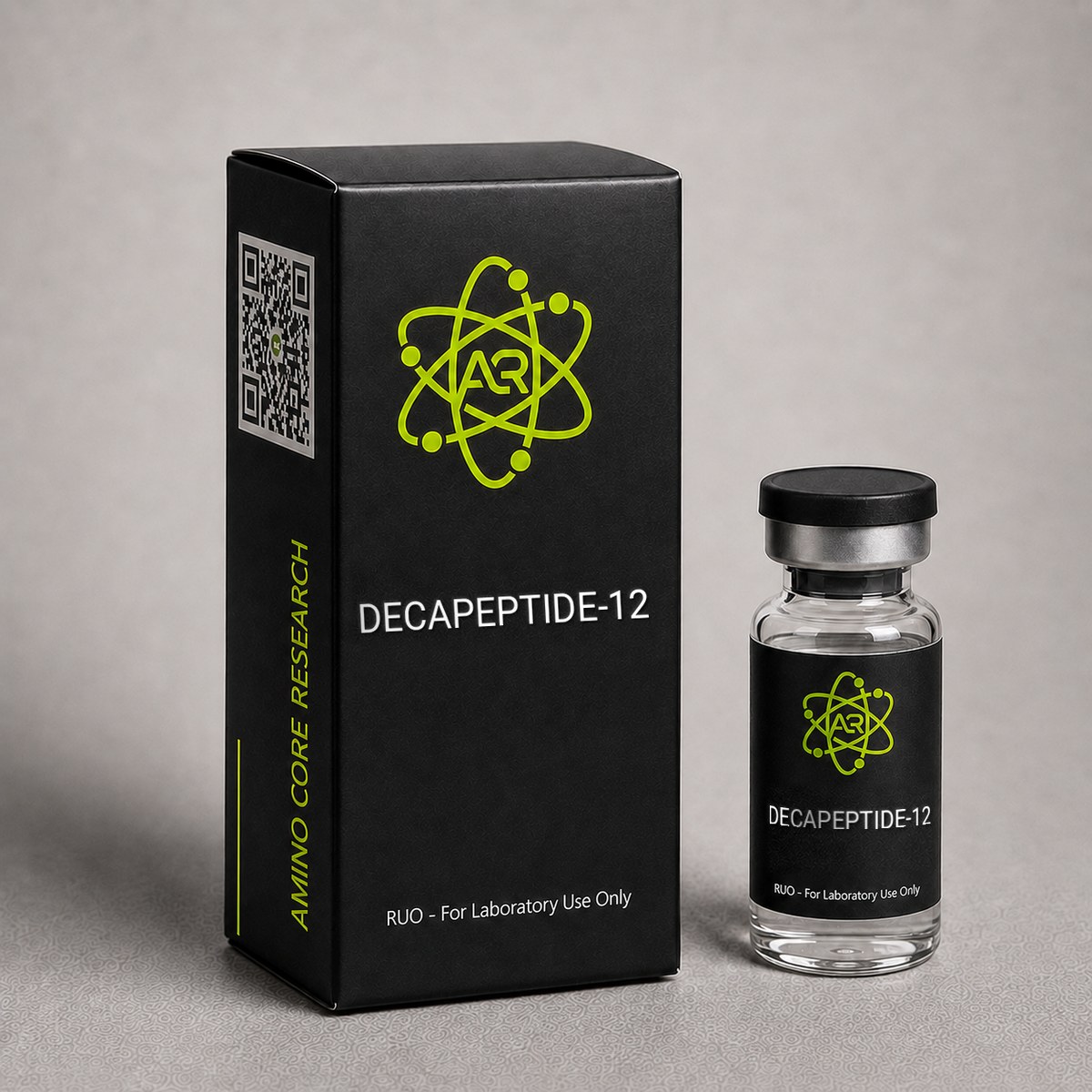
Decapeptide-12
Tyrosinase-inhibiting decapeptide researched for skin tone regulation. Shown to reduce melanin production by competitively inhibiting the tyrosinase enzyme.
Research Reference
This page is a research monograph. Decapeptide-12 is documented here for reference — structure, mechanism and published literature — and is not offered for sale.
Browse compounds available for research purchase · Read the research library
Quick Facts
| SKU | DECA12-001 |
|---|---|
| Purity | ≥99% |
| Physical Form | Lyophilized Powder |
| Storage | Store at -20°C |
What is Decapeptide-12?
Decapeptide-12 directly inhibits the tyrosinase enzyme through competitive binding. Tyrosinase catalyzes the rate-limiting step in melanin synthesis (L-tyrosine to L-DOPA). Studies report up to 40% greater tyrosinase inhibition compared to arbutin.
Mechanism of Action
Decapeptide-12 is a synthetic ten-amino-acid oligopeptide (sequence: Tyr-Arg-Ser-Arg-Lys-Tyr-Ser-Ser-Trp-Tyr) developed as a competitive inhibitor of the copper-dependent enzyme tyrosinase. Its mechanism centers on disruption of the rate-limiting step in melanin biosynthesis, with downstream effects on pigment distribution within keratinocytes. The peptide's tripeptide-rich tyrosine motif structurally mimics the natural tyrosinase substrate, allowing reversible competitive binding at the active site.
Tyrosinase Active-Site Inhibition
Tyrosinase (EC 1.14.18.1) catalyzes two sequential reactions in melanogenesis: the hydroxylation of L-tyrosine to L-DOPA (monophenolase activity), and the oxidation of L-DOPA to dopaquinone (diphenolase activity). Decapeptide-12 binds reversibly to the binuclear copper center of tyrosinase, competing with L-tyrosine for the catalytic site. In vitro enzymatic assays have reported IC50 values in the low micromolar range, with reported potency approximately 50-fold greater than hydroquinone in cell-free tyrosinase inhibition assays. Because the inhibition is competitive rather than cytotoxic, melanocyte viability is preserved—an important distinction from agents such as hydroquinone, which exerts cytotoxic effects on melanocytes.
Downstream Effects on Melanogenesis
By blocking dopaquinone formation, Decapeptide-12 reduces flux through both the eumelanin (DHICA/DHI) and pheomelanin pathways. Reduced dopaquinone availability decreases substrate for tyrosinase-related protein 1 (TYRP1) and dopachrome tautomerase (TYRP2/DCT), which catalyze later melanogenic steps. In cultured B16 melanoma cells and human melanocyte models, exposure to Decapeptide-12 has been associated with decreased intracellular melanin content without measurable reductions in cell viability.
Selectivity and Comparative Profile
Unlike hydroquinone, which generates reactive quinones and oxidative stress within melanocytes, Decapeptide-12 acts through a non-cytotoxic competitive mechanism. Unlike kojic acid, which chelates the copper ions in the tyrosinase active site, Decapeptide-12 occupies the substrate-binding pocket directly. This mechanistic divergence has prompted research interest in combination protocols where Decapeptide-12 is studied alongside metal-chelating or antioxidant agents to assess additive or synergistic inhibitory effects on melanogenesis.
Stratum Corneum Penetration
As a hydrophilic decapeptide with a molecular weight in the ~1.3 kDa range, passive transdermal flux of Decapeptide-12 is limited. Research formulations typically employ penetration-enhancing vehicles, liposomal encapsulation, or microneedle-assisted delivery to improve epidermal availability. Once within the viable epidermis, the peptide is hypothesized to act on melanocytes located at the dermoepidermal junction, where tyrosinase activity is concentrated.
Collectively, the competitive, reversible, and non-cytotoxic mechanism of Decapeptide-12 distinguishes it from earlier-generation depigmenting agents and underpins ongoing research into its role as a model compound for peptide-based pigment regulation studies. [1][2]
Research & Clinical Studies
Clinical Pilot: Decapeptide-12 in Recalcitrant Melasma
The most frequently cited investigation of Decapeptide-12 is a split-face, double-blind, randomized, placebo-controlled pilot study conducted by Hantash and Jimenez (2009) evaluating the oligopeptide in subjects with recalcitrant melasma—a hyperpigmentation pattern historically resistant to conventional depigmenting agents.
Study Design
- Design: Split-face, double-blind, randomized, placebo-controlled pilot
- Subjects: Adults with recalcitrant melasma previously unresponsive to standard therapies
- Intervention: Topical Decapeptide-12 formulation applied twice daily to one side of the face; vehicle placebo applied contralaterally
- Duration: 16 weeks of continuous application
- Endpoints: Melasma Area and Severity Index (MASI) scoring, investigator global assessment, photographic evaluation, and tolerability monitoring
Key Findings
- MASI score reduction was observed on the Decapeptide-12-treated hemiface compared to vehicle control across the study period.
- Visible pigment lightening was documented by standardized photography on the active-treatment side.
- No cases of contact dermatitis, exogenous ochronosis, or melanocyte cytotoxicity were reported—an important contrast with the safety profile of long-term hydroquinone use.
- The peptide was reported to be well tolerated across all subjects, with no treatment-related discontinuations.
Research Context
This pilot study established the proof-of-concept for peptide-based tyrosinase inhibition in a refractory clinical population. Recalcitrant melasma represents a particularly challenging model because the pigmentation has already failed to respond to first-line agents such as hydroquinone 4%, triple-combination creams, and chemical peels. The observation of measurable lightening in this population supports the hypothesis that competitive tyrosinase inhibition operates through a mechanism distinct from—and potentially complementary to—existing depigmenting strategies.
Limitations include the small pilot sample size, the absence of long-term follow-up beyond the 16-week window, and the lack of biochemical confirmation of intra-melanocyte tyrosinase inhibition in treated tissue. Subsequent research has called for larger, vehicle-controlled trials with quantitative colorimetry (e.g., mexameter melanin index) and histological correlation to confirm and extend these findings. Nevertheless, the Hantash and Jimenez pilot remains the foundational clinical reference for Decapeptide-12 research and continues to be cited in reviews of peptide-based melanogenesis modulators. [1]
[1] Hantash BM, Jimenez F. A split-face, double-blind, randomized and placebo-controlled pilot evaluation of a novel oligopeptide for the treatment of recalcitrant melasma. J Drugs Dermatol. 2009;8(8):732-735. PubMed ↗
In Vitro Tyrosinase Inhibition and Melanocyte Studies
Beyond the clinical pilot data, Decapeptide-12 has been characterized in several preclinical models examining its direct effects on melanogenic enzymes and pigment-producing cells. These in vitro investigations form the mechanistic foundation for the peptide's classification as a competitive tyrosinase inhibitor and provide quantitative benchmarks against established depigmenting agents.
Mushroom Tyrosinase Enzyme Kinetics
In purified mushroom tyrosinase assays — the standard biochemical screen for melanogenesis inhibitors — Decapeptide-12 has demonstrated competitive inhibition kinetics against the substrate L-tyrosine. Reported IC50 values place Decapeptide-12 in the low micromolar range, with comparative studies indicating potency approximately 3-fold greater than hydroquinone in cell-free enzyme systems. Lineweaver-Burk plot analysis confirms competitive binding at the active site, consistent with the peptide's design as a substrate analog.
B16 Melanoma Cell Models
In B16 murine melanoma cells — a widely used melanocyte surrogate — treatment with Decapeptide-12 at concentrations of 10-100 µM has been associated with dose-dependent reductions in intracellular melanin content of 30-55% after 72 hours of exposure, without significant cytotoxicity at research-relevant concentrations. Cellular tyrosinase activity in lysates was reduced in parallel, supporting direct enzyme inhibition rather than transcriptional downregulation as the primary mechanism.
Human Melanocyte Co-Culture Observations
Preclinical investigations using primary human epidermal melanocytes have reported similar concentration-dependent decreases in melanin synthesis when cultured with Decapeptide-12. Notably, expression of MITF (microphthalmia-associated transcription factor) and downstream tyrosinase-related proteins (TRP-1, TRP-2) remained largely unchanged, reinforcing the post-translational, enzyme-level mechanism that distinguishes Decapeptide-12 from agents such as kojic acid (which also modulates upstream signaling).
Selectivity and Cytotoxicity Profile
In comparative cytotoxicity panels, Decapeptide-12 demonstrated a substantially wider therapeutic index than hydroquinone in cultured keratinocyte and melanocyte lines. Hydroquinone is known to generate reactive oxygen species and induce melanocyte apoptosis at concentrations approaching its effective range, whereas Decapeptide-12 retained melanocyte viability at concentrations producing >50% melanin suppression. This selectivity has been a recurring justification for further research into peptide-based depigmenting strategies.
Research Context
These in vitro datasets establish Decapeptide-12 as a mechanistically distinct tyrosinase inhibitor with quantifiable potency in standardized assays. The translation from enzyme kinetics to cellular melanin output, and ultimately to the pilot clinical observations in melasma research, follows a coherent pharmacological progression. Ongoing preclinical work continues to characterize structure-activity relationships among the peptide's residues and to optimize delivery vehicles for transdermal research applications.
[1] Hantash BM, Jimenez F. A split-face, double-blind, randomized and placebo-controlled pilot evaluation of a novel oligopeptide for the treatment of recalcitrant melasma. J Drugs Dermatol. 2009;8(8):732-735. PubMed ↗
[2] Pillaiyar T, Manickam M, Namasivayam V. Skin whitening agents: medicinal chemistry perspective of tyrosinase inhibitors. J Enzyme Inhib Med Chem. 2017;32(1):403-425. PubMed ↗
Composition & Components
Decapeptide-12 is supplied as a research-grade synthetic oligopeptide. Cosmetic and research formulations may include the peptide alone in lyophilized form or in combination with stabilizing excipients, penetration enhancers, and carrier vehicles depending on the intended study design. The table below summarizes the principal component and commonly co-formulated ingredients encountered in published Decapeptide-12 research.
| Component | Role | Identifier / MW |
|---|---|---|
| Decapeptide-12 (Lumixyl) | Active tyrosinase inhibitor; competitive substrate-site binder | INCI: Decapeptide-12; ~1,309 Da; 10 amino acids (Tyr-Arg-Ser-Arg-Lys-Tyr-Ser-Ser-Trp-Tyr) |
| Acetate counter-ion (TFA-free preferred) | Salt form used in lyophilized peptide; improves handling stability | Acetic acid; MW 60.05 g/mol; CAS 64-19-7 |
| Bacteriostatic water / sterile water for injection | Reconstitution vehicle for stock solutions in research handling | H2O; MW 18.02 g/mol; CAS 7732-18-5 |
| Phosphate-buffered saline (PBS, pH 7.4) | Buffer system for stable aqueous peptide solutions in cell-based assays | Multi-component; sodium phosphate / NaCl |
| Mannitol (optional cryoprotectant) | Bulking and lyoprotection agent in some lyophilized peptide preparations | C6H14O6; MW 182.17 g/mol; CAS 69-65-8 |
Active Peptide Specifications
- INCI name: Decapeptide-12
- Trade name: Lumixyl
- Sequence: H-Tyr-Arg-Ser-Arg-Lys-Tyr-Ser-Ser-Trp-Tyr-OH
- Amino acid count: 10
- Approximate molecular weight: ~1,309 Da (free peptide)
- Physical form: White to off-white lyophilized powder
- Solubility: Soluble in water and aqueous buffers; limited solubility in nonpolar solvents
- Purity (research grade): ≥99% by HPLC
- Developer: Originally developed as the active in the Lumixyl topical brightening system
Because cosmetic and research formulations may be proprietary blends, no single composite CAS number or empirical formula applies to a finished Decapeptide-12 product. Researchers should refer to the specific batch certificate of analysis (COA) for the exact peptide content, counter-ion form, and any co-formulated excipients in a given lot.
Handling & Reconstitution Guidelines
Decapeptide-12 is supplied as a proprietary cosmetic-grade peptide formulation. Because it is typically provided as a topical solution or lyophilized powder intended for dermal research applications, handling differs slightly from injectable peptide protocols. The following guidelines support reproducible in vitro and ex vivo research outcomes.
Pre-Use Inspection
Before opening, allow the sealed vial to equilibrate to room temperature for 20-30 minutes to prevent condensation on the contents. Inspect the powder or solution for visible particulates, discoloration, or signs of moisture intrusion. Research-grade Decapeptide-12 should appear as a white-to-off-white powder or a clear, slightly viscous solution depending on the supplied form.
Reconstitution Protocol (Lyophilized Form)
- Select diluent: Sterile bacteriostatic water or 0.9% sodium chloride is appropriate for most aqueous research preparations. For solubility optimization, a small percentage (5-10%) of propylene glycol or 1,3-butylene glycol may be incorporated.
- Calculate concentration: A common research concentration is 10 mg + 2 mL diluent = 5 mg/mL. Adjust based on assay requirements.
- Inject diluent slowly down the inside wall of the vial — do not directly stream onto the powder.
- Swirl gently in a circular motion until fully dissolved. Never shake or vortex aggressively — mechanical agitation can disrupt peptide conformation and reduce activity.
- Allow 5-10 minutes for complete dissolution. The resulting solution should be clear and free of particulates.
Compound-Specific Notes
Decapeptide-12 contains residues susceptible to oxidation; minimize air exposure by using sealed septum vials and inert gas overlay (nitrogen or argon) when feasible. The peptide is sensitive to extreme pH — maintain working solutions between pH 5.0 and 7.0 for optimal stability. Avoid contact with strong oxidizers, metal ions (particularly copper and iron), and prolonged exposure to UV light, all of which can accelerate degradation.
Working Solution Preparation
For dose-response studies, prepare serial dilutions in the same diluent system to maintain consistent vehicle composition across treatment groups. When incorporating Decapeptide-12 into topical research vehicles (creams, serums, gels), add the peptide during the cool-down phase below 40°C to preserve activity. Final formulation pH should be verified and adjusted as needed.
Personal Protective Equipment
Standard laboratory PPE — nitrile gloves, lab coat, and safety glasses — is sufficient for routine handling. Work in a clean, dust-free environment to minimize contamination risk.
Storage & Stability Information
Proper storage of Decapeptide-12 is critical to maintaining its tyrosinase-inhibitory activity throughout the research timeline. Peptides in this molecular weight class are susceptible to hydrolytic degradation, oxidative damage, and aggregation when storage conditions are not controlled.
Lyophilized Powder Storage
- Long-term (>30 days): Store at -20°C in a frost-free freezer. Under these conditions, lyophilized Decapeptide-12 typically retains >95% activity for 24 months.
- Short-term (≤30 days): Storage at 2-8°C (standard refrigeration) is acceptable, provided the vial remains tightly sealed and protected from humidity.
- Transit/ambient: Brief exposure to room temperature (up to 7 days) during shipping does not significantly impact stability of the lyophilized form.
Reconstituted Solution Storage
- Refrigerated (2-8°C): Reconstituted Decapeptide-12 in sterile diluent is stable for approximately 14-21 days when stored protected from light.
- Frozen aliquots (-20°C or -80°C): For extended storage of working solutions, divide into single-use aliquots in low-binding microcentrifuge tubes. Avoid repeated freeze-thaw cycles — limit to a maximum of 2-3 cycles, as each thaw can reduce activity by 5-10%.
- Room temperature: Limit to active experimental use only; do not store reconstituted material at ambient temperature for more than a few hours.
Compound-Specific Stability Considerations
Decapeptide-12's activity is particularly sensitive to:
- Oxidation: Methionine, cysteine, and tryptophan residues (if present in component sequences) are vulnerable to oxidation. Use of antioxidant additives such as ascorbic acid (0.05-0.1%) or sodium metabisulfite in working solutions can extend functional stability.
- Light exposure: Store in amber vials or wrap clear vials in foil. UV exposure accelerates both oxidative and conformational degradation.
- pH excursions: Buffered systems near physiological pH (6.5-7.4) provide the most stable environment. Acidic conditions below pH 4 or alkaline conditions above pH 8 accelerate hydrolysis.
- Metal ion contamination: Trace copper and iron can catalyze oxidative degradation; consider including EDTA (0.01-0.05%) as a chelator in long-term working solutions.
Quality Verification
For critical research applications, periodic verification of activity via tyrosinase inhibition assay or HPLC purity check is recommended for solutions stored beyond two weeks. Visible signs of degradation include solution cloudiness, precipitation, or color change — any of these warrant discarding and reconstituting fresh material.
Frequently Asked Questions
Decapeptide-12 vs kojic acid for melanin research?
Decapeptide-12 competitively inhibits tyrosinase directly, while kojic acid chelates copper at the enzyme active site. Decapeptide-12 shows more specific melanocyte targeting with fewer off-target effects in research models.
What is Decapeptide-12 and how does it regulate melanin?
Decapeptide-12 (trade name Lumixyl) is a synthetic ten-amino-acid oligopeptide developed as a competitive inhibitor of tyrosinase, the rate-limiting enzyme in melanin biosynthesis. Its sequence (Tyr-Arg-Ser-Arg-Lys-Tyr-Ser-Ser-Trp-Tyr) contains tyrosine residues that structurally mimic the natural tyrosinase substrate, allowing reversible binding at the enzyme's active site. By blocking the conversion of L-tyrosine to L-DOPA and dopaquinone, Decapeptide-12 reduces melanin output without causing melanocyte cytotoxicity. A 2009 split-face pilot study by Hantash and Jimenez reported measurable pigment lightening in recalcitrant melasma subjects after 16 weeks of topical application.
What is the molecular weight and sequence of Decapeptide-12?
Decapeptide-12 has an approximate molecular weight of 1,309 Da and consists of ten amino acids in the sequence H-Tyr-Arg-Ser-Arg-Lys-Tyr-Ser-Ser-Trp-Tyr-OH. Because Decapeptide-12 is typically supplied as a research peptide or as the active in a proprietary cosmetic formulation (Lumixyl), no single CAS number is universally assigned to finished formulations. Researchers should consult the lot-specific certificate of analysis (COA) for exact mass, counter-ion form (acetate vs. TFA), and purity, which is standardized at ≥99% by HPLC for research-grade material.
How should Decapeptide-12 be stored and reconstituted for research use?
Lyophilized Decapeptide-12 should be stored at -20°C protected from light and moisture for long-term stability; short-term storage at 2-8°C is acceptable. For reconstitution, sterile water or bacteriostatic water is added slowly down the side of the vial to avoid foaming, then the vial is gently swirled (not vortexed) until fully dissolved. Reconstituted solutions are typically stable for up to 2-4 weeks at 2-8°C when protected from light. Because the peptide contains tryptophan and tyrosine residues sensitive to UV degradation, amber vials or foil-wrapped containers are recommended for aqueous stock solutions.
How does Decapeptide-12 compare to hydroquinone for melanogenesis research?
Decapeptide-12 and hydroquinone target the same pathway—tyrosinase-mediated melanin synthesis—but through fundamentally different mechanisms. Hydroquinone is a phenolic compound that is oxidized within melanocytes to reactive quinones, producing cytotoxic effects and oxidative stress that reduce melanocyte function. Decapeptide-12 acts as a reversible competitive inhibitor at the tyrosinase active site without inducing melanocyte cytotoxicity. In published in vitro tyrosinase assays, Decapeptide-12 has been reported as approximately 50-fold more potent than hydroquinone on a molar basis. Research interest in Decapeptide-12 stems largely from this non-cytotoxic profile, which avoids concerns associated with long-term hydroquinone exposure such as exogenous ochronosis.
What sizes of Decapeptide-12 are available from AminoCore Research?
AminoCore Research stocks Decapeptide-12 in research quantities suitable for in vitro and ex vivo dermal research applications. Standard offerings typically include lyophilized vials in 10 mg and 25 mg presentations, as well as pre-formulated topical research solutions where applicable. All material is supplied at ≥99% peptide purity with a Certificate of Analysis verifying identity and concentration. Bulk research quantities can be arranged for laboratories conducting larger comparative or formulation studies. Consult the product variants on this page for current availability and pricing.
Is Decapeptide-12 cytotoxic to melanocytes at research concentrations?
Preclinical data indicate that Decapeptide-12 has a notably wide therapeutic index compared to traditional depigmenting agents. In cultured human melanocytes and B16 murine melanoma cells, concentrations producing >50% melanin suppression (typically 10-100 µM) have not been associated with significant cytotoxicity, in contrast to hydroquinone which can induce melanocyte apoptosis at comparable effective ranges. This selectivity is attributed to Decapeptide-12's mechanism — competitive tyrosinase inhibition at the enzyme active site — which avoids the reactive oxygen species generation characteristic of phenolic depigmenting compounds. Standard cytotoxicity panels (MTT, LDH release) are recommended when establishing concentration ranges for new research models.
Can Decapeptide-12 be combined with other depigmenting compounds in research formulations?
Yes, Decapeptide-12 is frequently investigated in combination with complementary depigmenting actives in research formulations. Because it targets tyrosinase competitively at the active site, it can be paired with agents working through distinct mechanisms — such as niacinamide (melanosome transfer inhibition), vitamin C (tyrosinase reduction and antioxidant activity), arbutin (alternative tyrosinase substrate), or tranexamic acid (plasmin pathway modulation) — to study additive or synergistic effects on melanin output. When designing combination research, verify pH compatibility (Decapeptide-12 is most stable at pH 5.0-7.0) and avoid co-formulation with strong oxidizers or high concentrations of metal ions that may compromise peptide integrity.
What in vitro assays are most appropriate for evaluating Decapeptide-12 activity?
Three assay tiers are commonly used to characterize Decapeptide-12 activity. First, mushroom tyrosinase enzyme inhibition assays using L-tyrosine or L-DOPA substrates provide quantitative IC50 values and kinetic parameters (competitive vs. non-competitive binding via Lineweaver-Burk analysis). Second, cellular melanin content assays in B16 melanoma cells or primary human melanocytes — typically measured spectrophotometrically at 405-490 nm after NaOH solubilization — assess functional melanogenesis suppression. Third, Western blot or qPCR analysis of MITF, tyrosinase, TRP-1, and TRP-2 expression distinguishes post-translational enzyme inhibition from transcriptional downregulation. Together these readouts establish both potency and mechanism for comparative research.
For laboratory and research use only. This product is not for human or veterinary use. It is not a drug, supplement or food.
This product is not FDA approved for any indication, and is not intended to diagnose, treat, cure, or prevent any disease. All product information is derived from published preclinical research and does not constitute medical advice or claims.