

Introduction: A Copper Peptide That Modulates Thousands of Genes
GHK-Cu (glycyl-L-histidyl-L-lysine:copper(II)) is a naturally occurring tripeptide-copper complex that has emerged as one of the most versatile signaling molecules in regenerative research. First isolated from human blood plasma in 1973, this small molecule — just three amino acids coordinated with a single copper ion — has been shown to modulate the expression of over 4,000 human genes, representing nearly a third of the human genome.[1] Its effects span tissue remodeling, wound healing, anti-inflammatory signaling, antioxidant defense, and stem cell biology, making it a subject of intense scientific interest across multiple disciplines.
What distinguishes GHK-Cu from many other bioactive peptides is its dual identity: it functions both as a signaling peptide and as a copper delivery system, with the copper ion proving essential to most of its documented biological activities. This article provides a comprehensive overview for researchers approaching GHK-Cu for the first time or seeking a consolidated reference. For foundational context on peptide biology, see our guide on how peptides work in laboratory research. Detailed explorations of specific topics — including mechanism of action, molecular structure, handling and storage, and a head-to-head comparison with BPC-157 — are available throughout this cluster.
Discovery and Origin
From Human Plasma to the Laboratory
The discovery of GHK-Cu emerged from an elegant observation about aging. In 1973, biochemist Loren Pickart was investigating why liver tissue from older individuals synthesized proteins differently than tissue from younger donors. When old liver tissue was incubated in plasma from young (age 20–25) donors, it produced proteins at a rate comparable to young tissue — an effect that disappeared when plasma from older (age 60–80) donors was used instead. The active factor responsible for this rejuvenating effect was isolated and identified as the tripeptide glycyl-L-histidyl-L-lysine (GHK), which was present at substantially higher concentrations in young plasma.[2]
Subsequent research revealed that GHK exists predominantly in its copper-complexed form (GHK-Cu) under physiological conditions, owing to the peptide's remarkably high affinity for copper(II) ions. Plasma concentrations decline significantly with age: approximately 200 ng/mL at age 20, falling to roughly 80 ng/mL by age 60.[1] This age-dependent decline, coupled with GHK-Cu's broad biological activity profile, has generated sustained interest in whether the peptide's depletion contributes to age-related deterioration of tissue repair and regenerative capacity.
Beyond plasma, GHK has been detected in human saliva, urine, and the extracellular matrix, where it is released during tissue injury through proteolytic breakdown of collagen and other structural proteins. This release mechanism positions GHK-Cu as a wound-responsive signaling molecule — a molecular alarm that activates repair cascades precisely where tissue damage has occurred.[3]
Molecular Identity
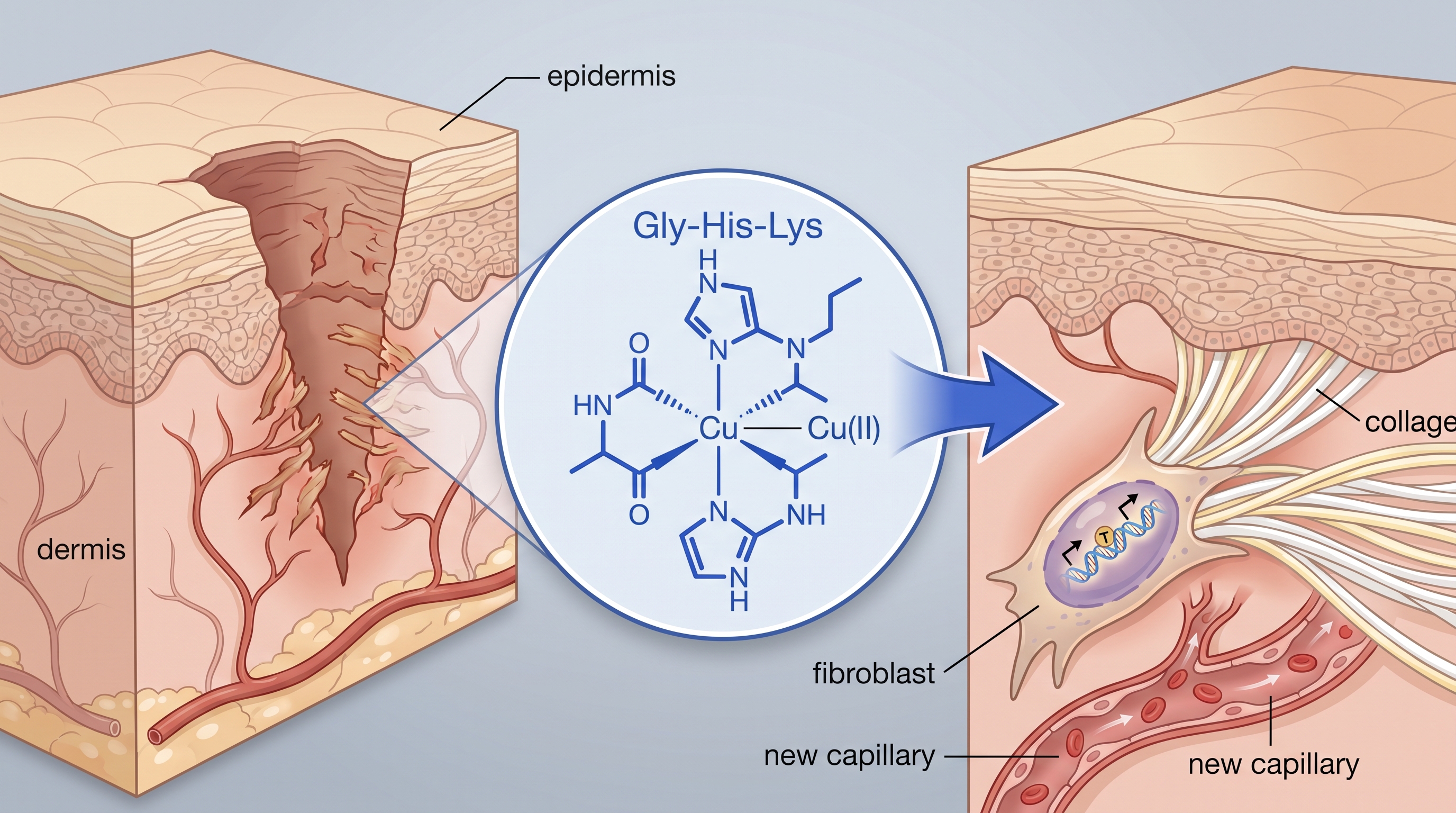
GHK-Cu consists of the amino acid sequence Gly-His-Lys complexed with a single copper(II) ion. Its molecular formula is C14H23CuN6O4, with a molecular weight of 401.91 g/mol. The CAS registry number is 89030-95-5, and the compound is listed in PubChem under CID 73587. In cosmetic ingredient nomenclature, GHK-Cu is registered under the INCI name Copper Tripeptide-1.[4]
The copper coordination is achieved primarily through the histidine imidazole nitrogen, the glycine alpha-amino nitrogen, and the deprotonated peptide bond nitrogen between glycine and histidine, forming a square-planar arrangement characteristic of biologically active copper(II) complexes. A detailed analysis of this coordination chemistry is provided in our article on GHK-Cu molecular structure. For researchers working with the physical peptide, our handling and storage guide provides protocols for reconstitution and preservation — the properly complexed peptide forms a distinctive royal blue solution that serves as a visual indicator of correct preparation.
Gene Modulation: The Central Discovery
Broad Institute Connectivity Map Studies
The most significant advance in understanding GHK-Cu's biology came from studies using the Broad Institute's Connectivity Map (cMap), a comprehensive database that catalogs gene expression changes produced by thousands of bioactive molecules. Analysis revealed that GHK-Cu modulates the expression of 4,048 human genes — approximately 31.2% of the human genome when measured at a 50% or greater change threshold. Of these, 59% were upregulated and 41% were downregulated.[1]
What made these findings particularly striking was not merely the breadth of gene modulation, but the direction: GHK-Cu consistently shifted pathological gene expression patterns back toward healthy baselines. When researchers examined the gene signature of metastatic colon cancer, GHK-Cu reversed approximately 70% of the aberrant gene expression changes. Similarly, when applied to the gene expression profile of patients with chronic obstructive pulmonary disease (COPD), GHK-Cu shifted the pattern from tissue destruction toward tissue remodeling and repair.[1]
The functional categories of modulated genes span virtually every major biological system: DNA repair enzymes are upregulated, collagen synthesis genes are activated, antioxidant defense pathways are enhanced, and inflammatory mediators including NF-κB and TNF-α are suppressed. This genomic-scale activity profile distinguishes GHK-Cu from peptides that operate through a single receptor or pathway, positioning it instead as a broad-spectrum biological reprogramming molecule.[3]
Primary Mechanisms of Action
Extracellular Matrix Synthesis
GHK-Cu stimulates the production of collagen types I and III, elastin, decorin, and glycosaminoglycans (including dermatan sulfate and chondroitin sulfate) in cultured fibroblasts at picomolar to low nanomolar concentrations. This activity follows a biphasic dose-response curve — a pattern in which moderate concentrations produce maximum stimulation, while higher concentrations yield diminishing or even inhibitory effects.[5] For a detailed analysis of GHK-Cu's signaling cascades, see our mechanism of action article.
Metalloproteinase Modulation
GHK-Cu demonstrates context-dependent regulation of matrix metalloproteinases (MMPs), simultaneously increasing MMP-1 and MMP-2 (which facilitate tissue remodeling by removing damaged matrix) while also upregulating TIMP-1 (tissue inhibitor of metalloproteinase-1, which prevents excessive matrix degradation). This balanced regulation enables controlled tissue remodeling rather than uncontrolled destruction or pathological fibrosis — a critical distinction for wound healing research.[5]
Angiogenesis
The peptide promotes new blood vessel formation through upregulation of vascular endothelial growth factor (VEGF) and enhancement of endothelial cell migration. Copper delivery to endothelial cells supports the function of copper-dependent angiogenic enzymes, providing a mechanistic link between GHK-Cu's copper transport function and its vascular effects.[6]
Anti-Inflammatory and Antioxidant Effects
GHK-Cu suppresses inflammatory signaling through downregulation of NF-κB, TNF-α, IL-6, and IL-1β. Concurrently, it enhances antioxidant defense by increasing expression of superoxide dismutase (SOD), catalase, and glutathione. The copper ion itself contributes SOD-like catalytic activity, directly scavenging superoxide radicals and protecting tissues from oxidative damage and lipid peroxidation.[3]
Stem Cell Effects
Research has demonstrated that GHK-Cu increases markers of cellular stemness and enhances the secretion of trophic factors by mesenchymal stem cells. In hair follicle research, GHK-Cu activates the Wnt/β-catenin signaling pathway, which governs the hair follicle growth cycle and stem cell maintenance. These findings suggest a role for GHK-Cu in maintaining progenitor cell populations and facilitating regenerative responses.[7]
Research Domains
Wound Healing
Wound healing represents GHK-Cu's most extensively studied research domain. In rat dermal wound models, GHK-Cu accelerated wound closure by 40–50% compared to controls, with increased accumulation of total protein, glycosaminoglycans, and DNA at wound sites. Biotinylated GHK incorporated into collagen matrices improved wound contraction, cell proliferation, and antioxidant enzyme expression.[5] In diabetic wound models — where impaired healing is a major clinical challenge — GHK-Cu treatment accelerated wound contraction and re-epithelialization while increasing local concentrations of glutathione and ascorbic acid.[6]
Skin Biology and Anti-Aging
Clinical studies have demonstrated that topical GHK-Cu increases skin thickness (both epidermal and dermal layers), improves hydration, reduces fine lines, enhances elasticity, and stimulates collagen I production. Nano-lipid carrier formulations of GHK-Cu have shown favorable comparisons to established cosmetic peptides including Matrixyl 3000. The tripeptide can penetrate the stratum corneum in multiple forms — as free GHK, as the copper complex GHK-Cu, and as the dimeric form (GHK)₂-Cu — enabling practical topical delivery.[4]
Inflammatory Bowel Disease
In murine models of DSS-induced colitis, GHK-Cu demonstrated anti-inflammatory activity through regulation of the SIRT1/STAT3 signaling pathway, reducing pro-inflammatory cytokines (IL-6, IL-1β, TNF-α) while improving expression of tight junction proteins ZO-1 and Occludin. A pilot clinical study in 16 patients with inflammatory bowel disease reported a 60% reduction in disease severity after 12 weeks of rectal GHK-Cu administration, with concurrent downregulation of RORγt — a transcription factor that drives Th17 cell differentiation and contributes to intestinal inflammation.[8]
Pulmonary Research
Connectivity Map analysis of COPD patient gene expression profiles revealed that GHK-Cu could shift the pattern from active tissue destruction toward repair and remodeling. When COPD patient-derived fibroblasts were treated with GHK-Cu, the peptide partially normalized the pathological gene expression signature, suggesting potential therapeutic relevance in chronic lung disease.[1]
Oncology Research
GHK-Cu has shown complex effects in cancer research contexts. At low nanomolar concentrations (1–10 nM), the peptide reactivated apoptotic programs in SH-SY5Y neuroblastoma cells, U937 leukemia cells, and breast cancer cell lines through caspase activation and modulation of growth regulatory genes. When combined with ascorbic acid, GHK-Cu inhibited sarcoma-180 growth in animal models. However, given GHK-Cu's simultaneous stimulation of angiogenesis and cell proliferation, the relationship between GHK-Cu and cancer biology remains complex and requires careful contextual interpretation.[1]
Neuroprotection
GHK-Cu has demonstrated anti-anxiety and analgesic effects in behavioral models, nerve outgrowth stimulation in cell culture, and has been proposed as a candidate for investigation in neurodegenerative conditions including Alzheimer's and Parkinson's diseases, where disrupted copper homeostasis is a recognized pathological feature. Tritiated GHK concentrates preferentially in the kidneys and brain after intravenous injection, confirming central nervous system penetration.[3]
Comparison with BPC-157
GHK-Cu is frequently discussed alongside BPC-157, as both peptides operate in overlapping research domains including wound healing, collagen remodeling, angiogenesis, and inflammation. However, their mechanisms are fundamentally distinct: GHK-Cu operates primarily through copper-dependent gene regulation and metalloproteinase modulation, while BPC-157 works through NO system modulation, VEGFR2/Src-Cav-1-eNOS signaling, and growth factor receptor upregulation. Their non-overlapping mechanistic profiles have generated interest in potential complementary applications. For a comprehensive side-by-side analysis, see our detailed GHK-Cu vs BPC-157 comparison.
Safety Profile and Limitations
Safety Data
GHK-Cu benefits from an established safety record that spans several decades. As a naturally occurring component of human plasma, saliva, and extracellular matrix, the peptide is inherently recognized by the body's biochemical systems. In published research, the most commonly reported adverse effect is mild, transient irritation at injection sites. Serious adverse events have not been documented in the available literature.[9]
Contraindications include Wilson's disease and other copper metabolism disorders, known copper allergy, active malignancy (due to theoretical concerns about growth stimulation), pregnancy and breastfeeding (insufficient safety data), severe hepatic impairment, and use in individuals under 18 years of age. Long-term use warrants monitoring of serum copper levels to ensure homeostasis is maintained.[9]
Critical Limitations
Despite the breadth of GHK-Cu research, several important limitations must be acknowledged. The majority of mechanistic data derives from in vitro cell culture systems and computational gene expression analyses, with fewer controlled in vivo studies than desirable. Human clinical data remain limited — particularly for systemic (non-topical) applications. The Connectivity Map findings, while compelling, represent computational predictions of gene modulation that require validation in intact biological systems. Additionally, the biphasic dose-response curve observed in many GHK-Cu studies means that establishing optimal concentrations for different applications remains an active area of investigation.[1]
Practical Considerations for Researchers
GHK-Cu is supplied as a lyophilized powder — a standard preservation approach discussed in our article on lyophilized peptides. The copper complex is light-sensitive and pH-sensitive, requiring more careful handling than many other research peptides. Proper reconstitution produces a distinctive royal blue solution; color changes toward green or brown indicate copper dissociation or oxidative degradation. Detailed protocols for reconstitution, storage, and quality verification are provided in our GHK-Cu handling and storage guide.
Regardless of the research application, ensuring adequate peptide purity is essential for reproducibility. GHK-Cu presents unique quality considerations due to its copper coordination — both the peptide sequence and the copper-to-peptide stoichiometry must be verified. For general guidance, see our article on peptide purity in scientific studies.
Conclusion
GHK-Cu occupies a unique position in peptide research. As a naturally occurring copper complex that declines measurably with age and modulates the expression of thousands of human genes, it bridges peptide biology, metal biochemistry, and genomic regulation in ways that few other small molecules can match. Its documented effects across wound healing, skin biology, inflammation, neurological function, and even cancer gene expression make it a versatile research tool with broad investigative potential.
The central challenge for the field is translating this breadth of preclinical and computational evidence into robust clinical validation. Researchers entering this domain should approach GHK-Cu with appropriate appreciation for both its remarkable biological profile and the substantial work that remains to fully characterize its therapeutic potential in human applications.
Related research: Explore the KLOW 4-peptide research blend — BPC-157 + TB-500 + GHK-Cu + KPV in a single tetrapeptide framework.