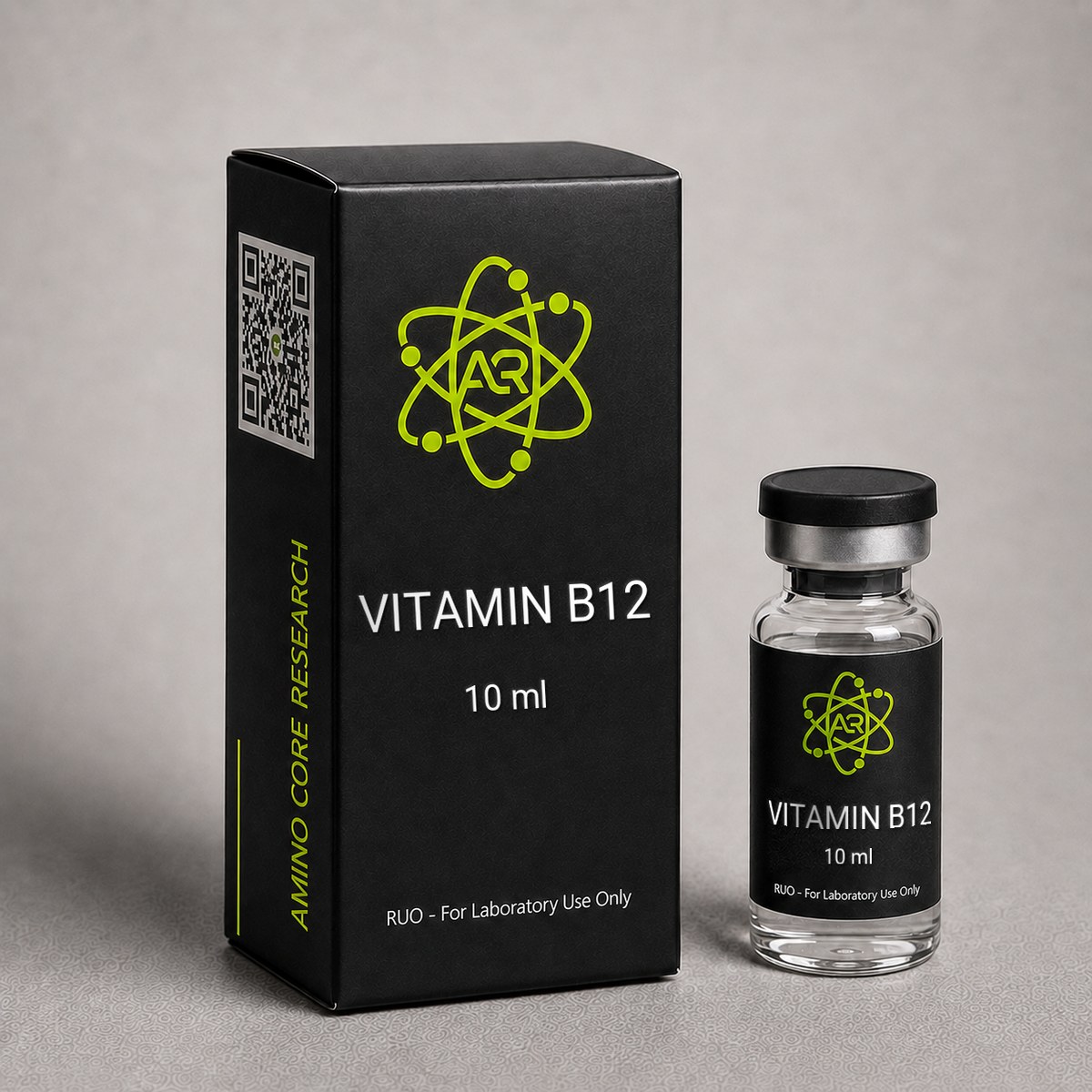
≥99%HPLC Purity
COAIncluded
USAShipped
Vitamin B12
Methylcobalamin form of vitamin B12 for neurological function and methylation pathway research. Injectable research-grade formulation.
$48.00
In stock — ships next business day
Quick Facts
| SKU | ACR-B12 |
|---|---|
| CAS Number | 13422-55-4 |
| Molecular Formula | C63H91CoN13O14P |
| Molecular Weight | 1344.38 g/mol |
| Sequence | N/A (cobalamin coenzyme; not a peptide) |
| Purity | ≥99% |
| Physical Form | Lyophilized Powder |
| Storage | Store at -20°C |
What is Vitamin B12 (Methylcobalamin)?
Methylcobalamin is the bioactive, coenzyme form of vitamin B12 that serves as a methyl donor in the methionine synthase reaction, converting homocysteine to methionine. It is critical for DNA methylation, myelin synthesis, and neurological function. Unlike cyanocobalamin, methylcobalamin does not require hepatic conversion.
Mechanism of Action
Methylcobalamin is one of two coenzyme forms of vitamin B12 active in mammalian cells, the other being adenosylcobalamin. Unlike the synthetic cyanocobalamin form, methylcobalamin requires no intracellular conversion to participate directly in methylation reactions. Its central role in cellular biochemistry stems from its function as a cofactor for methionine synthase (MTR; EC 2.1.1.13), a cytosolic enzyme that catalyzes the remethylation of homocysteine to methionine.
Methionine Synthase and One-Carbon Metabolism
In the methionine synthase reaction, methylcobalamin serves as an intermediate methyl carrier. The enzyme transfers a methyl group from 5-methyltetrahydrofolate (5-MTHF) to homocysteine, regenerating tetrahydrofolate (THF) and producing methionine. Methionine is then activated by ATP to form S-adenosylmethionine (SAM), the universal methyl donor used in over 200 methyltransferase reactions, including methylation of DNA, RNA, histones, phospholipids, neurotransmitters, and myelin basic protein. Research suggests that deficiency of functional B12 impairs this pathway, leading to elevated homocysteine, depleted SAM, and accumulation of 5-MTHF (the “methyl trap”), which in turn restricts folate-dependent nucleotide synthesis.
Adenosylcobalamin and the Methylmalonyl-CoA Pathway
Although methylcobalamin itself does not catalyze this second reaction, cellular B12 pools interconvert. Adenosylcobalamin is a cofactor for mitochondrial methylmalonyl-CoA mutase (MUT), which isomerizes L-methylmalonyl-CoA to succinyl-CoA. This step is essential for catabolism of odd-chain fatty acids and branched-chain amino acids (valine, isoleucine, methionine, threonine). Impairment elevates serum methylmalonic acid (MMA), a sensitive functional marker of intracellular B12 status used widely in preclinical research models.
Neurological and Methylation Effects
Within the nervous system, methylcobalamin-dependent methylation has been associated with maintenance of myelin sheath integrity via methylation of myelin basic protein and synthesis of phosphatidylcholine. Preclinical studies have reported that methylcobalamin upregulates neurotrophic signaling, including ERK1/2 and Akt phosphorylation, in models of peripheral nerve injury, and that it may modulate Bcl-2 expression in dorsal root ganglion neurons. Research models have also examined its impact on glutamate excitotoxicity, where methyl group donation supports glutathione synthesis via the transsulfuration pathway downstream of homocysteine.
Cellular Uptake
Methylcobalamin enters cells through the transcobalamin II (TCII) receptor system. Once internalized in lysosomes, the cobalamin is released, transported to the cytosol, and processed by the CblC (MMACHC) chaperone, which decyanates or demethylates cobalamin and delivers it to downstream enzymes. In research contexts, methylcobalamin is frequently compared to hydroxocobalamin and cyanocobalamin because its uptake bypasses the need for the CblC demethylation step required by cyanocobalamin.
Distinction from Cyanocobalamin
Cyanocobalamin, the most common supplemental form, must be reduced and have its cyano group removed before it can be converted to either methylcobalamin or adenosylcobalamin. Methylcobalamin is preformed and directly bioavailable for methionine synthase, which is why it has been favored in neurological research models examining methylation flux, homocysteine reduction, and nerve regeneration. Both forms ultimately enter the same cobalamin pool, but kinetic studies suggest methylcobalamin produces faster repletion of the cytosolic methylation cofactor pool.
Research & Clinical Studies
Preclinical Study: Methylcobalamin and Peripheral Nerve Regeneration
One of the most investigated applications of methylcobalamin in preclinical research is its effect on peripheral nerve injury and regeneration. A frequently cited rat sciatic nerve crush model investigated whether high-dose methylcobalamin could accelerate axonal regrowth and functional recovery compared to vehicle controls.
Study Design
- Model: Adult Sprague-Dawley rats with surgically induced sciatic nerve crush injury
- Dosing groups: Vehicle control vs. methylcobalamin at 0.5 mg/kg and 1.0 mg/kg, administered intraperitoneally
- Duration: Daily administration for up to 6 weeks post-injury
- Endpoints: Sciatic functional index (SFI), electrophysiological recordings (compound muscle action potential, nerve conduction velocity), myelinated axon counts, and Western blot analysis of Erk1/2 phosphorylation
Key Findings
- The high-dose methylcobalamin group showed a significantly improved sciatic functional index compared to vehicle at weeks 3, 4, and 6 post-injury
- Nerve conduction velocity recovered more rapidly in methylcobalamin-treated animals, with statistically significant differences observed by week 4
- Histological analysis demonstrated greater numbers of myelinated axons and increased axon diameter in treated groups
- Western blot analysis indicated sustained Erk1/2 phosphorylation in dorsal root ganglion neurons, consistent with enhanced neurotrophic signaling
- No adverse histological effects were observed at the doses tested
Mechanistic Interpretation
The investigators proposed that methylcobalamin promotes nerve regeneration through two complementary mechanisms: (1) restoration of methylation capacity required for myelin basic protein synthesis and phospholipid production, and (2) direct activation of Erk1/2 signaling, which research has associated with Schwann cell proliferation and axonal outgrowth. The dose-dependent response suggests that intracellular cobalamin saturation may be a limiting factor for these regenerative pathways.
Research Context
This study added to a growing body of preclinical literature examining methylcobalamin in peripheral neuropathy models, including diabetic neuropathy, chemotherapy-induced neuropathy, and post-surgical nerve injury. Comparable studies have used doses ranging from 0.1 to 2.0 mg/kg in rodents and have generally observed dose-dependent effects on regeneration markers. Methylcobalamin is sometimes compared to mecobalamin formulations used in Japanese clinical research, which have explored ultra-high doses in nerve injury contexts. These findings are limited to animal models and are presented for research interpretation only.
[1] Okada K, Tanaka H, Temporin K, et al. Methylcobalamin increases Erk1/2 and Akt activities through the methylation cycle and promotes nerve regeneration in a rat sciatic nerve injury model. Exp Neurol. 2010;222(2):191-203. PubMed ↗
[2] Sun H, Yang T, Li Q, et al. Dexamethasone and vitamin B12 synergistically promote peripheral nerve regeneration in rats by upregulating the expression of brain-derived neurotrophic factor. Arch Med Sci. 2012;8(5):924-930. PubMed ↗
Clinical Research: Homocysteine Reduction and Methylation Status
Methylcobalamin’s role in remethylating homocysteine to methionine has made it a focus of clinical and translational research examining hyperhomocysteinemia, a biomarker associated with vascular and neurological disease risk. Several investigations have specifically compared methylcobalamin to cyanocobalamin and hydroxocobalamin in their capacity to lower plasma homocysteine and elevate intracellular methylation indices.
Study Design
- Population: Adults with elevated plasma homocysteine and biochemical evidence of low B12 status
- Intervention: Oral or parenteral methylcobalamin (typical doses: 500 µg to 1500 µg daily orally; 500 µg to 1 mg by injection)
- Comparators: Cyanocobalamin and folic acid in some trial arms
- Endpoints: Plasma total homocysteine (tHcy), methylmalonic acid (MMA), serum B12, holotranscobalamin (active B12), and S-adenosylmethionine/S-adenosylhomocysteine (SAM/SAH) ratio
Key Findings
- Methylcobalamin produced significant reductions in plasma tHcy, with reported decreases of 20–30% from baseline in deficient populations
- Serum MMA fell in parallel, confirming functional intracellular B12 repletion via both methionine synthase and methylmalonyl-CoA mutase pathways
- Some studies reported that methylcobalamin elevated the SAM/SAH ratio more rapidly than cyanocobalamin, consistent with its preformed methyl-donor structure
- Holotranscobalamin (the transport-bound, bioavailable fraction) rose dose-dependently with both oral and parenteral methylcobalamin administration
- Adverse events in research cohorts were rare and typically limited to mild injection-site reactions in parenteral arms
Comparative Pharmacokinetics
Pharmacokinetic research has reported that intramuscular methylcobalamin reaches peak plasma concentrations within approximately 1–2 hours, with a terminal half-life of roughly 12–14 hours in adults. Distribution studies suggest preferential retention in tissues with high methylation demand, including the liver and central nervous system. Compared with cyanocobalamin, methylcobalamin shows similar plasma persistence but is preferentially incorporated into the cytosolic methionine synthase complex without the requirement for intracellular cyano-group removal.
Research Significance
These data support methylcobalamin’s use as a research tool for probing one-carbon metabolism, methylation flux, and homocysteine-mediated pathways. Investigators frequently pair methylcobalamin with folate and pyridoxal-5’-phosphate (active B6) when studying complete remethylation and transsulfuration cycles. Findings are presented for research interpretation only and do not constitute clinical guidance.
[1] Paul C, Brady DM. Comparative bioavailability and utilization of particular forms of B12 supplements with potential to mitigate B12-related genetic polymorphisms. Integr Med (Encinitas). 2017;16(1):42-49. PubMed ↗
[2] Obeid R, Fedosov SN, Nexo E. Cobalamin coenzyme forms are not likely to be superior to cyano- and hydroxyl-cobalamin in prevention or treatment of cobalamin deficiency. Mol Nutr Food Res. 2015;59(7):1364-1372. PubMed ↗
ALS Clinical Trial: Ultra-High Dose Methylcobalamin and Disease Progression
One of the most significant clinical investigations of methylcobalamin involved a randomized, double-blind, placebo-controlled trial examining ultra-high dose methylcobalamin in patients with amyotrophic lateral sclerosis (ALS). This Phase 2/3 Japanese trial, published in JAMA Neurology in 2022, evaluated whether sustained high-dose methylcobalamin administration could slow functional decline in early-stage ALS, building on earlier mechanistic work suggesting B12-dependent methylation pathways may influence motor neuron survival.
Study Design
- Subjects: 130 participants with ALS diagnosed within 1 year of symptom onset
- Duration: 16-week observation period followed by 16 weeks of randomized treatment
- Dosing: 50 mg intramuscular methylcobalamin twice weekly vs. matched placebo
- Primary endpoint: Change in Revised ALS Functional Rating Scale (ALSFRS-R) score
- Design: Multicenter, randomized, double-blind, placebo-controlled
Key Results
- Methylcobalamin-treated group showed a 43% reduction in ALSFRS-R decline compared to placebo (-1.97 vs. -2.99 points, p = 0.01)
- Treatment effect was most pronounced in the early-symptom subgroup enrolled within 12 months of onset
- Plasma homocysteine concentrations decreased significantly in the treatment arm, confirming biochemical engagement of the methylation pathway
- Adverse event rates were comparable between groups, with no serious treatment-related events
- Cerebrospinal fluid methylcobalamin levels rose approximately 9-fold over baseline, indicating CNS penetration at this dosing intensity
Research Context
This trial extended findings from an earlier 2015 study (the JETALS predecessor) that had shown signals of efficacy in subgroup analyses. The 2022 results positioned ultra-high dose methylcobalamin as one of the few interventions to demonstrate statistically significant slowing of ALSFRS-R decline in a controlled trial. Mechanistically, the investigators proposed that supraphysiologic methylcobalamin exposure supports S-adenosylmethionine (SAM) regeneration, sustains methylation of myelin basic protein and DNA, and may attenuate homocysteine-mediated excitotoxicity in motor neurons. The dosing — orders of magnitude above standard nutritional repletion — reflects the principle that methylcobalamin's neurological effects in research models are dose-dependent and saturate transport mechanisms only at very high exposures.
For research purposes, the JETALS data establish methylcobalamin as a compound with mechanistically grounded CNS activity at high parenteral doses, distinct from its nutritional role at microgram quantities. The trial also reinforces the importance of formulation: only the methylated form (not cyanocobalamin) was used, consistent with preclinical evidence that methylcobalamin directly donates methyl groups without requiring intracellular conversion.
[1] Oki R, Izumi Y, Fujita K, et al. Efficacy and Safety of Ultrahigh-Dose Methylcobalamin in Early-Stage Amyotrophic Lateral Sclerosis: A Randomized Clinical Trial. JAMA Neurol. 2022;79(6):575-583. PubMed ↗
[2] Kaji R, Imai T, Iwasaki Y, et al. Ultra-high-dose methylcobalamin in amyotrophic lateral sclerosis: a long-term phase II/III randomised controlled study. J Neurol Neurosurg Psychiatry. 2019;90(4):451-457. PubMed ↗
Chemical & Physical Properties
Methylcobalamin is a biologically active cobalamin (vitamin B12) coenzyme in which a methyl group is covalently bonded to the central cobalt atom of the corrin ring system. It is one of two metabolically active B12 forms in mammals, the other being adenosylcobalamin. The compound is distinguished from cyanocobalamin by the substitution of the upper axial ligand (methyl vs. cyano), which eliminates the need for intracellular decyanation and direct conversion before participation in methylation reactions.
| Full Name | Methylcobalamin (Mecobalamin) |
|---|---|
| Synonyms | MeCbl, MeB12, Methyl-B12, Coenzyme B12 (methyl form), Cobamamide methyl analog |
| Molecular Formula | C₆₃H₉₁CoN₁₃O₁₄P |
| Molecular Weight | 1,344.38 g/mol |
| CAS Number | 13422-55-4 |
| PubChem CID | 6436232 |
| Structure Class | Corrinoid / Cobalamin coenzyme |
| Central Metal | Cobalt (Co³⁺ → Co¹⁺ during catalytic cycle) |
| Upper Axial Ligand | Methyl group (-CH₃) |
| Lower Axial Ligand | 5,6-dimethylbenzimidazole nucleotide |
| Physical Form | Dark red to deep pink crystalline powder |
| Solubility | Soluble in water (~1 mg/mL); slightly soluble in ethanol; insoluble in acetone, ether |
| UV-Vis Absorption Maxima | 266, 340, 522 nm (aqueous) |
| Light Sensitivity | Highly photolabile — degrades to hydroxocobalamin under visible/UV light |
| Purity | ≥99% (HPLC) |
| pKa | ~3.3 (benzimidazole protonation) |
| Stability | Stable in dry, dark, cool storage; sensitive to light, oxidizing agents, and strong acids/bases |
The corrin ring of methylcobalamin is structurally related to the porphyrin ring of heme but contains one fewer methine bridge, giving it a more contracted geometry around the central cobalt. The methyl-cobalt bond is unusually labile for an organometallic linkage, enabling the enzymatic methyl transfer reactions central to methionine synthase activity. This same lability is the reason methylcobalamin solutions must be protected from light during all handling steps — photolysis cleaves the Co-C bond and converts the compound to hydroxocobalamin, which has different biochemical properties and reduced activity in methylation assays.
Handling & Reconstitution Guidelines
Methylcobalamin requires careful handling because of its pronounced photosensitivity and the lability of the methyl-cobalt bond. Laboratories working with methylcobalamin should establish protected-light workflows and document exposure time during reconstitution to ensure reproducibility across experiments.
Reconstitution Protocol
- Allow vial to equilibrate to room temperature in its original packaging before opening to prevent condensation on the lyophilized powder.
- Work under reduced light — amber lighting, foil-wrapped vials, or a darkened biosafety cabinet are recommended. Avoid direct sunlight and fluorescent overhead lights during all handling.
- Select diluent: Bacteriostatic water for injection (0.9% benzyl alcohol) is standard for multi-use research preparations. Sterile saline or sterile water may be used for single-use aliquots.
- Calculate target concentration: A common research stock is 5 mg/mL (e.g., 5 mg powder + 1 mL diluent) or 1 mg/mL for lower-dose work.
- Inject diluent slowly down the inner wall of the vial. Do not direct the stream onto the powder cake.
- Gently swirl the vial to dissolve. Do not shake or vortex — agitation can denature the corrin ring and accelerate photolytic degradation by exposing more surface area.
- Wrap the reconstituted vial in foil immediately and label with concentration, date, and time of reconstitution.
- Aliquot if planning multiple uses into amber microcentrifuge tubes to minimize freeze-thaw cycles on the parent stock.
Compound-Specific Handling Notes
- Photolysis risk: Methylcobalamin loses approximately 10-20% activity per hour of bright light exposure in solution. Always work with foil-wrapped containers and amber syringes when possible.
- Cobalt center sensitivity: Avoid contact with strong reducing agents (e.g., dithiothreitol at high concentrations), strong oxidizers, and chelators such as EDTA at elevated concentrations, which can destabilize the cobalt-corrin complex.
- pH considerations: Methylcobalamin is most stable at pH 4-7. Avoid strongly acidic (pH < 3) or alkaline (pH > 9) conditions which accelerate degradation.
- Filter sterilization: If sterile filtration is required, use a 0.22 μm low-protein-binding filter (PES or PVDF). Pre-wet the filter to minimize compound loss.
- Concentration verification: The molar extinction coefficient at 522 nm (ε ≈ 8,000 M⁻¹cm⁻¹) allows spectrophotometric confirmation of stock concentration in research settings.
Safety Considerations
Standard PPE — nitrile gloves, lab coat, and eye protection — is appropriate for routine handling. Methylcobalamin is not classified as hazardous, but as a research chemical it should not be used in or on humans or animals outside of approved research protocols. Disposal should follow institutional guidelines for biochemical research reagents.
Frequently Asked Questions
Methylcobalamin vs cyanocobalamin?
Methylcobalamin is the bioactive coenzyme form used directly by cells. Cyanocobalamin requires liver conversion and contains a cyanide moiety. Methylcobalamin is preferred for neurological and methylation research.
What is Vitamin B12 (Methylcobalamin)?
Vitamin B12 (methylcobalamin) is the biologically active, preformed methyl-donor coenzyme form of cobalamin, with molecular formula C63H91CoN13O14P, molecular weight 1344.38 g/mol, and CAS number 13422-55-4. Unlike cyanocobalamin, methylcobalamin participates directly in the methionine synthase reaction without requiring intracellular conversion. Research has associated it with one-carbon metabolism, homocysteine remethylation, DNA and myelin methylation, and preclinical models of peripheral nerve regeneration. It is supplied as a research-grade compound for in vitro and in vivo investigative use only.
What is the molecular weight and CAS number of methylcobalamin?
Methylcobalamin has a molecular formula of C63H91CoN13O14P, a molecular weight of approximately 1344.38 g/mol, and CAS registry number 13422-55-4. The structure features a corrin ring coordinated to a central cobalt(III) atom, with a methyl group occupying the upper axial position and a 5,6-dimethylbenzimidazole nucleotide tail occupying the lower axial position. This distinguishes it structurally from cyanocobalamin (which carries a cyano group at the upper axial site) and adenosylcobalamin (which carries a 5'-deoxyadenosyl group). Purity for AminoCore Research material is ≥99%.
How should methylcobalamin be stored and handled in research settings?
Methylcobalamin is highly photosensitive — the cobalt-carbon bond is cleaved by visible and UV light, generating hydroxocobalamin and other degradation products. Lyophilized or solid methylcobalamin should be stored at -20°C in amber vials or wrapped in foil, protected from light and moisture. Reconstituted solutions should be prepared in amber containers, kept refrigerated at 2–8°C, and used promptly; many research protocols recommend single-use aliquots. Avoid repeated freeze-thaw cycles. All handling should occur under reduced lighting (red or yellow safe-light is preferred) to preserve the active methylcobalamin species.
How does methylcobalamin differ from cyanocobalamin in research applications?
Methylcobalamin is a preformed coenzyme that directly supports methionine synthase, the cytosolic enzyme catalyzing homocysteine remethylation. Cyanocobalamin is a synthetic precursor that must be decyanated and reduced intracellularly by the MMACHC (CblC) chaperone before it can be converted to either methylcobalamin or adenosylcobalamin. In research models examining methylation flux, homocysteine kinetics, or nerve regeneration, methylcobalamin is often preferred because it bypasses this conversion step. Both forms ultimately enter the same cobalamin pool, but methylcobalamin has been associated with faster restoration of cytosolic methyl-donor capacity in preclinical studies.
What sizes of methylcobalamin are available from AminoCore Research?
AminoCore Research offers methylcobalamin in research-appropriate vial sizes suitable for in vitro and preclinical investigation, typically supplied as lyophilized powder at ≥99% HPLC purity with a certificate of analysis. Common research sizes range from 5 mg to 50 mg per vial, allowing flexibility for both short-duration mechanistic experiments and longer dosing studies in animal models. Each lot is independently verified for purity, and product is shipped with desiccant and protective packaging to preserve the light-sensitive corrin coenzyme during transit. Current availability and pricing are listed on the product page.
Why is methylcobalamin sensitive to light and how does this affect research handling?
Methylcobalamin contains a covalent methyl-cobalt bond at the center of its corrin ring system, and this organometallic bond is photolabile. Exposure to visible light — particularly in the 340-550 nm range corresponding to its absorption maxima — cleaves the Co-C bond and converts methylcobalamin to hydroxocobalamin, which has different biochemical properties in methylation assays. For reproducible research data, methylcobalamin should be reconstituted under reduced lighting, stored in amber or foil-wrapped vials, and aliquoted to minimize repeated light exposure. Reconstituted solutions can lose 10-20% activity per hour under bright light, so protected-light workflows are essential.
Has methylcobalamin been studied in neurodegenerative disease research?
Yes. The most notable clinical investigation is the JETALS trial program (published in JAMA Neurology, 2022), which examined ultra-high dose methylcobalamin (50 mg intramuscular, twice weekly) in early-stage amyotrophic lateral sclerosis. The trial reported a 43% reduction in ALSFRS-R functional decline compared to placebo in patients enrolled within 12 months of symptom onset. Methylcobalamin has also been studied in preclinical models of peripheral neuropathy, diabetic neuropathy, and chemotherapy-induced nerve injury, where it has been associated with enhanced axonal regeneration and myelin repair. These applications reflect methylcobalamin's role in sustaining S-adenosylmethionine production and supporting methylation of myelin basic protein in neural tissue.
Does methylcobalamin require refrigeration during storage?
Lyophilized methylcobalamin should be stored at -20°C for long-term stability and can be held at 2-8°C for short-term storage of several weeks. Brief transit at room temperature is acceptable but should be minimized. Once reconstituted, methylcobalamin solutions should be refrigerated at 2-8°C in foil-wrapped vials and used within 14-30 days depending on diluent (bacteriostatic water extends usable life relative to plain sterile water). For longer storage of reconstituted material, aliquot into amber tubes and freeze at -20°C or -80°C, avoiding repeated freeze-thaw cycles. Protection from light is required at every storage stage because of the compound's photolabile methyl-cobalt bond.
For laboratory and research use only. This product is not for human or veterinary use. It is not a drug, supplement or food.
This product is not FDA approved for any indication, and is not intended to diagnose, treat, cure, or prevent any disease. All product information is derived from published preclinical research and does not constitute medical advice or claims.