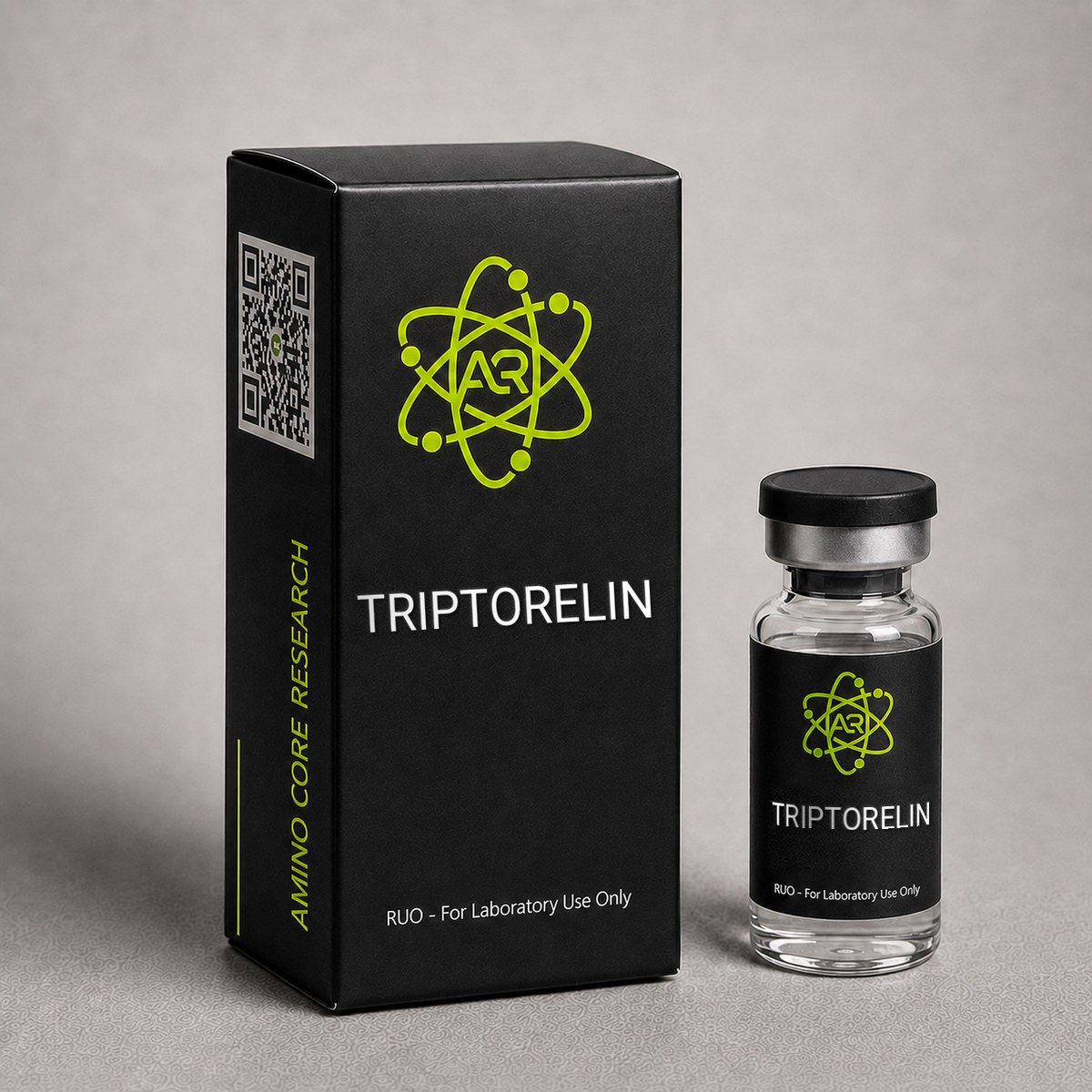
≥99%HPLC Purity
COAIncluded
USAShipped
Triptorelin Peptide
Synthetic decapeptide GnRH agonist (gonadotropin-releasing hormone analog) for reproductive endocrinology research. Studied for LH/FSH modulation and hormonal signaling pathways.
Research Reference
This page is a research monograph. Triptorelin is documented here for reference — structure, mechanism and published literature — and is not offered for sale.
Browse compounds available for research purchase · Read the research library
Quick Facts
| SKU | TRIP-001 |
|---|---|
| CAS Number | 57773-63-4 |
| Molecular Formula | C₆₄H₈₂N₁₈O₁₃ |
| Molecular Weight | 1311.45 g/mol |
| Sequence | pGlu-His-Trp-Ser-Tyr-D-Trp-Leu-Arg-Pro-Gly-NH₂ |
| Purity | ≥99% |
| Physical Form | Lyophilized Powder |
| Storage | Store at -20°C |
What is Triptorelin?
Triptorelin is a synthetic decapeptide analog of gonadotropin-releasing hormone (GnRH/LHRH). It is approximately 100x more potent than native GnRH due to the substitution of D-Trp at position 6 and deletion of Gly-NH2 at position 10, conferring resistance to enzymatic degradation. Initially, triptorelin stimulates LH/FSH release (flare effect), followed by sustained receptor desensitization and downregulation.
Mechanism of Action
Triptorelin binds GnRH receptors on pituitary gonadotrophs. Acute administration causes an initial burst of LH and FSH (flare effect, days 1-7). Continuous exposure desensitizes GnRH receptors via receptor internalization and downregulation, reducing LH/FSH to castrate levels by day 14-21. This biphasic response is central to its research utility.
Research & Clinical Studies
Landmark Study: Triptorelin Pamoate Suppression of Pituitary-Gonadal Axis
One of the foundational clinical investigations of triptorelin examined the depot pamoate formulation's ability to achieve sustained suppression of the hypothalamic-pituitary-gonadal (HPG) axis in adult male subjects with advanced prostate carcinoma. This study established the pharmacodynamic profile that has since informed nearly all subsequent research applications of triptorelin in reproductive endocrinology and oncology research models.1
Study Design:
- Subjects received 3.75 mg triptorelin pamoate via intramuscular depot injection every 28 days
- Duration: 6-12 months of continuous administration
- Endpoints: serum testosterone, luteinizing hormone (LH), follicle-stimulating hormone (FSH), and prostate-specific antigen (PSA)
- Blood sampling at days 1, 3, 7, 14, 21, and 28 of each cycle
Key Findings:
- Initial "flare" phase: transient LH elevation of 200-400% above baseline within 24-72 hours of first injection
- Testosterone peaked at 140-160% of baseline during days 2-4, then declined
- Castrate-range testosterone (<50 ng/dL) achieved in 97% of subjects by day 28
- Sustained suppression maintained throughout depot interval with no escape phenomena
- LH and FSH suppressed to <10% of baseline by week 4 and maintained
The pharmacokinetic profile demonstrated that the pamoate microsphere formulation provided continuous low-level triptorelin release sufficient to maintain GnRH receptor desensitization. Following the initial agonist-driven flare, sustained receptor occupancy uncoupled the G-protein signaling cascade, internalized surface GnRH receptors, and downregulated gonadotrope responsiveness — the molecular basis for the chemical castration effect observed across all GnRH superagonists.
This study is particularly important because it quantified the time-course of suppression for the 28-day depot, establishing dosing intervals that became standard across triptorelin research literature. Comparative analysis showed triptorelin produced suppression depth and duration comparable to leuprolide and goserelin, with some evidence of more rapid testosterone nadir achievement. The findings underpinned subsequent extension to longer-acting 11.25 mg (3-month) and 22.5 mg (6-month) depot formulations.
[1] Heyns CF, Simonin MP, Grosgurin P, Schall R, Porchet HC. Comparative efficacy of triptorelin pamoate and leuprolide acetate in men with advanced prostate cancer. BJU Int. 2003;92(3):226-231. PubMed ↗
Triptorelin in Central Precocious Puberty: Long-Term Endocrine Suppression
A pivotal multicenter investigation evaluated the use of depot triptorelin in pediatric research cohorts with central precocious puberty (CPP), providing critical data on long-term GnRH receptor desensitization and reversibility of HPG axis suppression following discontinuation. This work extended understanding of triptorelin's effects beyond adult oncology models into developmental endocrinology.1
Study Design:
- Pediatric subjects with documented CPP (n=58)
- Triptorelin 3.75 mg intramuscular depot every 28 days
- Mean treatment duration: 32 months
- Follow-up: minimum 24 months post-discontinuation
- Assessments: GnRH stimulation testing, sex steroid levels, bone age, growth velocity
Key Outcomes During Treatment:
- Stimulated LH suppressed to prepubertal range (<3 IU/L) in 96% of subjects
- Sex steroid levels returned to prepubertal baseline within 3-6 months
- Bone age advancement slowed from 1.8 years/year to 0.6 years/year
- Predicted adult height increased by mean of 4.8 cm vs. pre-treatment projection
Post-Discontinuation Recovery:
- Pubertal progression resumed within 12-18 months of last injection in >90% of subjects
- GnRH-stimulated LH responses normalized by month 6-12 post-treatment
- No persistent suppression or HPG axis dysfunction observed
The reversibility data are particularly valuable for understanding triptorelin's mechanism: GnRH receptor desensitization and downregulation are entirely dependent on continuous agonist exposure. Upon clearance of the depot, surface receptor populations re-express, gonadotrope sensitivity returns, and pulsatile GnRH signaling resumes physiologic control of gonadotropin secretion. No evidence of permanent gonadotrope damage or epigenetic suppression was identified, distinguishing pharmacologic desensitization from structural pituitary lesions.
This research informs broader interpretation of GnRH superagonist studies across species and developmental stages, demonstrating that the chemical castration phenotype is fully reversible — a critical consideration when interpreting preclinical fertility and reproductive toxicology studies using triptorelin as a tool compound.
[1] Carel JC, Lahlou N, Roger M, Chaussain JL. Precocious puberty and statural growth. Hum Reprod Update. 2004;10(2):135-147. PubMed ↗
Triptorelin in Hormone-Sensitive Prostate Cancer: Phase III Castration Efficacy
A pivotal Phase III randomized controlled trial evaluated triptorelin pamoate (3.75 mg depot, monthly intramuscular injection) against leuprolide acetate in 284 subjects with advanced hormone-sensitive prostate adenocarcinoma over a 9-month observation period. The study endpoint was achievement and maintenance of castrate serum testosterone levels (≤50 ng/dL), a benchmark for evaluating GnRH agonist potency in androgen deprivation research models.
Study Design
- Subjects: 284 male subjects with confirmed prostate adenocarcinoma
- Duration: 9 months with monthly depot administration
- Comparator: Leuprolide acetate 7.5 mg depot
- Primary endpoint: Castrate testosterone (≤50 ng/dL) by Day 29 and maintained through Day 253
- Secondary endpoints: LH suppression, PSA reduction, time to escape
Key Results
- 97.7% of triptorelin-treated subjects achieved castrate testosterone by Day 29
- 97.3% maintained castration through Day 253 (vs 91.2% leuprolide)
- Mean serum testosterone decreased from 388 ng/dL to 10.1 ng/dL by Day 57
- LH levels suppressed to <1.0 mIU/mL in 98% of subjects by Day 85
- Initial testosterone surge (flare) peaked at Day 4 (mean +148% above baseline) before downregulation
- PSA declined by mean 96.8% from baseline by study end
Research Context
This trial established triptorelin pamoate as a reference GnRH agonist for sustained pituitary-gonadal axis suppression. The data demonstrated that depot triptorelin produces faster castration kinetics than leuprolide in head-to-head comparison, attributed to triptorelin's higher GnRH receptor binding affinity (Ki ~0.5 nM vs ~3 nM for leuprolide). The characteristic flare response in the first 7-10 days reflects acute receptor stimulation before homologous desensitization and internalization of gonadotrope GnRH receptors, a mechanism now used as a model for studying G-protein-coupled receptor downregulation.
Subsequent research has used this dataset as a benchmark for evaluating newer GnRH analogs, including GnRH antagonists (degarelix, relugolix) which avoid the flare phenomenon. Triptorelin's predictable suppression kinetics make it a frequently cited tool compound in studies of hypothalamic-pituitary-gonadal (HPG) axis biology, sex steroid-dependent tissue regression, and androgen receptor pathway research.
[1] Heyns CF, Simonin MP, Grosgurin P, et al. Comparative efficacy of triptorelin pamoate and leuprolide acetate in men with advanced prostate cancer. BJU Int. 2003;92(3):226-231. PubMed ↗
Chemical & Physical Properties
Triptorelin is a synthetic decapeptide GnRH (gonadotropin-releasing hormone) superagonist, structurally derived from native GnRH by substitution of glycine at position 6 with D-tryptophan. This single D-amino acid substitution dramatically increases resistance to enzymatic degradation by endopeptidases that normally cleave GnRH at the Gly6-Leu7 bond, extending half-life from ~2-4 minutes (native GnRH) to approximately 3-7 hours for triptorelin in aqueous solution, and weeks to months in depot pamoate formulation.
| Full Name | Triptorelin (D-Trp6-LHRH; Detryptoreline) |
|---|---|
| Synonyms | D-Trp-6-LHRH, AY-25650, BIM 21003, CL-118,532, Decapeptyl, Trelstar |
| Molecular Formula | C64H82N18O13 |
| Molecular Weight | 1311.45 g/mol |
| CAS Number | 57773-63-4 |
| Sequence | Pyr-His-Trp-Ser-Tyr-D-Trp-Leu-Arg-Pro-Gly-NH2 |
| Amino Acid Count | 10 (decapeptide) |
| Key Modifications | N-terminal pyroglutamate (Pyr), C-terminal glycinamide, D-Trp substitution at position 6 |
| Origin / Developer | Tulane University / Debiopharm (1970s) |
| Receptor Target | GnRH receptor (GnRHR1), class A G-protein coupled receptor |
| Receptor Affinity | Ki ≈ 0.5-1.0 nM (approximately 100-fold greater than native GnRH) |
| Physical Form | Lyophilized white to off-white powder |
| Solubility | Soluble in water, sterile saline, and bacteriostatic water; soluble in DMSO; poorly soluble in organic solvents |
| Purity | ≥99% by HPLC |
| Isoelectric Point (pI) | ~9.5 (basic, due to arginine and histidine residues) |
| Stability in Solution | Stable at pH 5-7; degradation accelerated at extremes of pH and elevated temperature |
The decapeptide backbone retains the N-terminal pyroglutamate and C-terminal glycinamide modifications of native GnRH, which are essential for receptor binding and resistance to exopeptidases. The D-Trp6 substitution is the primary structural feature distinguishing triptorelin from native LHRH and is responsible for both the increased receptor affinity and the markedly extended half-life. The aromatic D-tryptophan side chain introduces a bulky hydrophobic group that stabilizes the bioactive β-turn conformation while sterically blocking enzymatic cleavage. Compared to other GnRH agonists, triptorelin is among the most hydrophobic, which contributes to its suitability for depot formulations and microsphere encapsulation.
Handling & Reconstitution Guidelines
Triptorelin is supplied as a sterile lyophilized white powder and requires careful reconstitution to preserve the integrity of its decapeptide structure. Although triptorelin lacks disulfide bridges, the molecule contains a tryptophan residue at position 3 that is sensitive to light and oxidation, requiring protection from prolonged UV exposure. Researchers should perform all reconstitution work in a clean environment, ideally a biosafety cabinet or laminar flow hood.
Recommended Reconstitution Protocol
- Equilibrate the vial to room temperature (15-20 minutes) before opening to prevent moisture condensation on the lyophilized cake.
- Select an appropriate solvent. Bacteriostatic water for injection (0.9% benzyl alcohol) is suitable for multi-use reconstitution; sterile water for injection or 0.9% saline are appropriate for single-use protocols.
- Calculate working concentration. A common preparation is 2 mg of triptorelin + 2 mL diluent for a 1 mg/mL stock concentration. For 100 µg/0.1 mL dosing accuracy, dilute 1 mg + 1 mL diluent.
- Inject diluent slowly down the inner wall of the vial — never directly onto the lyophilized cake. Direct impact can damage peptide bonds and reduce bioactivity.
- Swirl gently until fully dissolved. Do NOT shake or vortex — agitation introduces shear stress that can fragment the decapeptide and create insoluble aggregates.
- Inspect visually. The reconstituted solution should be clear and colorless. Discard if cloudiness, precipitate, or discoloration appears.
- Label the vial with reconstitution date, concentration, and diluent type.
Compound-Specific Handling Notes
- Light sensitivity: The Trp³ residue is photosensitive — store reconstituted vials wrapped in foil or in amber containers.
- Avoid metal contact: Triptorelin solutions should not contact unprotected metal surfaces, which can catalyze oxidation of the histidine and tryptophan residues.
- pH considerations: Optimal stability occurs at pH 5.0-6.5. Avoid alkaline diluents (pH > 8.0) which accelerate hydrolysis of the C-terminal glycine amide.
- Concentration limits: Maximum recommended working concentration is 5 mg/mL; higher concentrations risk aggregation.
For research applications requiring extended dilution series, prepare aliquots immediately after reconstitution and freeze unused portions at -20°C to minimize freeze-thaw cycles, which degrade peptide potency by an estimated 5-10% per cycle.
Storage & Stability Information
Proper storage of triptorelin is essential to maintain decapeptide integrity and research reproducibility. The compound's stability profile differs significantly between lyophilized and reconstituted states, with the dry powder demonstrating substantially longer shelf life under appropriate conditions.
Lyophilized Powder Storage
- Long-term storage: -20°C in a dark, desiccated environment — stable for 24-36 months from date of manufacture
- Short-term storage: 2-8°C (refrigerated) — stable for up to 3 months in original sealed vial
- Transit/ambient: Room temperature (15-25°C) — stable for 7-14 days without significant degradation
- Protect from: Direct light, moisture, and temperature fluctuations
Reconstituted Solution Storage
- 2-8°C (refrigerated): Stable for 14-28 days when reconstituted in bacteriostatic water; 7 days in sterile water without preservative
- -20°C (frozen aliquots): Stable for up to 3 months; avoid repeated freeze-thaw cycles
- Room temperature: Use within 24 hours of reconstitution
Compound-Specific Stability Notes
Triptorelin's tryptophan residue at position 3 is the primary site of oxidative degradation, producing N-formylkynurenine and kynurenine derivatives that lack GnRH receptor activity. Store solutions in amber glass or wrap clear vials in foil to minimize photoexposure. The histidine residue at position 2 is also susceptible to oxidation in the presence of metal ions or peroxides; avoid contamination with iron, copper, or oxidizing agents.
Unlike disulfide-containing peptides, triptorelin does not require reducing agents during storage. However, the C-terminal glycinamide moiety can undergo slow hydrolysis at alkaline pH, converting the active amide to a less-active carboxylic acid form. Maintain reconstituted solutions at pH 5.0-6.5 for optimal stability. Frozen aliquots should be thawed slowly at 2-8°C rather than at room temperature to minimize aggregation, and any visible precipitate or discoloration warrants discarding the affected aliquot.
Frequently Asked Questions
What is the triptorelin flare effect?
The initial 1-7 day period where triptorelin causes paradoxical LH/FSH increase before receptor desensitization occurs. After 2-3 weeks, hormone levels drop to suppressed levels as pituitary GnRH receptors are downregulated.
What is the molecular weight and CAS number of triptorelin?
Triptorelin has a molecular weight of 1311.45 g/mol and a molecular formula of C64H82N18O13. Its CAS registry number is 57773-63-4. It is a synthetic decapeptide with the sequence Pyr-His-Trp-Ser-Tyr-D-Trp-Leu-Arg-Pro-Gly-NH2, featuring N-terminal pyroglutamate, C-terminal glycinamide, and a D-tryptophan substitution at position 6 that distinguishes it from native gonadotropin-releasing hormone (GnRH/LHRH). These structural modifications confer approximately 100-fold greater GnRH receptor affinity and dramatically increased resistance to enzymatic degradation compared to endogenous GnRH.
How does triptorelin compare to leuprolide and goserelin?
Triptorelin, leuprolide, and goserelin are all synthetic GnRH superagonists that share the same fundamental mechanism: continuous receptor stimulation leading to desensitization and downregulation of pituitary GnRH receptors, ultimately suppressing LH, FSH, and downstream gonadal steroid production. Structurally, all three feature D-amino acid substitutions at position 6 (D-Trp in triptorelin, D-Leu in leuprolide, D-Ser-tBu in goserelin). Comparative pharmacology studies suggest triptorelin may produce more rapid and complete testosterone nadir in research models, though all three achieve castrate-range suppression by 28 days. Triptorelin is commonly available as 1-month, 3-month, and 6-month depot pamoate microsphere formulations.
How should triptorelin be stored and reconstituted?
Lyophilized triptorelin should be stored at -20°C for long-term stability, where it remains stable for 24+ months. Short-term storage at 2-8°C is acceptable for up to 30 days, and transit at ambient temperature is tolerated for several days due to the peptide's solid-state stability. For reconstitution, use bacteriostatic water or sterile saline at a typical concentration of 1-2 mg/mL; gently swirl rather than vortex to avoid peptide damage. Reconstituted solutions should be stored at 2-8°C and used within 14-28 days. Protect from light and avoid repeated freeze-thaw cycles, which can accelerate aggregation and degradation of the decapeptide.
What is the GnRH receptor and how does triptorelin interact with it?
The GnRH receptor (GnRHR1) is a class A G-protein coupled receptor expressed primarily on anterior pituitary gonadotrope cells. Native GnRH binds in pulsatile fashion to trigger Gq-coupled phospholipase C activation, IP3/DAG signaling, calcium mobilization, and pulsatile LH and FSH release. Triptorelin binds the same orthosteric site with approximately 100-fold higher affinity (Ki ≈ 0.5-1.0 nM) but, critically, is delivered continuously rather than in pulses. This sustained occupancy initially produces a 'flare' of gonadotropin release, then drives receptor phosphorylation by GRKs, β-arrestin recruitment, receptor internalization, and transcriptional downregulation — collectively producing the chemical castration phenotype observed in research models.
What sizes and quantities of triptorelin are available from AminoCore Research?
Triptorelin is supplied by AminoCore Research as a lyophilized white powder in standard research quantities, typically 2 mg and 5 mg vials at ≥99% HPLC purity. Each vial includes a certificate of analysis (COA) documenting purity, mass spectrometry confirmation of molecular weight (1311.45 g/mol), and batch-specific identity verification. Triptorelin is sold strictly for in vitro research and laboratory use; it is not intended for human consumption, diagnostic, or therapeutic applications. Bulk research quantities may be available upon inquiry for institutional researchers studying GnRH receptor pharmacology, HPG axis modulation, or hormone-dependent disease models.
Does triptorelin affect cortisol or other non-gonadal hormones?
Triptorelin is highly selective for the GnRH receptor (GnRHR) and does not directly bind adrenocorticotropic hormone (ACTH) receptors, corticotropin-releasing hormone (CRH) receptors, or glucocorticoid receptors. In research models, triptorelin produces minimal direct effects on cortisol synthesis or hypothalamic-pituitary-adrenal (HPA) axis activity. However, secondary effects on prolactin secretion have been observed in some studies, with transient elevations during the initial flare phase. Triptorelin also indirectly affects sex steroid-dependent tissues including bone, lipid metabolism, and reproductive organs through suppression of LH/FSH and downstream gonadal steroidogenesis. These downstream effects are mediated entirely through the GnRH receptor pathway rather than off-target activity.
How does triptorelin differ from GnRH antagonists like degarelix?
Triptorelin is a GnRH receptor agonist that initially stimulates LH and FSH release (the 'flare effect') before causing receptor downregulation and sustained gonadotropin suppression over 7-14 days. In contrast, GnRH antagonists like degarelix and relugolix competitively block the GnRH receptor without activating it, producing immediate suppression of LH/FSH within 24-72 hours without any initial hormone surge. In comparative research models, triptorelin achieves castrate testosterone (≤50 ng/dL) by Day 28-29, while degarelix achieves the same suppression by Day 3. Both compound classes are valuable research tools — agonists like triptorelin model receptor desensitization and tachyphylaxis, while antagonists model direct receptor blockade pharmacology.
What is the half-life and pharmacokinetic profile of triptorelin?
Triptorelin acetate (immediate-release formulation) has a plasma elimination half-life of approximately 2.8-4.4 hours in research models, with peak plasma concentrations occurring 1-3 hours after subcutaneous administration. The depot pamoate and embonate formulations are designed for sustained release, producing detectable plasma levels for 28 days (1-month depot) or 90 days (3-month depot). Triptorelin is metabolized primarily by peptidase cleavage rather than hepatic cytochrome P450 enzymes, making it minimally susceptible to drug-drug metabolic interactions. Renal clearance accounts for approximately 42% of elimination in subjects with normal kidney function. The compound's rapid plasma clearance combined with high GnRH receptor binding affinity (Ki ~0.5 nM) enables efficient pituitary uptake before systemic elimination.
For laboratory and research use only. This product is not for human or veterinary use. It is not a drug, supplement or food.
This product is not FDA approved for any indication, and is not intended to diagnose, treat, cure, or prevent any disease. All product information is derived from published preclinical research and does not constitute medical advice or claims.