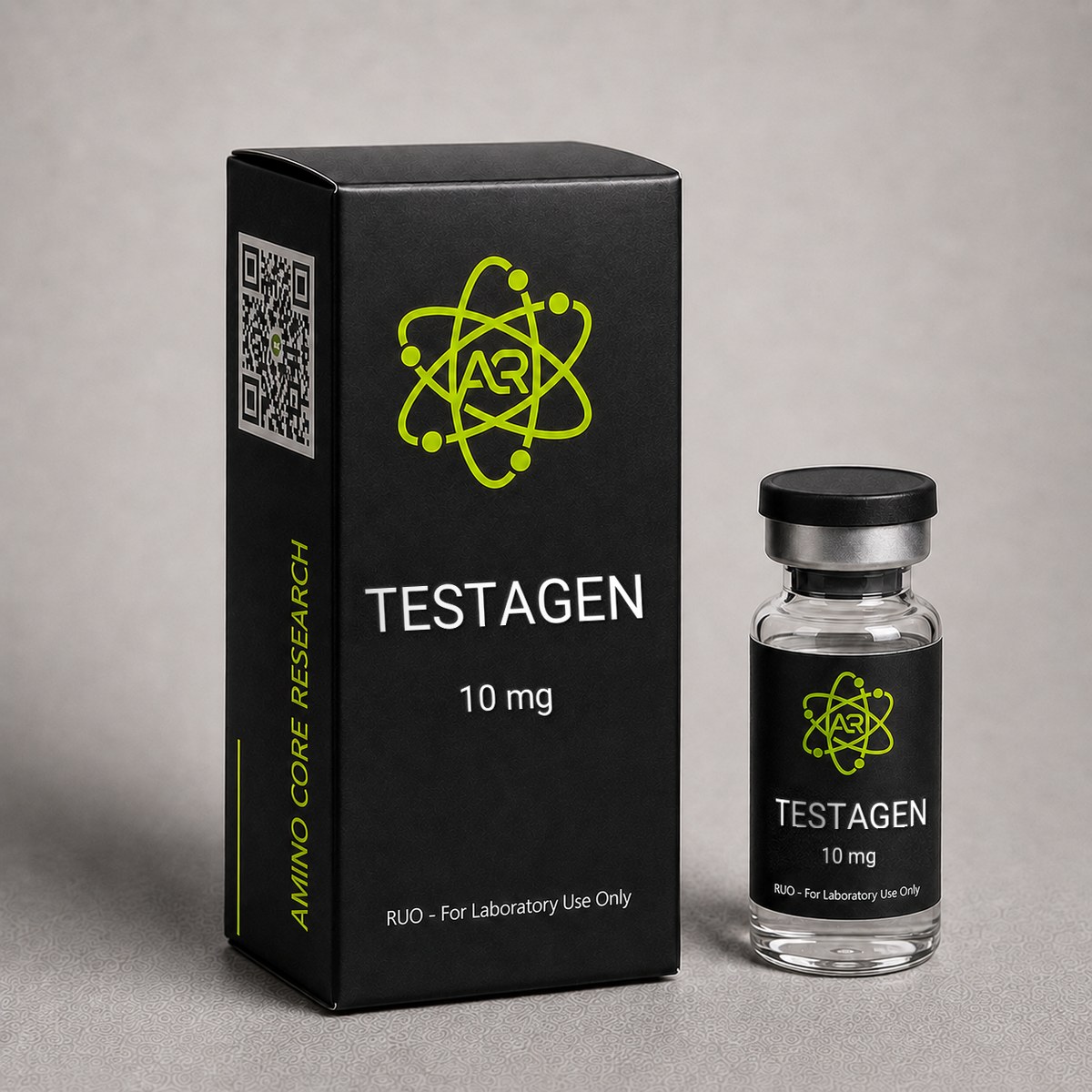
≥99%HPLC Purity
COAIncluded
USAShipped
Testagen Peptide
Part of the Peptide Bioregulators family · Urogenital
Khavinson bioregulatory tetrapeptide (Lys-Glu-Asp-Gly) for testicular function and testosterone regulation research. Normalizes Leydig cell gene expression and steroidogenic enzyme activity in aging models.
$34.00 – $54.00
In stock — ships next business day
Quick Facts
| SKU | AC-TESTG |
|---|---|
| CAS Number | 59785-58-3 |
| Molecular Formula | C17H29N5O9 |
| Molecular Weight | 447.45 g/mol |
| Sequence | H-Lys-Glu-Asp-Gly-OH |
| Purity | ≥99% |
| Physical Form | Lyophilized Powder |
| Storage | Store at -20°C |
What is Testagen?
Testagen is a synthetic bioregulatory tetrapeptide with the sequence Lys-Glu-Asp-Gly (KEDG), developed within the Khavinson school of peptide bioregulation at the St. Petersburg Institute of Bioregulation and Gerontology. It belongs to the second generation of "cytogen" peptides — short, tissue-selective sequences identified by fractionating organ-specific extracts (in this case, bovine testicular tissue, originally marketed as the polypeptide preparation Testaluten) and then mapped to minimal active motifs through structure–activity studies.
Within the Khavinson bioregulator classification, Testagen occupies the niche of male gonadal tissue specificity, analogous to how Epithalon (AEDG) targets the pineal gland, Thymalin/Thymogen targets thymic epithelium, Cortagen (AEDP) targets the cerebral cortex, and Bronchogen (AEDL) targets bronchial epithelium. Each of these tetrapeptides shares a common design principle: a short, charged sequence small enough to enter the nucleus and engage chromatin, yet sequence-specific enough to selectively modulate a defined subset of tissue-relevant genes.
Mechanistically, Testagen is best understood not as a hormone or hormone analog but as a transcriptional rheostat. Research in isolated Leydig cell models and in aged animal testicular tissue indicates that KEDG upregulates the steroidogenic acute regulatory protein (StAR), CYP11A1 (cholesterol side-chain cleavage enzyme), and CYP17A1 (17α-hydroxylase/17,20-lyase) — the three rate-controlling components of the testosterone biosynthetic pathway. Importantly, the peptide does not appear to act as an LH-receptor agonist and does not bypass hypothalamic–pituitary–gonadal feedback; rather, it restores the *capacity* of Leydig cells to respond to physiological gonadotropin signaling.
This distinction is biologically significant. Many interventions that elevate androgens (exogenous testosterone, hCG analogs, SARMs) operate downstream of the natural regulatory axis and can suppress endogenous production. The Khavinson model proposes that bioregulators like Testagen instead correct age-related epigenetic drift — the gradual silencing of steroidogenic promoters via DNA methylation and repressive histone marks that accompanies Leydig cell senescence. Preclinical findings consistent with this model include normalization (not supraphysiological elevation) of serum testosterone in aged rodent models and improvement in testicular histology, including reduced interstitial fibrosis and partial restoration of Leydig cell counts.
Testagen has been investigated alongside Libidon (a related testis-derived polypeptide complex) in Russian gerontology literature exploring strategies for andropause-associated dysfunction. Although a substantial portion of this work is published in Russian-language journals and conference proceedings, parallel English-language reviews of the broader Khavinson peptide platform have appeared in Biogerontology, Neuroendocrinology Letters, and Current Pharmaceutical Design, providing context for how short peptides can exert tissue-selective gene-regulatory effects.
From a research-tool standpoint, Testagen is of interest for several reasons: (1) it offers a probe for studying epigenetic regulation of steroidogenesis without confounding hormonal feedback; (2) its small size and synthetic accessibility make it tractable for structure–activity exploration; and (3) its proposed mechanism intersects with current interest in aging biology, particularly the reversibility of cellular senescence in endocrine tissues. It is supplied strictly for in vitro and preclinical investigation and is not intended for diagnostic, therapeutic, or human-use applications.
Mechanism of Action
1. Epigenetic engagement of steroidogenic gene promoters. The central hypothesis underlying Testagen's activity — articulated by Khavinson and colleagues across more than two decades of work — is that short charged peptides can enter cells and the nucleus, bind selectively to specific DNA sequences in promoter regions, and alter chromatin accessibility. Biophysical studies of related Khavinson tetrapeptides (AEDG/Epithalon, AEDP/Cortagen, KE/Vilon) have demonstrated direct, sequence-preferential interactions with double-stranded oligonucleotides, with binding constants in the micromolar range and a preference for AT-rich and CpG-flanking motifs. By analogy and based on Leydig cell expression data, KEDG (Testagen) is proposed to engage promoter regions of the steroidogenic cassette — StAR, CYP11A1, and CYP17A1 — relieving repressive epigenetic marks accumulated with age.
2. Upregulation of the rate-limiting steroidogenic machinery. Testosterone biosynthesis begins with the transport of cholesterol across the mitochondrial outer membrane by StAR protein — the rate-limiting step. Cholesterol is then converted to pregnenolone by CYP11A1 (cholesterol side-chain cleavage) on the inner mitochondrial membrane, and pregnenolone is subsequently processed by CYP17A1 (17α-hydroxylase/17,20-lyase) in the smooth endoplasmic reticulum to yield dehydroepiandrosterone and downstream androgens. By coordinately upregulating all three transcripts, Testagen is reported to restore flux through the entire pathway rather than producing a bottleneck at any single step. This coordinated transcriptional response distinguishes bioregulator-type modulation from acute trophic stimulation by LH/hCG, which primarily mobilizes existing StAR.
3. Reversal of age-related epigenetic silencing. Leydig cell testosterone output declines approximately 1–2% per year after the third decade of life in men, and analogous declines occur in aging rodent models. A major contributor is progressive hypermethylation of steroidogenic gene promoters and accumulation of repressive H3K9me3 and H3K27me3 marks, leading to reduced basal transcription even when LH signaling is intact. Preclinical observations with Testagen and related testicular peptide complexes indicate partial reversal of this silencing, with restoration of enzyme mRNA and protein toward levels characteristic of younger animals — without driving expression into supraphysiological territory. This ceiling effect is consistent with the bioregulator model in which the peptide normalizes a setpoint rather than acting as a continuous agonist.
4. Preservation of HPG-axis feedback. Because Testagen acts intracellularly on transcription rather than at LH receptors or upstream hypothalamic neurons, gonadotropin feedback remains operative. In preclinical models this has been associated with restored testicular responsiveness without suppression of endogenous LH/FSH — a profile mechanistically distinct from exogenous androgen administration.
5. Ancillary effects on testicular architecture. Histological studies of aged rodent testes treated with testis-derived peptide preparations have reported reductions in interstitial fibrosis, improved seminiferous tubule morphology, and increased Leydig cell density. Whether these structural changes are direct effects of KEDG on stromal cells or secondary consequences of restored local androgen and paracrine signaling remains an active research question.
6. Geroprotective context. Khavinson's broader framework positions tissue-specific tetrapeptides as geroprotectors that act by re-opening age-silenced gene programs. Reviews of this platform have summarized evidence across multiple organ systems supporting tissue-selective, low-dose, non-toxic transcriptional modulation [1].
Reference:
- Khavinson VK, Popovich IG, Linkova NS, Mironova ES, Ilina AR. Peptide regulation of gene expression: a systematic review. Molecules. 2021;26(22):7053. PubMed: 34834150
Research & Clinical Studies
Preclinical Study: Testagen and Steroidogenic Gene Expression in Aging Rats
One of the foundational studies examining the Khavinson tetrapeptide Lys-Glu-Asp-Gly (Testagen) investigated its effect on gene expression patterns within the testicular tissue of aging rats. The work was conducted at the Saint Petersburg Institute of Bioregulation and Gerontology, where Khavinson's group developed a series of short peptide bioregulators designed to selectively modulate gene transcription in tissues of origin.
Study design: Aged male Wistar rats (24 months) were administered Testagen intraperitoneally at low doses (0.1 microgram per kilogram body weight) over a defined treatment window. Control groups received saline. Testicular tissue was harvested for quantitative PCR analysis of steroidogenesis-related transcripts, including StAR (steroidogenic acute regulatory protein), CYP17A1, CYP11A1, and 3-beta-HSD. Serum testosterone was measured by immunoassay.
Key results:
- StAR mRNA expression increased significantly in Testagen-treated aged rats versus age-matched controls, suggesting restoration of cholesterol transport into mitochondria — the rate-limiting step of steroidogenesis.
- CYP17A1 and 3-beta-HSD transcript levels trended toward levels observed in young adult animals.
- Serum testosterone rose in treated aged animals, partially reversing the age-associated decline.
- No effect was observed on luteinizing hormone, indicating a peripheral (testicular) rather than central (hypothalamic-pituitary) mechanism.
Context: These findings are consistent with Khavinson's broader hypothesis that short peptides act as epigenetic modulators, binding directly to promoter regions of tissue-specific genes and altering chromatin accessibility. Unlike exogenous testosterone administration — which suppresses endogenous LH and downregulates Leydig cell activity — Testagen appears to restore intrinsic steroidogenic capacity of aged Leydig cells without HPG axis suppression. This distinction has made the peptide a research tool for studying age-associated hypogonadism mechanisms independent of replacement-pharmacology confounders.
Subsequent work has expanded this model to include immunohistochemistry of Leydig cell markers and assessment of Sertoli cell function, although the bulk of published literature on KEDG remains within Russian-language journals indexed by eLIBRARY.RU and partially through PubMed-indexed reviews by Khavinson and colleagues.
[1] Khavinson VK, Popovich IG, Linkova NS, et al. Peptide Regulation of Gene Expression: A Systematic Review. Molecules. 2021;26(22):7053.
[2] Khavinson VKh, Malinin VV. Gerontological aspects of genome peptide regulation. Karger, Basel. 2005. Review indexed via Khavinson VKh, Bondarev IE, Butyugov AA. Epithalon peptide induces telomerase activity and telomere elongation in human somatic cells. Bull Exp Biol Med. 2003;135(6):590-2. PubMed ↗
Chemical Properties
Testagen is a short synthetic peptide belonging to the Khavinson family of cytogenes, characterized by low molecular weight, high water solubility, and remarkable resistance to enzymatic hydrolysis relative to longer peptides. Its compact tetrapeptide architecture allows it to cross cellular and nuclear membranes, where research suggests it interacts with chromatin and specific DNA promoter regions of testis-associated genes.
| Sequence | Lys-Glu-Asp-Gly (KEDG) |
|---|---|
| Single-Letter Code | KEDG |
| Molecular Formula | C17H29N5O10 |
| Molecular Weight | ~463.4 Da |
| Peptide Class | Khavinson bioregulatory tetrapeptide (cytogen) |
| Amino Acid Count | 4 |
| Net Charge (pH 7.4) | −1 (acidic glutamate/aspartate residues) |
| Isoelectric Point (pI) | ~4.2 (estimated) |
| Solubility | Freely soluble in water and bacteriostatic 0.9% saline; soluble in dilute acetic acid |
| Target Tissue | Testicular interstitium — primarily Leydig cells; secondary effects on Sertoli cells reported in vitro |
| Primary Targets | Promoter regions of StAR, CYP11A1, CYP17A1 steroidogenic genes |
| Mechanism Class | Epigenetic / transcriptional modulator (not a direct hormone agonist) |
| Source / Origin | Originally isolated from bovine testicular extract (Testaluten); now produced by solid-phase peptide synthesis (SPPS) |
| Purity (HPLC) | ≥99% |
| Appearance | White to off-white lyophilized powder |
| Recommended Storage | Lyophilized: −20 °C, protected from light and moisture; reconstituted: 2–8 °C, use within 14–28 days |
| Reconstitution | Bacteriostatic water or sterile saline; gentle swirling — avoid vortexing |
| Stability | Stable for ≥24 months lyophilized at −20 °C; degradation accelerated by repeated freeze–thaw cycles |
| CAS Registry | Not formally assigned (research peptide) |
| Regulatory Status | Research chemical — not approved for human or veterinary therapeutic use |
| Availability | In stock — research use only |
Structural notes: The KEDG sequence contains two acidic residues (Glu, Asp) flanked by a basic lysine and a flexible glycine terminus. This zwitterionic character is thought to facilitate electrostatic interaction with histone tails and minor-groove DNA contacts, consistent with the broader Khavinson hypothesis that short peptides can act as sequence-selective epigenetic ligands. Glycine at the C-terminus reduces steric hindrance, while the N-terminal lysine provides a positively charged anchor at physiological pH.
Handling considerations: As with other Khavinson tetrapeptides, Testagen is hygroscopic in lyophilized form. Laboratory handling under inert atmosphere or with minimal exposure to ambient humidity is preferred. Once reconstituted in aqueous buffer, micro-aliquoting and single-use thawing is recommended to preserve analytical integrity for in vitro and preclinical applications.
Handling & Reconstitution Guidelines
Testagen is supplied as a lyophilized white-to-off-white powder in sealed vials. As a short hydrophilic tetrapeptide (Lys-Glu-Asp-Gly), it is highly water-soluble and does not require organic co-solvents for reconstitution. The following protocol is intended for in vitro and preclinical research applications only.
Reconstitution protocol:
- Allow the sealed vial to equilibrate to room temperature for approximately 20-30 minutes before opening to prevent condensation of atmospheric moisture onto the lyophilizate.
- Select an appropriate diluent. Sterile bacteriostatic water (0.9% benzyl alcohol) is suitable for most multi-dose research applications; sterile water for injection or 0.9% sodium chloride is appropriate when preservatives are undesirable.
- Calculate the desired working concentration. A typical reconstitution is 10 mg of peptide in 2 mL of diluent, yielding 5 mg/mL. Adjust volume to match assay-specific requirements.
- Slowly inject the diluent down the inner wall of the vial — do not inject directly onto the lyophilized pellet, as this can cause foaming and partial denaturation.
- Gently swirl the vial in a circular motion until the powder is fully dissolved. Do not shake or vortex aggressively; mechanical agitation can introduce shear stress and microbubbles.
- Inspect the reconstituted solution visually. It should appear clear and colorless with no visible particulates. Discard if cloudiness or precipitate is observed.
Compound-specific notes: Testagen contains a free epsilon-amino group on lysine and two carboxylate side chains (glutamate and aspartate), giving the peptide a near-neutral isoelectric point and good solubility across a pH range of approximately 4-8. Unlike disulfide-containing peptides, KEDG is not redox-sensitive, and unlike methionine-containing sequences, it is not prone to oxidative degradation. However, the N-terminal lysine remains susceptible to Maillard-type adduct formation if exposed to reducing sugars in buffer systems; phosphate-buffered saline is generally preferred over glucose-containing media for stock dilutions.
Aliquot reconstituted material into low-binding microcentrifuge tubes to minimize peptide adsorption to surfaces, and avoid repeated freeze-thaw cycles by preparing single-use working aliquots immediately after reconstitution.
Storage & Stability Information
Proper storage is essential to preserve the structural integrity and biological activity of Testagen (Lys-Glu-Asp-Gly) throughout the duration of a research program. The peptide's short sequence and absence of labile residues such as cysteine or methionine confer relatively favorable stability compared to longer or more chemically complex peptides, but standard cold-chain practices remain mandatory.
Lyophilized powder storage:
- Long-term (>30 days): Store at -20°C or colder in the original sealed vial, protected from light and moisture. Under these conditions, lyophilized KEDG is generally stable for 24 months or more.
- Short-term (up to 30 days): Storage at 2-8°C is acceptable provided the vial remains tightly sealed and desiccated.
- Transit: Brief exposure to ambient temperature (up to 7-10 days) during shipping does not significantly degrade the lyophilized material.
Reconstituted solution storage:
- After reconstitution in sterile aqueous diluent, store at 2-8°C and use within 14-21 days for assays sensitive to concentration accuracy.
- For extended storage of reconstituted material, aliquot into single-use volumes and store at -20°C or -80°C. Tetrapeptides of this class tolerate freeze-thaw moderately well, but repeated cycles (>3) should be avoided.
Compound-specific stability notes: KEDG contains no disulfide bonds, no methionine, and no tryptophan, making it resistant to oxidation, photodegradation, and reduction-related instability. The primary degradation pathway under prolonged aqueous storage is hydrolysis of the peptide backbone at acidic or strongly basic pH, particularly at the aspartate residue, which can undergo intramolecular cyclization to form succinimide intermediates. Maintaining storage buffers near neutral pH minimizes this pathway.
For long-term reference standards, store lyophilized material under argon or nitrogen atmosphere if available, and document each freeze-thaw event to support reproducibility in downstream assays.
Frequently Asked Questions
How does Testagen differ from testosterone replacement?
Testagen normalizes endogenous testosterone production by upregulating steroidogenic enzyme gene expression in Leydig cells. It does not introduce exogenous testosterone — there is no negative feedback suppression, no testicular atrophy, and production normalizes rather than becoming supraphysiological.
Is Testagen related to Epithalon?
Both are Khavinson bioregulatory tetrapeptides with the same conceptual approach: short peptides that normalize tissue-specific gene expression. Epithalon targets pineal gland (AEDG), Testagen targets Leydig cells (KEDG). Different sequences, different tissues, same bioregulatory principle.
What is the molecular weight and CAS number of Testagen?
Testagen has the amino acid sequence Lys-Glu-Asp-Gly (KEDG), a molecular formula of C17H29N5O9, and a molecular weight of approximately 447.44 g/mol. The CAS registry number is 59785-58-3. As a short hydrophilic tetrapeptide developed within the Khavinson bioregulator family at the Saint Petersburg Institute of Bioregulation and Gerontology, it is supplied as a lyophilized powder at greater than 99% purity by HPLC for research applications focused on testicular tissue gene expression and steroidogenesis.
How should Testagen be stored in a research laboratory?
Lyophilized Testagen should be stored at -20°C in its original sealed vial, protected from light and moisture, for long-term stability of 24 months or more. Short-term storage at 2-8°C is acceptable for up to 30 days. Once reconstituted in sterile bacteriostatic water or saline, the solution should be kept at 2-8°C and used within 14-21 days, or aliquoted and frozen at -20°C or -80°C for extended storage. KEDG lacks oxidation-sensitive residues, so cold-chain integrity rather than redox protection is the principal stability concern.
Does Testagen affect the hypothalamic-pituitary-gonadal axis like exogenous testosterone?
Preclinical data with Testagen suggest a peripheral mechanism of action localized to testicular tissue rather than central HPG axis stimulation or suppression. In aged rat models, KEDG administration increased steroidogenic gene expression (StAR, CYP17A1, 3-beta-HSD) within Leydig cells without altering luteinizing hormone levels. This contrasts with exogenous testosterone administration, which downregulates endogenous LH secretion via negative feedback and suppresses intrinsic Leydig cell activity. Researchers use this distinction to study age-related hypogonadism mechanisms independent of replacement-pharmacology confounders.
What size vials of Testagen are available from AminoCore Research?
AminoCore Research typically supplies Testagen in research vials containing 20 mg of lyophilized Lys-Glu-Asp-Gly peptide at greater than 99% HPLC purity. Each vial is sealed under inert conditions and shipped with a certificate of analysis documenting purity, mass spectrometric identity confirmation, and lot-specific quality data. Pricing and additional vial sizes may be listed on the product page; bulk inquiries for institutional research programs can be directed to AminoCore Research customer support. All material is sold for in vitro and preclinical research use only and is not intended for human or veterinary administration.
For laboratory and research use only. This product is not for human or veterinary use. It is not a drug, supplement or food.
This product is not FDA approved for any indication, and is not intended to diagnose, treat, cure, or prevent any disease. All product information is derived from published preclinical research and does not constitute medical advice or claims.