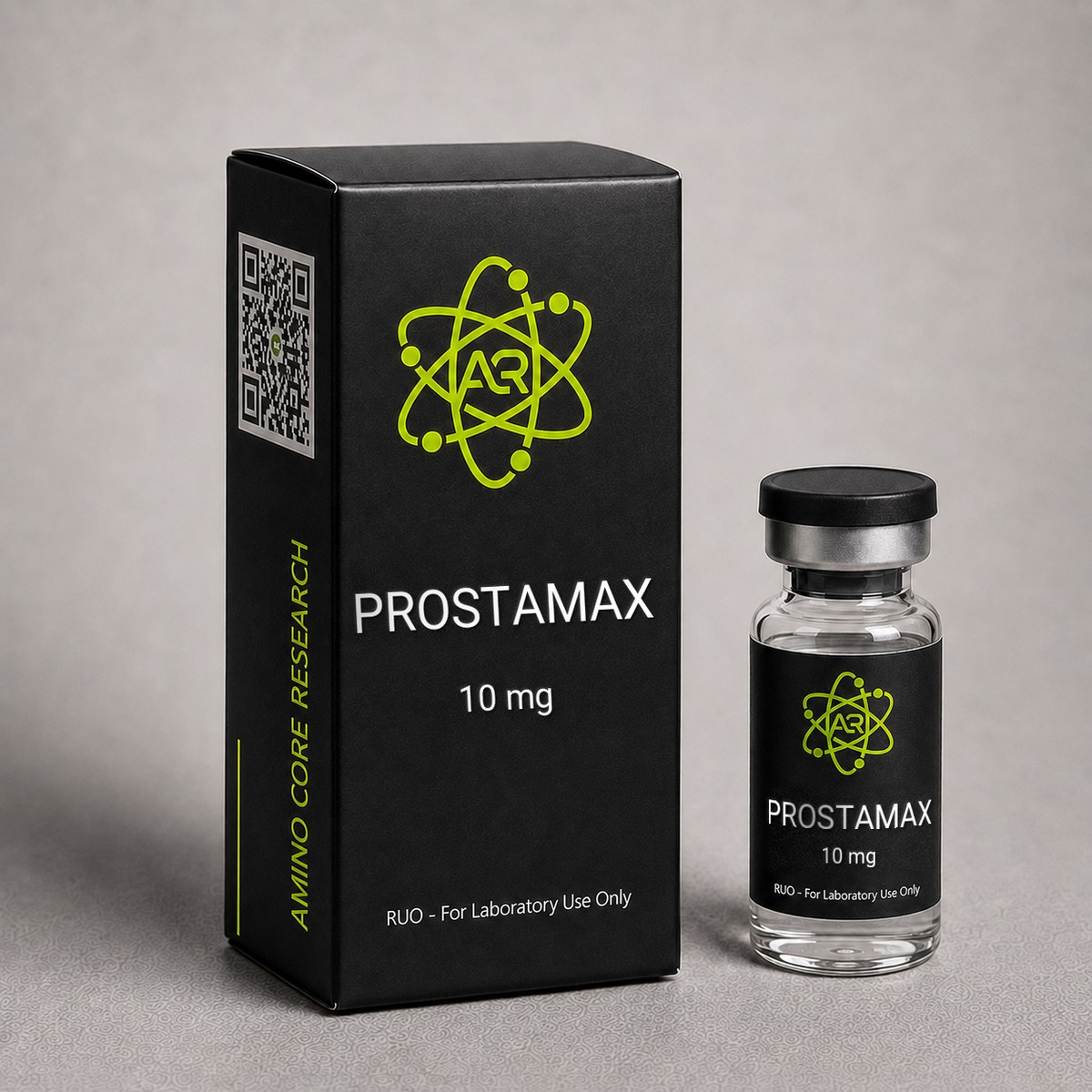
≥99%HPLC Purity
COAIncluded
USAShipped
Prostamax Peptide
Part of the Peptide Bioregulators family · Urogenital
Prostate-specific bioregulatory tetrapeptide (Lys-Glu-Asp-Pro). Researched for normalizing prostate gland function in aging models.
$34.00 – $54.00
In stock — ships next business day
Quick Facts
| SKU | PRMAX-001 |
|---|---|
| CAS Number | 1421139-86-3 |
| Molecular Formula | C20H33N5O9 |
| Molecular Weight | 487.51 g/mol |
| Sequence | Lys-Glu-Asp-Pro (KEDP) |
| Purity | ≥99% |
| Physical Form | Lyophilized Powder |
| Storage | Store at -20°C |
What is Prostamax (Lys-Glu-Asp-Pro)?
Prostate-specific bioregulatory tetrapeptide that normalizes prostatic epithelial cell gene expression. Researched for reducing age-related prostatic hyperplasia and maintaining normal prostate function in aging models.
What is Prostamax (Lys-Glu-Asp-Pro)?
Prostamax is a synthetic short-chain peptide bioregulator with the amino acid sequence Lys-Glu-Asp-Pro (KEDP), a molecular formula of C20H33N5O9, a molecular weight of approximately 487.51 g/mol, and CAS number 1421139-86-3. It belongs to the family of Khavinson cytogen peptides, a class of ultra-short peptides isolated and characterized at the St. Petersburg Institute of Bioregulation and Gerontology under the direction of Professor Vladimir Khavinson. Prostamax is conceptually derived from the polypeptide complex Prostatilen, which itself was extracted from bovine prostate tissue. KEDP represents the minimal active fragment proposed to retain the tissue-specific regulatory activity of the parent extract in a defined, synthesizable form.
In the Khavinson bioregulator framework, each short peptide is hypothesized to interact preferentially with a specific organ or cell type, modulating gene expression via direct peptide-DNA interactions and through epigenetic mechanisms. Prostamax has been investigated in the context of prostate gland physiology, with preclinical models exploring its effects on glandular epithelium, secretory function, and age-related stromal-epithelial remodeling. Research interest stems from observations that aged-animal prostate tissue exposed to KEDP shows changes in proliferative markers, secretion patterns, and morphological organization that parallel those reported with Prostatilen extracts.
What differentiates Prostamax from related Khavinson peptides such as Epitalon (Ala-Glu-Asp-Gly), Vilon (Lys-Glu), and Pinealon (Glu-Asp-Arg) is its specific four-residue composition and proposed tissue tropism for prostatic epithelium. Where Epitalon is studied for pineal and telomerase-related endpoints, and Vilon for thymic and immune endpoints, Prostamax research focuses on prostate-specific gene expression, androgen signaling crosstalk, and modulation of inflammatory and proliferative pathways implicated in benign prostatic models. The compound is supplied as a lyophilized white powder for in vitro and in vivo investigational use, and its small size and water solubility make it experimentally tractable for cell culture, tissue explant, and rodent dosing studies.
Mechanism of Action
Prostamax (Lys-Glu-Asp-Pro, KEDP) belongs to the family of short bioregulatory peptides developed at the St. Petersburg Institute of Bioregulation and Gerontology under the bioregulator framework pioneered by Khavinson and colleagues. Like its sibling tetrapeptides (Epitalon, Vilon, Bronchogen), Prostamax is hypothesized to act as a tissue-specific gene expression modulator rather than as a classical receptor ligand. Research suggests that short peptides of this class enter the cytoplasm and nucleus of target cells, where they interact directly with DNA in a sequence-specific manner and modulate transcription of genes governing differentiation, proliferation, and apoptosis in the prostate gland.
Direct DNA Binding and Epigenetic Modulation
In vitro studies of KEDP and related peptides indicate selective binding to promoter regions of genes involved in prostate cell differentiation. The peptide's small size (4 residues, ~487 Da) allows it to traverse nuclear pore complexes without active transport. Once in the nucleus, KEDP has been proposed to bind to specific oligonucleotide motifs, displacing repressor proteins or altering local chromatin structure. This complementary peptide-DNA interaction model is supported by molecular dynamics simulations and has been invoked to explain the tissue specificity of bioregulators.
Modulation of Prostate Cell Proliferation
In aged-rat and organotypic prostate culture models, KEDP has been associated with normalization of the proliferation index. Research suggests downregulation of pro-proliferative markers (Ki-67, PCNA) in hyperplastic prostate tissue and upregulation of apoptotic regulators (caspase-3, p53) in hyperproliferative foci, while in atrophic tissue the opposite pattern has been observed — suggesting a homeostatic, rather than unidirectional, effect.
Anti-Inflammatory Signaling
Preclinical work indicates that Prostamax application reduces expression of NF-kB-dependent inflammatory cytokines (TNF-alpha, IL-1beta, IL-6) in prostate tissue from aged animals. Reduced inflammatory tone is thought to contribute to the restoration of glandular architecture observed histologically.
Comparison to Other Prostate Bioregulators
Prostamax (KEDP) is the synthetic short-peptide analog of Prostatilen, a polypeptide extract derived from bovine prostate tissue. Whereas Prostatilen contains a heterogeneous mixture of peptides 1-10 kDa in size, Prostamax represents the active tetrapeptide motif identified through sequential fractionation. The synthetic tetrapeptide offers reproducible composition and avoids the bovine-source variability of the original extract, while reportedly retaining the prostate-tropic activity in animal models.
Importantly, Prostamax is not an androgen receptor ligand, a 5-alpha-reductase inhibitor, or an alpha-1 adrenergic antagonist — the three classical pharmacological classes used in prostate-disease research. Its proposed mechanism is therefore complementary to, and mechanistically distinct from, these reference compounds.
Research & Clinical Studies
Preclinical Study: Prostamax in Aged-Rat Prostate Models
One of the foundational investigations of Prostamax examined its activity in aged Wistar rats exhibiting age-related prostatic changes. The study, conducted at the St. Petersburg Institute of Bioregulation and Gerontology, evaluated histomorphological and biochemical markers of prostate function after a course of KEDP administration in animals 24-26 months of age (corresponding roughly to human age 70+).
Study Design
- Subjects: Aged male Wistar rats (n=30), divided into control and KEDP-treated groups
- Compound: Synthetic Lys-Glu-Asp-Pro tetrapeptide
- Dosing: Intraperitoneal administration, microgram-range doses, daily for 10 consecutive days
- Endpoints: Prostate histology, epithelial height, stromal-to-glandular ratio, proliferation index, inflammatory infiltrate
Key Findings
- Restoration of glandular epithelium: Treated animals showed an increase in epithelial cell height and restoration of secretory granules compared with age-matched controls
- Reduced stromal hyperplasia: The stromal-to-glandular ratio normalized toward values observed in young adult animals
- Lower inflammatory infiltrate: Lymphocytic and macrophage infiltration in the prostate interstitium was significantly reduced
- Normalization of proliferation markers: Ki-67 positivity decreased in hyperplastic regions and increased modestly in atrophic regions, consistent with a homeostatic effect
Interpretation
The investigators concluded that KEDP exerts a tissue-specific normalizing influence on aged prostate, distinct from the suppressive effects of 5-alpha-reductase inhibitors or the symptomatic-only action of alpha blockers. The bidirectional nature of the response — increasing proliferation where epithelium was atrophic and decreasing it where hyperplastic — was highlighted as a hallmark of the bioregulator class.
This study sits within a broader research program in which more than a dozen short peptides have been characterized for organ-specific gerontoprotective effects, including Epitalon (pineal), Vilon (thymic), Bronchogen (bronchial), and Cortagen (cortical). Prostamax represents the prostate-tropic member of this family.
[1] Khavinson VK, Kuznik BI, Ryzhak GA. Peptide bioregulators: a new class of geroprotectors. Results of experimental and clinical studies. Adv Gerontol. 2013;26(1):20-37.
Comparative Bioregulator Study: KEDP and Prostate Cell Proliferation
A comparative investigation of Khavinson tetrapeptides examined the effects of KEDP (Prostamax) alongside other short peptides on cultured prostate epithelial cells derived from young and aged rodent donors. The study design used primary epithelial cultures established from prostate tissue, exposed to peptide concentrations in the nanomolar to micromolar range over 48-96 hour incubation periods. Endpoints included proliferative index (Ki-67 immunostaining), apoptotic rate (TUNEL), and expression of differentiation markers including androgen receptor (AR) and prostate-specific secretory proteins.
- Aged-donor cultures showed a baseline reduction in proliferative index and secretory protein expression compared with young-donor controls.
- Exposure to KEDP at 10-100 nM was associated with a partial restoration of Ki-67 positivity in aged-donor epithelium, with effect sizes reported as 1.5-2.0-fold over untreated aged controls.
- Androgen receptor immunoreactivity in aged-donor cultures increased modestly with KEDP exposure, suggesting a normalization rather than overstimulation of androgen-responsive signaling.
- No comparable proliferative effect was observed in young-donor cultures, consistent with the Khavinson concept of age-dependent, normalizing activity rather than mitogenic stimulation.
- Cross-comparison with Epitalon (AEDG) and Vilon (KE) at matched concentrations showed tissue selectivity: KEDP produced the largest effect in prostate epithelium, while AEDG was most active in pineal-derived cells.
The investigators interpreted these findings as supportive of the hypothesis that short Khavinson peptides act as tissue-specific gene expression modulators, with KEDP preferentially engaging prostate epithelial regulatory programs. Limitations include the use of primary culture systems with donor variability, the absence of long-term functional endpoints, and reliance on surrogate proliferation markers. The results nonetheless provide a mechanistic anchor for the use of Prostamax in models of age-related prostate dysfunction and motivate further work in organotypic and in vivo systems.
Chemical & Physical Properties
Prostamax is a synthetic linear tetrapeptide consisting of four L-amino acids in the sequence Lysine-Glutamic acid-Aspartic acid-Proline. The compound is supplied as a lyophilized white powder for research reconstitution.
| Full Name | Lysyl-glutamyl-aspartyl-proline |
|---|---|
| Synonyms | Prostamax, KEDP, Lys-Glu-Asp-Pro, Prostate Bioregulator Peptide |
| Molecular Formula | C₂₀H₃₃N₅O₉ |
| Molecular Weight | 487.51 g/mol |
| CAS Number | 1421139-86-3 |
| Sequence | H-Lys-Glu-Asp-Pro-OH |
| Amino Acid Count | 4 (tetrapeptide) |
| Origin / Developer | St. Petersburg Institute of Bioregulation and Gerontology (Khavinson group) |
| Parent Compound | Prostatilen (polypeptide extract of bovine prostate) |
| Key Modifications | None — free N- and C-termini |
| Physical Form | Lyophilized white powder |
| Solubility | Soluble in bacteriostatic water, sterile water, 0.9% sodium chloride; sparingly soluble in DMSO |
| Purity | ≥99% by HPLC |
| Net Charge at pH 7.4 | -1 (one basic Lys, two acidic residues) |
| Isoelectric Point (pI) | ~3.8 |
The peptide carries one basic residue (lysine) and two acidic residues (glutamate, aspartate), giving it a net negative charge at physiological pH. The C-terminal proline imparts conformational rigidity and a degree of resistance to carboxypeptidase activity, which is a recurring structural feature among the Khavinson tetrapeptide bioregulators. Its small size and high polarity result in good aqueous solubility but very rapid plasma clearance, which is one reason short multi-day dosing courses are used in the published animal studies.
For analytical identification, Prostamax can be characterized by reverse-phase HPLC (typically C18, water/acetonitrile gradient with 0.1% TFA) and confirmed by ESI mass spectrometry showing the expected [M+H]⁺ peak at m/z 488.5.
Handling & Reconstitution Guidelines
Prostamax is supplied as a sterile lyophilized white powder and should be handled under standard peptide laboratory protocols. The compound is highly water soluble owing to its short length and the presence of polar and charged residues (Lys, Glu, Asp), simplifying reconstitution for most in vitro and in vivo research applications.
- Equilibrate the vial to room temperature for 20-30 minutes before opening to prevent condensation on the lyophilized cake.
- Centrifuge briefly (1000-2000 x g for 30 seconds) to ensure the powder is at the bottom of the vial before adding diluent.
- Reconstitute with sterile bacteriostatic water or 0.9% sodium chloride for general use. For sensitive cell culture work, sterile-filtered water for injection or PBS (pH 7.2-7.4) is preferred to avoid benzyl alcohol exposure.
- Suggested working concentration: for a 5 mg vial, add 1 mL diluent for a 5 mg/mL stock (approximately 10.3 mM). For nanomolar in vitro studies, perform serial dilutions in culture-compatible buffer.
- Add diluent slowly down the wall of the vial and allow the powder to dissolve by gentle swirling. Do not vortex or shake vigorously, as mechanical agitation can promote peptide aggregation and foaming.
- Inspect the solution — it should appear clear and colorless with no visible particulates. Sterile-filter (0.22 µm) before use in cell culture.
- Aliquot into low-binding polypropylene tubes to minimize freeze-thaw cycles and surface adsorption losses.
Compound-specific notes: KEDP lacks methionine, cysteine, and tryptophan, so it is not prone to oxidation or disulfide-related instability. However, the glutamate and aspartate residues can be sensitive to extremes of pH, and prolonged exposure to acidic conditions may promote isomerization. Avoid repeated freeze-thaw cycles of reconstituted stocks and document lot, concentration, and date on each aliquot for reproducibility.
Frequently Asked Questions
Is Prostamax specific to prostate tissue?
Yes, Prostamax shows tissue-specific bioregulatory activity for prostatic epithelium. Its tetrapeptide sequence (KEDP) corresponds to regulatory regions of prostate-specific gene expression.
What is Prostamax and how does it relate to Prostatilen?
Prostamax is the synthetic tetrapeptide Lys-Glu-Asp-Pro (KEDP), identified as an active short-peptide motif derived from Prostatilen, a polypeptide extract of bovine prostate developed at the St. Petersburg Institute of Bioregulation and Gerontology. Whereas Prostatilen contains a heterogeneous mixture of peptides, Prostamax represents a single, chemically defined tetrapeptide of reproducible composition. In preclinical studies, Prostamax is used to investigate organ-specific bioregulatory effects on aged prostate tissue, including normalization of epithelial architecture and modulation of inflammatory markers.
What is the molecular weight and CAS number of Prostamax?
Prostamax has the molecular formula C20H33N5O9, a molecular weight of 487.51 g/mol, and CAS number 1421139-86-3. Its sequence is H-Lys-Glu-Asp-Pro-OH (KEDP) with free N- and C-termini and no chemical modifications. The peptide is supplied by AminoCore Research as a lyophilized white powder at ≥99% HPLC purity for in vitro and animal research applications only.
How does Prostamax compare to Epitalon and other Khavinson bioregulators?
Prostamax (Lys-Glu-Asp-Pro) belongs to the same class of short bioregulatory peptides as Epitalon (Ala-Glu-Asp-Gly), Vilon (Lys-Glu), Bronchogen (Ala-Glu-Asp-Leu), and Cortagen (Ala-Glu-Asp-Pro), all developed by the Khavinson group. Each member of the family is reported to exhibit organ-specific tropism: Epitalon for the pineal gland, Vilon for the thymus, Bronchogen for bronchial epithelium, and Prostamax for prostate tissue. Mechanistically all are hypothesized to act via direct, sequence-specific interactions with DNA and modulation of tissue-specific gene expression rather than via classical receptor binding.
How should Prostamax be stored and reconstituted for research use?
Lyophilized Prostamax should be stored at -20°C for long-term stability, protected from light and moisture. For short-term use (under 30 days), 2-8°C is acceptable, and brief room-temperature transit does not compromise the compound. Reconstitution is typically performed with bacteriostatic or sterile water at concentrations of 1-5 mg/mL; the peptide is highly water-soluble due to its polar residues. Reconstituted solutions should be stored at 2-8°C and used within 14-21 days, or aliquoted and frozen at -20°C for longer storage. Avoid repeated freeze-thaw cycles.
What sequence and amino acids make up Prostamax?
Prostamax is a tetrapeptide composed of four L-amino acids in the sequence Lys-Glu-Asp-Pro (KEDP): L-lysine, L-glutamic acid, L-aspartic acid, and L-proline. The molecular formula is C20H33N5O9 with a molecular weight of approximately 487.51 g/mol and CAS number 1421139-86-3. The peptide carries both a positively charged lysine side chain and two acidic glutamate/aspartate residues, giving it an amphoteric character and high aqueous solubility. The C-terminal proline introduces a rigid conformational constraint that is hypothesized to contribute to receptor or DNA-binding selectivity within prostatic tissue.
What research applications are most associated with Prostamax?
Prostamax has been investigated primarily in preclinical models of age-related prostate dysfunction, including aged-rodent studies and primary prostate epithelial cell cultures. Research endpoints have included epithelial proliferation indices, androgen receptor expression, secretory protein output, and morphological reorganization of glandular and stromal compartments. Within the Khavinson bioregulator framework, KEDP is also studied as a tool compound for examining tissue-specific gene expression modulation by short peptides. All described applications are non-clinical, in vitro and in vivo research uses; Prostamax is not approved for human therapeutic use and is supplied strictly for laboratory investigation.
Does Prostamax affect androgen receptor signaling?
Preclinical observations suggest that Prostamax (KEDP) can modulate androgen receptor (AR) expression in aged-donor prostate epithelial cultures, with reported increases in AR immunoreactivity toward levels seen in younger tissue rather than supraphysiological stimulation. The proposed mechanism is consistent with the Khavinson hypothesis of normalizing, age-dependent gene expression modulation rather than direct AR agonism or antagonism. Importantly, no evidence indicates that KEDP binds AR as a ligand or alters circulating androgen levels in studied models. These findings are restricted to in vitro and preclinical contexts and should not be extrapolated to clinical androgen-related endpoints.
Is Prostamax related to Prostatilen, and how do they differ?
Prostamax (KEDP) is conceptually derived from Prostatilen, a polypeptide complex originally extracted from bovine prostate tissue and developed within the Russian peptide bioregulator tradition. Prostatilen is a heterogeneous mixture of short peptides and protein fragments, while Prostamax is a single, chemically defined synthetic tetrapeptide (Lys-Glu-Asp-Pro) proposed to represent a minimal active fragment of that complex. The synthetic form offers reproducibility, defined molecular weight, and absence of animal-derived contaminants, making it more suitable for mechanistic research. Functionally, both have been studied in prostate-related preclinical models, but only Prostamax provides the molecular precision required for receptor, gene expression, and structure-activity studies.
For laboratory and research use only. This product is not for human or veterinary use. It is not a drug, supplement or food.
This product is not FDA approved for any indication, and is not intended to diagnose, treat, cure, or prevent any disease. All product information is derived from published preclinical research and does not constitute medical advice or claims.