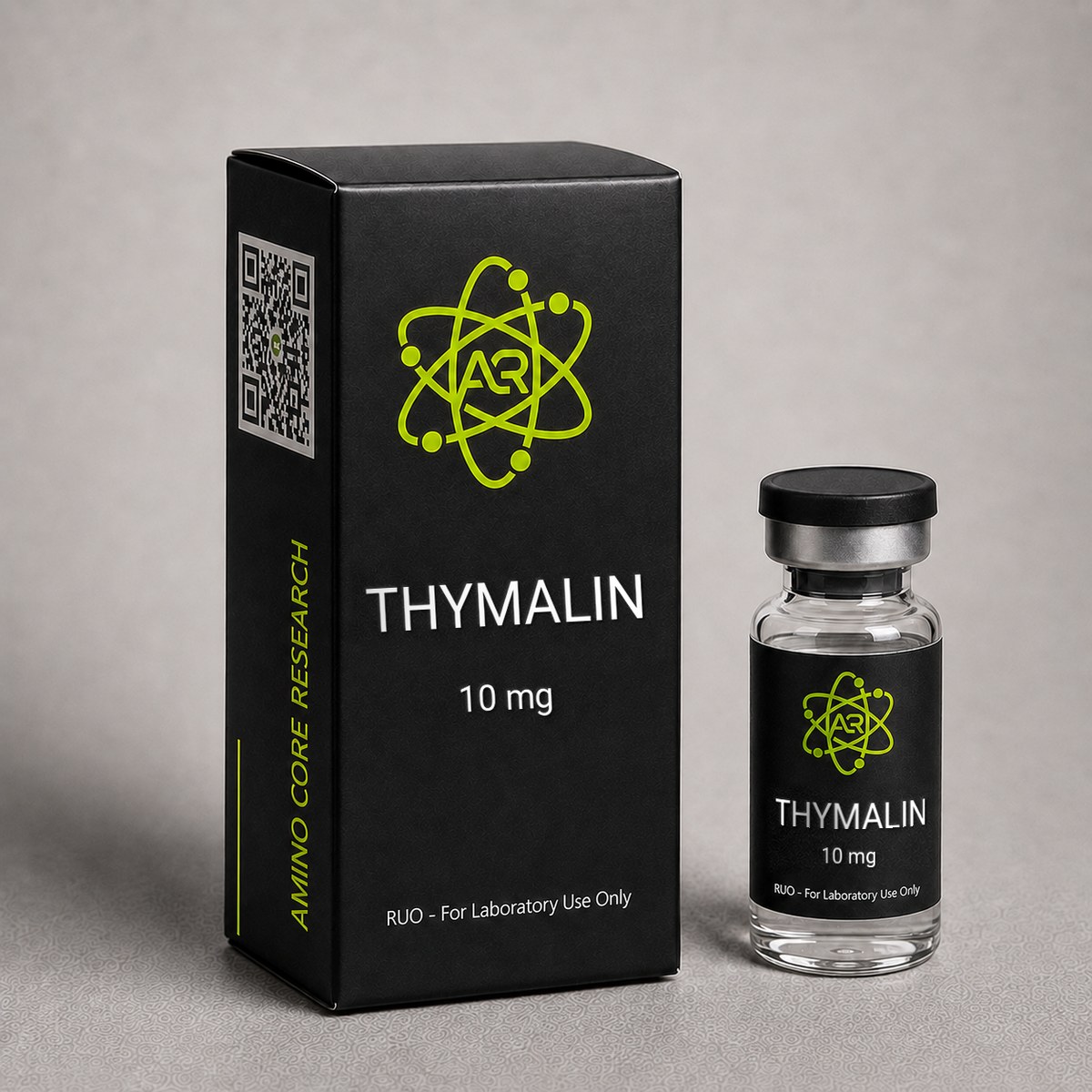
≥99%HPLC Purity
COAIncluded
USAShipped
Thymalin Peptide
Part of the Peptide Bioregulators family · Immune / thymic
Thymalin is a thymus-derived polypeptide complex from the Khavinson cytomax line. As an extract it has no single defined sequence or molecular weight; the synthetic dipeptide counterpart is Thymogen (Glu-Trp). Supplied with a third-party certificate of analysis.
$32.00 – $51.00
In stock — ships next business day
Quick Facts
| SKU | ACR-THYM |
|---|---|
| CAS Number | 37211-64-4 |
| Molecular Formula | Not applicable (polypeptide complex) |
| Molecular Weight | Not applicable (heterogeneous mixture, ~1-10 kDa fractions) |
| Sequence | Polypeptide complex (thymus-derived); no single defined sequence |
| Purity | ≥99% |
| Physical Form | Lyophilized Powder |
| Storage | Store at -20°C |
What is Thymalin?
Thymalin is a polypeptide complex extracted from the thymus gland of young calves (bovine origin), developed in the 1970s at the Military Medical Academy in Saint Petersburg, Russia, by Professor Vladimir Khavinson and colleagues as part of the pioneering cytomedine (peptide bioregulator) research program. Unlike synthetic single-sequence peptides, Thymalin is a heterogeneous mixture of low-molecular-weight polypeptides (approximately 1-10 kDa) obtained via acid-acetone extraction and subsequent purification of thymic tissue. Because it is an extract rather than a chemically defined compound, it does not have a single molecular formula, a discrete molecular weight, or an amino acid sequence in the conventional sense. Its CAS registry number is 37211-64-4, and it is officially registered in the Russian Federation State Pharmacopoeia.
Thymalin has been the subject of more than five decades of research in the Russian scientific literature, with over 200 publications examining its effects on immune modulation, cellular immunity, and biological aging markers. It is considered the parent preparation of the Khavinson thymic peptide line, which subsequently gave rise to the synthetic dipeptide Thymogen (L-Glu-L-Trp) and the tetrapeptide Thymopentin (Arg-Lys-Asp-Val-Tyr). Thymogen was designed to reproduce the principal active dipeptide fraction isolated from Thymalin, offering a chemically defined alternative for research applications where a single-sequence peptide is preferred.
What distinguishes Thymalin from single synthetic peptides is its polypharmacological profile: because the extract contains multiple thymic polypeptide fractions, research has associated it with modulation of T-lymphocyte differentiation, restoration of CD4/CD8 ratios in immunosenescent models, and normalization of neuroendocrine markers. Long-term observational studies conducted by Khavinson and colleagues in elderly cohorts reported associations between repeated Thymalin administration and shifts in biological aging biomarkers, positioning it within the peptide bioregulator paradigm of geroprotection. It remains one of the most extensively studied thymic extracts in the peptide research literature, though its heterogeneous nature means batch-to-batch composition analysis via SDS-PAGE or HPLC fingerprinting is required for reproducible experimental work.
For research use only. Thymalin is supplied as a lyophilized powder with a third-party certificate of analysis characterizing the polypeptide fraction distribution. Not for human or veterinary use.
Mechanism of Action
Thymalin exerts its biological activity through multiple parallel pathways reflecting the heterogeneous composition of its polypeptide fractions. Research suggests three principal mechanistic domains: T-cell maturation signaling, neuroendocrine-immune axis modulation, and epigenetic regulation of gene expression via short peptide fragments.
T-Lymphocyte Differentiation and Maturation: The predominant reported mechanism involves promotion of thymocyte maturation from CD4-CD8- double-negative precursors into functional CD4+ and CD8+ single-positive T-cells. In preclinical models, Thymalin fractions have been associated with upregulation of terminal deoxynucleotidyl transferase (TdT) activity and induction of surface markers characteristic of thymic epithelial-dependent T-cell education. This mechanism partially overlaps with that attributed to thymopoietin-derived peptides such as Thymopentin, though Thymalin's activity is broader due to its multi-fraction composition.
Cytokine and Immune Balance Modulation: Research has associated Thymalin exposure with normalization of Th1/Th2 cytokine ratios in immunosenescent and immunocompromised models. Reported effects include modulation of interleukin-2 (IL-2) production, restoration of natural killer (NK) cell activity, and normalization of the CD4+/CD8+ ratio, which typically declines with age. These effects have been documented primarily in elderly cohorts where baseline immune parameters were suppressed.
Neuroendocrine-Immune Axis: Preclinical studies have reported that Thymalin fractions influence the hypothalamic-pituitary axis, with associations to normalization of melatonin secretion patterns and corticosteroid rhythms. This bidirectional communication between thymic peptides and the pineal-hypothalamic axis is a central tenet of the Khavinson peptide bioregulator theory.
Short Peptide Epigenetic Signaling: Later research from the Khavinson group proposed that the dipeptide (Glu-Trp) and tripeptide fragments within Thymalin function as short peptide bioregulators capable of penetrating cellular and nuclear membranes to interact directly with promoter regions of DNA. In vitro studies have suggested that Glu-Trp can bind to specific nucleotide sequences, potentially modulating expression of genes involved in immune function and cellular senescence. This proposed epigenetic mechanism remains an active area of investigation and requires additional validation via ChIP-seq and comparable molecular tools.
Comparison to Related Compounds: Whereas Thymosin Alpha-1 (Tα1) is a single 28-amino-acid peptide with TLR2/TLR9 agonist activity, Thymalin represents a broader extract encompassing multiple molecular weight fractions and mechanisms. Thymogen (Glu-Trp) represents the isolated principal active dipeptide, offering higher chemical definition at the cost of the multi-target profile characteristic of the parent extract.
Research & Clinical Studies
Long-Term Geroprotective Study in Elderly Cohorts
One of the most cited investigations of Thymalin is a long-term observational study conducted by Khavinson and colleagues examining the effects of repeated Thymalin administration on mortality and biological aging markers in elderly cohorts. The multi-year study followed subjects aged 60-85 who received periodic courses of Thymalin, alone or in combination with the pineal peptide preparation Epithalamin (the natural extract counterpart to Epithalon), compared to matched control cohorts.
Study Design:
- Cohort size: several hundred elderly subjects across multiple sub-studies conducted at Saint Petersburg Institute of Bioregulation and Gerontology
- Duration: 6-12 years of follow-up
- Dosing: intramuscular Thymalin courses (10 mg, 5-day cycles) administered 1-2 times per year
- Endpoints: all-cause mortality, immune parameters (CD4/CD8, NK activity), lipid profile, and clinical morbidity
Key Reported Findings:
- The combined Thymalin plus Epithalamin group showed a ~50% reduction in all-cause mortality over the 6-year follow-up period compared to controls
- Thymalin monotherapy was associated with ~28% reduction in mortality relative to controls
- Normalization of CD4/CD8 ratios and increased NK cell activity was reported in treated cohorts
- Reduction in incidence of acute respiratory illness episodes was observed
These findings have been widely cited in the Russian peptide bioregulator literature and were subsequently reviewed in international neuroendocrinology publications. However, the studies are observational rather than blinded randomized controlled trials by modern Western regulatory standards, and independent replication outside the Khavinson group remains limited. The results are best interpreted as hypothesis-generating regarding the geroprotective potential of thymic peptide bioregulators, warranting further rigorous investigation.
The observed magnitude of effect nonetheless positioned Thymalin as a founding compound in the peptide geroprotection field and provided the empirical basis for subsequent development of synthetic short peptide analogs including Thymogen and Epithalon.
Thymalin in Cardiovascular Comorbidity: Immune Restoration in Elderly Patients
One of the most extensively investigated clinical applications of Thymalin is in elderly patients with cardiovascular pathology, where age-related immune decline (immunosenescence) contributes to chronic inflammation and disease progression. A series of studies conducted by Kuznik, Khavinson and colleagues in Russian gerontology centers evaluated Thymalin as an adjunct in patients with ischemic heart disease, hypertension, and metabolic syndrome, focusing on immunological and hemostatic normalization.
Study Design
- Subjects: 220 elderly patients (mean age 71.4 years) with confirmed atherosclerosis and associated ischemic heart disease.
- Duration: 3-year follow-up with repeated Thymalin courses (10 mg intramuscularly daily for 10 days, repeated every 6 months).
- Comparators: Standard cardiovascular therapy alone vs. standard therapy plus Thymalin courses.
- Endpoints: T-cell subsets (CD3+, CD4+, CD8+), cytokine profiles (IL-1, IL-6, TNF-α), fibrinogen, D-dimer, and clinical exacerbation frequency.
Key Findings
- CD4+ T-lymphocyte counts increased by ~28% in the Thymalin group compared to baseline, versus no significant change in controls (p<0.01).
- Pro-inflammatory cytokines IL-6 and TNF-α declined by 35-42% after two Thymalin cycles, reflecting attenuation of the low-grade chronic inflammation characteristic of aging ("inflammaging").
- Fibrinogen and D-dimer values normalized in a significant fraction of hypercoagulable patients, suggesting a secondary effect on hemostatic balance mediated through cytokine modulation.
- Frequency of acute cardiovascular exacerbations was reduced approximately 1.7-fold over the 3-year observation period versus the control arm.
Interpretation
These findings support the hypothesis that thymic polypeptide restoration in the elderly can shift the immune profile away from a senescent, pro-inflammatory phenotype and toward one more resembling that of younger adults. Because CD4+ T-cell decline and elevated IL-6 are among the most robust biomarkers of biological aging, the observed normalization is mechanistically consistent with a geroprotective effect. The results align with the broader Khavinson peptide bioregulator paradigm, which posits that short peptides can regulate gene expression involved in tissue-specific homeostasis. However, most of these studies were conducted in single centers without full double-blinding, and independent Western replication is limited—factors that must be considered when interpreting the magnitude of effect.
For research purposes, this dataset provides a foundation for investigating Thymalin as a model preparation to study thymic peptide effects on T-cell homeostasis, cytokine networks, and endothelial function in aging animal models.
[1] Kuznik BI, Morozov VG, Khavinson VKh. Cytomedines and their role in the regulation of physiological functions. Usp Sovrem Biol. Review of thymic peptide bioregulators including Thymalin.
[2] Khavinson VKh, Kuznik BI, Ryzhak GA. Peptide bioregulators: a new class of geroprotectors. Report 2. Clinical studies. Adv Gerontol. 2013;3(3):175-180.
Chemical & Physical Properties
Thymalin is not a single defined molecule but a standardized acid-extracted polypeptide fraction from calf (bovine) thymus tissue. As such, several of the physicochemical descriptors typically provided for synthetic peptides are heterogeneous ranges rather than single values. The properties below reflect the pharmacopoeial specification used in Russian Federation manufacturing (Pharmacopoeial Article 42-2960-00) and commonly cited literature values.
| Full Name | Thymalin (Thymalinum) |
|---|---|
| Synonyms | Thymus polypeptide complex, Cytomax-T, Thymic bioregulator |
| Source | Acid extract of calf (Bos taurus) thymus gland |
| Molecular Formula | Not applicable — heterogeneous polypeptide mixture |
| Molecular Weight | Approx. 1–10 kDa fractions (predominantly <10 kDa peptides) |
| CAS Number | 37211-64-4 |
| Sequence / Structure | Undefined — mixture of low-molecular-weight polypeptides; synthetic dipeptide analog is Thymogen (Glu-Trp) |
| Amino Acid Count | Variable across polypeptide fractions |
| Origin / Developer | V. Kh. Khavinson and colleagues, St. Petersburg Institute of Bioregulation and Gerontology (1970s–1980s) |
| Physical Form | Lyophilized white to off-white amorphous powder |
| Solubility | Freely soluble in water and 0.9% sodium chloride solution; insoluble in ethanol and non-polar solvents |
| Standardization | Biological activity assay based on rosette-forming T-lymphocyte induction; total nitrogen and peptide content per pharmacopoeial spec |
| Purity | Research grade, third-party COA supplied |
| Endotoxin | Tested per lot per pharmacopoeial requirements |
Notes on Heterogeneity
Analytical characterization by SDS-PAGE and size-exclusion chromatography typically shows a broad distribution of peptide species between approximately 1 and 10 kDa, with the biologically active fraction concentrated in the low-molecular-weight range. Amino acid composition analysis of Thymalin preparations has reported enrichment in glutamic acid, aspartic acid, glycine, and alanine residues, consistent with a mixture in which short acidic peptides predominate. This compositional profile is what originally motivated the synthesis of the dipeptide Glu-Trp (Thymogen) as a defined analog capturing part of the biological activity.
Because Thymalin is a mixture rather than a single molecule, lot-to-lot variability is inherent, and comparative studies typically standardize by protein/peptide mass and by biological potency assays rather than by molar dose.
Handling & Reconstitution Guidelines
Thymalin is supplied as a lyophilized polypeptide powder that requires reconstitution in an appropriate aqueous vehicle prior to use in research protocols. Because it is a heterogeneous mixture rather than a defined single peptide, handling considerations differ subtly from those for synthetic peptides such as Thymosin Alpha-1 or Thymogen.
Recommended Reconstitution Protocol
- Equilibrate the vial to room temperature for 15–20 minutes after removal from refrigeration/freezer. This prevents condensation from forming inside the vial when the seal is punctured.
- Select a suitable diluent. Sterile bacteriostatic water (0.9% benzyl alcohol) or sterile 0.9% sodium chloride are the most common vehicles. Historical clinical preparations were reconstituted in isotonic saline immediately before use.
- Calculate the working concentration. A typical laboratory concentration is 10 mg of Thymalin lyophilizate reconstituted in 1–2 mL of diluent, yielding 5–10 mg/mL of total polypeptide.
- Introduce diluent gently down the vial wall using a sterile syringe. Do not inject directly onto the lyophilized cake at high pressure.
- Allow the powder to dissolve passively for 1–2 minutes, then swirl gently. Do NOT vortex or shake vigorously — mechanical shear can denature larger polypeptide fractions and generate insoluble aggregates.
- Inspect the solution. A properly reconstituted preparation should be clear to slightly opalescent and colorless to pale yellow, without visible particulates.
Compound-Specific Handling Notes
- Heterogeneity: Because Thymalin contains peptides across a molecular weight range, the largest species (~8–10 kDa) are most susceptible to surface adsorption on plastic. For low-concentration working stocks, silanized or low-binding polypropylene tubes are recommended.
- Endotoxin awareness: As a biological extract, Thymalin is more sensitive to microbial contamination than a synthetic peptide. Always use aseptic technique and single-use sterile diluents.
- Filtration: If sterile filtration is required, use a low-protein-binding 0.22 µm PVDF or PES filter and account for potential loss of the highest-MW fractions.
- Aliquoting: For long research campaigns, aliquot reconstituted material into single-use volumes to minimize freeze-thaw cycles, each of which can degrade peptide integrity.
This product is supplied strictly for in vitro laboratory research and not for human or veterinary use. Research personnel should follow institutional biosafety guidelines when handling animal-derived polypeptide preparations.
Frequently Asked Questions
What is Thymalin and how is it different from Thymosin Alpha-1?
Thymalin is a polypeptide complex extracted from bovine thymus tissue, developed by Professor Vladimir Khavinson in the 1970s as part of the Russian cytomedine research program. Unlike Thymosin Alpha-1, which is a chemically defined 28-amino-acid synthetic peptide with a discrete sequence and molecular weight, Thymalin is a heterogeneous extract containing multiple polypeptide fractions ranging approximately 1-10 kDa. This gives Thymalin a broader, multi-target immunomodulatory profile in research models, whereas Thymosin Alpha-1 exhibits more defined TLR-mediated signaling. The synthetic dipeptide Thymogen (Glu-Trp) was later developed to represent the principal active fraction isolated from Thymalin.
Does Thymalin have a molecular formula or CAS number?
Thymalin's CAS registry number is 37211-64-4. However, because it is a heterogeneous polypeptide extract rather than a single chemically defined compound, it does not have a single molecular formula, a discrete molecular weight, or a defined amino acid sequence. The extract contains multiple polypeptide fractions in the approximate 1-10 kDa range. This is a key distinction from synthetic peptides in the same research family, such as Thymogen (Glu-Trp) or Thymopentin, which have precise formulas and sequences. Batch-to-batch characterization via HPLC or SDS-PAGE fingerprinting is standard for reproducible research applications.
How should Thymalin be stored?
Lyophilized Thymalin should be stored at -20°C for long-term stability, protected from light and moisture. For short-term storage (up to several weeks), 2-8°C refrigeration is acceptable. Room temperature exposure should be limited to transit conditions only. Once reconstituted in bacteriostatic water or sterile saline, the solution should be kept at 2-8°C and used within 7-14 days to maintain polypeptide integrity. Repeated freeze-thaw cycles should be avoided, as they may fragment the higher molecular weight fractions. Aliquoting reconstituted material before freezing is recommended for research protocols requiring extended timelines.
How does Thymalin compare to Thymogen (Glu-Trp)?
Thymogen is a chemically synthesized dipeptide (L-glutamyl-L-tryptophan) developed by the Khavinson group as the isolated principal active fraction of Thymalin. In effect, Thymogen represents the smallest defined active unit distilled from the parent extract. Thymalin, being a full polypeptide complex, contains Thymogen-equivalent activity alongside additional higher-molecular-weight fractions that contribute broader immunomodulatory effects in research models. Thymogen offers advantages in reproducibility and structural definition (MW 333.34 g/mol, C16H19N3O5), while Thymalin offers the multi-target profile of the original extract. Choice between them depends on whether a research protocol prioritizes chemical definition or breadth of activity.
What is the molecular weight of Thymalin?
Thymalin does not have a single defined molecular weight because it is an acid-extracted polypeptide complex from calf thymus rather than a synthetic single peptide. Analytical characterization shows a distribution of polypeptide species predominantly between approximately 1 and 10 kDa, with the biologically active fraction concentrated in the low-molecular-weight range. Amino acid analyses report enrichment in glutamic acid, aspartic acid, glycine, and alanine residues. Because of this heterogeneity, doses in the research literature are standardized by total peptide mass (typically expressed in mg of lyophilizate) and by biological potency assays rather than by molar concentration.
What research applications is Thymalin used for?
In the peer-reviewed literature, Thymalin has been investigated primarily as a model preparation for studying thymic immune restoration and geroprotection. Documented research areas include: (1) immunosenescence in elderly cohorts, where Thymalin has been associated with increased CD4+ T-cell counts and reduced IL-6/TNF-α; (2) cardiovascular comorbidities of aging, including atherosclerosis and hypercoagulability; (3) telomere biology and cellular aging markers in the broader Khavinson bioregulator framework; and (4) as a comparator against the defined synthetic dipeptide Thymogen (Glu-Trp). AminoCore Research supplies Thymalin exclusively for in vitro laboratory investigation.
Why does Thymalin have no molecular formula?
A molecular formula describes the atomic composition of a single defined chemical entity. Thymalin, by contrast, is a standardized polypeptide extract containing dozens to hundreds of distinct peptide species of varying length, sequence, and molecular weight. No single formula can represent the mixture. This is analogous to why extracts such as thymosin fraction 5 or crude thymic extracts also lack a defined formula. The CAS number 37211-64-4 refers to the standardized preparation as a substance, not to a single molecule. Researchers requiring a defined chemical entity with a specific formula and CAS often use Thymogen (Glu-Trp) or Thymosin Alpha-1 instead.
What sizes of Thymalin are available from AminoCore Research?
AminoCore Research supplies Thymalin as lyophilized polypeptide powder in vialed research quantities. Please refer to the product variant selector on this page for current available sizes, pricing, and lot-specific certificate of analysis information. Each lot is supplied with a third-party COA documenting identity and standardization according to the reference pharmacopoeial specification. All Thymalin is intended solely for in vitro laboratory research and is not offered for human, clinical, or veterinary use.
For laboratory and research use only. This product is not for human or veterinary use. It is not a drug, supplement or food.
This product is not FDA approved for any indication, and is not intended to diagnose, treat, cure, or prevent any disease. All product information is derived from published preclinical research and does not constitute medical advice or claims.