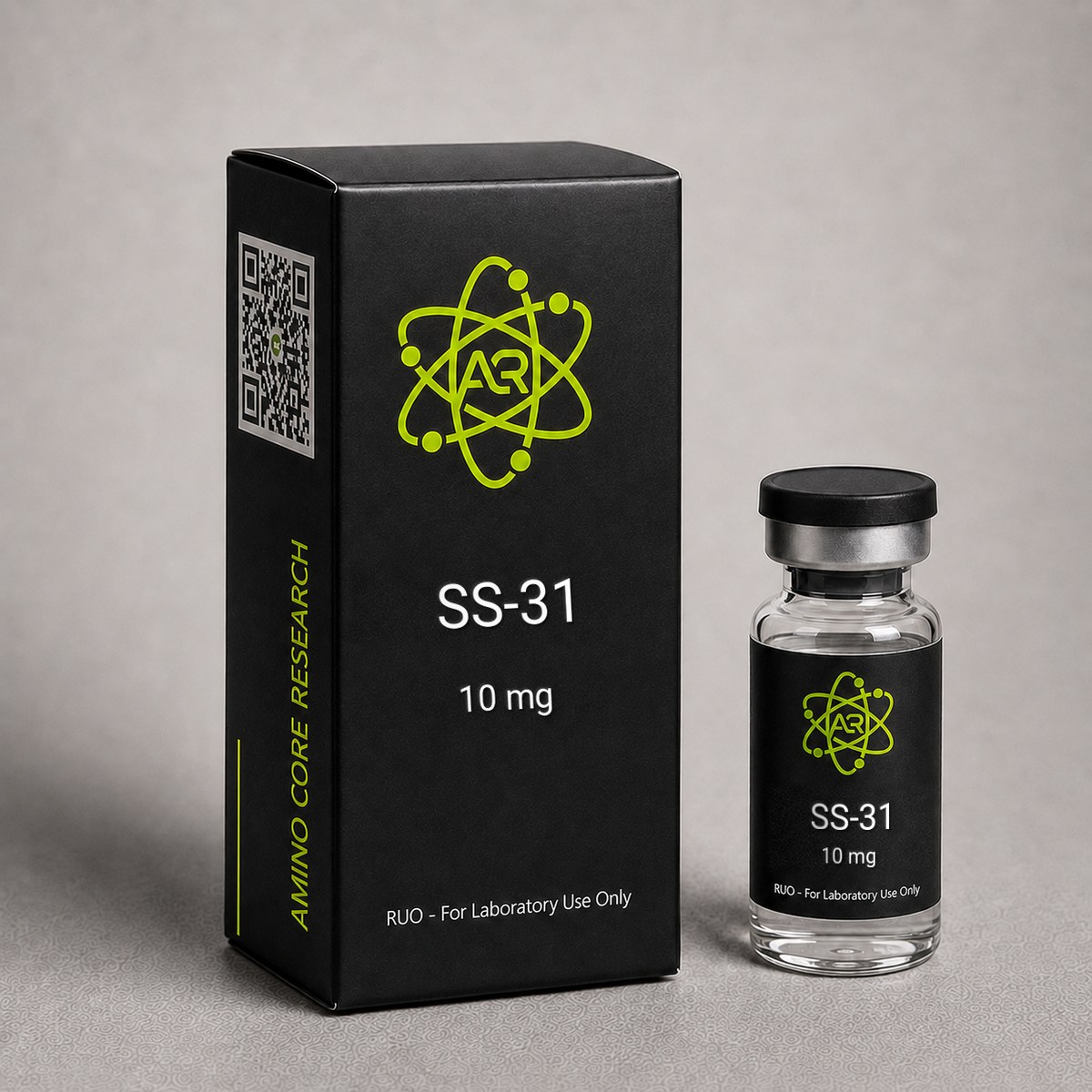
≥99%HPLC Purity
COAIncluded
USAShipped
SS-31 (Elamipretide) Peptide
Mitochondria-targeted tetrapeptide. Studied for cardiolipin interaction and mitochondrial inner membrane stabilization research.
$89.00
In stock — ships next business day
Quick Facts
| SKU | ACR-SS31 |
|---|---|
| CAS Number | 736992-21-5 |
| Molecular Formula | C32H49N5O5 |
| Molecular Weight | 571.77 g/mol |
| Sequence | D-Arg-Dmt-Lys-Phe-NH2 |
| Purity | ≥99% |
| Physical Form | Lyophilized Powder |
| Storage | Store at -20°C |
What is SS-31?
SS-31 (Elamipretide/Bendavia) is a cell-permeable, mitochondria-targeted tetrapeptide with the sequence D-Arg-Dmt-Lys-Phe-NH2. Dmt (2,6-dimethyltyrosine) is a modified aromatic residue that enhances mitochondrial membrane interaction. The alternating aromatic-cationic motif allows the peptide to concentrate >1000-fold within mitochondria.
SS-31 selectively binds cardiolipin, a unique bis-phospholipid found exclusively on the inner mitochondrial membrane. Cardiolipin constitutes approximately 20% of inner membrane lipid content and is essential for cristae structure and electron transport chain complex organization.
For laboratory research use only.
Mechanism of Action: Cardiolipin Targeting
SS-31 (D-Arg-Dmt-Lys-Phe-NH₂) achieves mitochondrial targeting through its alternating aromatic-cationic motif. The mechanism involves multiple levels:
- Mitochondrial accumulation: The cationic charges (+3 at pH 7.4) drive >1,000-fold concentration within mitochondria via the large negative membrane potential (ΔΨm ≈ -180 mV) across the inner membrane
- Cardiolipin binding: Once in the inner membrane, SS-31 binds cardiolipin through electrostatic (Arg, Lys) and hydrophobic (Dmt, Phe) interactions. Cardiolipin is unique to mitochondria and essential for electron transport chain function
- Electron transport optimization: SS-31 binding prevents cytochrome c from converting to a peroxidase (a pathological conformational change), maintaining it as an efficient electron carrier between Complex III and IV
- ROS reduction: By optimizing electron flow, SS-31 reduces electron leakage at Complex I and III — the primary sites of mitochondrial superoxide generation. ROS production decreases without compromising ATP synthesis
This mechanism is fundamentally different from antioxidants (which scavenge ROS after production) — SS-31 prevents excessive ROS generation at the source while improving energy production.
Research & Clinical Studies
SS-31 and Heart Failure Research
Elamipretide advanced to Phase 2/3 clinical trials for heart failure with reduced ejection fraction (HFrEF) and Barth syndrome (genetic cardiomyopathy caused by cardiolipin remodeling defects). In Barth syndrome trials, SS-31 improved 6-minute walk distance and cardiac stroke volume. The mechanism — direct cardiolipin stabilization — addresses the root bioenergetic cause rather than symptoms.
In aged mice, SS-31 treatment restored cardiac diastolic function to young-adult levels, reversed age-related mitochondrial cristae disorganization, and improved cardiac reserve capacity. These findings position SS-31 as a lead compound in cardiac aging research.
[1] Szeto HH et al. Mitochondria-targeted peptide accelerates ATP recovery and reduces ischemic kidney injury. J Am Soc Nephrol. 2011;22(6):1041-1052. PubMed ↗
SS-31 and Aging/Longevity Research
Mitochondrial dysfunction is a central hallmark of biological aging, and SS-31 (elamipretide) has emerged as one of the most extensively characterized small molecules capable of reversing several age-associated mitochondrial deficits in preclinical models. By selectively binding the inner-mitochondrial-membrane phospholipid cardiolipin, SS-31 stabilizes electron transport chain (ETC) supercomplexes, preserves cristae curvature, and reduces electron leak that otherwise accelerates with chronological aging.
Restoration of cristae ultrastructure: Electron microscopy studies in aged murine skeletal muscle and cardiac tissue have demonstrated that the characteristic flattening, swelling, and loss of cristae density observed with age can be reversed after relatively short SS-31 exposure (1–8 weeks in rodent models). Because cristae morphology directly governs the local concentration of ETC complexes and ATP synthase dimers, this structural recovery underlies much of the functional improvement.
ETC complex function and ATP synthesis: Aged mitochondria characteristically exhibit decreased Complex I and Complex IV activity with elevated electron leak and superoxide generation. In preclinical studies, SS-31 treatment normalized Complex I–IV coupled respiration, restored P/O ratios (ATP produced per oxygen consumed), and increased steady-state ATP levels in aged tissue toward values observed in young controls. Importantly, mitochondrial DNA copy number and biogenesis markers (PGC-1α, TFAM) were not consistently elevated, supporting the interpretation that SS-31 optimizes the function of existing mitochondria rather than driving new mitochondrial production.
Skeletal muscle and exercise capacity: Siegel and colleagues reported that an 8-day course of SS-31 in aged mice substantially restored in vivo skeletal muscle energetics measured by ³¹P magnetic resonance spectroscopy, with concurrent improvements in fatigue resistance and treadmill endurance. The rapidity of the response—within days rather than months—distinguishes SS-31 from interventions that act through transcriptional reprogramming or biogenesis.
Cardiac aging: In aged murine hearts, SS-31 reduced diastolic dysfunction, lowered protein carbonyl content (an oxidative damage marker), and improved cardiomyocyte calcium handling. These effects are thought to derive from reduced mitochondrial ROS leak into the cytosol, where ROS otherwise oxidize ryanodine receptors and SERCA.
Renal and neurological aging models: Aged kidney models show preserved tubular mitochondrial function and reduced fibrosis after SS-31 administration. In neurodegeneration-relevant models, SS-31 has been reported to reduce synaptic mitochondrial fragmentation and preserve presynaptic ATP supply, parameters relevant to age-related cognitive decline.
Oxidative damage and senescence markers: Reductions in 4-hydroxynonenal adducts, 8-oxo-dG, and protein carbonyls are consistently reported. Some studies additionally report decreased expression of senescence-associated secretory phenotype (SASP) cytokines (IL-6, TNF-α) in treated aged tissues, suggesting an indirect anti-inflammaging effect downstream of restored redox homeostasis.
Mechanistic interpretation: Because cardiolipin oxidation increases with age and disrupts ETC supercomplex assembly, SS-31's protection of cardiolipin from peroxidation provides a unifying mechanism for these diverse age-reversal phenotypes. The peptide does not act as a free-radical scavenger directly; rather, it prevents the generation of ROS at the source by maintaining efficient electron flow.
For research use only. These findings derive from preclinical animal and cell models and do not constitute clinical claims.
[1] Siegel MP, Kruse SE, Percival JM, et al. Mitochondrial-targeted peptide rapidly improves mitochondrial energetics and skeletal muscle performance in aged mice. Aging Cell. 2013;12(5):763-771. PubMed ↗
SS-31 and Kidney Research
SS-31 demonstrated significant renoprotective effects in ischemia-reperfusion injury (the most common cause of acute kidney injury). In rat models, SS-31 administered before ischemia:
- Accelerated ATP recovery by 3-fold during reperfusion
- Reduced tubular cell necrosis and apoptosis by >50%
- Preserved mitochondrial cristae ultrastructure
- Reduced oxidative stress markers (F2-isoprostanes, protein carbonyls)
- Improved GFR recovery at 24 hours
The renoprotective effect was attributed to preservation of mitochondrial function during the ischemic period — maintaining enough ATP to prevent necrotic cell death while reducing reperfusion-induced ROS burst.
[1] Szeto HH et al. Mitochondria-targeted peptide accelerates ATP recovery and reduces ischemic kidney injury. J Am Soc Nephrol. 2011;22(6):1041-1052. PubMed ↗
SS-31 and Skeletal Muscle Aging
Muscle mitochondrial dysfunction is a primary driver of age-related sarcopenia. SS-31 research in aged mice demonstrates:
- Restored mitochondrial ATP production to young-adult levels within 1 hour of treatment
- Reversed age-related decline in exercise capacity (treadmill endurance +30%)
- Improved muscle force generation (specific force in isolated muscle +15-20%)
- Restored mitochondrial cristae density and organization (electron microscopy)
- Effects were apparent within days, not weeks — suggesting optimization of existing mitochondria rather than requiring new biogenesis
The rapid onset of SS-31 effects is particularly notable. Unlike interventions requiring mitochondrial biogenesis (exercise, PGC-1α activation), SS-31 immediately improves existing mitochondrial function by optimizing the cardiolipin-cytochrome c interaction.
Chemical Properties
| Sequence | D-Arg-Dmt-Lys-Phe-NH₂ (Dmt = 2'6'-dimethyltyrosine) |
|---|---|
| Formula | C₃₂H₄₉N₅O₅ |
| MW | 571.77 g/mol |
| CAS | 736992-21-5 |
| Target | Cardiolipin (inner mitochondrial membrane) |
| Amino Acids | 4 (tetrapeptide with non-natural residues) |
| Key Feature | Concentrates >1000-fold in mitochondria |
| Purity | ≥99% HPLC |
Handling & Reconstitution
Reconstitution solvent selection: SS-31 (elamipretide) is highly water-soluble owing to its net positive charge (+3 at physiological pH from the D-Arg guanidinium, Lys ε-amine, and free N-terminus). Bacteriostatic water for injection (0.9% benzyl alcohol) is the standard reconstitution vehicle for laboratory research applications and maintains a mildly acidic pH that favors peptide stability. Sterile water for injection or 0.9% sodium chloride are acceptable alternatives where a preservative-free vehicle is required.
Reconstitution procedure: Allow the lyophilized vial to equilibrate to room temperature (approximately 20 minutes) before opening to prevent moisture condensation. Wipe the rubber stopper with 70% isopropanol. Using a sterile syringe, slowly inject the calculated volume of reconstitution solvent down the inner glass wall of the vial rather than directly onto the powder cake; this minimizes mechanical disruption and foaming. Gently swirl—do not shake or vortex vigorously—until the powder is fully dissolved (typically within 30–60 seconds given the small tetrapeptide size of 639.8 Da for the acetate salt or 595.7 Da for the free base).
Concentration calculations:
- 5 mg vial + 1.0 mL diluent = 5.0 mg/mL stock
- 5 mg vial + 2.0 mL diluent = 2.5 mg/mL stock
- 10 mg vial + 2.0 mL diluent = 5.0 mg/mL stock
For low-concentration working solutions (below 0.1 mg/mL), prepare immediately before use to minimize surface adsorption losses.
Structural considerations affecting handling: The peptide sequence is H-D-Arg-Dmt-Lys-Phe-NH₂, where Dmt is the non-proteinogenic 2,6-dimethyltyrosine. The D-arginine residue confers resistance to most aminopeptidases, contributing to the relatively long plasma half-life observed in preclinical pharmacokinetic studies. The C-terminal amide further protects against carboxypeptidase action. These features mean SS-31 is more robust than typical L-amino-acid tetrapeptides during routine handling.
Light protection: The 2,6-dimethylated tyrosine ring is the principal photosensitive moiety. Perform reconstitution under reduced ambient light, ideally using amber glass vials or vials wrapped in aluminum foil. Avoid direct exposure to fluorescent or UV laboratory lighting for periods exceeding a few minutes during manipulation. Photo-oxidation generates inactive ortho-quinone and dityrosine-crosslinked products that diminish biological activity.
Surface adsorption: Cationic peptides can adsorb to glass and polypropylene surfaces. For dilute working solutions (<0.01 mg/mL), use low-binding polypropylene tubes (e.g., Eppendorf LoBind) and consider pre-rinsing pipette tips with the diluent. The addition of 0.01–0.1% bovine serum albumin or 0.01% polysorbate-80 can reduce adsorption losses when preparing very dilute solutions for in vitro assays, though this should be omitted when carrier protein interferes with downstream readouts.
Aliquoting: For experiments requiring multiple uses of a single reconstituted vial, prepare single-use aliquots in low-binding tubes immediately after reconstitution and freeze at -20°C. Thaw individual aliquots only as needed. Avoid more than one freeze-thaw cycle per aliquot.
Sterility and contamination: Use aseptic technique throughout. Bacteriostatic water provides limited antimicrobial activity but is not a substitute for sterile handling.
pH and buffer compatibility: SS-31 is compatible with most physiologically relevant buffers (PBS, HBSS, HEPES-buffered media) at pH 4.0–7.4. Avoid alkaline conditions and avoid contact with copper or iron salts that catalyze oxidation of the Dmt residue.
For laboratory research use only. Not for human or veterinary administration.
Storage & Stability
Lyophilized powder: Store at -20°C in a sealed, desiccated container for up to 24 months from the date of synthesis. For long-term archival storage exceeding two years, -80°C is preferred to minimize residual moisture-driven hydrolysis. The lyophilized form is hygroscopic; allow vials to equilibrate to room temperature for 20–30 minutes before opening to prevent atmospheric moisture condensation onto the powder, which can initiate localized hydrolysis of peptide bonds.
Reconstituted solution: After dissolution in bacteriostatic water or sterile saline, store at 2–8°C and use within 14 days. For extended storage of reconstituted material, single-use aliquots can be frozen at -20°C for up to 60 days, although repeated freeze-thaw cycles should be strictly avoided as they promote peptide aggregation and loss of biological activity. Each freeze-thaw cycle can reduce potency by an estimated 5–10% for small tetrapeptides.
Photosensitivity considerations: SS-31 contains a 2,6-dimethyltyrosine (Dmt) residue at position 1, which is the principal chromophore and is sensitive to UV and short-wavelength visible light. Photo-oxidation of the phenolic ring can generate inactive degradation products, including dityrosine crosslinks and ortho-quinone derivatives. All storage and handling should be performed under amber glass, in foil-wrapped vials, or under low-intensity yellow lighting. Laboratory benches with fluorescent overhead lighting are acceptable for brief manipulations but prolonged exposure should be avoided.
Temperature excursions: Short transit exposure (up to 7 days) at ambient temperature (15–25°C) does not appreciably degrade the lyophilized powder, owing to the inherent thermal stability of the four-residue backbone (D-Arg-Dmt-Lys-Phe-NH₂). Brief excursions to 30–35°C during shipping have been reported as acceptable for related Szeto-Schiller peptides without significant loss of mitochondrial-targeting activity, but cumulative thermal load should be minimized.
Container and material compatibility: Use borosilicate glass or low-binding polypropylene vials. Standard polypropylene microcentrifuge tubes can adsorb 1–3% of dissolved peptide via hydrophobic surface interactions; low-protein-binding (Eppendorf LoBind or equivalent) tubes are recommended for stock solutions below 1 mg/mL. Avoid contact with metal cations such as Cu²⁺ and Fe³⁺, which can catalyze oxidation of the Dmt residue.
pH and buffer stability: SS-31 is most stable at slightly acidic pH (4.0–6.0). At alkaline pH (>8.0), the free amino terminus and lysine ε-amine become deprotonated and more susceptible to oxidative and carbamylation reactions. Bacteriostatic water (0.9% benzyl alcohol) typically maintains pH near 5.0–5.5, which is favorable for the cationic peptide.
Visual inspection: Lyophilized SS-31 should appear as a white to off-white amorphous powder or fluffy cake. Reconstituted solutions should be clear and colorless. Any yellow tint, visible particulates, or cloudiness indicates oxidation or aggregation and the material should be discarded. Periodic LC-MS or HPLC purity verification is recommended for stocks held longer than 6 months.
Research use only: This material is intended exclusively for in vitro and preclinical laboratory investigation. It is not for human or veterinary use.
Frequently Asked Questions
What is SS-31?
SS-31 (Elamipretide) is a mitochondria-targeted tetrapeptide that binds cardiolipin on the inner mitochondrial membrane. Its aromatic-cationic structure allows >1000-fold mitochondrial concentration. For research use only.
How does SS-31 target mitochondria?
SS-31 has an alternating aromatic-cationic motif (Arg-Dmt-Lys-Phe) that drives 1000x concentration in mitochondria via the large negative membrane potential (-180mV). Once there, it binds cardiolipin on the inner membrane, optimizing electron transport chain function.
What is cardiolipin and why does it matter?
Cardiolipin is a unique phospholipid found exclusively in the inner mitochondrial membrane. It is essential for Complex III and IV function, cristae formation, and ATP synthase assembly. Cardiolipin oxidation and depletion is a primary driver of mitochondrial dysfunction in aging.
Why not just take antioxidants instead of SS-31?
Fundamentally different approach. Antioxidants scavenge ROS after they are produced (damage already occurring). SS-31 prevents excessive ROS generation at the source by optimizing electron transport. Additionally, SS-31 concentrates 1000x in mitochondria; most oral antioxidants achieve minimal mitochondrial penetration.
What makes SS-31 different from CoQ10 or MitoQ?
CoQ10 is an electron carrier that requires reduction to ubiquinol for activity. MitoQ is a TPP+-conjugated CoQ analog. SS-31 works through a completely different mechanism — cardiolipin binding that optimizes cytochrome c electron transfer. SS-31 also has a different targeting mechanism (aromatic-cationic vs TPP+).
Is SS-31 in clinical trials?
Yes, elamipretide (SS-31) has been tested in Phase 2/3 trials for Barth syndrome (rare mitochondrial cardiomyopathy), heart failure with reduced ejection fraction (HFrEF), age-related macular degeneration, and primary mitochondrial myopathy. Mixed results — positive in Barth syndrome, inconclusive in broader HFrEF.
For laboratory and research use only. This product is not for human or veterinary use. It is not a drug, supplement or food.
This product is not FDA approved for any indication, and is not intended to diagnose, treat, cure, or prevent any disease. All product information is derived from published preclinical research and does not constitute medical advice or claims.