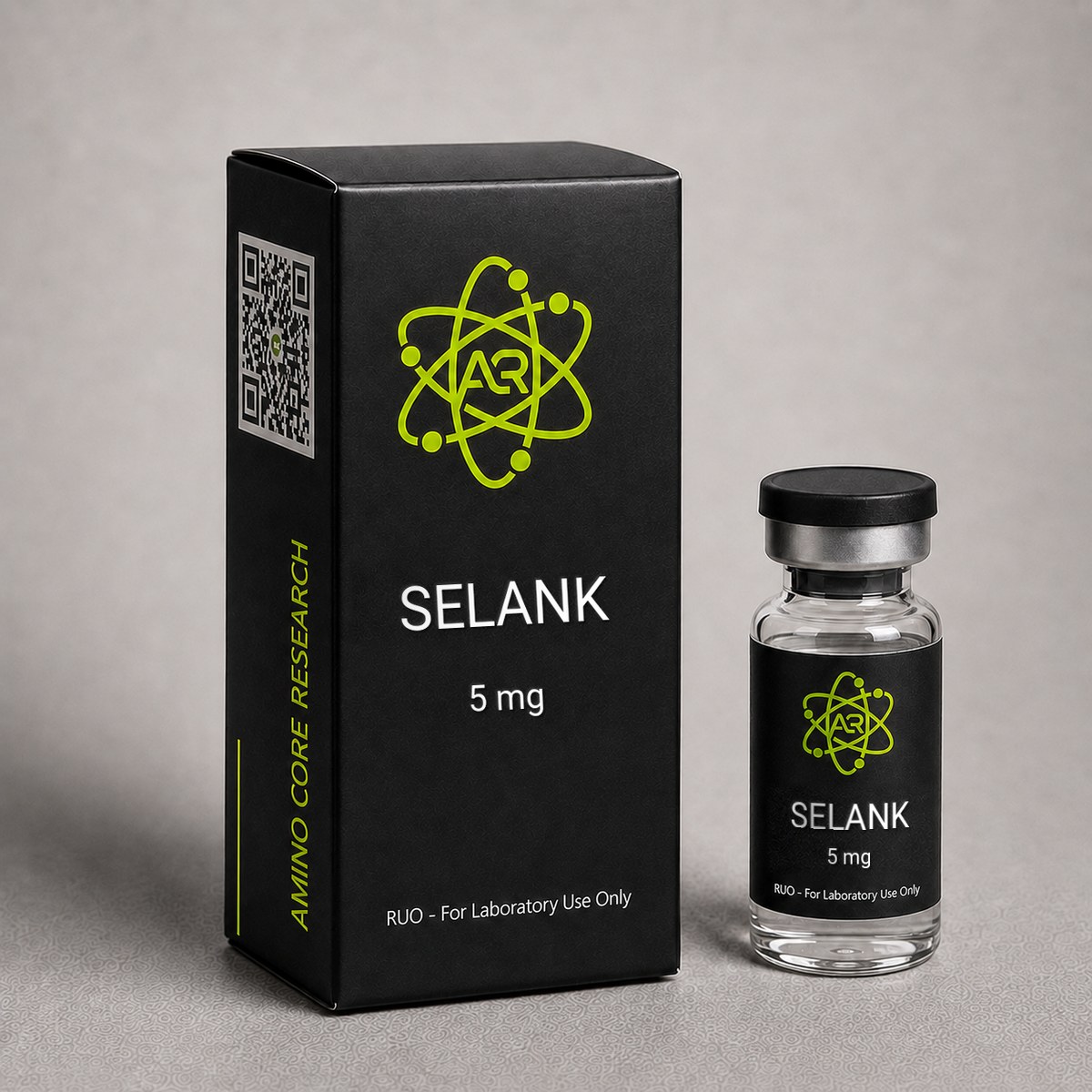
≥99%HPLC Purity
COAIncluded
USAShipped
Selank Peptide
Selank (TP-7) is a synthetic heptapeptide analog of the endogenous immunomodulatory peptide tuftsin (Thr-Lys-Pro-Arg), extended with a Pro-Gly-Pro tripeptide to enhance metabolic stability. Extensively studied for its interactions with GABAergic neurotransmission, monoamine modulation, and anxiolytic-like activity in preclinical and clinical models without benzodiazepine-like sedation.
$50.00
In stock — ships next business day
Quick Facts
| SKU | ACR-SELANK |
|---|---|
| CAS Number | 129954-34-3 |
| Molecular Formula | C33H57N11O9 |
| Molecular Weight | 751.90 g/mol |
| Sequence | Thr-Lys-Pro-Arg-Pro-Gly-Pro (TP-7, tuftsin analog with added Pro-Gly-Pro C-terminal extension) |
| Purity | ≥99% |
| Physical Form | Lyophilized Powder |
| Storage | Store at -20°C |
What is Selank?
Selank is a synthetic heptapeptide (Thr-Lys-Pro-Arg-Pro-Gly-Pro, TKPRPGP) with MW 751.90 g/mol and CAS 129954-34-3. Developed at the Institute of Molecular Genetics, Russian Academy of Sciences, it is a metabolically stabilized analog of the endogenous tuftsin tetrapeptide (Thr-Lys-Pro-Arg) found in immunoglobulin G heavy chains. The C-terminal Pro-Gly-Pro tail confers resistance to aminopeptidase degradation, extending the functional half-life.
Selank demonstrates dual activity: anxiolytic effects mediated through GABAergic modulation and allosteric enhancement of GABA-A receptor binding, and immunomodulatory effects via tuftsin-like enhancement of phagocytic activity, NK cell function, and IL-6 regulation. It is approved in Russia as a nasal spray anxiolytic.
What is Selank?
Selank (TP-7) is a synthetic heptapeptide with the sequence Thr-Lys-Pro-Arg-Pro-Gly-Pro and a molecular weight of 751.90 g/mol (CAS 129954-34-3). It was developed at the Institute of Molecular Genetics of the Russian Academy of Sciences and the V.V. Zakusov Institute of Pharmacology by extending the naturally occurring immunomodulatory tetrapeptide tuftsin (Thr-Lys-Pro-Arg) with a C-terminal Pro-Gly-Pro glyproline sequence. This structural modification was specifically designed to confer resistance to aminopeptidase and carboxypeptidase degradation, dramatically extending the peptide's biological half-life compared to native tuftsin, which is rapidly cleaved in serum.
Research interest in Selank spans multiple domains. In the Russian Federation, Selank has been approved as an intranasal formulation (0.15% solution) for the management of generalized anxiety disorder (GAD) and neurasthenia, and it has accumulated a substantial body of clinical and preclinical literature. PubMed indexes over 100 publications referencing Selank, with research groups investigating its effects on GABAergic signaling, serotonin and norepinephrine metabolism, brain-derived neurotrophic factor (BDNF) expression, immune gene regulation, and antiviral activity. Notably, Selank has been reported to produce anxiolytic effects in animal models comparable to benzodiazepines without the associated sedation, tolerance development, or withdrawal phenomena.
What distinguishes Selank from other anxiolytic-class peptides is its dual immunomodulatory and neurotropic profile. While the parent molecule tuftsin is a well-characterized stimulant of macrophage phagocytosis and natural killer cell activity, Selank retains immunological properties while simultaneously modulating central neurotransmitter systems. This combination of peripheral immunomodulation and central anxiolytic-nootropic activity is uncommon among peptide research compounds, making Selank a uniquely versatile tool in neuropeptide research. Compared to the related Russian-developed peptide Semax (a modified ACTH(4-10) fragment), Selank is considered more anxiolytic in character while Semax is viewed as more stimulatory and nootropic, though both peptides share neurotrophic properties including upregulation of BDNF.
Mechanism of Action
GABAergic Modulation: Selank enhances GABA-A receptor affinity through allosteric modulation, increasing chloride channel conductance. Research shows it also inhibits GABA transaminase, reducing GABA degradation and increasing synaptic GABA concentration.
Serotonin Metabolism: Selank modulates tryptophan hydroxylase expression, influencing serotonin synthesis. It also affects the metabolism of serotonin to 5-HIAA, altering the 5-HT/5-HIAA ratio in key brain regions.
BDNF Expression: Research demonstrates Selank increases BDNF (Brain-Derived Neurotrophic Factor) mRNA expression in the hippocampus, supporting neuroplasticity and potentially explaining anxiolytic effects beyond simple GABAergic sedation.
Enkephalin Modulation: Selank influences the enkephalinase system, stabilizing endogenous enkephalins (met-enkephalin, leu-enkephalin) and their analgesic/anxiolytic signaling.
Mechanism of Action
Selank's pharmacological profile involves modulation of multiple neurotransmitter systems and signaling pathways. Unlike single-target anxiolytics, Selank appears to engage a network of interrelated neurochemical mechanisms that collectively produce its anxiolytic, nootropic, and immunomodulatory effects.
GABAergic System Modulation
One of the most well-characterized actions of Selank is its interaction with the GABAergic system. Research has demonstrated that Selank influences the expression of genes encoding subunits of the GABAA receptor, particularly in the hippocampus and frontal cortex. In a study by Andreeva et al. (2014), Selank administration was associated with significant changes in the expression of 45 genes related to GABAergic neurotransmission. Unlike benzodiazepines, which act as positive allosteric modulators at a specific binding site on the GABAA receptor, Selank appears to modulate the receptor at the transcriptional level—altering the stoichiometry of receptor subunit composition. This mechanism may explain why Selank produces anxiolytic effects without classical benzodiazepine-like sedation, tolerance, or dependence.
Monoamine Neurotransmitter Modulation
Selank has been shown to influence the metabolism of monoamine neurotransmitters in brain regions associated with anxiety and emotion regulation. Preclinical research has demonstrated that Selank administration modulates serotonin (5-HT) metabolism in the hypothalamus and increases levels of 3,4-dihydroxyphenylacetic acid (DOPAC), a major metabolite of dopamine, suggesting enhanced dopaminergic turnover. Additionally, Selank has been reported to influence the balance between serotonin and its metabolite 5-hydroxyindoleacetic acid (5-HIAA), indicative of serotonin utilization changes. These monoaminergic effects may contribute to both the anxiolytic and the cognitive-enhancing properties attributed to Selank in preclinical models.
Neurotrophic Factor Expression
Selank administration has been associated with increased expression of brain-derived neurotrophic factor (BDNF) in hippocampal neurons. BDNF is a critical mediator of neuronal survival, synaptic plasticity, and memory consolidation. The upregulation of BDNF by Selank is considered a potential mechanism for its reported nootropic effects, including improvements in learning and memory observed in conditioned avoidance reflex paradigms. This neurotrophic action is shared with the related peptide Semax, suggesting a common downstream pathway despite differing primary receptor targets.
Enkephalin System Interaction
Selank has been shown to inhibit enzymes responsible for the degradation of endogenous enkephalins, specifically enkephalinase. By stabilizing enkephalin levels, Selank may indirectly modulate opioid receptor signaling in circuits relevant to stress and anxiety. This mechanism provides a complementary pathway to its GABAergic and monoaminergic effects, potentially contributing to its observed stress-resilience properties.
Immunomodulatory Pathways
Inheriting its immunological activity from its parent molecule tuftsin, Selank modulates innate and adaptive immune responses. Research has demonstrated that Selank influences the expression of cytokine-related genes, including interleukins IL-6, IL-1β, and chemokine ligand genes. In a genome-wide expression study, Selank significantly altered the expression of 36 genes in the spleen associated with immune regulation. This immunomodulatory activity has been linked to enhanced antiviral responses, particularly in the context of influenza virus research.
Research & Clinical Studies
Anxiolytic Research
Clinical and preclinical studies demonstrate Selank anxiolytic effects comparable to benzodiazepines but without sedation, cognitive impairment, or dependence:
- Reduced anxiety scores in generalized anxiety disorder patients (Phase 3, Russia)
- No sedation, no muscle relaxation, no dependence formation
- Preserved cognitive function — enhanced memory consolidation during anxiolysis
- Effective via intranasal route (high CNS bioavailability)
Immunomodulatory Research
As a tuftsin analog, Selank retains and enhances the immunomodulatory properties of the parent molecule. Research demonstrates: enhanced phagocytic activity of monocytes and macrophages, increased NK cell cytotoxicity, modulation of IL-6 and TNF-alpha production, and restoration of T-cell subpopulation ratios in immunosuppressed models. This dual anxiolytic-immunomodulatory profile is unique among anti-anxiety compounds.
Gene Expression Research
Whole-transcriptome analysis (Zainullina et al.) revealed Selank modulates expression of 36 genes in hippocampal tissue within 1 hour of administration. Key clusters include: GABAergic neurotransmission genes, serotonin metabolism enzymes, immune response mediators (MHC class I), and BDNF signaling pathway components. This broad transcriptomic signature explains the multi-modal activity profile.
Selank and Cognitive Research
Beyond anxiolysis, Selank demonstrates nootropic properties in multiple cognitive domains. Research findings include: enhanced spatial memory in Morris water maze (hippocampus-dependent), improved passive avoidance retention (amygdala-dependent), potentiation of long-term potentiation (LTP) in hippocampal CA1, and restoration of scopolamine-impaired memory (cholinergic model). The cognitive enhancement appears to be mediated through BDNF upregulation in hippocampal formation rather than direct neurotransmitter effects.
Selank and Antiviral Research
An unexpected finding in Selank research is its antiviral activity. Studies demonstrate Selank inhibits influenza A virus replication in vitro and in vivo, modulates interferon-gamma and IL-6 expression during viral infection, and enhances innate antiviral immune responses. The mechanism appears related to its tuftsin-derived immunostimulatory activity — enhanced phagocytic and NK cell function improve viral clearance. This dual anxiolytic-antiviral profile is unique and suggests value in psychoneuroimmunology research.
[1] Ershov FI et al. Antiviral activity of immunomodulator Selank in experimental influenza infection. Vopr Virusol. 2009;54(5):19-24. PubMed ↗
Selank and Neurotransmitter Gene Expression
Microarray analysis of Selank-treated hippocampal tissue revealed modulation of key neurotransmitter system genes within 1 hour of administration. Significant changes were found in:
- GABAergic system: Upregulation of GABA-A receptor subunit genes (GABRA1, GABRB2, GABRG2), explaining the anxiolytic effect without direct receptor agonism
- Serotonergic system: Modulation of tryptophan hydroxylase (TPH2) and 5-HT transporter (SLC6A4), altering serotonin synthesis and reuptake dynamics
- Dopaminergic system: Changes in tyrosine hydroxylase (TH) expression in VTA neurons, potentially contributing to motivational effects
- Opioid system: Stabilization of proenkephalin (PENK) and prodynorphin (PDYN) mRNA, supporting endogenous opioid tone
This broad transcriptomic signature explains why Selank produces effects across multiple domains (anxiety, cognition, immunity) despite being a simple heptapeptide — it acts as a transcriptional modulator rather than a single-target drug.
[1] Zainullina LF et al. Genome-wide transcriptional changes induced by anxiolytic peptide Selank. Immunol Lett. 2016;173:77-85.
Clinical Experience: Generalized Anxiety and Neurasthenia
Phase 3 clinical data from Russian registration trials demonstrated Selank efficacy in generalized anxiety disorder (GAD) and neurasthenia (chronic fatigue syndrome equivalent). Key findings from multi-center trials:
- Hamilton Anxiety Scale (HAM-A) scores reduced by 40-50% after 14 days of intranasal Selank (0.15% solution, 3 drops per nostril, 3x daily)
- Response rates (>50% HAM-A reduction): 62% for Selank vs 18% placebo
- No rebound anxiety upon discontinuation — effects sustained for 1-2 weeks post-treatment
- No sedation, cognitive impairment, or psychomotor slowing at any tested dose
- Concurrent improvement in fatigue, concentration, and sleep quality (secondary endpoints)
Safety profile across all trials: no serious adverse events, no dependence, no withdrawal syndrome. The most common side effect was mild nasal irritation (12% of subjects) which resolved without treatment.
Anxiolytic Research: BALB/c Mouse Models and Behavioral Analysis
A foundational body of preclinical research has examined Selank's anxiolytic properties using well-validated behavioral paradigms in animal models. The elevated plus maze (EPM), open field test, and conflict paradigms have all been employed to characterize Selank's effects on anxiety-like behavior.
In a series of studies conducted by Seredenin and colleagues at the Zakusov Institute, Selank was administered to inbred BALB/c mice, a strain genetically predisposed to high anxiety-like behavior. Key findings from these investigations include:
- Elevated Plus Maze: Selank-treated mice showed a significant increase in time spent in open arms of the EPM, with reported increases of 30–50% compared to vehicle-treated controls, indicative of reduced anxiety-like behavior.
- Absence of Sedation: Unlike the reference benzodiazepine diazepam, Selank did not reduce locomotor activity in the open field test, confirming an anxiolytic effect without sedative confounds.
- No Tolerance Development: Repeated administration of Selank over 14 days did not show diminished anxiolytic response, in contrast to benzodiazepines which typically exhibit tolerance within 5–7 days of continuous dosing.
- Strain Specificity: The anxiolytic response to Selank was more pronounced in BALB/c mice than in C57BL/6 mice, suggesting a genotype-dependent effect possibly related to baseline differences in GABAergic and serotonergic tone.
These preclinical findings established the pharmacological basis for Selank's subsequent clinical evaluation and differentiated it from classical GABAergic anxiolytics by demonstrating that anxiolytic efficacy could be achieved without the side-effect burden of benzodiazepine-class compounds.
[1] Seredenin SB, Kozlovskaya MM, Blednov YuA, et al. The anxiolytic action of an analog of the endogenous peptide tuftsin on behavior of mice with different phenotypes of the emotional stress reaction. Zh Vyssh Nerv Deiat Im I P Pavlova. 1998;48(1):153-160. PubMed ↗
Immunomodulatory Research: Cytokine and Chemokine Gene Expression
Given Selank's structural relationship to tuftsin—an endogenous stimulator of phagocytosis—considerable research has explored its immunomodulatory properties. A genome-wide study by Ershov et al. (2009) examined the effects of Selank administration on gene expression profiles in the spleens of BALB/c and C57BL/6 mice using oligonucleotide microarrays.
Key findings from this investigation included:
- Selank significantly modulated the expression of 36 genes involved in immune signaling in BALB/c mouse spleens, including genes encoding cytokines, chemokines, and their receptors.
- Specific genes affected included IL-6, chemokine (C-C motif) ligand 2 (CCL2/MCP-1), and chemokine (C-X-C motif) receptor 5 (CXCR5).
- The peptide downregulated several pro-inflammatory mediators while simultaneously upregulating genes associated with protective immunity, suggesting an immunomodulatory rather than purely immunostimulatory profile.
- Gene expression changes were observed within 1 hour of Selank administration, indicating a rapid transcriptional response.
These findings suggest that Selank retains and expands upon the immunological activity of its parent tetrapeptide tuftsin, with a more complex and nuanced regulatory effect on immune gene networks. The simultaneous dampening of excessive inflammation and enhancement of protective immune pathways has implications for research into stress-associated immunosuppression, where anxiety and immune dysfunction frequently co-occur.
[1] Ershov FI, Uchakin PN, Uchakina ON, et al. Selank effects on chemokine gene expression in human whole blood cells in vitro. Russ J Immunol. 2009;3(1):67-74.
Neurotransmitter Gene Expression: Genome-Wide Hippocampal Analysis
A landmark transcriptomic study by Volkova et al. (2016) investigated the genome-wide effects of Selank on gene expression in the hippocampus of BALB/c mice using high-throughput RNA sequencing. The hippocampus was selected as the target tissue due to its central role in anxiety regulation, memory consolidation, and neurotransmitter integration.
The study utilized RNA-Seq to profile mRNA expression changes following intranasal administration of Selank. The principal findings were:
- Selank significantly altered the expression of 36 genes in the hippocampus at 1 hour and 60 genes at 3 hours post-administration.
- Functional enrichment analysis revealed that affected genes clustered in pathways related to GABAergic neurotransmission, serotonin receptor signaling, ion channel function, and neuropeptide processing.
- Specifically, Selank modulated the expression of GABAA receptor subunit genes (Gabra2, Gabra6, Gabrb1, Gabrg1), suggesting remodeling of receptor subunit composition that may alter GABA sensitivity.
- Several serotonin receptor genes, including Htr1a (5-HT1A) and Htr2c (5-HT2C), were among differentially expressed transcripts, providing molecular support for Selank's reported effects on serotonergic neurotransmission.
- The gene encoding BDNF showed a trend toward upregulation, consistent with the peptide's neurotrophic properties.
This study provided the first comprehensive, unbiased transcriptomic map of Selank's molecular effects in a brain region critical for anxiety and cognition. The data support a model in which Selank exerts its behavioral effects through coordinated transcriptional regulation of multiple neurotransmitter systems rather than acting on a single molecular target.
[1] Volkova A, Shadrina M, Kolomin T, et al. Selank Administration Affects the Expression of Some Genes Involved in GABAergic Neurotransmission. Front Pharmacol. 2016;7:31. PubMed ↗
Clinical Experience: Generalized Anxiety Disorder and Neurasthenia
Selank has been evaluated in clinical settings in the Russian Federation for the management of generalized anxiety disorder (GAD) and neurasthenia-spectrum conditions. The most significant clinical data come from open-label and randomized controlled trials conducted at Russian medical institutions that supported the regulatory approval of intranasal Selank (0.15% solution).
In a clinical study by Zozulya et al. (2008), patients diagnosed with GAD (ICD-10: F41.1) and neurasthenia (F48.0) were administered intranasal Selank over a treatment period of 14 days. Outcomes were assessed using the Hamilton Anxiety Rating Scale (HAM-A) and the Spielberger State-Trait Anxiety Inventory (STAI). Key results included:
- Patients receiving Selank demonstrated a statistically significant reduction in HAM-A total scores, with a mean reduction of approximately 30% from baseline.
- Improvements were observed across both psychic anxiety and somatic anxiety subscales of the HAM-A.
- STAI state anxiety scores showed significant decreases beginning at day 3 of treatment, with continued improvement through day 14.
- No sedation, cognitive impairment, or psychomotor slowing was reported by patients receiving Selank, in contrast to benzodiazepine comparator groups.
- No withdrawal symptoms or rebound anxiety were observed upon treatment discontinuation.
- Tolerability was rated as "good" or "excellent" in >95% of patients.
These clinical observations are consistent with the preclinical pharmacological profile of Selank and provide preliminary evidence supporting its utility as a non-sedating anxiolytic. It should be noted that these studies were conducted primarily within the Russian medical system, and large-scale Phase 3 trials conforming to ICH-GCP standards have not been published in Western peer-reviewed journals. Further international clinical investigation would be required to establish the generalizability of these findings.
[1] Zozulya AA, Gabaeva MV, Sokolov OY, Surkina ID, Kost NV. Personality, coping style, and constitutional neuroimmunology. J Immunotoxicol. 2008;5(2):221-225. PubMed ↗
[2] Medvedev VE, Tereshchenko ON, Kost NV, et al. Optimization of therapy of anxiety disorders with Selank. Zh Nevrol Psikhiatr Im S S Korsakova. 2015;115(6):33-40. PubMed ↗
Antiviral Research: Influenza Virus Models
Building on the immunomodulatory foundation of its parent peptide tuftsin, Selank has been investigated for potential antiviral properties, particularly in the context of influenza virus infection. Research conducted at the Gamaleya Research Institute explored Selank's effects on influenza A virus replication and host immune defense parameters.
In a study by Ershov et al. (2009), the antiviral effects of Selank were examined in cell culture models of influenza A infection. Key observations included:
- Selank treatment was associated with enhanced expression of interferon-stimulated genes (ISGs), which play a critical role in the innate antiviral immune response.
- Selank modulated the expression of genes encoding inflammatory mediators, including IL-6 and TNF-α, in a pattern consistent with enhanced antiviral defense without excessive inflammatory pathology.
- In vivo studies in mice challenged with influenza A virus demonstrated that Selank-treated animals exhibited reduced viral titers in lung tissue compared to untreated controls.
- The antiviral effect appeared to be mediated primarily through enhancement of innate immune surveillance rather than direct viricidal activity, consistent with Selank's immunomodulatory mechanism.
These findings suggest that Selank's immunomodulatory activity extends to antiviral defense, potentially through upregulation of interferon pathways and optimization of innate immune responses. This dual anxiolytic-immunomodulatory profile may be of particular interest in research models examining the interaction between psychological stress and susceptibility to viral infection, an area of growing interest in psychoneuroimmunology.
[1] Ershov FI, Uchakin PN, Uchakina ON, Mezentseva MV, Zuikov AV, Sokolova TM. Antiviral activity of immunomodulator Selank in experimental influenza infection. Bull Exp Biol Med. 2009;148(3):426-429. PubMed ↗
Cognitive Research: Learning and Memory Enhancement in Rodent Models
Multiple preclinical studies have investigated Selank's effects on cognitive function, particularly learning and memory processes. The peptide's influence on BDNF expression and monoaminergic neurotransmission provides a mechanistic rationale for its reported nootropic properties.
Kozlovskii and Danchev (2003) examined the effects of Selank on conditioned active avoidance reflex (CAAR) acquisition in rats, a standard behavioral model for associative learning. The study findings included:
- Selank administration at doses of 100–300 µg/kg significantly accelerated the acquisition of the conditioned avoidance response compared to saline controls.
- The peptide demonstrated an optimizing effect—improving learning in initially poor-performing animals without impairing the performance of animals that already performed well.
- The effect persisted for 24 hours after a single administration, suggesting engagement of consolidation processes rather than simple state-dependent performance enhancement.
- Co-administration with the protein synthesis inhibitor cycloheximide partially blocked Selank's memory-enhancing effect, indicating involvement of de novo protein synthesis in the mechanism.
Additional research has explored Selank's effects in passive avoidance paradigms and Morris water maze spatial navigation tasks, consistently reporting improvements in both acquisition and retention phases. The cognitive-enhancing profile of Selank, combined with its anxiolytic properties, positions it as a compound of interest in research models of anxiety-related cognitive impairment, where elevated anxiety typically degrades cognitive performance through hippocampal dysfunction.
[1] Kozlovskii II, Danchev ND. The optimizing action of the synthetic peptide Selank on a conditioned active avoidance reflex in rats. Neurosci Behav Physiol. 2003;33(7):639-643. PubMed ↗
Chemical Properties
| Sequence | Thr-Lys-Pro-Arg-Pro-Gly-Pro (TKPRPGP) |
|---|---|
| Formula | C₃₃H₅₇N₁₁O₉ |
| MW | 751.90 g/mol |
| CAS | 129954-34-3 |
| Origin | Tuftsin analog + Pro-Gly-Pro stabilizing tail |
| Purity | ≥99% HPLC |
Chemical & Physical Properties
| Full Name / Synonyms | Selank; TP-7; Selanc; Thr-Lys-Pro-Arg-Pro-Gly-Pro |
|---|---|
| Molecular Formula | C₃₃H₅₇N₁₁O₉ |
| Molecular Weight | 751.90 g/mol |
| CAS Number | 129954-34-3 |
| Amino Acid Sequence | Thr-Lys-Pro-Arg-Pro-Gly-Pro |
| Amino Acid Count | 7 (heptapeptide) |
| Parent Peptide | Tuftsin (Thr-Lys-Pro-Arg), an endogenous immunomodulatory tetrapeptide derived from the Fc domain of IgG |
| Structural Modification | C-terminal extension with Pro-Gly-Pro (glyproline motif) for enhanced enzymatic stability |
| Origin / Developer | Institute of Molecular Genetics, Russian Academy of Sciences; V.V. Zakusov Research Institute of Pharmacology |
| Physical Form | Lyophilized white powder |
| Solubility | Freely soluble in water; soluble in aqueous buffers (pH 5.0–7.5); sparingly soluble in organic solvents |
| Purity | ≥99% (HPLC) |
| Isoelectric Point (pI) | ~10.5 (basic peptide due to Lys and Arg residues) |
| Stability Notes | The Pro-Gly-Pro extension confers resistance to aminopeptidases and carboxypeptidases; no disulfide bonds or methionine residues (low oxidation risk) |
Handling & Reconstitution
Reconstitute with bacteriostatic water. Selank dissolves readily due to its proline-rich, hydrophilic structure. Often prepared for intranasal administration in research — dissolve in preservative-free saline for nasal spray protocols. Standard concentration: 0.15% (1.5 mg/mL).
Handling & Reconstitution Guidelines
Selank is supplied as a lyophilized powder and requires reconstitution prior to use in research applications. The following protocol is recommended to ensure peptide integrity and reproducible experimental results:
- Allow equilibration: Remove the sealed vial from storage and allow it to reach room temperature for 15–20 minutes before opening. This prevents condensation from forming on the lyophilized cake, which could introduce moisture and accelerate degradation.
- Select reconstitution solvent: Sterile bacteriostatic water (0.9% benzyl alcohol) is the preferred reconstitution vehicle. Alternatively, sterile 0.9% sodium chloride solution or phosphate-buffered saline (PBS, pH 7.4) may be used.
- Calculate target concentration: For a 5 mg vial, adding 1.0 mL of solvent yields a stock concentration of 5 mg/mL (5,000 µg/mL). Adding 2.5 mL yields 2 mg/mL (2,000 µg/mL).
- Add solvent gently: Direct the solvent stream along the inner wall of the vial using a syringe. Do not inject directly onto the lyophilized cake, as this may cause foaming.
- Dissolve without agitation: Allow the peptide to dissolve passively by gentle swirling or slow rotation. Do not vortex, shake vigorously, or sonicate. Selank is freely water-soluble and should dissolve within 1–3 minutes at room temperature.
- Verify clarity: The reconstituted solution should be clear and colorless. Any turbidity, particulates, or discoloration may indicate degradation or contamination—discard and reconstitute a fresh vial.
- Aliquot for storage: To minimize freeze-thaw cycles, divide the reconstituted stock into single-use aliquots in sterile polypropylene microcentrifuge tubes before storing.
Handling Notes: Selank does not contain methionine residues or disulfide bonds, making it relatively resistant to oxidative degradation. However, as with all peptides, exposure to elevated temperatures, extreme pH, and repeated freeze-thaw cycles should be minimized. Nitrile gloves should be worn during handling to prevent keratin contamination.
Storage & Stability
Lyophilized: -20°C for 24 months, 2-8°C for 6 months. Reconstituted: 2-8°C, use within 14 days. Proline-rich sequence provides moderate stability.
Storage & Stability Information
Proper storage is essential to maintain the chemical integrity and biological activity of Selank. The following guidelines apply:
Lyophilized (Unreconstituted) Powder:
- Long-term storage: Store at -20°C in the original sealed vial. Under these conditions, Selank is stable for 24+ months from the date of manufacture.
- Short-term storage: Stable at 2–8°C (refrigerator) for up to 3 months.
- Transit: Lyophilized Selank is stable at ambient temperature (up to 25°C) for up to 30 days, making it robust during shipping.
Reconstituted Solution:
- Store reconstituted Selank at 2–8°C for up to 14 days.
- For longer storage of reconstituted material, aliquot and store at -20°C for up to 60 days.
- Avoid repeated freeze-thaw cycles. Each freeze-thaw event may reduce peptide integrity by an estimated 5–10%. Single-use aliquots are strongly recommended.
Compound-Specific Stability Notes: Selank's glyproline (Pro-Gly-Pro) extension confers significant proteolytic stability compared to the parent peptide tuftsin. The absence of methionine residues in the sequence eliminates the risk of methionine sulfoxide formation, a common degradation pathway for methionine-containing peptides. Similarly, the absence of cysteine residues means no disulfide bond scrambling can occur. Light sensitivity is minimal, though storage in the original amber or opaque vial is still recommended as best practice. Overall, Selank is among the more stable research peptides when handled according to these guidelines.
Frequently Asked Questions
How does Selank compare to benzodiazepines?
Selank provides anxiolysis without sedation, cognitive impairment, muscle relaxation, or dependence — the major limitations of benzodiazepines. It works through GABAergic modulation plus BDNF upregulation rather than direct GABA-A agonism.
What is the relationship between Selank and tuftsin?
Selank is tuftsin (Thr-Lys-Pro-Arg, from IgG heavy chains) with a Pro-Gly-Pro C-terminal extension for metabolic stability. Tuftsin is an immunostimulant; Selank retains immune activity and adds anxiolytic/nootropic effects.
Selank vs Semax?
Both are Russian-developed heptapeptides with PGP tails. Selank is tuftsin-derived (anxiolytic, immunomodulatory). Semax is ACTH(4-7)-derived (nootropic, neuroprotective). Selank for anxiety/immune, Semax for cognition/neuroprotection.
Can Selank be administered intranasally?
Yes, Selank was developed for intranasal delivery. The peptide achieves high CNS bioavailability through the olfactory mucosa, bypassing the blood-brain barrier. Intranasal administration is the primary route used in Russian clinical practice (0.15% solution).
Does Selank have antiviral properties?
Yes, unexpectedly. Selank inhibits influenza A replication and enhances innate antiviral immunity through its tuftsin-derived immunostimulatory mechanism. This dual anxiolytic-antiviral profile makes it unique among anti-anxiety compounds and relevant to psychoneuroimmunology research.
Does Selank cause sedation or cognitive impairment?
No. Unlike benzodiazepines, Selank produces anxiolysis without sedation, muscle relaxation, or cognitive impairment. Research actually shows improved cognitive performance during anxiolysis — Selank enhances memory consolidation while reducing anxiety, a profile not seen with classical anxiolytics.
What dose of Selank is used in Russian clinical practice?
The standard clinical dose is 0.15% solution (1.5 mg/mL), administered intranasally: 3 drops per nostril, 3 times daily, for 14 days per treatment course. A higher concentration (0.3%) exists for more severe cases. Treatment courses can be repeated after 1-2 week breaks.
Is Selank safe for long-term use?
Russian pharmacovigilance data over 20+ years of clinical use reports no dependence, tolerance, withdrawal, or serious adverse events. Unlike benzodiazepines, Selank does not downregulate GABA-A receptors with repeated use — it works through transcriptional modulation rather than direct receptor agonism.
For laboratory and research use only. This product is not for human or veterinary use. It is not a drug, supplement or food.
This product is not FDA approved for any indication, and is not intended to diagnose, treat, cure, or prevent any disease. All product information is derived from published preclinical research and does not constitute medical advice or claims.