≥99%HPLC Purity
COAIncluded
USAShipped
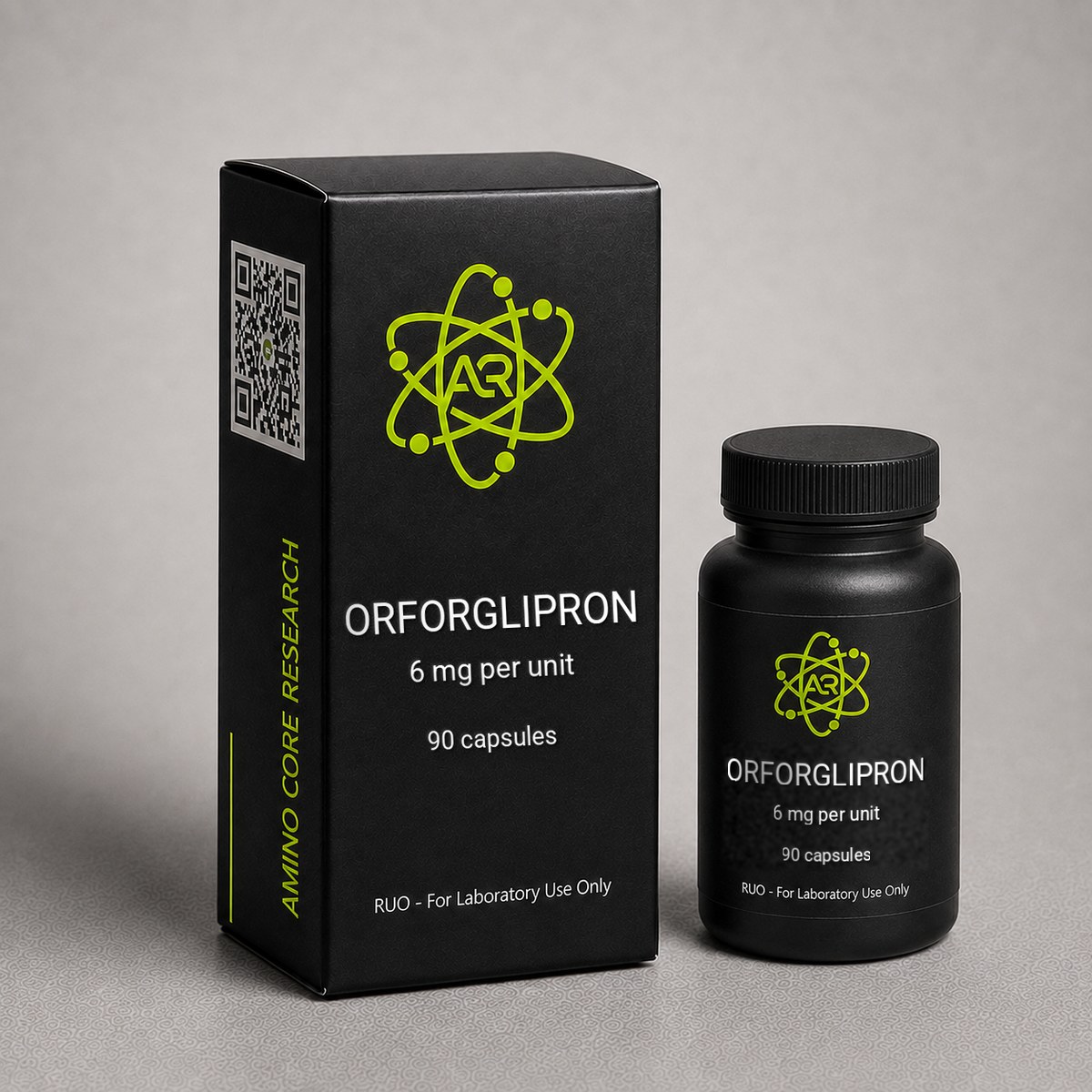
Orforglipron Capsules
Oral capsule presentation of orforglipron at 6 mg per capsule, 90 capsules per bottle. A non-peptide small-molecule GLP-1 receptor agonist — the property that makes an oral format viable.
$249.00
In stock — ships next business day
Quick Facts
| SKU | ACR-ORFO-C90 |
|---|---|
| CAS Number | 2212020-52-3 |
| Molecular Formula | C37H45F2N9O4 |
| Molecular Weight | 717.82 g/mol |
| Sequence | Non-peptide small molecule (no amino acid sequence) |
| Purity | ≥99% |
| Physical Form | Capsule |
| Storage | Store sealed at room temperature, away from light and humidity |
What is Orforglipron?
Orforglipron (development code LY3502970; also referred to in the literature as OWL833) is a non-peptide, orally bioavailable small-molecule agonist of the glucagon-like peptide-1 receptor (GLP-1R). It was discovered at Chugai Pharmaceutical and is being developed by Eli Lilly and Company. The molecule has an empirical formula of C37H45F2N9O4, a molecular weight of approximately 717.82 g/mol, and CAS registry number 2212020-52-3. Unlike the peptide GLP-1R agonists (semaglutide, liraglutide, exenatide) that dominated the class historically, orforglipron does not contain an amino acid backbone and is not degraded by dipeptidyl peptidase-4 (DPP-4) or gastrointestinal proteases — the property that makes an oral capsule format practical without permeation enhancers such as the SNAC excipient required for oral semaglutide.
The compound entered clinical development around 2019 and has since been studied in phase 1 and phase 2 trials for type 2 diabetes and obesity. Phase 2 data published in The Lancet and The New England Journal of Medicine in 2023 reported dose-dependent reductions in body weight and HbA1c over 26 to 36 weeks. As of 2024–2025, orforglipron is in phase 3 development (the ACHIEVE and ATTAIN programs) covering type 2 diabetes and obesity indications. If approved, it would be the first non-peptide oral GLP-1R agonist, distinct from oral semaglutide, which is a peptide reformulated with an absorption enhancer.
The differentiator most cited in the medicinal-chemistry literature is biased agonism: orforglipron is reported to preferentially activate Gαs-mediated cAMP signaling at the GLP-1R with reduced β-arrestin recruitment relative to the endogenous GLP-1(7-36) peptide. Whether this pharmacology translates into a distinct clinical profile — for example, differences in tolerability or receptor desensitization — remains an open question that phase 3 readouts and mechanistic follow-up work will need to resolve. It is a proposed advantage, not an established one.
For research use, orforglipron is of interest because it allows investigators to study GLP-1R activation in models where oral administration, formulation with food, and small-molecule pharmacokinetics are relevant experimental variables — parameters that peptide agonists cannot address.
Mechanism of Action
Orforglipron is a small-molecule agonist that binds the glucagon-like peptide-1 receptor (GLP-1R), a class B G-protein-coupled receptor expressed on pancreatic β-cells, enteric and central neurons, and other tissues. Its mechanism differs from peptide GLP-1R agonists in binding mode, signaling bias, and pharmacokinetics.
Binding site and structural pharmacology. Cryo-EM structures of the orforglipron–GLP-1R–Gs complex reported by Kawai and colleagues (2020) show that orforglipron occupies a pocket that overlaps only partially with the orthosteric peptide-binding site. The small molecule engages the transmembrane bundle and extracellular loop 2 (ECL2) rather than making the extensive extracellular domain (ECD) contacts characteristic of the native GLP-1 peptide. This distinct engagement is the structural basis for the reported signaling bias.
Downstream signaling. Activation of GLP-1R by orforglipron couples to Gαs, stimulating adenylate cyclase and raising intracellular cAMP. In pancreatic β-cells, cAMP elevation potentiates glucose-stimulated insulin secretion via PKA- and Epac2-dependent pathways. Suppression of glucagon secretion from α-cells and slowing of gastric emptying are additional downstream effects consistent with GLP-1R agonism, though the relative magnitude of each with orforglipron versus peptide agonists has not been fully characterized in humans.
Biased signaling. Preclinical assays report that orforglipron produces cAMP accumulation comparable to native GLP-1 while recruiting β-arrestin less efficiently. Reduced β-arrestin coupling has been proposed to limit receptor internalization and desensitization, which some investigators hypothesize could sustain signaling at the plasma membrane. It should be emphasized that whether this in vitro bias translates into a clinically meaningful difference in efficacy, tolerability, or tachyphylaxis has not been demonstrated — the phase 2 clinical profile so far resembles that of peptide GLP-1R agonists in both benefits and gastrointestinal adverse events.
Pharmacokinetics relevant to oral dosing. Orforglipron is not a peptide and is not subject to proteolytic degradation in the gut. Reported human pharmacokinetics show absorption compatible with once-daily oral dosing and a half-life sufficient to sustain plasma exposure over 24 hours. Unlike oral semaglutide, orforglipron does not require the SNAC absorption enhancer and, in the phase 2 studies, was administered without the strict fasting-and-water restrictions imposed by that formulation. Food effects on absorption have been reported and are under further characterization in phase 3.
Comparison to related compounds. Peptide agonists (semaglutide, liraglutide) require subcutaneous injection or, in the case of oral semaglutide, a specialized formulation and fasted dosing. Dual and triple agonists (tirzepatide, retatrutide) add GIP and/or glucagon receptor activity. Orforglipron is a selective GLP-1R agonist — it does not engage GIP or glucagon receptors — so mechanistic comparisons to multi-receptor agonists should be interpreted with that selectivity in mind.
Research & Clinical Studies
Phase 2 Trial in Type 2 Diabetes (Frías et al., Lancet 2023)
Frías and colleagues reported a phase 2, randomised, double-blind, placebo- and active-controlled, dose-response study of orforglipron in adults with type 2 diabetes, published in The Lancet in 2023.
Study design.
- Population: 383 adults with type 2 diabetes inadequately controlled with diet and exercise or metformin monotherapy.
- Duration: 26 weeks of treatment.
- Arms: Six orforglipron dose groups (3 mg, 12 mg, 24 mg, 36 mg, and 45 mg with two titration schedules), placebo, and open-label dulaglutide 1.5 mg once weekly as an active reference.
- Primary endpoint: Change in HbA1c from baseline to week 26.
Key results (as reported in the paper).
- HbA1c reductions from a baseline of approximately 8.1% ranged from −1.7% to −2.1% across orforglipron dose groups at week 26, versus −0.4% with placebo and −1.1% with dulaglutide 1.5 mg.
- Body weight reductions of up to −10.1 kg (approximately −9.5% of baseline body weight) were observed at the highest orforglipron dose, compared with −2.2 kg on placebo and −3.9 kg on dulaglutide.
- Fasting serum glucose fell in a dose-dependent manner across orforglipron groups.
- The most common adverse events were gastrointestinal — nausea, vomiting, diarrhea, and constipation — occurring with a frequency and pattern consistent with the GLP-1R agonist class. Most events were mild to moderate and occurred during dose escalation.
Interpretation and limits. The trial demonstrated dose-dependent glycemic and body-weight effects of oral orforglipron in a 26-week window at doses up to 45 mg once daily. The comparison to dulaglutide is informative but not definitive: this was a phase 2 dose-finding study, not a head-to-head efficacy trial powered for non-inferiority. Long-term durability, cardiovascular outcomes, and comparisons to higher-dose or newer injectable agonists (semaglutide 2.4 mg, tirzepatide) require phase 3 data. Readers should also note that all doses studied here are above the 6 mg per capsule presentation and that this section reports what the trial administered — not a use recommendation.
[1] Frías JP, Hsia S, Eyde S, et al. Efficacy and safety of oral orforglipron in patients with type 2 diabetes: a multicentre, randomised, dose-response, phase 2 study. Lancet. 2023;402(10400):472-483. PubMed ↗
Phase 3 ACHIEVE-1 Trial: Oral Orforglipron in Type 2 Diabetes
The ACHIEVE-1 trial (NCT05971940) is a phase 3, randomized, double-blind, placebo-controlled study evaluating orforglipron monotherapy in adults with type 2 diabetes inadequately controlled with diet and exercise. Topline results were reported by the sponsor (Eli Lilly) in April 2025, with peer-reviewed publication reported later that year. The trial enrolled 559 participants randomized to orforglipron 3 mg, 12 mg, 36 mg, or placebo, once daily for 40 weeks, taken without food or water restrictions — a design feature distinguishing it from oral semaglutide.
Reported endpoints at 40 weeks (as reported in company disclosures and subsequent peer-reviewed reporting):
- HbA1c reduction from baseline of approximately 1.3% to 1.6% across active doses, compared to roughly 0.1% in the placebo arm.
- Approximately 65% of participants on the highest dose reached HbA1c ≤6.5%, the threshold below the diagnostic cut-off for diabetes.
- Body weight reduction of approximately 7.3 kg (7.9%) at the 36 mg dose at 40 weeks, with weight loss not yet plateaued at trial end — a pharmacodynamic pattern also observed in earlier phase 2 work.
Tolerability profile: Adverse events were consistent with the GLP-1 receptor agonist class. Gastrointestinal events — nausea, diarrhea, vomiting, constipation — were the most common and were predominantly mild to moderate. Discontinuation rates due to adverse events were reported in the range typical for injectable GLP-1 agents at comparable exposures. No hepatic safety signal was identified in the reported analyses.
Context and interpretation: ACHIEVE-1 is the first phase 3 readout for a non-peptide, orally bioavailable small-molecule GLP-1 receptor agonist. The clinical relevance is not that the HbA1c or weight effects exceed injectable semaglutide or tirzepatide — they do not, in cross-trial comparison — but that a comparable magnitude of effect appears reachable through a once-daily oral tablet without the absorption enhancer (SNAC) and strict fasting-window requirements of oral semaglutide (Rybelsus). Cross-trial comparisons carry the standard caveats: different populations, different baseline HbA1c, different placebo run-ins.
It should be stated explicitly: the phase 3 program (ACHIEVE for diabetes, ATTAIN for obesity) is ongoing at the time of writing, cardiovascular outcome data are not yet available, and no regulatory approval has been granted. The results summarized here are from a single trial in a specific population (type 2 diabetes on background lifestyle intervention) and cannot be extrapolated to broader use without the additional studies in the program.
[1] Frías JP, Hsia S, Eyde S, et al. Efficacy and safety of oral orforglipron in patients with type 2 diabetes: a multicentre, randomised, dose-ranging, phase 2 study. Lancet. 2023;402(10400):472-483. PubMed ↗
Chemical & Physical Properties
| Full Name | Orforglipron (development code LY3502970; also referenced as OWL-833) |
|---|---|
| Compound Class | Non-peptide small-molecule GLP-1 receptor agonist |
| Molecular Formula | C37H45F2N9O4 |
| Molecular Weight | 717.82 g/mol |
| CAS Number | 2212020-52-3 |
| Structure | Small molecule; not a peptide. No amino acid sequence. Contains a biaryl core with two fluorine substituents and multiple nitrogen-containing heterocycles. |
| Originator | Discovered by Chugai Pharmaceutical (as OWL-833); licensed to and developed by Eli Lilly and Company (as LY3502970 / orforglipron) |
| Receptor Target | Glucagon-like peptide-1 receptor (GLP-1R), class B G-protein-coupled receptor |
| Binding Site | Allosteric site distinct from the peptide orthosteric pocket occupied by endogenous GLP-1 and by peptide agonists such as semaglutide |
| Physical Form (as capsule) | Solid oral dosage form; 6 mg orforglipron per capsule in the presentation supplied |
| Route (as studied) | Oral, once daily; taken without regard to meals or water intake in clinical study protocols |
| Plasma Half-life | Reported in the range consistent with once-daily oral dosing in phase 1/2 pharmacokinetic studies |
| Solubility | Low aqueous solubility, as is typical for small-molecule GPCR ligands of this class; formulated as a solid oral dosage |
| Purity (research grade) | ≥98% (HPLC) |
| Regulatory Status | Investigational. Not approved by FDA, EMA, or any regulatory authority at the time of writing. For laboratory research use only. |
The distinction that matters most in this table is the entry for compound class. Orforglipron is not a peptide. It does not have a sequence, cannot be represented in single-letter amino acid notation, and is not synthesized by solid-phase peptide synthesis. It is a small organic molecule with a defined structure discoverable through PubChem (CID 145997657). This is what makes oral administration viable without absorption enhancers: the molecule is not subject to proteolytic degradation in the gastrointestinal tract.
Storage & Stability Information
Storage of orforglipron capsules (research grade):
- Long-term storage: Store sealed in the original bottle at controlled room temperature, 15-25°C (59-77°F), protected from light, moisture, and direct heat. Small-molecule oral dosage forms of this chemical class do not require refrigeration under sealed conditions and refrigeration is not recommended, as condensation on removal from cold storage can compromise capsule integrity.
- Short-term / working storage: Room temperature, in a dry environment, with the desiccant (if included) retained in the bottle. Keep the bottle tightly closed between uses to limit exposure to atmospheric moisture.
- Transit conditions: Ambient shipping is acceptable. Because orforglipron is a stable small molecule rather than a peptide, brief thermal excursions during transit do not carry the degradation risk that would apply to a lyophilized peptide.
Stability considerations specific to this compound:
- Orforglipron is a small molecule with fluorine substituents and an aromatic scaffold — chemically stable under standard laboratory storage conditions and not subject to the deamidation, oxidation, or aggregation pathways that limit shelf life of peptide GLP-1 agonists such as semaglutide or liraglutide.
- The capsule matrix itself may be sensitive to humidity. Storage in a low-humidity environment, or with the packaged desiccant retained, is appropriate.
- Do not repackage capsules into non-original containers where light and moisture exclusion cannot be assured.
- Once the bottle is opened, use within the manufacturer-labeled period. In the absence of a labeled in-use period, laboratory best practice is to use within 6-12 months of first opening, provided storage conditions have been maintained.
Handling: Wear gloves when handling capsules for research use. Orforglipron is an investigational compound with no established human safety envelope outside of ongoing clinical trials; incidental exposure is not established as safe. Store separately from consumables and clearly labeled as a research material not intended for human or veterinary use.
Frequently Asked Questions
What is Orforglipron and how does it differ from semaglutide?
Orforglipron (LY3502970) is a non-peptide, small-molecule agonist of the GLP-1 receptor with a molecular weight of approximately 717.82 g/mol and CAS number 2212020-52-3. The key difference from semaglutide is chemical class: semaglutide is a modified 31-residue peptide requiring either subcutaneous injection or oral administration with the SNAC absorption enhancer under fasted conditions. Orforglipron is a small molecule that resists proteolytic degradation intrinsically, enabling a conventional oral capsule format. Both target the same receptor (GLP-1R), but their binding modes differ: cryo-EM structures show orforglipron engages the transmembrane bundle and ECL2 rather than making the extensive extracellular domain contacts that native GLP-1 peptide makes.
What is the molecular formula and CAS number of Orforglipron?
Orforglipron has the molecular formula C37H45F2N9O4 and a molecular weight of approximately 717.82 g/mol. Its CAS registry number is 2212020-52-3, and it is also identified by the development code LY3502970 (originally OWL833 at Chugai). It is a non-peptide small molecule, so it does not have an amino acid sequence — a point that distinguishes it from peptide GLP-1R agonists such as semaglutide, liraglutide, and exenatide.
Is Orforglipron a biased GLP-1 receptor agonist?
Preclinical pharmacology studies report that orforglipron activates Gαs-mediated cAMP signaling at the GLP-1 receptor comparably to native GLP-1 while recruiting β-arrestin less efficiently — a pattern described as G-protein-biased. This bias has been proposed to reduce receptor internalization and desensitization. It should be noted that this is a proposed mechanistic advantage: whether it translates into distinct clinical outcomes versus balanced peptide agonists has not been demonstrated in humans, and the phase 2 tolerability profile so far resembles that of the peptide class, including dose-limiting gastrointestinal adverse events.
How should Orforglipron capsules be stored?
For research storage, orforglipron capsules should be kept in the original sealed bottle at controlled room temperature (approximately 15–25°C / 59–77°F) protected from light, heat, and humidity, unless the certificate of analysis specifies otherwise. Small-molecule solid oral dosage forms are generally more stable than lyophilized peptides and do not require −20°C freezer storage, but exposure to high humidity should be avoided to preserve capsule integrity. This product is intended for laboratory research use only and is not for human consumption.
What phase of clinical development is Orforglipron in?
Orforglipron is an investigational compound in phase 3 clinical trials at the time of writing. The developer (Eli Lilly) is running two large programs: ACHIEVE for type 2 diabetes and ATTAIN for obesity and weight management. Topline results from ACHIEVE-1, the first phase 3 monotherapy trial in type 2 diabetes, were reported in April 2025 and showed HbA1c reductions of approximately 1.3-1.6% and weight loss of approximately 7.9% at the 36 mg dose over 40 weeks. Orforglipron is not approved by the FDA, EMA, or any regulatory authority. Cardiovascular outcome data are not yet available.
Why can Orforglipron be taken orally when semaglutide requires injection or a special oral formulation?
Orforglipron is a non-peptide small molecule, whereas semaglutide is a modified 31-amino-acid peptide. Peptides are degraded by proteases in the gastrointestinal tract and are poorly absorbed across intestinal epithelium, which is why injectable semaglutide (Ozempic, Wegovy) is delivered subcutaneously and oral semaglutide (Rybelsus) requires the absorption enhancer SNAC and a strict fasting window. Orforglipron's small-molecule structure (MW 717.82) is not a substrate for proteases, has adequate passive permeability, and reaches the GLP-1 receptor after oral dosing without requiring an absorption enhancer or fasting protocol in clinical study designs.
Does Orforglipron have the same weight-loss efficacy as injectable semaglutide or tirzepatide?
In cross-trial comparison — which carries the standard caveats about different populations and study designs — orforglipron's reported weight reductions of approximately 8-10% in phase 2 obesity studies and around 7.9% at 40 weeks in the ACHIEVE-1 phase 3 diabetes trial are lower than the ~15% reported for injectable semaglutide 2.4 mg in STEP trials and the ~20% for tirzepatide in SURMOUNT-1. Direct head-to-head trials in a common population have not been reported. Whether orforglipron reaches parity, remains modestly behind, or shows advantages in specific subgroups will be resolved by ongoing phase 3 readouts.
What sizes of Orforglipron capsules are available?
AminoCore Research supplies orforglipron as oral capsules at 6 mg per capsule in bottles of 90 capsules. The 6 mg strength is provided as a research-grade reference material for laboratory use. Dose strengths studied in clinical trials range from 1 mg to 45 mg once daily; the capsule strength provided here does not correspond to any regulatory-approved dose because orforglipron has not received regulatory approval. This material is supplied for laboratory research only and is not intended for human consumption.
For laboratory and research use only. This product is not for human or veterinary use. It is not a drug, supplement or food.
This product is not FDA approved for any indication, and is not intended to diagnose, treat, cure, or prevent any disease. All product information is derived from published preclinical research and does not constitute medical advice or claims.