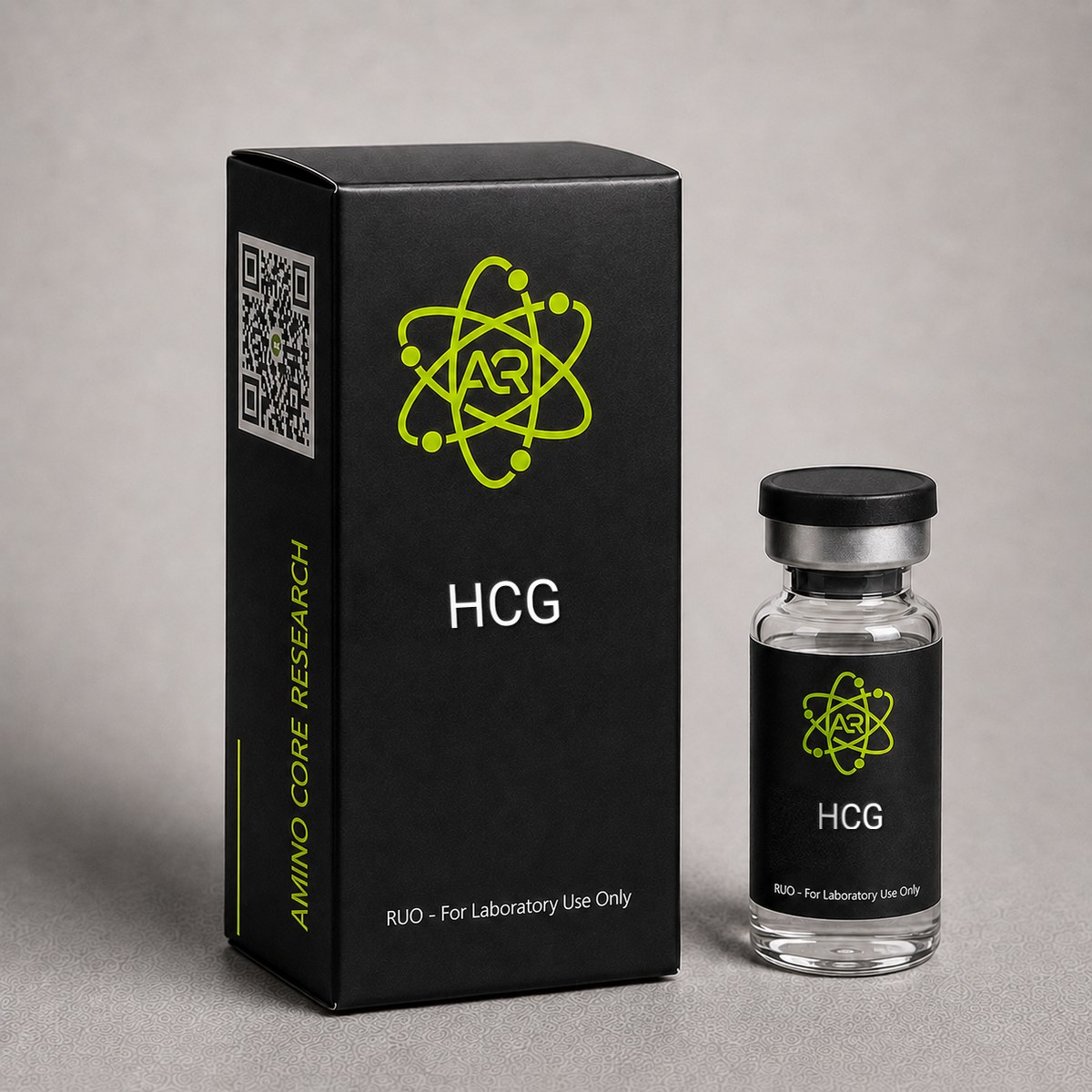
≥99%HPLC Purity
COAIncluded
USAShipped
HCG Peptide
Human Chorionic Gonadotropin (hCG) is a heterodimeric glycoprotein hormone composed of alpha and beta subunits that activates the LH/CG receptor (LHCGR). It is studied extensively for gonadal steroidogenesis, Leydig cell function, and reproductive endocrinology research.
Research Reference
This page is a research monograph. HCG is documented here for reference — structure, mechanism and published literature — and is not offered for sale.
Browse compounds available for research purchase · Read the research library
Quick Facts
| SKU | ACR-HCG |
|---|---|
| CAS Number | 9002-61-3 |
| Molecular Formula | C1105H1770N318O336S26 |
| Molecular Weight | 36700.00 g/mol |
| Sequence | Glycoprotein heterodimer |
| Purity | ≥99% |
| Physical Form | Lyophilized Powder |
| Storage | Store at -20°C |
What is HCG?
Human Chorionic Gonadotropin is a glycoprotein hormone with LH-mimetic properties. It binds LHCGR and stimulates steroidogenesis, valuable in reproductive endocrinology and Leydig cell research.
Mechanism of Action
HCG binds the LH/CG receptor on Leydig cells, activating cAMP/PKA cascade. This stimulates cholesterol-to-pregnenolone conversion via StAR protein, the rate-limiting step in steroid biosynthesis.
Research & Clinical Studies
Landmark Study: hCG Structure and LHCGR Activation
One of the foundational studies on human chorionic gonadotropin (hCG) was the crystallographic determination of its three-dimensional structure by Lapthorn et al. (1994), which revealed that hCG belongs to the cystine-knot growth factor superfamily. This work fundamentally changed how researchers understood glycoprotein hormone signaling and receptor engagement.
Study Design
- Approach: X-ray crystallography of partially deglycosylated hCG at 2.6 Å resolution
- Objective: Determine the heterodimeric architecture of the alpha and beta subunits
- Comparative analysis: Structural alignment with related glycoprotein hormones (LH, FSH, TSH)
Key Findings
- hCG adopts a cystine-knot fold previously identified in NGF, TGF-beta, and PDGF
- The alpha subunit (92 amino acids) is shared across LH, FSH, TSH, and hCG
- The beta subunit (145 amino acids) contains a unique C-terminal peptide (CTP) with four O-linked glycosylation sites that extends hCG's plasma half-life to ~24-36 hours, compared to ~20 minutes for LH
- The two subunits are held together by non-covalent interactions and a "seatbelt" disulfide loop in the beta subunit wrapping around the alpha subunit
Receptor Activation Studies
Subsequent functional studies demonstrated that hCG binds the LH/CG receptor (LHCGR) with high affinity (Kd ~0.1-1 nM) and triggers Gs-mediated adenylyl cyclase activation, elevating intracellular cAMP. In Leydig cells, this cascade activates steroidogenic acute regulatory protein (StAR) and CYP17A1, driving testosterone biosynthesis. In ovarian theca and granulosa-lutein cells, hCG drives progesterone and estradiol production.
Research Significance
This structural work enabled the development of recombinant hCG (choriogonadotropin alfa), long-acting LHCGR agonists, and provided the template for understanding how subunit pairing dictates receptor selectivity across the glycoprotein hormone family. It remains one of the most cited papers in reproductive endocrinology research.
Phase 2 Trial: hCG in Hypogonadotropic Hypogonadism and Spermatogenesis Induction
A landmark clinical investigation reported by Liu et al. (2009) pooled data from multiple controlled trials evaluating gonadotropin therapy — specifically human chorionic gonadotropin (hCG) alone or in combination with follicle-stimulating hormone (FSH) — for the induction of spermatogenesis in men with hypogonadotropic hypogonadism (HH). This meta-analysis represents one of the most comprehensive datasets characterizing hCG-mediated Leydig cell stimulation and downstream testicular maturation in a research context.
Study Design
- Subjects: Pooled cohort of men with congenital or acquired hypogonadotropic hypogonadism (n = several hundred across included trials)
- Intervention: hCG administered at typical research doses of 1,500-2,500 IU subcutaneously, 2-3 times per week, with or without subsequent FSH co-administration
- Duration: Treatment windows ranging from 6 to 24 months
- Primary endpoints: Serum testosterone normalization, testicular volume, sperm concentration in ejaculate
Key Results
- Serum testosterone increased into the normal adult male range in approximately 95% of subjects receiving hCG monotherapy, confirming robust Leydig cell LHCGR activation
- Mean testicular volume increased from baseline values (often <4 mL) to 5-10 mL after 6-12 months of hCG monotherapy
- Spermatogenesis was induced in approximately 75% of subjects when hCG was combined with FSH; ~40-60% achieved sperm in ejaculate with hCG alone in subjects with partial gonadotropin deficiency
- Median time to first appearance of sperm was 7-9 months
- Predictors of response included larger baseline testicular volume and absence of cryptorchidism history
Research Significance
This pooled analysis provided definitive evidence that hCG functions as a high-fidelity LH analog in vivo, capable of sustaining the full cascade of testicular steroidogenesis and supporting spermatogenesis when paired with FSH. From a mechanism-of-action standpoint, the data confirm that hCG's extended circulating half-life (approximately 24-36 hours versus ~20 minutes for endogenous LH) translates to sustained Leydig cell cAMP/PKA pathway activation and durable intratesticular testosterone (ITT) production. ITT concentrations in the testis are reported to be 50-100 fold higher than serum testosterone, and this gradient is essential for Sertoli cell support of germ cell maturation. The study has become a foundational reference for reproductive endocrinology research investigating LHCGR pharmacology, dose-response relationships, and the relative contributions of LH-like versus FSH-like signaling to spermatogenic output.
[1] Liu PY, Baker HW, Jayadev V, Zacharin M, Conway AJ, Handelsman DJ. Induction of spermatogenesis and fertility during gonadotropin treatment of gonadotropin-deficient infertile men: predictors of fertility outcome. J Clin Endocrinol Metab. 2009;94(3):801-808. PubMed ↗
Comparative Study: hCG vs Recombinant LH Receptor Pharmacology
Casarini et al. (2012) conducted a comparative receptor signaling study examining how hCG and luteinizing hormone (LH) differ in their activation of the shared LH/CG receptor (LHCGR), despite binding the same receptor with overlapping affinity. The work, published in PLoS ONE, provided one of the clearest in vitro dissections of biased agonism between these two structurally related glycoprotein hormones.
Study Design
- Model: HEK293 and COS-7 cells stably expressing human LHCGR
- Comparator ligands: Recombinant human hCG vs recombinant human LH
- Concentration range: 10⁻¹² to 10⁻⁷ M, stimulation periods 5-60 minutes
- Endpoints measured: cAMP accumulation, ERK1/2 phosphorylation, AKT phosphorylation, steroidogenic gene expression (StAR, CYP11A1)
Key Results
- hCG produced approximately 5-fold greater maximal cAMP accumulation than equimolar LH, consistent with stronger Gαs coupling
- LH preferentially activated ERK1/2 and AKT phosphorylation at lower concentrations, suggesting bias toward β-arrestin and proliferative signaling
- StAR (steroidogenic acute regulatory protein) mRNA induction was significantly higher with hCG stimulation, correlating with the cAMP/PKA preference
- Both hormones reached similar EC50 values (~10⁻¹⁰ M) but differed in efficacy and pathway selectivity
- The biased agonism was attributable to the unique C-terminal peptide (CTP) extension and glycosylation pattern of the hCG β-subunit
Research Significance
This study reframed hCG and LH not as interchangeable LHCGR agonists but as functionally distinct biased ligands, with implications for steroidogenesis research, ovulation induction modeling, and Leydig cell biology. The preferential cAMP/steroidogenic signaling of hCG explains its sustained utility as a research probe for studying androgen and progesterone production, while LH's bias toward proliferative kinase cascades may be more relevant for studies of granulosa cell growth and ovarian remodeling. The data also help explain clinical and preclinical observations that hCG produces stronger, more prolonged testosterone responses than equivalent LH doses, even when receptor occupancy is matched. For investigators using hCG as a tool compound to study LHCGR pharmacology, these findings underscore the importance of selecting the appropriate gonadotropin to model specific downstream pathways.
[1] Casarini L, Lispi M, Longobardi S, Milosa F, La Marca A, Tagliasacchi D, Pignatti E, Simoni M. LH and hCG action on the same receptor results in quantitatively and qualitatively different intracellular signalling. PLoS One. 2012;7(10):e46682. PubMed ↗
Chemical & Physical Properties
Human Chorionic Gonadotropin (hCG) is a complex heterodimeric glycoprotein hormone. The following table summarizes its key physicochemical characteristics as relevant to laboratory research.
| Full Name | Human Chorionic Gonadotropin |
|---|---|
| Synonyms | hCG, Choriogonadotropin, CG, Chorionic Gonadotrophin |
| Molecular Formula | C₁₁₀₅H₁₇₇₀N₃₁₈O₃₃₆S₂₆ (protein backbone, excluding glycans) |
| Molecular Weight | ~36,700 Da (fully glycosylated); ~25,700 Da (deglycosylated) |
| CAS Number | 9002-61-3 |
| Structure | Heterodimer of non-covalently associated alpha and beta subunits |
| Alpha Subunit | 92 amino acids (shared with LH, FSH, TSH); 2 N-linked glycans |
| Beta Subunit | 145 amino acids (hCG-specific); 2 N-linked + 4 O-linked glycans |
| Carbohydrate Content | ~30% by mass (sialic acid, mannose, galactose, N-acetylglucosamine, fucose) |
| Disulfide Bonds | 5 in alpha subunit, 6 in beta subunit (including cystine-knot motif) |
| Origin / Source | Naturally secreted by syncytiotrophoblast cells of the placenta; also produced recombinantly |
| Receptor | LH/CG receptor (LHCGR) — Gs-coupled GPCR |
| Plasma Half-Life | ~24-36 hours (extended by C-terminal peptide glycosylation) |
| Physical Form | Lyophilized white to off-white powder |
| Solubility | Soluble in bacteriostatic water, sterile water, or 0.9% saline; do not vortex |
| Purity | ≥99% (HPLC) |
| Storage | Lyophilized: -20°C; reconstituted: 2-8°C, short-term use |
The high carbohydrate content of hCG — particularly the terminal sialic acid residues — is essential for its prolonged circulatory half-life. Desialylation dramatically reduces hCG bioactivity in vivo by accelerating hepatic clearance via the asialoglycoprotein receptor, although in vitro receptor binding remains intact. This makes glycan integrity a critical consideration for research applications involving systemic administration models.
Handling & Reconstitution Guidelines
Human Chorionic Gonadotropin is a glycoprotein hormone and requires careful handling to preserve subunit association and glycan integrity. Improper reconstitution can lead to subunit dissociation, loss of receptor binding, and reduced experimental reproducibility.
Recommended Reconstitution Protocol
- Equilibrate the vial to room temperature for 20-30 minutes before opening to prevent moisture condensation on the lyophilized powder.
- Select diluent: Use bacteriostatic water for injection (0.9% benzyl alcohol) for multi-use reconstitution, or sterile water/0.9% saline for single-use applications.
- Calculate concentration: A typical reconstitution is 5,000 IU + 5 mL diluent = 1,000 IU/mL. For a 10,000 IU vial with 10 mL diluent, the resulting concentration is also 1,000 IU/mL.
- Add diluent slowly by directing the stream against the inner wall of the vial — never directly onto the lyophilized cake.
- Swirl gently in a circular motion until fully dissolved. Do NOT shake or vortex — agitation can denature the heterodimer and cause subunit dissociation.
- Inspect visually: The reconstituted solution should be clear and colorless. Discard if cloudy, discolored, or containing particulates.
Compound-Specific Handling Notes
- Glycoprotein sensitivity: hCG's biological activity depends on intact glycosylation. Avoid extreme pH (stay between pH 6-8) and temperatures above 25°C during handling.
- Subunit dissociation: The alpha and beta subunits are held together by non-covalent forces. Heat, mechanical shear (vortexing), and chaotropic agents can dissociate them irreversibly.
- Adsorption to surfaces: At low concentrations, hCG can adsorb to glass and plastic. Use low-protein-binding tubes for dilute working stocks, or include 0.1% BSA as a carrier protein.
- Sterility: Use aseptic technique. If using bacteriostatic water, the reconstituted solution is suitable for repeated withdrawal over 30 days when refrigerated.
All handling should occur in a clean laboratory environment with appropriate PPE. This material is intended for in vitro research and laboratory use only and is not for human or veterinary administration.
Storage & Stability Information
Human Chorionic Gonadotropin (hCG) is a highly glycosylated heterodimeric glycoprotein with significant tertiary structure stabilized by disulfide bonds (cystine knots in both alpha and beta subunits). Maintaining the structural integrity of these features is critical for preserving LHCGR binding affinity and biological activity in research applications. Improper storage can result in subunit dissociation, deglycosylation, and aggregation — all of which substantially reduce receptor activation potency.
Lyophilized Powder Storage
- Long-term (>30 days): Store at -20°C in a frost-free freezer, protected from light and moisture. Under these conditions, lyophilized hCG is typically stable for 24-36 months.
- Short-term (≤30 days): Storage at 2-8°C in a sealed, desiccated container is acceptable for working stocks.
- Transit / room temperature: Lyophilized hCG tolerates up to 14 days at ambient temperature (≤25°C) without significant loss of activity, owing to the stabilizing effect of the freeze-dried matrix.
Reconstituted Solution Storage
- After reconstitution in bacteriostatic water or sterile saline, store at 2-8°C and use within 30 days for optimal potency retention.
- For extended storage of reconstituted solution, aliquot into low-protein-binding tubes and freeze at -20°C or -80°C; stable for approximately 60-90 days when frozen.
- Avoid repeated freeze-thaw cycles — each cycle can reduce activity by 5-15% due to subunit dissociation and aggregation. Limit to ≤3 freeze-thaw events.
Compound-Specific Stability Notes
- Disulfide bond integrity: hCG contains 11 disulfide bonds (5 in alpha, 6 in beta subunit). Avoid exposure to reducing agents (DTT, β-mercaptoethanol) which will denature the heterodimer.
- Glycosylation sensitivity: The N- and O-linked glycans (particularly on the β-CTP) are essential for the extended in vivo half-life. Do not expose to glycosidases or extreme pH (<4 or >9).
- Surface adsorption: At low concentrations (<10 IU/mL), glycoproteins like hCG can adsorb to glass and plastic surfaces, causing apparent loss of activity. Include carrier protein (0.1% BSA) in dilute working solutions.
- Temperature shock: Avoid rapid temperature transitions; allow vials to equilibrate to room temperature before opening to prevent condensation and moisture uptake.
For analytical research use only. Not for human or veterinary therapeutic application.
Frequently Asked Questions
What receptor does HCG target?
HCG binds the LH/CG receptor (LHCGR), the same receptor activated by LH. It stimulates testosterone in males and progesterone in females.
What is the molecular weight and CAS number of HCG?
Human Chorionic Gonadotropin (hCG) has a molecular weight of approximately 36,700 Daltons in its fully glycosylated native form, with the protein backbone contributing approximately 25,700 Da and N- and O-linked carbohydrate chains accounting for the remaining ~30% of mass. The CAS Registry Number for hCG is 9002-61-3. It is a heterodimeric glycoprotein composed of a 92-amino-acid alpha subunit (shared with LH, FSH, and TSH) and a unique 145-amino-acid beta subunit. The protein-only molecular formula is approximately C1105H1770N318O336S26, though the exact mass varies based on glycoform composition.
How does HCG compare to luteinizing hormone (LH) in research applications?
hCG and LH both activate the same receptor (LHCGR) and share an identical alpha subunit, but they differ critically in their beta subunits and pharmacokinetics. hCG's beta subunit contains a unique C-terminal peptide (CTP) with four O-linked glycosylation sites, extending its plasma half-life to approximately 24-36 hours compared to LH's ~20 minutes. In receptor binding assays, hCG typically shows 6-8 times greater potency than LH due to prolonged receptor engagement. For research models studying sustained LHCGR activation, steroidogenesis, or Leydig/theca cell biology, hCG is often preferred as a long-acting receptor agonist.
How should HCG be stored for laboratory research?
Lyophilized hCG should be stored at -20°C for long-term stability, where it remains stable for 24+ months. For short-term storage, 2-8°C is acceptable for several weeks. Once reconstituted with bacteriostatic water, hCG solutions should be stored at 2-8°C and used within 30 days; with sterile water alone, use within 24-72 hours. Avoid repeated freeze-thaw cycles of reconstituted solution, as this can cause subunit dissociation and loss of bioactivity. Protect from light, heat, and mechanical agitation. Single-use aliquots stored at -80°C are recommended for long-term preservation of reconstituted material.
What receptor signaling pathway does HCG activate?
hCG activates the LH/CG receptor (LHCGR), a class A G-protein-coupled receptor expressed on Leydig cells, ovarian theca and granulosa-lutein cells, and corpus luteum. Receptor activation primarily couples to Gαs, stimulating adenylyl cyclase and elevating intracellular cAMP, which activates PKA. PKA then phosphorylates steroidogenic acute regulatory protein (StAR), facilitating cholesterol transport into mitochondria where CYP11A1 initiates steroid biosynthesis. Downstream this drives testosterone production in Leydig cells and progesterone/estradiol production in ovarian cells. At higher hCG concentrations, secondary Gq coupling activates phospholipase C, generating IP3 and DAG and mobilizing intracellular calcium — a pathway studied in ovulation research models.
What sizes of HCG are available for research?
AminoCore Research offers HCG (Human Chorionic Gonadotropin) in lyophilized vial formats typical for laboratory research, with standard sizing measured in international units (IU). Common research quantities include 5,000 IU and 10,000 IU vials, allowing researchers to prepare appropriate working concentrations for in vitro LHCGR activation studies, Leydig cell steroidogenesis assays, and ovarian granulosa cell models. Each vial is supplied as a sterile lyophilized powder with ≥99% purity verified by HPLC and SDS-PAGE, accompanied by a Certificate of Analysis. All products are intended strictly for in vitro and preclinical research applications and are not for human or veterinary use.
Does HCG require co-administration of FSH in spermatogenesis research models?
In research models of hypogonadotropic hypogonadism, HCG alone effectively activates Leydig cell LHCGR signaling and restores intratesticular testosterone (ITT) concentrations, which are essential for early stages of spermatogenesis. However, complete germ cell maturation in most preclinical models additionally requires follicle-stimulating hormone (FSH) signaling through Sertoli cells. Published pooled clinical research (Liu et al., 2009) reports that HCG monotherapy induces detectable spermatogenesis in approximately 40-60% of partial-deficiency subjects, while combined HCG + FSH protocols achieve spermatogenesis induction in approximately 75% of cases. Researchers typically select monotherapy or combination protocols based on the specific spermatogenic endpoint under investigation.
Why does HCG have a longer half-life than luteinizing hormone (LH)?
HCG's extended circulating half-life of approximately 24-36 hours — compared to roughly 20 minutes for endogenous LH — is attributable to its unique β-subunit C-terminal peptide (CTP) extension and dense O-linked glycosylation. The HCG β-subunit contains an additional 24 amino acid CTP not present in LHβ, bearing four O-linked sialylated glycans. These terminal sialic acid residues prevent hepatic clearance via the asialoglycoprotein receptor and substantially slow renal filtration. This pharmacokinetic property makes HCG a valuable research tool for studying sustained LHCGR activation and prolonged cAMP/PKA-driven steroidogenesis, where rapid LH clearance would otherwise complicate experimental interpretation.
Is HCG the same as luteinizing hormone (LH)?
No. HCG and LH are structurally related but functionally distinct glycoprotein hormones that share the same receptor (LHCGR). Both are heterodimers consisting of a common alpha subunit and a hormone-specific beta subunit, and their beta subunits share approximately 85% sequence homology. However, HCGβ contains a unique 24-amino-acid C-terminal peptide extension with additional glycosylation sites, giving HCG a substantially longer half-life and distinct biased signaling at LHCGR. Comparative receptor pharmacology studies (Casarini et al., 2012) have shown HCG preferentially activates the Gαs/cAMP/PKA steroidogenic pathway, while LH biases toward ERK1/2 and AKT proliferative signaling at the same receptor.
For laboratory and research use only. This product is not for human or veterinary use. It is not a drug, supplement or food.
This product is not FDA approved for any indication, and is not intended to diagnose, treat, cure, or prevent any disease. All product information is derived from published preclinical research and does not constitute medical advice or claims.