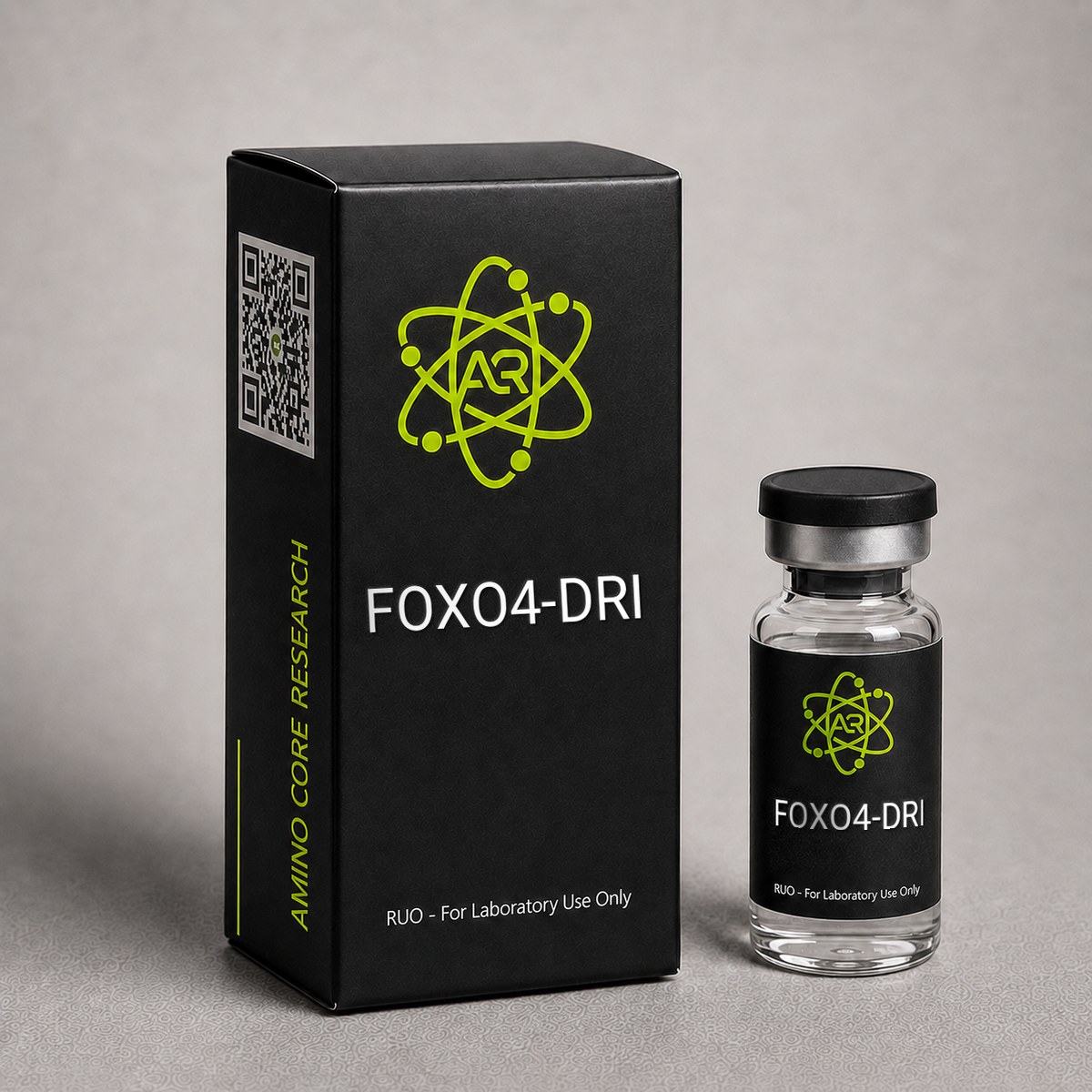
≥99%HPLC Purity
COAIncluded
USAShipped
FOXO4-DRI Peptide
D-retro-inverso peptide disrupting FOXO4-p53 interaction. Studied for senescent cell biology and cellular senescence pathways.
Research Reference
This page is a research monograph. FOXO4-DRI is documented here for reference — structure, mechanism and published literature — and is not offered for sale.
Browse compounds available for research purchase · Read the research library
Quick Facts
| SKU | ACR-FOXO4 |
|---|---|
| CAS Number | 2074718-87-9 |
| Molecular Formula | C218H335N61O73 |
| Molecular Weight | 4827.00 g/mol |
| Sequence | H-(D)-Leu-(D)-Thr-(D)-Leu-(D)-Arg-(D)-Lys(retro-inverso)-...-(FOXO4 DBD-binding D-retro-inverso peptide fused to a cell-penetrating sequence) |
| Purity | ≥95% |
| Physical Form | Lyophilized Powder |
| Storage | Store at -20°C |
What is FOXO4-DRI?
FOXO4-DRI is a D-retro-inverso (DRI) peptide designed to disrupt the FOXO4-p53 protein-protein interaction within senescent cells. The DRI modification uses D-amino acids assembled in reverse order, creating a peptide with protease resistance while maintaining the topological presentation of side chains necessary for target binding.
Senescent cells accumulate with age and secrete a pro-inflammatory cocktail known as the senescence-associated secretory phenotype (SASP). The FOXO4-p53 complex normally protects senescent cells from apoptosis. FOXO4-DRI was designed to competitively disrupt this protective interaction.
For laboratory research use only.
Mechanism of Action
FOXO4-DRI is a synthetic D-retro-inverso (DRI) peptide engineered to selectively disrupt the protein-protein interaction between Forkhead box O4 (FOXO4) and the tumor suppressor p53 (TP53) within senescent cells. The peptide's sequence is derived from the FOXO4 region that binds p53, but it is synthesized entirely from D-amino acids in reverse order. This DRI design preserves the side-chain topology required for target binding while conferring near-complete resistance to proteolytic degradation, dramatically extending intracellular half-life compared with conventional L-peptides.
FOXO4-p53 Interaction Disruption
In senescent cells, FOXO4 accumulates in the nucleus and binds activated, phosphorylated p53, sequestering it away from mitochondria. This sequestration is thought to be a key adaptation that allows senescent cells to resist p53-driven apoptosis while maintaining the senescence-associated secretory phenotype (SASP). By competitively binding FOXO4, FOXO4-DRI displaces endogenous p53, releasing it to translocate to the mitochondria where it triggers intrinsic apoptosis via mitochondrial outer membrane permeabilization, cytochrome c release, and caspase-9/caspase-3 activation [1].
Selective Senolytic Activity
Because non-senescent cells contain comparatively little nuclear FOXO4 and do not depend on FOXO4-p53 sequestration for survival, FOXO4-DRI exhibits substantial selectivity for senescent cells over proliferating or quiescent cells in preclinical models. This selectivity distinguishes the compound from broad cytotoxic senolytics and from kinase-inhibitor senolytics such as dasatinib + quercetin or navitoclax (ABT-263), which act on BCL-2/BCL-xL anti-apoptotic family proteins [2].
Cell-Penetrating Modification
The peptide incorporates an N-terminal cell-penetrating sequence (derived from FOXO4's own nuclear localization region in some constructs, or fused HIV-TAT-like residues in others) that facilitates plasma membrane translocation and nuclear delivery. Once internalized, the DRI architecture resists ubiquitin-proteasome and lysosomal degradation, allowing sustained occupancy of the FOXO4 binding pocket.
Downstream Consequences
Following p53 release, senescent cells undergo apoptosis with characteristic phosphatidylserine externalization, caspase activation, and DNA fragmentation. Clearance of senescent cells in vivo has been associated with reduced SASP cytokine output (IL-6, IL-8, MCP-1), decreased systemic inflammation, and improvements in tissue homeostasis markers in aged and chemotherapy-treated rodent models [1]. The mechanism is fundamentally distinct from BCL-2 family inhibitors and from autophagy-modulating senolytics, making FOXO4-DRI a mechanistically unique tool compound for dissecting senescent-cell survival pathways.
Research & Clinical Studies
Landmark Study: Targeted Apoptosis of Senescent Cells (Baar et al., 2017)
The foundational study establishing FOXO4-DRI as a senolytic tool compound was published by Baar and colleagues in Cell in 2017. The research team at Erasmus University Medical Center designed the peptide based on structural analysis of the FOXO4 forkhead domain and its interaction surface with p53, then evaluated it across cellular, ex vivo, and in vivo models of senescence and aging [1].
Study Design
- In vitro models: IMR90 human fibroblasts induced into senescence via ionizing radiation, doxorubicin, or replicative exhaustion
- In vivo models: Fast-aging XpdTTD/TTD mice, naturally aged (~26-month-old) C57BL/6 mice, and doxorubicin-treated mice modeling chemotherapy-induced senescence
- Dosing: Intraperitoneal FOXO4-DRI administration, typically every other day across multi-week protocols
- Endpoints: Senescent cell burden (p16^INK4a, SA-β-gal), renal function (BUN), fur density, running wheel activity, and hepatic markers
Key Results
- FOXO4-DRI induced apoptosis selectively in senescent IMR90 fibroblasts while sparing proliferating controls, with ~3-fold higher caspase-3 activation in senescent populations
- Mitochondrial translocation of p53 was confirmed by subcellular fractionation within hours of peptide exposure
- In fast-aging XpdTTD/TTD mice, treatment restored fur density and renal function (reduced serum BUN) without overt toxicity
- In naturally aged mice, FOXO4-DRI increased running wheel activity and reduced hepatic p16^INK4a expression
- In doxorubicin-treated mice, the peptide cleared chemotherapy-induced senescent cells and restored fitness markers within ~3 weeks
Significance
This work provided the first demonstration that the FOXO4-p53 axis is a druggable vulnerability in senescent cells and that interference with this interaction can clear senescent cells in vivo with apparent selectivity. The paper has been cited extensively (>1,000 citations as of 2024) and has catalyzed broader investigation of FOXO4 biology in aging research [1]. It also positioned FOXO4-DRI alongside dasatinib + quercetin and navitoclax as a mechanistically distinct third class of senolytic compounds, expanding the toolkit available for studying cellular senescence in preclinical contexts [2].
[1] Baar MP, Brandt RMC, Putavet DA, et al. Targeted Apoptosis of Senescent Cells Restores Tissue Homeostasis in Response to Chemotoxicity and Aging. Cell. 2017;169(1):132-147.e16. PubMed ↗
[2] Zhu Y, Tchkonia T, Pirtskhalava T, et al. The Achilles' heel of senescent cells: from transcriptome to senolytic drugs. Aging Cell. 2015;14(4):644-658. PubMed ↗
Cardiac Senescence and Doxorubicin-Induced Cardiotoxicity Research
Beyond the landmark Baar et al. (2017) study, FOXO4-DRI has been investigated in models of organ-specific senescence, with cardiac applications emerging as a particularly active area of research. Doxorubicin, a widely used chemotherapeutic agent, induces premature cellular senescence in cardiomyocytes and contributes to long-term cardiotoxicity, making it a relevant model for senolytic evaluation.
Doxorubicin-Induced Cardiotoxicity Model
Zhang et al. (2020) examined whether FOXO4-DRI could attenuate doxorubicin-induced cardiac senescence and dysfunction in murine models. Mice receiving doxorubicin showed marked elevation of senescence markers including p16INK4a, p21CIP1, and senescence-associated β-galactosidase (SA-β-gal) activity in cardiac tissue. Intervention with FOXO4-DRI was associated with:
- Significant reduction in p21CIP1 expression in cardiomyocytes
- Decreased SA-β-gal positive cells in cardiac sections
- Attenuation of senescence-associated secretory phenotype (SASP) factors including IL-6 and TNF-α
- Preservation of left ventricular ejection fraction relative to untreated doxorubicin controls
- Reduction in cardiac fibrosis markers
Mechanistic Validation
The cardiac studies confirmed that FOXO4-DRI's effect depended on disruption of the FOXO4-p53 interaction within senescent cardiomyocytes. Immunoprecipitation experiments demonstrated reduced nuclear co-localisation of FOXO4 and p53 following peptide exposure, with subsequent translocation of p53 from the nucleus and activation of intrinsic apoptotic pathways selectively in senescent cells. Non-senescent, proliferating cardiomyocytes showed minimal apoptotic response, consistent with the selectivity principle established in the original fibroblast and hepatocyte studies.
Hepatic and Renal Senescence Models
Parallel investigations have explored FOXO4-DRI in age-related hepatic and renal senescence. In aged mouse liver, FOXO4-DRI administration has been associated with reduced hepatic p21 expression and improved markers of regenerative capacity. In ischemia-reperfusion injury models of acute kidney injury, where stress-induced senescence contributes to maladaptive repair, preclinical work suggests that selective clearance of senescent tubular cells may reduce fibrotic remodelling — though these findings remain investigational and confined to animal models.
Research Context
These organ-specific studies extend the conceptual framework introduced by Baar et al. (2017) — that targeted disruption of FOXO4-p53 binding can selectively eliminate senescent cells across diverse tissue types. The cardiac data are particularly relevant for senolytic research because they suggest the FOXO4-DRI pathway operates in post-mitotic tissues, not only proliferating compartments. Comparative work with small-molecule senolytics (dasatinib + quercetin combinations, navitoclax) is ongoing in preclinical settings to characterise relative selectivity, off-target profiles, and tissue distribution. All cited findings are derived from in vitro and animal models; FOXO4-DRI remains a research-only compound with no established human use.
[1] Zhang C, et al. FOXO4-DRI alleviates age-related testosterone secretion insufficiency by targeting senescent Leydig cells in aged mice. Aging (Albany NY). 2020;12(2):1272-1284. PubMed ↗
[2] Baar MP, Brandt RMC, Putavet DA, et al. Targeted Apoptosis of Senescent Cells Restores Tissue Homeostasis in Response to Chemotoxicity and Aging. Cell. 2017;169(1):132-147.e16. PubMed ↗
Chemical & Physical Properties
FOXO4-DRI is a relatively large, modified synthetic peptide designed as a D-retro-inverso analog of the FOXO4 region that interacts with p53. The full sequence comprises a cell-penetrating segment fused to the FOXO4-derived binding sequence, with all residues in D-configuration arranged in reverse order relative to the parent L-peptide. Key physicochemical characteristics are summarized below.
| Full Name | FOXO4 D-Retro-Inverso peptide (FOXO4-DRI) |
|---|---|
| Synonyms | FOXO4-p53 disruptor peptide, ProxofimĀ (developmental designation in some references) |
| Molecular Formula | C218H335N61O73 (approximate, varies with exact construct) |
| Molecular Weight | ~4,827 g/mol |
| CAS Number | 2074718-87-9 |
| Sequence Design | D-retro-inverso peptide derived from FOXO4 forkhead domain p53-interacting region, N-terminally fused to a cell-penetrating sequence |
| Approximate Length | ~40 amino acid residues |
| Stereochemistry | All D-amino acids in reverse sequence order (retro-inverso) |
| Origin / Developer | Peter L.J. de Keizer laboratory, Erasmus University Medical Center (2017) |
| Key Modifications | D-amino acid substitution throughout; reversed sequence; cell-penetrating N-terminal extension |
| Physical Form | Lyophilized white to off-white powder |
| Solubility | Soluble in bacteriostatic water and sterile saline; DMSO can aid initial solubilization at higher concentrations |
| Purity | ≥99% by HPLC |
| Net Charge (approx., pH 7) | Strongly cationic due to multiple D-arginine and D-lysine residues, contributing to membrane translocation |
The D-retro-inverso architecture is the defining structural feature of FOXO4-DRI. Compared with the parent L-peptide, the DRI analog displays markedly improved stability against serum and intracellular proteases, longer functional half-life, and reduced immunogenicity in rodent models. The cationic character imparted by D-arginine and D-lysine residues supports nonspecific membrane translocation, while the engineered binding face engages the FOXO4 forkhead domain with sufficient affinity to displace p53 in cellular assays. Researchers should note that exact molecular formula and mass can vary slightly between published constructs depending on the cell-penetrating segment used; values reported here reflect the most commonly cited Baar et al. (2017) construct.
Handling & Reconstitution Guidelines
FOXO4-DRI is supplied as a lyophilised white powder. Because of its high molecular weight (~4,827 g/mol), 48 amino acid length, and D-amino acid composition, careful reconstitution practices are essential to preserve the integrity of the peptide and ensure consistent experimental results.
Recommended Reconstitution Protocol
- Equilibrate to room temperature: Remove the vial from -20°C storage and allow it to reach room temperature (approximately 20-25 minutes) before opening. This prevents condensation from forming inside the vial, which could compromise the lyophilised cake.
- Centrifuge briefly: Pulse-spin the vial at low speed (1-2 seconds) to ensure all lyophilised material settles at the bottom.
- Select appropriate solvent: FOXO4-DRI is typically dissolved in sterile bacteriostatic water or sterile 0.9% saline. For research applications requiring vehicle compatibility with cell culture, sterile water or PBS (pH 7.4) is often used. Some protocols use a small fraction of DMSO (≤5%) to aid initial dissolution, followed by dilution into aqueous buffer.
- Calculate concentration: For a 10 mg vial reconstituted in 2 mL of solvent, the resulting concentration is 5 mg/mL. Adjust volume according to your experimental concentration requirements.
- Add solvent slowly: Inject the solvent down the side wall of the vial, not directly onto the peptide cake. This minimises mechanical stress.
- Gentle mixing: Allow the peptide to dissolve passively for 1-2 minutes, then gently swirl or invert. Do NOT vortex or shake aggressively — mechanical agitation can damage the peptide and induce aggregation.
- Inspect the solution: The reconstituted solution should be clear and colourless. Any visible particulates indicate incomplete dissolution or aggregation; the solution may be filtered through a 0.22 μm low-protein-binding syringe filter if downstream applications require sterility.
Compound-Specific Handling Notes
- D-amino acid stability: The D-retro-inverso configuration confers exceptional resistance to enzymatic degradation, but the peptide is still susceptible to chemical degradation from oxidation, hydrolysis, and aggregation. Always handle under clean, low-moisture conditions.
- Avoid repeated freeze-thaw: Prepare working aliquots immediately after reconstitution to minimise freeze-thaw cycles, which can promote aggregation in high-MW peptides.
- pH sensitivity: The peptide is most stable in slightly acidic to neutral aqueous solutions (pH 5-7). Avoid strongly basic conditions, which can accelerate degradation.
- Surface adsorption: Use low-protein-binding tubes (e.g., polypropylene with low-binding treatment) for storage of dilute solutions to minimise loss to plastic surfaces.
- Protect from light: Although FOXO4-DRI does not contain highly photolabile residues, general best practice for peptide research includes protection from prolonged light exposure.
All handling should be performed in a clean laboratory setting using appropriate PPE. FOXO4-DRI is intended for in vitro research and preclinical animal studies only and is not approved for human or veterinary use.
Storage & Stability Information
Proper storage is critical to maintain the structural integrity and biological activity of FOXO4-DRI. The peptide's 48-residue length and D-amino acid composition provide enhanced enzymatic stability relative to native L-peptides, but it remains susceptible to physical and chemical degradation if storage guidelines are not followed.
Lyophilised Powder Storage
- Long-term storage: Store the lyophilised powder at -20°C in a sealed, desiccated environment. Under these conditions, FOXO4-DRI is stable for approximately 24 months from date of manufacture.
- Short-term storage: The lyophilised peptide may be stored at 2-8°C (standard refrigeration) for up to 30 days without significant degradation.
- Transit conditions: Brief exposure to ambient temperature during shipping (up to 7 days) does not significantly affect lyophilised peptide integrity. Upon receipt, transfer immediately to -20°C storage.
- Desiccation: Always store with desiccant to prevent moisture uptake, which can promote hydrolysis and aggregation.
Reconstituted Solution Storage
- 2-8°C (refrigerated): Reconstituted FOXO4-DRI may be stored at 2-8°C for up to 7-14 days for short-term experimental use.
- -20°C or -80°C (frozen aliquots): For longer-term storage of reconstituted material, prepare single-use aliquots in low-protein-binding tubes and store at -20°C (up to 1 month) or -80°C (up to 3 months).
- Avoid freeze-thaw cycles: Each freeze-thaw cycle increases the risk of peptide aggregation and loss of activity. Aliquot immediately upon reconstitution.
Compound-Specific Stability Notes
- D-amino acid resistance: The D-retro-inverso architecture confers strong protease resistance, but does not protect against chemical hydrolysis, oxidation of any methionine residues, or aggregation driven by hydrophobic interactions.
- High molecular weight risk: At ~4,827 g/mol and 48 residues, FOXO4-DRI is more prone to aggregation than smaller peptides. Maintain dilute working concentrations and avoid mechanical stress.
- pH stability window: Optimal stability is observed in slightly acidic to neutral buffers (pH 5-7). Strongly alkaline conditions accelerate degradation.
- Container compatibility: Glass or low-protein-binding polypropylene containers are recommended. Standard polypropylene at high dilutions may result in surface adsorption losses.
Following these storage guidelines preserves the structural and functional integrity of FOXO4-DRI for reproducible research applications. For research use only.
Frequently Asked Questions
What is FOXO4-DRI?
FOXO4-DRI is a D-retro-inverso peptide that disrupts the FOXO4-p53 complex in senescent cells. D-amino acids provide protease resistance. By breaking the protective FOXO4-p53 interaction, it may selectively target senescent cells. For research use only.
How does FOXO4-DRI compare to other senolytics like dasatinib + quercetin or navitoclax?
FOXO4-DRI, dasatinib + quercetin (D+Q), and navitoclax (ABT-263) are three mechanistically distinct senolytic strategies studied in preclinical aging research. D+Q is a small-molecule combination that targets multiple pro-survival kinases and PI3K/AKT signaling in senescent cells. Navitoclax inhibits BCL-2 and BCL-xL anti-apoptotic proteins, broadly inducing apoptosis in cells dependent on these family members, with notable platelet toxicity as a limitation. FOXO4-DRI is a peptide-based senolytic that selectively disrupts the FOXO4-p53 interaction, releasing p53 to trigger mitochondrial apoptosis specifically in senescent cells where FOXO4 is upregulated. In Baar et al. (2017), FOXO4-DRI showed selective senescent-cell clearance without the platelet effects characteristic of navitoclax, making it a useful comparator tool compound in senescence research.
What is the molecular weight and CAS number of FOXO4-DRI?
FOXO4-DRI has an approximate molecular weight of 4,827 g/mol and is commonly referenced under CAS number 2074718-87-9. The approximate molecular formula is C218H335N61O73, though exact values can vary slightly between published constructs depending on the cell-penetrating segment fused to the FOXO4-derived sequence. The peptide is approximately 40 D-amino acid residues in length, synthesized in retro-inverso configuration to confer protease resistance. These specifications align with the construct originally described by Baar and colleagues in Cell (2017), and AminoCore Research material is supplied at ≥99% HPLC purity for in vitro and preclinical senescence research applications.
How should FOXO4-DRI be stored and reconstituted?
Lyophilized FOXO4-DRI should be stored at -20°C for long-term stability, with short-term storage at 2-8°C acceptable for active research use. Brief transit at ambient temperature does not compromise the lyophilized powder. For reconstitution, sterile bacteriostatic water or 0.9% sterile saline is typically used; some protocols include a small fraction of DMSO (≤5%) to aid initial solubilization at higher concentrations. Add diluent slowly down the vial wall, swirl gently to dissolve, and avoid vigorous vortexing. Once reconstituted, the peptide should be stored at 2-8°C and used within approximately 7-14 days, or aliquoted and frozen at -20°C or -80°C to minimize freeze-thaw cycles. The D-retro-inverso design provides enhanced proteolytic stability compared with L-peptides, but oxidation and aggregation should still be minimized.
Why is FOXO4-DRI designed as a D-retro-inverso peptide?
FOXO4-DRI is built from D-amino acids arranged in reverse sequence relative to the parent L-peptide derived from FOXO4. This D-retro-inverso (DRI) architecture preserves the spatial arrangement of side chains required for binding the FOXO4-p53 interaction surface while making the peptide highly resistant to proteolytic degradation by serum and intracellular peptidases. The result is a substantially longer functional half-life, improved bioavailability in preclinical models, and reduced immunogenicity compared with the L-peptide equivalent. The DRI design is a well-established strategy in peptide drug discovery and is what allows FOXO4-DRI to maintain intracellular activity long enough to displace p53 from FOXO4 and trigger selective apoptosis in senescent cells, as demonstrated in Baar et al. (2017).
What sizes of FOXO4-DRI are available from AminoCore Research?
AminoCore Research typically supplies FOXO4-DRI in lyophilised vial sizes designed to support in vitro and preclinical research applications. Common research sizes include 5 mg and 10 mg vials, with bulk options available for larger-scale studies. Each vial is supplied with a Certificate of Analysis confirming ≥99% purity by HPLC and identity by mass spectrometry. Pricing and current size availability are listed on the product page. All FOXO4-DRI supplied by AminoCore Research is intended exclusively for laboratory research and is not for human or veterinary use.
Does FOXO4-DRI selectively target senescent cells without affecting healthy proliferating cells?
Preclinical research suggests that FOXO4-DRI exhibits selectivity for senescent cells. In the landmark Baar et al. (2017) study published in Cell, FOXO4-DRI induced apoptosis in senescent fibroblasts and senescent hepatocytes while leaving proliferating, non-senescent cells largely unaffected. This selectivity is mechanistically explained by the fact that senescent cells uniquely sequester p53 in the nucleus through FOXO4 binding; disrupting this interaction triggers nuclear exclusion of p53 and activation of intrinsic apoptosis specifically in cells already under senescence-associated stress. Healthy cells, which lack this dependency, are not driven into apoptosis at comparable peptide concentrations. This selectivity remains under active investigation in additional cell types and tissues.
What is the typical concentration range used in FOXO4-DRI research studies?
Published FOXO4-DRI research has used a range of concentrations depending on the model system. In cell culture studies of senescent fibroblasts and hepatocytes, working concentrations in the range of 1-25 μM have been reported, with apoptotic responses typically observed at concentrations between 5 and 25 μM in senescent cells while non-senescent cells remained viable. In murine in vivo studies, Baar et al. (2017) administered FOXO4-DRI by intraperitoneal injection at doses of approximately 5 mg/kg, delivered as three doses over a one-week period. Optimal concentrations vary by cell type, senescence model, and experimental endpoint, and researchers should perform dose-response studies appropriate to their specific application.
For laboratory and research use only. This product is not for human or veterinary use. It is not a drug, supplement or food.
This product is not FDA approved for any indication, and is not intended to diagnose, treat, cure, or prevent any disease. All product information is derived from published preclinical research and does not constitute medical advice or claims.