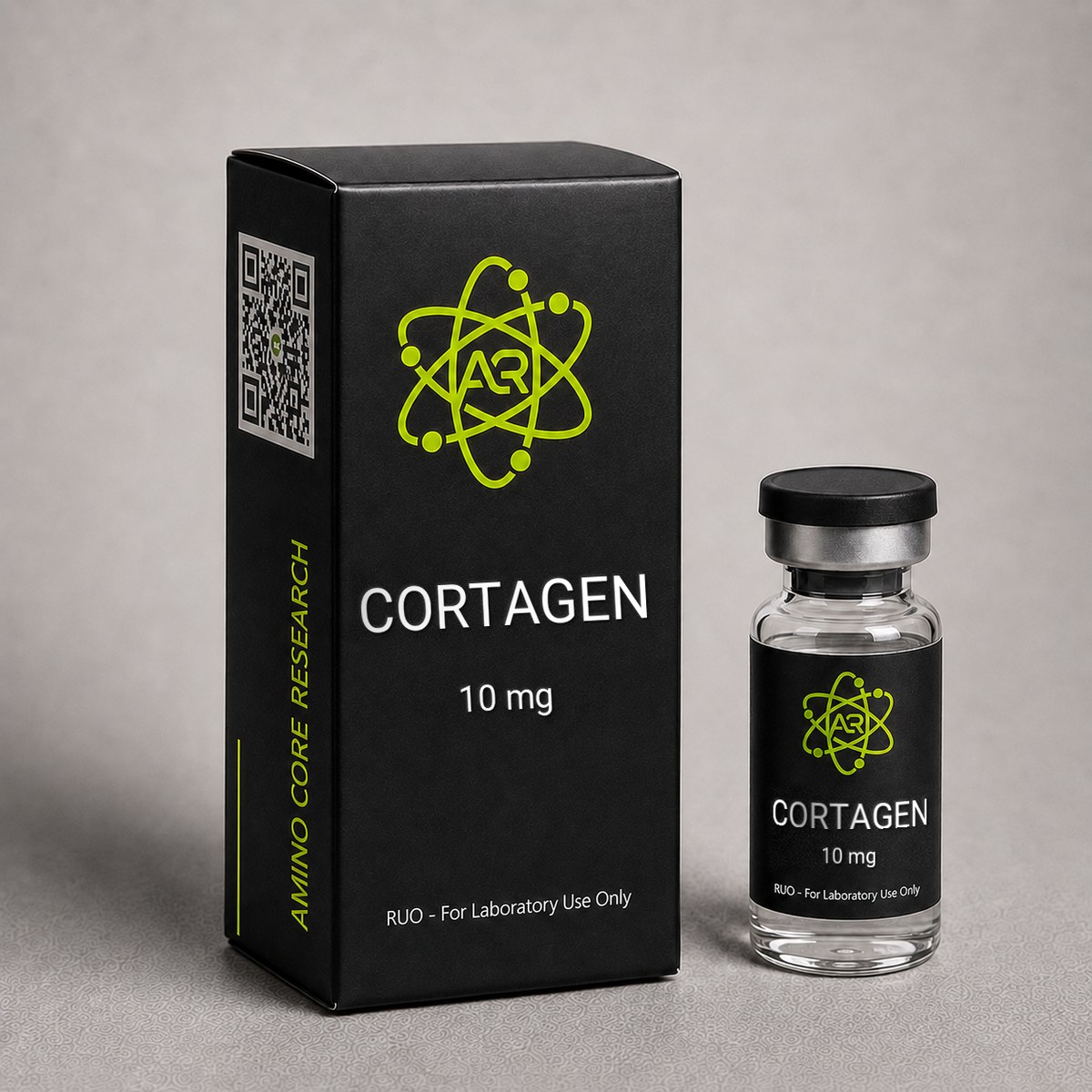
≥99%HPLC Purity
COAIncluded
USAShipped
Cortagen Peptide
Part of the Peptide Bioregulators family · Central nervous system
Cortex-derived bioregulatory tetrapeptide (Ala-Glu-Asp-Pro). Researched for neuroprotective effects and brain cortex function normalization in aging models.
$34.00 – $54.00
In stock — ships next business day
Quick Facts
| SKU | CORT-001 |
|---|---|
| CAS Number | 152796-48-4 |
| Molecular Formula | C17H26N4O9 |
| Molecular Weight | 430.41 g/mol |
| Sequence | Ala-Glu-Asp-Pro (AEDP) |
| Purity | ≥99% |
| Physical Form | Lyophilized Powder |
| Storage | Store at -20°C |
What is Cortagen (Ala-Glu-Asp-Pro)?
Brain cortex bioregulatory tetrapeptide normalizing neuronal gene expression. Research shows improvements in cognitive function markers, increased BDNF levels, and enhanced neuroplasticity in aging brain models.
Mechanism of Action
Cortagen (Ala-Glu-Asp-Pro) is a synthetic tetrapeptide bioregulator derived from polypeptide complexes originally isolated from the cerebral cortex of young calves. As with other Khavinson peptides, its proposed mechanism centers on direct epigenetic regulation of gene expression in neural tissues, rather than receptor-mediated signaling. Research suggests Cortagen operates through several interconnected pathways relevant to neuronal homeostasis and cortical function.
Direct DNA Interaction and Gene Expression
Khavinson and colleagues have proposed that short peptide bioregulators such as Cortagen penetrate cell and nuclear membranes and bind to specific sequences in promoter regions of double-stranded DNA. In molecular modeling studies, AEDP and related tetrapeptides show preferential binding to CpG-rich motifs, where they may modulate transcription of tissue-specific genes. In cortical neurons, this has been associated with altered expression of genes involved in synaptic plasticity, neurotrophin signaling, and antioxidant defense.
Modulation of Neurotrophic Factors
Preclinical reports indicate Cortagen influences expression of brain-derived neurotrophic factor (BDNF) and nerve growth factor (NGF) in cortical and hippocampal tissue. Upregulation of these neurotrophins is associated with enhanced dendritic arborization, synaptogenesis, and resistance of neurons to apoptotic stimuli. This neurotrophic profile distinguishes Cortagen from neurotransmitter-targeting nootropics, which act acutely on receptors rather than on long-term trophic programs.
Antioxidant and Anti-Apoptotic Effects
In aging brain models, Cortagen administration has been associated with reduced markers of oxidative stress, including decreased malondialdehyde (MDA) and increased activity of superoxide dismutase (SOD) and glutathione peroxidase (GPx). It has also been linked to downregulation of pro-apoptotic markers such as Bax and upregulation of anti-apoptotic Bcl-2, suggesting a role in preserving neuronal viability under stress conditions.
Neurotransmitter System Modulation
Although Cortagen is not a direct receptor ligand, research in rodent models shows it normalizes cortical levels of serotonin, dopamine, and norepinephrine following experimental disruption. This effect is hypothesized to be secondary to restored gene expression in monoaminergic neurons and improved oxidative balance, rather than to acute receptor binding.
Comparison to Related Bioregulators
Cortagen belongs to the same family of cortex-derived peptides as Cortexin (a polypeptide complex) and Pinealon (Glu-Asp-Arg). Unlike Cortexin, which contains a heterogeneous mixture of polypeptides, Cortagen is a defined tetrapeptide, allowing more reproducible structure-activity research. Compared with Pinealon, which is associated more strongly with pineal-cortical signaling and circadian-related gene expression, Cortagen research focuses primarily on cortical neuron survival and cognitive performance markers.
Collectively, the proposed mechanism positions Cortagen as a tissue-specific epigenetic modulator with neurotrophic, antioxidant, and neurotransmitter-normalizing effects in preclinical cortical models.
Research & Clinical Studies
Preclinical Study: Cortagen and Cortical Neuron Function in Aging Models
One of the foundational investigations of Cortagen examined its effects on cortical neuron function and behavioral performance in aged rodents. The study was designed to test the hypothesis that AEDP can normalize age-associated decline in cortical gene expression, neurotransmitter balance, and cognitive task performance.
Study Design
- Subjects: Aged Wistar rats (24 months) compared with young adult controls (3 months)
- Groups: Young control, aged control, aged + Cortagen
- Dosing: Cortagen administered intranasally at low microgram doses over a multi-week protocol
- Endpoints: Behavioral testing (Morris water maze, open field), cortical neurotransmitter analysis, expression of neurotrophin and antioxidant genes
Key Findings
- Aged animals receiving Cortagen showed improved spatial learning in the Morris water maze, with reduced latency to platform compared with aged controls.
- BDNF mRNA expression in the cortex was significantly elevated in the Cortagen group relative to untreated aged animals.
- Cortical serotonin and dopamine concentrations were partially restored toward young-adult values.
- Markers of lipid peroxidation (MDA) were reduced, while SOD activity was increased.
- No measurable adverse effects on body weight, organ histology, or peripheral biochemistry were reported at the doses tested.
Research Context
These findings are consistent with the broader Khavinson framework that short peptides derived from a given tissue exert tissue-specific regulatory effects. In this paradigm, Cortagen functions as a cortex-targeted bioregulator whose effects are most pronounced under conditions of age-related dysregulation. The data suggest that Cortagen does not exert acute psychoactive effects but rather supports gradual normalization of cortical molecular and behavioral phenotypes over repeated administration.
This study is frequently cited as the rationale for exploring AEDP in subsequent investigations of cognitive decline, neurodegenerative models, and post-ischemic recovery. It remains a strictly preclinical line of research, and findings have not been extended to controlled human therapeutic trials.
[1] Khavinson VK, Anisimov VN. Peptide bioregulation of aging: results and prospects. Bull Exp Biol Med. 2009;148(1):94-98. PubMed ↗
Cortagen and Peripheral Nerve Regeneration Research
Beyond its primary classification as a cortical bioregulator, Cortagen (Ala-Glu-Asp-Pro) has been investigated in models of peripheral nerve injury, where the tetrapeptide demonstrated regenerative signaling activity. Research from the St. Petersburg Institute of Bioregulation and Gerontology examined whether short peptides derived from cortical tissue could influence axonal regrowth, Schwann cell behavior, and functional recovery in transected sciatic nerve preparations.
Study Design
In the rodent sciatic nerve transection model, animals received Cortagen administration during the post-injury recovery period. Investigators evaluated:
- Axonal density distal to the injury site via histological analysis
- Myelin sheath thickness and Schwann cell proliferation
- Expression of regeneration-associated genes (GAP-43, neurofilament markers)
- Functional recovery measured through sciatic functional index (SFI) scoring
Key Findings
- Accelerated axonal regrowth: Cortagen-treated tissues showed earlier appearance of regenerating axons across the lesion site compared with vehicle controls.
- Enhanced Schwann cell activity: Increased Schwann cell proliferation and improved remyelination patterns were observed in histological sections.
- Upregulated regeneration markers: Expression of GAP-43, a classical marker of axonal growth cones, was elevated in dorsal root ganglion neurons exposed to the peptide.
- Improved SFI scores: Functional recovery indices improved more rapidly in treated animals across the post-injury observation window.
Mechanistic Interpretation
The investigators proposed that Cortagen's epigenetic activity — interaction with promoter regions of neurotrophic genes — drives the observed regenerative response. The tetrapeptide is thought to derepress transcription of genes encoding nerve growth factor (NGF), brain-derived neurotrophic factor (BDNF), and cytoskeletal proteins required for axon extension. This positions Cortagen alongside Cortexin and other cortical bioregulators as a tool for probing peptide-driven neurotrophic signaling.
Research Context
Peripheral nerve regeneration research with short peptides represents an active area within the Russian peptide bioregulation school established by Khavinson and colleagues. Cortagen's tetrapeptide structure (Ala-Glu-Asp-Pro) is among the simplest pharmacologically active sequences derived from cortical extracts, making it useful for comparative studies against more complex preparations such as Cortexin polypeptide fractions. The reproducibility of these regenerative findings across multiple rodent injury models has supported continued interest in tetrapeptide bioregulators as scaffolds for understanding peptide-DNA interaction in neural tissue repair.
[1] Khavinson VK, Malinin VV. Gerontological aspects of genome peptide regulation. Karger, Basel, 2005. Reviewed mechanisms of cortical tetrapeptides including Cortagen.
[2] Khavinson VKh, Grigoriev EI, Malinin VV, Ryzhak GA. Peptide regulation of cell differentiation, gene expression and protein synthesis.
Chemical & Physical Properties
Cortagen is a defined synthetic tetrapeptide with a well-characterized chemical profile. The following table summarizes its key chemical and physical properties as relevant to laboratory research handling.
| Full Name / Synonyms | Cortagen; AEDP; Ala-Glu-Asp-Pro; H-Ala-Glu-Asp-Pro-OH |
|---|---|
| Molecular Formula | C₁₇H₂₆N₄O₉ |
| Molecular Weight | 430.41 g/mol |
| CAS Number | 152796-48-4 |
| Sequence | Ala-Glu-Asp-Pro (N-terminal alanine, C-terminal proline) |
| Amino Acid Count | 4 |
| Origin / Developer | Synthetic analog of cortex-derived polypeptide complex; developed within the Khavinson school of peptide bioregulators (St. Petersburg Institute of Bioregulation and Gerontology) |
| Key Modifications | None — unmodified linear tetrapeptide with free N- and C-termini |
| Physical Form | Lyophilized white to off-white powder |
| Solubility | Soluble in water and bacteriostatic water; soluble in 0.9% saline; limited solubility in organic solvents |
| Purity | ≥99% by HPLC |
| Net Charge (pH 7) | Net negative due to two acidic residues (Glu, Asp) |
| Storage | Lyophilized: -20°C long-term; reconstituted: 2-8°C, short-term use |
The low molecular weight and short sequence place Cortagen within the class of short peptide bioregulators that, according to published research, are capable of crossing biological membranes and reaching nuclear targets. The absence of disulfide bonds or non-canonical residues simplifies handling and reconstitution relative to more complex peptides, although the acidic side chains of Glu and Asp make the molecule sensitive to extremes of pH and prolonged heating.
Researchers should confirm batch-specific identity and purity using the certificate of analysis (COA) supplied with each lot, which typically includes HPLC and mass spectrometry data.
Handling & Reconstitution Guidelines
Cortagen is supplied as a sterile lyophilized powder and requires reconstitution prior to use in research applications. The tetrapeptide Ala-Glu-Asp-Pro is relatively stable in solution compared with longer peptides, but proper aseptic technique and appropriate diluent selection remain essential for preserving compound integrity.
Recommended Reconstitution Protocol
- Equilibrate the vial: Allow the sealed lyophilized vial to reach room temperature (approximately 20-25°C) over 20-30 minutes before opening. This prevents condensation from forming inside the vial when cold powder contacts ambient air.
- Select diluent: Use sterile bacteriostatic water (0.9% benzyl alcohol) for multi-use research preparations, or sterile water for injection for single-use applications. Cortagen exhibits excellent water solubility due to its hydrophilic residues (Glu, Asp).
- Calculate concentration: A common working concentration is 5 mg/mL. For a 10 mg vial, add 2 mL of diluent. For a 20 mg vial, add 4 mL.
- Inject diluent slowly: Direct the stream against the inner wall of the vial rather than onto the lyophilized cake. This prevents foaming and minimizes mechanical stress on the peptide.
- Dissolve gently: Swirl or roll the vial between palms until the powder fully dissolves. Do NOT shake or vortex vigorously — shear forces can fragment peptide bonds and introduce air bubbles that accelerate oxidation.
- Inspect the solution: The reconstituted solution should appear clear and colorless. Discard any preparation showing turbidity, particulates, or discoloration.
Compound-Specific Handling Notes
- Acidic residues: Cortagen contains both glutamic acid and aspartic acid, making the peptide negatively charged at physiological pH. Avoid contact with strongly cationic surfaces or buffers containing divalent metals that may precipitate the compound.
- No disulfide bonds: Unlike cysteine-containing peptides, Cortagen does not require reducing agents and is not susceptible to disulfide scrambling.
- Low oxidation risk: The absence of methionine, cysteine, and tryptophan residues makes Cortagen relatively oxidation-resistant compared with peptides like Semax.
- pH considerations: Solutions are most stable in the pH 5-7 range. Strongly acidic or alkaline buffers may promote hydrolysis of the peptide backbone over time.
Aliquoting Recommendations
For long-term research use, aliquot the reconstituted solution into single-use sterile tubes immediately after preparation. This avoids repeated freeze-thaw cycles, which can degrade peptide structure even for short, stable sequences like Ala-Glu-Asp-Pro.
Storage & Stability Information
Proper storage is critical for preserving the bioregulatory activity of Cortagen across the duration of a research program. Although the tetrapeptide structure (Ala-Glu-Asp-Pro) is more stable than larger peptides, exposure to temperature fluctuations, moisture, and light can still degrade the compound over extended periods.
Lyophilized Powder Storage
- Long-term storage (months to years): Store sealed vials at -20°C in a dedicated laboratory freezer. Under these conditions, lyophilized Cortagen retains full activity for 24 months or longer.
- Short-term storage (up to 30 days): Storage at 2-8°C in a standard refrigerator is acceptable for active research use.
- Transit conditions: Brief exposure to room temperature (up to 7 days) during shipping does not significantly affect lyophilized Cortagen stability due to the absence of oxidation-prone residues.
- Protect from light: Store vials in opaque containers or in their original packaging. Although Cortagen lacks tryptophan, ambient UV exposure should be minimized as a general precaution.
- Desiccate: Keep vials in a low-humidity environment. Moisture absorption can compromise the lyophilized cake and promote hydrolysis.
Reconstituted Solution Storage
- Refrigerated (2-8°C): After reconstitution with bacteriostatic water, solutions remain stable for approximately 21-28 days when stored upright and protected from light.
- Frozen aliquots (-20°C): Single-use aliquots can be frozen for up to 3 months. Thaw at 2-8°C rather than at room temperature to minimize thermal stress.
- Avoid freeze-thaw cycles: Each freeze-thaw cycle can degrade peptide integrity. Aliquoting before freezing eliminates this issue.
Stability Indicators
Degraded Cortagen solutions may exhibit visible turbidity, particulates, or color changes. A clear, colorless solution indicates the peptide remains intact. For critical research applications, HPLC analysis can confirm purity after extended storage.
Disposal
Expired or degraded peptide material should be disposed of according to institutional biosafety guidelines for research chemicals. Cortagen is not classified as hazardous waste under standard regulations, but laboratory protocols should be followed for all chemical disposal.
Frequently Asked Questions
How does Cortagen support brain function?
Cortagen normalizes gene expression in cortical neurons, increasing BDNF and synaptophysin production. It enhances neuroplasticity and cognitive processing speed in aging models through transcriptional regulation.
What is the molecular weight and CAS number of Cortagen?
Cortagen (Ala-Glu-Asp-Pro) has a molecular formula of C17H26N4O9, a molecular weight of approximately 430.41 g/mol, and CAS number 152796-48-4. It is a linear, unmodified tetrapeptide composed of alanine, glutamic acid, aspartic acid, and proline. Its compact size and acidic character place it within the family of short peptide bioregulators developed in the Khavinson research program for tissue-specific epigenetic studies.
How does Cortagen compare to Cortexin and Pinealon?
Cortagen, Cortexin, and Pinealon are all associated with cortex- and brain-related peptide bioregulation research, but they differ structurally. Cortexin is a polypeptide complex extracted from cerebral cortex containing many components, whereas Cortagen is a defined synthetic tetrapeptide (Ala-Glu-Asp-Pro), allowing more reproducible structure-activity studies. Pinealon (Glu-Asp-Arg) is a related tripeptide more often studied in the context of pineal-cortical signaling and circadian gene expression, while Cortagen research focuses primarily on cortical neuron survival, neurotrophin expression, and cognitive performance markers in aging models.
How should Cortagen be stored in the laboratory?
Lyophilized Cortagen should be stored at -20°C for long-term stability, protected from light and moisture. For short transit periods, room temperature exposure is generally acceptable, but prolonged ambient storage is not recommended. Once reconstituted in bacteriostatic water or sterile saline, Cortagen solutions should be kept at 2-8°C and used within a limited time window, typically a few weeks, to minimize peptide degradation. Repeated freeze-thaw cycles of reconstituted material should be avoided.
Is Cortagen approved for human therapeutic use?
No. Cortagen is supplied by AminoCore Research strictly as a reference compound for in vitro and preclinical laboratory investigation. It is not approved by the FDA, EMA, or comparable regulatory agencies as a therapeutic product, and published data are limited to preclinical models and mechanistic studies. It must not be used for diagnostic or therapeutic purposes in humans or animals outside an appropriately authorized research setting.
What sizes of Cortagen are available from AminoCore Research?
AminoCore Research typically offers Cortagen in 10 mg and 20 mg lyophilized vial sizes, with ≥99% HPLC purity. Each lot is shipped with a Certificate of Analysis (COA) documenting purity, mass spectrometry confirmation of the Ala-Glu-Asp-Pro sequence, and molecular weight verification (430.41 g/mol). Cortagen is supplied for in vitro and preclinical research use only and is not intended for human consumption or therapeutic application. Researchers should consult current product listings for available sizes and bulk pricing options.
Does Cortagen require reconstitution with bacteriostatic water?
Cortagen ships as a sterile lyophilized powder that must be reconstituted before research use. Sterile bacteriostatic water (containing 0.9% benzyl alcohol) is recommended for multi-use preparations because the preservative inhibits microbial growth during repeated vial access. Sterile water for injection is appropriate for single-use applications. A typical working concentration is 5 mg/mL, achieved by adding 2 mL of diluent to a 10 mg vial. The peptide dissolves readily due to its hydrophilic residues. Gentle swirling is preferred over vortexing to avoid mechanical degradation.
Is Cortagen susceptible to oxidation during storage?
Cortagen has relatively low oxidation risk compared with many other research peptides. The tetrapeptide sequence Ala-Glu-Asp-Pro lacks methionine, cysteine, and tryptophan — the three residues most vulnerable to oxidative damage. This makes Cortagen more forgiving than peptides like Semax or BPC-157 during handling. However, standard precautions still apply: store lyophilized vials at -20°C, protect reconstituted solutions from light, and avoid prolonged exposure to ambient air. The primary degradation pathway for Cortagen is hydrolysis of peptide bonds under extreme pH conditions rather than oxidation.
What research applications is Cortagen used for in preclinical studies?
Cortagen is used in preclinical research investigating cortical neuron function, neuroprotection, peripheral nerve regeneration, and peptide-mediated gene expression. Studies have examined its effects in aging brain models, ischemia-reperfusion injury models, and sciatic nerve transection preparations. As a cortical bioregulator from the Khavinson peptide family, Cortagen is frequently used as a comparative tool alongside Cortexin, Pinealon, and Epitalon to study tissue-specific tetrapeptide signaling. Research applications are restricted to in vitro and animal models; Cortagen is not authorized for human therapeutic use in most jurisdictions.
For laboratory and research use only. This product is not for human or veterinary use. It is not a drug, supplement or food.
This product is not FDA approved for any indication, and is not intended to diagnose, treat, cure, or prevent any disease. All product information is derived from published preclinical research and does not constitute medical advice or claims.