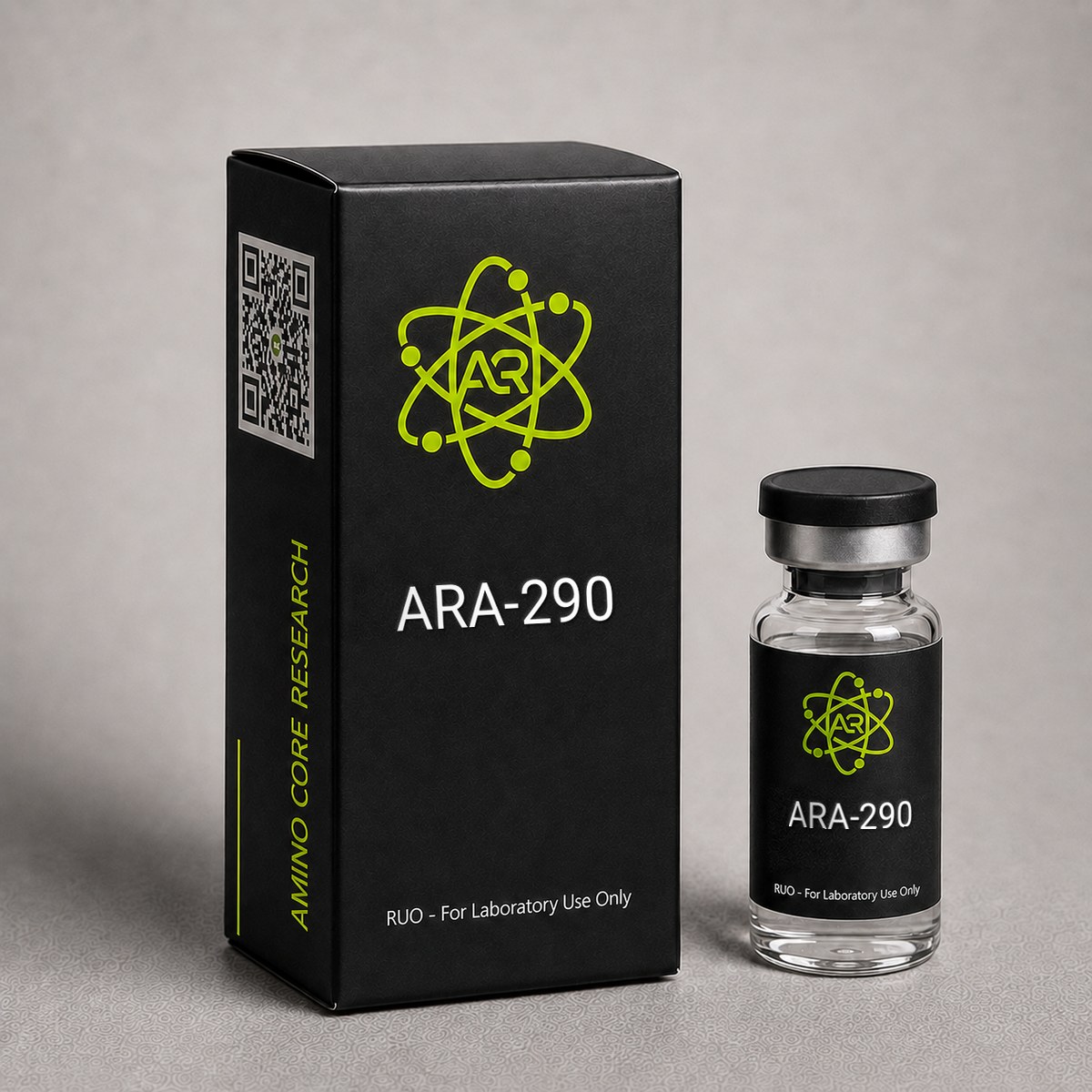
≥99%HPLC Purity
COAIncluded
USAShipped
ARA-290 (Cibinetide) Peptide
Innate repair receptor (IRR) agonist peptide. 11-amino acid peptide derived from erythropoietin helix B surface.
$65.00
In stock — ships next business day
Quick Facts
| SKU | ACR-ARA290 |
|---|---|
| CAS Number | 1208243-50-8 |
| Molecular Formula | C55H89N17O15 |
| Molecular Weight | 1260.52 g/mol |
| Sequence | Pyr-Glu-Gln-Leu-Glu-Arg-Ala-Leu-Asn-Ser-Ser (QEQLERALNSS, N-terminal pyroglutamate) |
| Purity | ≥99% |
| Physical Form | Lyophilized Powder |
| Storage | Store at -20°C |
What is ARA-290?
ARA-290 (Cibinetide) is a non-erythropoietic EPO-derived peptide that activates the Innate Repair Receptor. It provides tissue protection and anti-inflammatory effects without stimulating red blood cell production.
Mechanism of Action
ARA-290 (cibinetide) is an 11-amino acid linear peptide whose sequence corresponds to the aqueous-exposed face of helix B of erythropoietin (EPO). It was rationally designed to dissociate the cytoprotective and tissue-repair activities of EPO from its hematopoietic effects, exploiting the fact that these two activity profiles are mediated by structurally distinct receptor complexes.
Selective Activation of the Innate Repair Receptor (IRR)
Classical EPO signaling in erythroid progenitors occurs through a homodimer of the erythropoietin receptor (EPOR2). In contrast, tissue-protective signaling occurs through a heteromeric complex composed of EPOR and the common β-chain (CD131, βcR) shared with GM-CSF, IL-3 and IL-5 receptors. This EPOR/βcR heterocomplex is termed the innate repair receptor (IRR). ARA-290 binds the IRR with nanomolar affinity but does not engage EPOR2 homodimers, producing tissue-protective effects without stimulating erythropoiesis, platelet activation, or elevations in hematocrit.[1]
Downstream Signaling Cascades
Engagement of the IRR activates several intracellular pathways implicated in cell survival and resolution of inflammation:
- JAK2/STAT3 and STAT5 — antiapoptotic gene expression (Bcl-xL, Mcl-1).
- PI3K/AKT — inhibition of GSK-3β and pro-apoptotic BAD phosphorylation.
- MAPK (ERK1/2) — cytoprotection and modulation of proliferation in repair-competent cells.
- NF-κB modulation — reduced transcription of TNF-α, IL-6, and IL-1β in activated macrophages.
Anti-inflammatory and Neurotrophic Effects
In preclinical models, ARA-290 reduces pro-inflammatory cytokine release from activated immune cells, attenuates neutrophil infiltration, and decreases oxidative stress in injured tissue. In sensory neurons, IRR activation has been associated with restoration of small nerve fiber density and improvement of corneal nerve fiber metrics, suggesting a neurotrophic component relevant to small fiber neuropathy research.[2]
Differentiation from Erythropoietin
Unlike EPO, ARA-290 has a plasma half-life of only ~2 minutes, yet produces biological effects lasting hours to days, consistent with receptor-mediated hit-and-run signaling. Because it does not bind EPOR2, ARA-290 lacks the thrombotic and hypertensive liabilities that limit chronic EPO administration, making it a useful tool compound for dissecting the cytoprotective arm of EPO biology in research models.
Research & Clinical Studies
Phase 2 Trial: Sarcoidosis-Associated Small Fiber Neuropathy
One of the most influential clinical investigations of ARA-290 examined its effects in patients with sarcoidosis-associated small fiber neuropathy (SFN), a condition characterized by loss of intraepidermal nerve fiber density, neuropathic pain, and autonomic dysfunction. The study was a randomized, double-blind, placebo-controlled Phase 2 trial conducted by Heij and colleagues.
Study Design
- Population: 22 patients with sarcoidosis-associated SFN documented by reduced corneal nerve fiber metrics and elevated Small Fiber Neuropathy Screening List (SFNSL) scores.
- Intervention: ARA-290 4 mg subcutaneously daily vs placebo for 28 days.
- Primary endpoints: Change in SFNSL score, neuropathic pain (Brief Pain Inventory), and quality-of-life measures.
- Secondary endpoints: Corneal nerve fiber density (CNFD), exercise capacity (6-minute walk test).
Key Results
- SFNSL score decreased by a mean of −7.7 points in the ARA-290 group vs +1.2 points with placebo (p < 0.01).
- Pain intensity and pain interference scores decreased significantly in the active arm.
- Mean 6-minute walk distance increased by ~60 meters after 28 days of ARA-290.
- No hematocrit elevation, blood-pressure increase, or treatment-related serious adverse events were reported.
Research Context
This study was significant because it provided early human evidence that selective IRR activation could improve neuropathic symptoms without the hematologic and cardiovascular liabilities of EPO. It also reinforced the use of corneal confocal microscopy as a non-invasive biomarker of small nerve fiber integrity, an endpoint now widely adopted in neuropathy research. Subsequent open-label extensions reported sustained improvements over 6+ months of dosing, supporting durability of the tissue-protective response.[1]
[1] Heij L, et al. Safety and efficacy of ARA 290 in sarcoidosis patients with symptoms of small fiber neuropathy: a randomized, double-blind pilot study. Mol Med. 2012;18:1430-1436. PubMed ↗
Diabetic Neuropathic Pain and Metabolic Improvements
A 28-day randomized, double-blind, placebo-controlled Phase 2 study by Brines and colleagues evaluated ARA-290 (cibinetide) in patients with type 2 diabetes and documented neuropathic pain. The trial enrolled 48 participants who were randomized to receive subcutaneous ARA-290 (4 mg) or matching placebo daily for 28 days, with a 28-day follow-up. The study was designed to assess the safety, tolerability, and effects of innate repair receptor (IRR) activation on neuropathic symptoms, corneal nerve fiber morphology, and metabolic parameters.
Key Results
- Neuropathic pain (PI-NRS): ARA-290 produced a statistically significant reduction in pain intensity compared with placebo, with effects persisting through the 28-day follow-up period after dosing ended, suggesting a disease-modifying rather than purely symptomatic action.
- Quality of life: Improvements were observed in SF-36 mental and physical component scores, consistent with reduced neuropathic burden.
- Corneal nerve fiber density: In vivo corneal confocal microscopy demonstrated trends toward increased small nerve fiber density in the ARA-290 group, providing a structural correlate to symptomatic improvement.
- HbA1c: Glycated hemoglobin decreased significantly in the ARA-290 group (approximately -0.5%) versus placebo, an unexpected metabolic finding attributed to reduced tissue inflammation and improved insulin signaling.
- Safety: No changes in hemoglobin, hematocrit, reticulocyte count, or blood pressure were observed, confirming the non-erythropoietic profile of ARA-290.
These data provide preclinical and translational support for the hypothesis that selective IRR activation can simultaneously address small fiber neuropathy and contribute to metabolic homeostasis in diabetes, distinct from the erythropoietic actions of native EPO. The lack of hematological effects is mechanistically consistent with ARA-290's design as a helix B surface peptide that does not engage the classical EPOR/EPOR homodimer responsible for erythropoiesis.
Subsequent open-label extension data and corroborative work in sarcoidosis-associated neuropathy populations have reinforced the reproducibility of the small-fiber regenerative signal. Researchers continue to investigate whether the metabolic findings reflect direct effects on adipose tissue inflammation, improved pancreatic islet function, or indirect benefits from restoration of autonomic small-fiber signaling. In the context of related tissue-repair peptides, ARA-290 is differentiated by its convergence of anti-inflammatory, neurotrophic, and metabolic activity through a single molecular target (the IRR heteromer composed of EPOR and CD131/βcR).
[1] Brines M, Dunne AN, van Velzen M, et al. ARA 290, a nonerythropoietic peptide engineered from erythropoietin, improves metabolic control and neuropathic symptoms in patients with type 2 diabetes. Mol Med. 2015;20:658-666. PubMed ↗
Chemical & Physical Properties
ARA-290 (cibinetide) is a short linear peptide derived from the helix B surface of human erythropoietin. The N-terminal glutamine is typically cyclized to pyroglutamate (pyr-Glu), which confers resistance to aminopeptidase degradation. The compound contains no disulfide bridges and no non-natural amino acids, making it relatively straightforward to handle compared with cysteine-rich peptides.
| Full Name | ARA-290 (Cibinetide); Erythropoietin Helix B Surface Peptide |
|---|---|
| Synonyms | Cibinetide, pHBSP, Helix B Surface Peptide |
| Molecular Formula | C55H89N17O15 |
| Molecular Weight | 1260.52 g/mol |
| CAS Number | 1208243-50-8 |
| Sequence | Pyr-Glu-Gln-Leu-Glu-Arg-Ala-Leu-Asn-Ser-Ser (single-letter: pyroQEQLERALNSS) |
| Amino Acid Count | 11 |
| Origin / Developer | Designed by Araim Pharmaceuticals (Brines, Cerami and colleagues) based on the aqueous face of EPO helix B |
| Key Modifications | N-terminal pyroglutamate cyclization (resistance to aminopeptidases) |
| Physical Form | Lyophilized white powder |
| Solubility | Soluble in sterile water and bacteriostatic water; soluble in PBS at neutral pH |
| Purity | ≥99% by HPLC |
| Receptor Target | Innate Repair Receptor (EPOR/βcR heteromer) |
| Plasma Half-life | ~2 minutes (effects persist for hours via signaling) |
The peptide is supplied as a lyophilized powder under inert gas to minimize oxidation. Because the sequence lacks methionine, tryptophan, and cysteine, ARA-290 is comparatively stable against oxidative degradation, though general best practices for peptide handling still apply.
Handling & Reconstitution Guidelines
ARA-290 (cibinetide) is supplied as a sterile, lyophilized white powder intended for laboratory research use only. Proper reconstitution preserves the structural integrity of the 11-residue helix B surface peptide and ensures reproducible activity in cell-based and in vivo research models. Because ARA-290 is highly water-soluble and does not contain disulfide bridges, reconstitution is straightforward, but standard aseptic technique should be observed.
Recommended Reconstitution Protocol
- Equilibrate the vial to room temperature (15-25°C) for 20-30 minutes before opening. This prevents condensation from forming on the cold lyophilizate when the stopper is pierced.
- Briefly centrifuge the vial (if a benchtop microcentrifuge is available) to ensure all powder is at the base before introducing diluent.
- Select diluent: Bacteriostatic water for injection (0.9% benzyl alcohol) is preferred for multi-day studies; sterile water for injection or 0.9% sodium chloride is acceptable for single-use preparations.
- Add diluent slowly down the inner wall of the vial — do not inject directly onto the powder cake. A typical preparation is 5 mg + 2 mL = 2.5 mg/mL, or 10 mg + 2 mL = 5 mg/mL.
- Dissolve gently by swirling the vial in a slow circular motion or inverting 5-10 times. Do not shake or vortex — agitation can introduce shear stress, denature the peptide, and create foaming that reduces effective concentration.
- Inspect the resulting solution. It should be clear and colorless with no visible particulates. If turbidity or particulates are present, discard and prepare a fresh vial.
- Aliquot the reconstituted solution into low-binding sterile tubes if extended use is planned, to minimize freeze-thaw cycles.
Compound-Specific Handling Notes
- ARA-290 contains no methionine or cysteine residues, so methionine oxidation and disulfide scrambling are not concerns — a stability advantage over many EPO-derived constructs.
- The peptide is sensitive to repeated freeze-thaw cycles; limit to 3 or fewer.
- Protect from prolonged ambient light exposure during weighing and reconstitution.
- Use low-protein-binding pipette tips and storage vials to minimize adsorptive losses at low working concentrations (<100 µg/mL).
All handling should be conducted in accordance with the user's institutional biosafety guidelines. ARA-290 is not for human or veterinary use; it is intended exclusively for in vitro and in vivo laboratory research conducted by qualified investigators.
Storage & Stability Information
Proper storage of ARA-290 (cibinetide) is essential to maintain peptide integrity, IRR binding affinity, and reproducibility across long-term research programs. The compound's compact 11-residue structure and absence of disulfide bonds confer relatively favorable stability compared with larger erythropoiesis-stimulating proteins, but standard cold-chain practices remain critical.
Lyophilized Powder Storage
- Long-term (≥1 month): Store sealed lyophilized vials at -20°C in a manual-defrost freezer. Under these conditions, ARA-290 is typically stable for 24 months or longer from the date of manufacture, provided the desiccated environment is maintained.
- Short-term (≤30 days): Storage at 2-8°C in a refrigerator is acceptable for ongoing experimental campaigns where frequent access is required.
- Transit: Brief exposure to ambient temperature (up to 7 days) during shipping does not measurably degrade the lyophilized peptide, due to the absence of oxidation-prone residues.
Reconstituted Solution Storage
- After reconstitution in bacteriostatic water, store at 2-8°C and use within 28 days for highest reproducibility.
- For longer retention, aliquot into single-use volumes and store at -20°C or -80°C for up to 3 months. Avoid more than 2-3 freeze-thaw cycles.
- Allow frozen aliquots to thaw at 2-8°C rather than at room temperature to minimize local concentration gradients.
Compound-Specific Stability Notes
- ARA-290 contains no methionine, cysteine, or tryptophan residues, eliminating the most common oxidative degradation pathways seen in EPO and related peptides.
- The peptide is stable across a pH range of approximately 5-8; extremes of pH should be avoided in buffer selection.
- Adsorption to glass and polypropylene surfaces is minimal at concentrations above 0.5 mg/mL but can become significant at sub-microgram/mL working dilutions — carrier protein (e.g., 0.1% BSA) may be added for dilute working solutions.
Always document reconstitution date, diluent, and storage temperature on each vial to support data traceability and quality assurance.
Frequently Asked Questions
How does ARA-290 differ from EPO?
ARA-290 activates the Innate Repair Receptor without erythropoiesis. EPO activates both pathways. ARA-290 provides tissue protection without polycythemia risk.
What is ARA-290 (Cibinetide)?
ARA-290, also known as cibinetide, is an 11-amino acid linear peptide derived from the aqueous-exposed surface of helix B of erythropoietin (EPO). It was engineered to selectively activate the innate repair receptor (IRR), a heteromer of the EPO receptor and the common β-chain (CD131), without engaging the classical EPOR homodimer responsible for erythropoiesis. In preclinical models, ARA-290 has been associated with reduced inflammation, improved tissue repair, and restoration of small nerve fiber density, making it a widely studied tool compound in tissue protection and neuropathy research.
What is the molecular weight and CAS number of ARA-290?
ARA-290 (cibinetide) has a molecular formula of C55H89N17O15, a molecular weight of 1260.52 g/mol, and CAS number 1208243-50-8. Its sequence is pyroGlu-Glu-Gln-Leu-Glu-Arg-Ala-Leu-Asn-Ser-Ser (pyroQEQLERALNSS), where the N-terminal glutamine is cyclized to pyroglutamate to protect against aminopeptidase cleavage. AminoCore Research supplies ARA-290 as a lyophilized powder at ≥99% HPLC purity for in vitro and in vivo laboratory research.
How should ARA-290 be reconstituted and stored?
Lyophilized ARA-290 should be stored at −20°C, protected from light and moisture, and is stable for extended periods under these conditions. For reconstitution, sterile or bacteriostatic water is typically added directly to the vial wall and allowed to dissolve without vortexing; gentle swirling preserves peptide integrity. After reconstitution, ARA-290 should be stored at 2–8°C and used within approximately 2–4 weeks, or aliquoted and frozen at −20°C or −80°C for longer-term storage to minimize freeze-thaw cycles.
Does ARA-290 stimulate red blood cell production like EPO?
No. Although ARA-290 is derived from erythropoietin, it was specifically designed to dissociate tissue-protective activity from hematopoietic activity. It binds the EPOR/βcR heteromer (innate repair receptor) but not the EPOR homodimer responsible for stimulating erythroid progenitor cells. In published clinical and preclinical studies, ARA-290 administration produced no significant increase in hematocrit, hemoglobin, reticulocyte count, or blood pressure, distinguishing it pharmacologically from EPO and EPO analogs such as darbepoetin.
What sizes of ARA-290 are available from AminoCore Research?
ARA-290 (cibinetide) is offered by AminoCore Research in research-scale vials, typically including 5 mg and 10 mg lyophilized powder formats. Each lot is supplied with a Certificate of Analysis documenting ≥99% HPLC purity, mass spectrometry confirmation of the 1260.52 g/mol molecular weight, and identity verification against the published 11-amino acid sequence (QEQLERALNSS). Bulk and custom configurations may be available upon written inquiry for qualified academic and commercial research laboratories. All material is intended exclusively for in vitro and in vivo laboratory research and is not for human or veterinary use.
Does ARA-290 affect blood pressure or cardiovascular parameters in research models?
Published research on ARA-290 (cibinetide) consistently reports no significant changes in systolic or diastolic blood pressure, heart rate, hemoglobin, hematocrit, or reticulocyte counts across Phase 1 and Phase 2 clinical investigations. This favorable profile reflects ARA-290's selectivity for the innate repair receptor (IRR), a heteromer of EPOR and CD131/βcR, rather than the classical EPOR homodimer that mediates erythropoiesis and contributes to EPO's hypertensive and thrombotic effects. In preclinical cardiac ischemia-reperfusion and heart failure models, ARA-290 has actually been associated with reduced infarct size and improved cardiac function without raising blood pressure, supporting its tissue-protective rather than pro-erythropoietic mechanism.
How is ARA-290 stored and what is its shelf life?
Lyophilized ARA-290 should be stored at -20°C in a manual-defrost freezer for long-term retention, where it remains stable for approximately 24 months from manufacture. Short-term refrigeration at 2-8°C is acceptable for active experimental campaigns. Once reconstituted in bacteriostatic water, the peptide is stable at 2-8°C for up to 28 days, or aliquoted and stored at -20°C to -80°C for up to 3 months with no more than 2-3 freeze-thaw cycles. Because ARA-290 lacks methionine, cysteine, and tryptophan, it is not subject to the oxidative degradation pathways that limit the shelf life of many other peptides.
How does ARA-290 compare to BPC-157 for tissue repair research?
ARA-290 (cibinetide) and BPC-157 are both research peptides associated with tissue protection but operate through fundamentally different mechanisms. ARA-290 is an 11-residue helix B surface peptide that selectively activates the innate repair receptor (IRR, an EPOR/CD131 heteromer), driving anti-inflammatory, anti-apoptotic, and small-fiber neuroregenerative effects without erythropoiesis. BPC-157 is a 15-residue gastric pentadecapeptide thought to modulate nitric oxide, VEGF, and growth-factor signaling to support angiogenesis and connective-tissue repair. Research applications differ: ARA-290 is most studied in neuropathy, diabetic complications, and inflammatory injury models, whereas BPC-157 is investigated primarily in tendon, ligament, and gastrointestinal repair contexts.
For laboratory and research use only. This product is not for human or veterinary use. It is not a drug, supplement or food.
This product is not FDA approved for any indication, and is not intended to diagnose, treat, cure, or prevent any disease. All product information is derived from published preclinical research and does not constitute medical advice or claims.