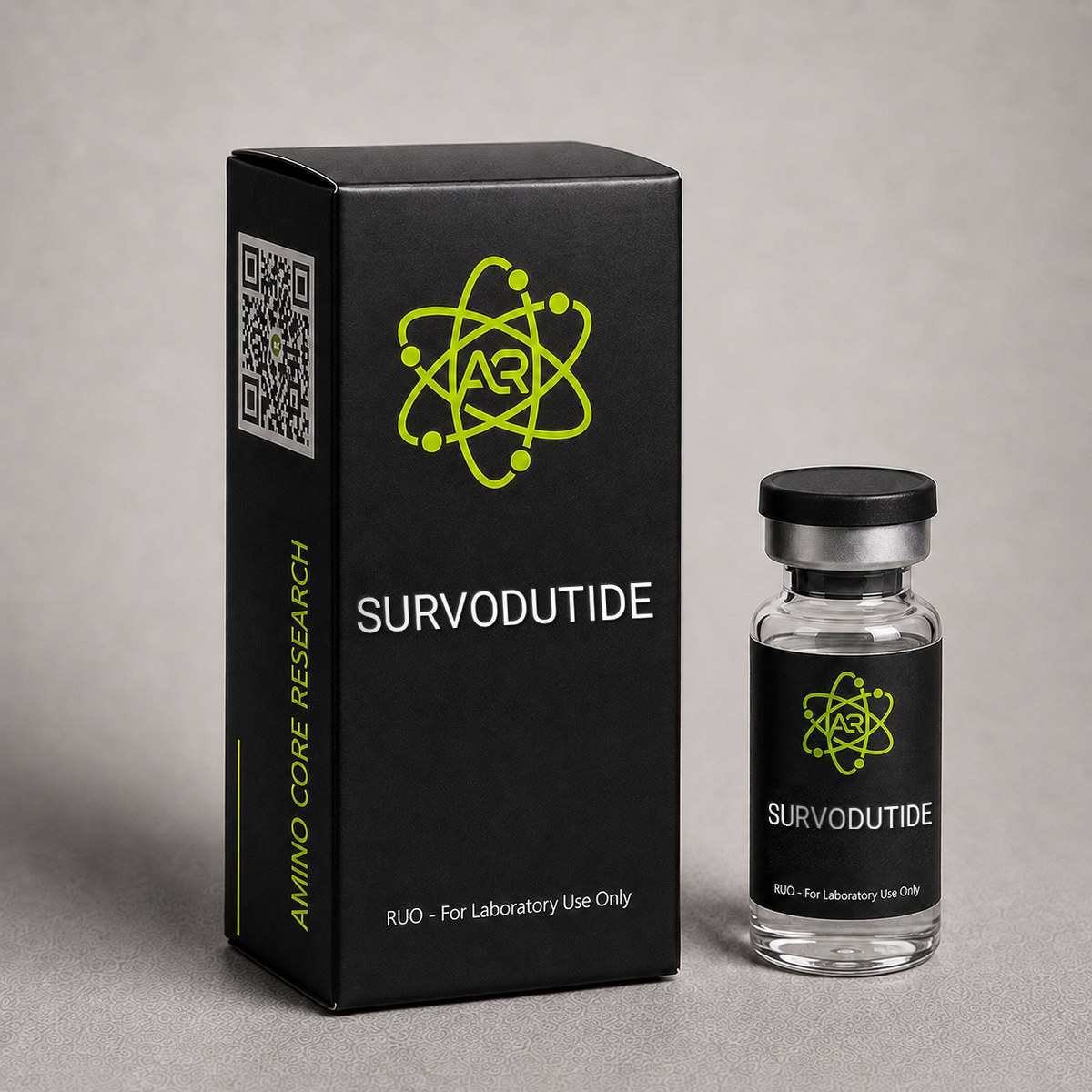
≥99%HPLC Purity
COAIncluded
USAShipped
Survodutide Peptide
Dual glucagon/GLP-1 receptor agonist peptide. Studied for dual incretin receptor co-activation and metabolic pathway research.
Research Reference
This page is a research monograph. Survodutide is documented here for reference — structure, mechanism and published literature — and is not offered for sale.
Browse compounds available for research purchase · Read the research library
Quick Facts
| SKU | ACR-SURVO |
|---|---|
| CAS Number | 2407991-90-6 |
| Molecular Formula | C189H288N48O57 |
| Molecular Weight | 4205.7 g/mol |
| Sequence | H-His-Aib-Gln-Gly-Thr-Phe-Thr-Ser-Asp-Tyr-Ser-Lys-Tyr-Leu-Asp-Glu-Lys-Lys-Ala-Lys-Glu-Phe-Val-Glu-Trp-Leu-Leu-Glu-Gly-Gly-Pro-Ser-Ser-Gly-Ala-Pro-Pro-Pro-Ser-OH (Lys17 and Lys20 modified with fatty acid chain via γGlu linker) |
| Purity | ≥97% |
| Physical Form | Lyophilized Powder |
| Storage | Store at -20°C |
What is Survodutide?
Survodutide (BI 456906) is a dual glucagon receptor (GCGR) and GLP-1 receptor (GLP-1R) agonist developed as an acylated peptide with optimized dual receptor co-agonism. It represents the emerging class of dual/multi-agonist incretin peptides.
The dual agonism strategy combines GLP-1R activation (promoting insulin secretion and satiety signaling) with GCGR activation (promoting hepatic lipid oxidation and energy expenditure). Published research has investigated the balanced receptor activation profile and downstream cAMP signaling.
For laboratory research use only.
Mechanism of Action
Survodutide (BI 456906) is a long-acting dual agonist that simultaneously activates the glucagon receptor (GCGR) and the glucagon-like peptide-1 receptor (GLP-1R). This dual incretin/glucagon co-activation strategy represents one of the most extensively studied multi-receptor approaches in metabolic pathway research, with the goal of combining the appetite-suppressing and insulinotropic effects of GLP-1R agonism with the energy expenditure-enhancing effects of GCGR agonism.
GLP-1 Receptor Activation
Survodutide binds the GLP-1 receptor, a class B G-protein coupled receptor (GPCR) expressed in pancreatic β-cells, the central nervous system (particularly the arcuate nucleus and area postrema), gastrointestinal tract, and cardiovascular tissues. GLP-1R activation triggers Gαs-coupled adenylyl cyclase activation, elevating intracellular cAMP and activating protein kinase A (PKA) and Epac2 signaling cascades. Downstream effects in preclinical models include glucose-dependent insulin secretion from β-cells, suppression of glucagon release from α-cells under hyperglycemic conditions, delayed gastric emptying, and central appetite suppression via POMC/CART neurons in the hypothalamus.
Glucagon Receptor Activation
Concurrently, survodutide activates the glucagon receptor, predominantly expressed in hepatocytes, adipocytes, and to a lesser extent in cardiac and renal tissue. GCGR activation also couples to Gαs/cAMP/PKA signaling but produces distinct downstream effects: increased hepatic lipid oxidation, enhanced thermogenesis in brown adipose tissue, increased basal energy expenditure, and stimulation of fibroblast growth factor 21 (FGF21) secretion. In preclinical obesity models, GCGR co-agonism has been associated with reductions in hepatic steatosis and triglyceride content independent of weight loss.
Balanced Co-Agonism and Fatty Acid Modification
Survodutide is engineered as a 39-amino-acid peptide with a fatty acid side chain attached via a γ-glutamate linker. This lipidation strategy, similar to that used in semaglutide and liraglutide, promotes reversible binding to serum albumin, extending the plasma half-life to approximately 7 days and supporting once-weekly subcutaneous administration in research protocols. The molecule has been reported to display approximately balanced potency at both receptors, distinguishing it from glucagon-biased or GLP-1-biased dual agonists.
Integrated Metabolic Effects
The integrated pharmacology produces complementary effects: GLP-1R agonism reduces caloric intake via appetite suppression and delayed gastric emptying, while GCGR agonism increases energy expenditure and lipid mobilization. In rodent models, this combination has produced greater reductions in body weight and hepatic fat than either pathway alone. Compared with selective GLP-1R agonists such as semaglutide, survodutide's dual mechanism is associated with greater hepatic lipid clearance in preclinical NAFLD/MASH models.
Research & Clinical Studies
Phase 2 Trial: Body Weight Reduction in Obesity
A randomized, double-blind, placebo-controlled Phase 2 dose-finding trial published in The Lancet (2024) evaluated survodutide in adults with obesity. The 46-week study enrolled 387 participants with a body mass index (BMI) ≥27 kg/m² without type 2 diabetes, randomized to receive once-weekly subcutaneous survodutide at maintenance doses of 0.6 mg, 2.4 mg, 3.6 mg, or 4.8 mg, or matching placebo, following a 20-week dose-escalation period.
Study Design
- Population: 387 adults with obesity (BMI ≥27 kg/m²), without diabetes
- Duration: 46 weeks (20-week titration + 26-week maintenance)
- Dosing: Once-weekly subcutaneous injection, four dose arms vs placebo
- Primary endpoint: Percentage change in body weight from baseline at week 46
Key Results
- Mean body weight reduction of -19.0% at the 4.8 mg dose, compared with -2.0% in the placebo arm
- Dose-dependent weight reduction: -6.2% (0.6 mg), -12.5% (2.4 mg), -13.2% (3.6 mg), -18.7% (4.8 mg)
- 40.2% of participants on the 4.8 mg dose achieved ≥20% weight loss
- Reductions in waist circumference, systolic blood pressure, and HbA1c observed across active dose arms
- Most common adverse events were gastrointestinal (nausea, vomiting, diarrhea, constipation), consistent with the GLP-1R component and generally mild-to-moderate
Research Context
The magnitude of weight loss observed (-19% at the highest dose over ~10.5 months) is among the largest reported for any incretin-based agent in non-diabetic populations and is comparable to weight reductions reported in Phase 2 studies of tirzepatide and retatrutide. Unlike selective GLP-1R agonists, the addition of glucagon receptor co-agonism may contribute to weight loss through increased energy expenditure rather than caloric restriction alone, a hypothesis supported by indirect calorimetry data from companion preclinical and Phase 1 studies. These data establish survodutide as a leading candidate among dual GCGR/GLP-1R co-agonists in metabolic research.
[1] le Roux CW, Steen O, Lucas KJ, Startseva E, Unseld A, Hennige AM. Glucagon and GLP-1 receptor dual agonist survodutide for obesity: a randomised, double-blind, placebo-controlled, dose-finding phase 2 trial. Lancet Diabetes Endocrinol. 2024;12(3):162-173. PubMed ↗
Phase 2 Trial: MASH/NASH Liver Histology Outcomes
A Phase 2 randomized, double-blind, placebo-controlled trial published in the New England Journal of Medicine (2024) investigated survodutide in participants with biopsy-confirmed metabolic dysfunction-associated steatohepatitis (MASH, formerly NASH) and fibrosis stages F1–F3. This study addressed the hypothesis that dual GCGR/GLP-1R agonism would produce superior hepatic outcomes compared with selective GLP-1R agonism due to the direct hepatic effects of glucagon receptor activation.
Study Design
- Population: 293 adults with biopsy-confirmed MASH and fibrosis stage F1–F3
- Duration: 48 weeks
- Dosing: Once-weekly subcutaneous survodutide at maintenance doses of 2.4 mg, 4.8 mg, or 6.0 mg vs placebo
- Primary endpoint: Histological improvement in MASH without worsening of fibrosis
Key Results
- 83% of participants on any survodutide dose achieved histological improvement in MASH, vs 18.2% on placebo
- 64.5% of survodutide-treated participants showed improvement in fibrosis by ≥1 stage without MASH worsening
- Significant reductions in liver fat content measured by MRI-PDFF
- Reductions in liver enzymes (ALT, AST, GGT) observed across active arms
- Weight reductions of approximately 9–15% accompanied histological improvements
Research Context
These histological outcomes are notable because MASH/NASH has historically been a difficult endpoint to improve pharmacologically. The magnitude of fibrosis improvement (~64% with ≥1-stage improvement) compares favorably with selective GLP-1R agonist data in similar populations, supporting the hypothesis that direct glucagon receptor activation on hepatocytes contributes additively to hepatic lipid clearance and reduction of lipotoxicity. This study has informed the design of ongoing Phase 3 programs investigating survodutide in metabolic liver disease.
[1] Sanyal AJ, Bedossa P, Fraessdorf M, et al. A Phase 2 Randomized Trial of Survodutide in MASH and Fibrosis. N Engl J Med. 2024;391(4):311-319. PubMed ↗
Chemical & Physical Properties
Survodutide (development codes BI 456906, NN9277) is a synthetic 29-amino-acid peptide engineered as a dual agonist of the glucagon (GCG) and glucagon-like peptide-1 (GLP-1) receptors. It was co-developed by Boehringer Ingelheim and Zealand Pharma as part of a class of multi-receptor incretin/glucagon analogues being investigated for obesity, type 2 diabetes, and metabolic dysfunction-associated steatohepatitis (MASH). Its peptide backbone is derived from glucagon, modified with substitutions that confer GLP-1 receptor cross-reactivity, and conjugated to a fatty acid side chain via a γGlu-2xOEG linker to enable albumin binding and extend the plasma half-life to a once-weekly dosing profile.
| Full Name / Synonyms | Survodutide; BI 456906; NN9277 |
|---|---|
| Molecular Formula | C189H288N48O57 |
| Molecular Weight | 4205.7 g/mol |
| CAS Number | 2407991-90-6 |
| Sequence / Structure | H-His-Aib-Gln-Gly-Thr-Phe-Thr-Ser-Asp-Tyr-Ser-Lys-Tyr-Leu-Asp-Glu-Lys(γGlu-2xOEG-C18 diacid)-Ala-Ala-Lys-Glu-Phe-Ile-Glu-Trp-Leu-Glu-Ser-Ala-OH |
| Amino Acid Count | 29 residues |
| Origin / Developer | Boehringer Ingelheim / Zealand Pharma |
| Key Modifications | Aib at position 2 (DPP-IV resistance); Lys17 acylated with γGlu-2xOEG-C18 diacid linker (albumin binding, extended half-life) |
| Physical Form | Lyophilized white to off-white powder |
| Solubility | Soluble in bacteriostatic water, sterile water, and 0.1% acetic acid; limited solubility in pure water at neutral pH |
| Purity | ≥99% (HPLC) |
| Half-Life | Approximately 140-160 hours (supports once-weekly administration in clinical studies) |
| Receptor Activity | Balanced dual GCG / GLP-1 receptor agonism (approximately 1:1 in vitro potency ratio) |
The Aib (α-aminoisobutyric acid) substitution at position 2 confers resistance to dipeptidyl peptidase-IV (DPP-IV) cleavage, the primary enzymatic inactivation pathway for native glucagon-family peptides. The C18 fatty diacid side chain attached via a γ-glutamate–2×OEG linker at Lys17 mediates reversible binding to serum albumin, which simultaneously protects the peptide from renal filtration and proteolytic clearance. This molecular architecture is conceptually similar to that used in semaglutide and tirzepatide, but Survodutide is unique in retaining strong intrinsic glucagon receptor agonism, which is hypothesised to add a hepatic energy expenditure and lipid-mobilisation component on top of GLP-1-mediated appetite and glycaemic effects.
Handling & Reconstitution Guidelines
Survodutide is supplied as a sterile lyophilized powder and should be handled under conditions appropriate for a research-grade peptide containing both an albumin-binding fatty acid chain and oxidation-sensitive residues (tryptophan, methionine-adjacent motifs). Improper reconstitution can result in aggregation, loss of receptor potency, or formation of insoluble fatty-acid micelles. The following protocol reflects standard practice for long-acting acylated peptides.
- Equilibrate the vial: Remove the lyophilized vial from -20°C storage and allow it to warm to room temperature for 20-30 minutes before opening. Opening a cold vial can cause condensation on the peptide cake, accelerating hydrolysis.
- Select reconstitution solvent: Use bacteriostatic water for injection (0.9% benzyl alcohol) for multi-use research aliquots, or sterile water for injection for single-use preparations. Avoid acidic buffers, which can protonate the fatty acid linker and reduce solubility.
- Calculate working concentration: For a 10 mg vial, adding 2 mL of bacteriostatic water yields a 5 mg/mL stock. For a 5 mg vial, 1 mL of solvent yields the same 5 mg/mL concentration. Higher concentrations (>10 mg/mL) are not recommended due to risk of opalescence from albumin-binder self-association.
- Inject solvent slowly: Direct the solvent stream down the side wall of the vial, not directly onto the peptide cake. This prevents foaming, which denatures the peptide.
- Dissolve gently: Allow the vial to sit undisturbed for 2-3 minutes, then swirl in a slow circular motion. Do not shake or vortex — mechanical agitation generates air-water interfaces that promote unfolding and aggregation of acylated peptides.
- Inspect the solution: A properly reconstituted solution should be clear to slightly opalescent and colourless. Discard any solution that is cloudy, contains visible particulates, or has a yellow tint.
- Aliquot if needed: For long-term storage of reconstituted material, aliquot into low-binding polypropylene tubes to minimise peptide adsorption to surfaces.
Compound-specific notes: Survodutide contains a tryptophan residue (Trp25) that is susceptible to photo-oxidation; protect solutions from direct light. The C18 fatty diacid linker makes the molecule mildly amphipathic, so the reconstituted solution may show transient opalescence immediately after solvent addition that clears within 5 minutes. Persistent cloudiness indicates aggregation and the vial should be discarded. Avoid repeated freeze-thaw cycles of reconstituted solution, as the acylated side chain promotes irreversible aggregation upon thermal cycling.
Storage & Stability Information
Survodutide stability is governed by the same factors that affect other long-acting acylated incretin analogues such as semaglutide and tirzepatide: oxidation of aromatic residues, hydrolysis of the peptide backbone, and aggregation driven by the fatty-acid side chain. Adherence to the following storage guidance preserves receptor potency and chromatographic purity for the labelled shelf life.
Lyophilized powder storage:
- Long-term (>30 days): Store sealed at -20°C in the original desiccated vial. Under these conditions, lyophilized Survodutide is stable for at least 24 months based on accelerated stability data for structurally analogous acylated GLP-1/glucagon peptides.
- Short-term (up to 30 days): 2-8°C (standard refrigeration) is acceptable for vials that will be used within a month.
- Transit / room temperature: The lyophilized form tolerates short excursions to ambient temperature (up to 7 days at 20-25°C) without measurable loss of potency, which makes international shipment without dry ice feasible.
Reconstituted solution storage:
- Once reconstituted in bacteriostatic water, store at 2-8°C and use within 28 days. This window is consistent with the stability profile of the bacteriostatic preservative and the chemical stability of the acylated peptide in solution.
- For reconstitution in sterile (non-bacteriostatic) water, use within 24 hours and keep refrigerated between uses.
- Avoid freezing the reconstituted solution. Freeze-thaw cycling of acylated peptides causes irreversible aggregation at the air-ice interface and reduces functional concentration.
Compound-specific stability considerations: The tryptophan residue at position 25 is the primary oxidation hotspot; minimise exposure to fluorescent and UV light, and avoid storage near oxidising agents. The fatty diacid linker is hydrolysis-sensitive at acidic pH (<4) and at elevated temperatures (>30°C in solution), both of which can cleave the albumin-binding moiety and eliminate the long half-life pharmacokinetics. For best results, store working aliquots in amber low-binding polypropylene tubes, keep vials upright, and do not centrifuge reconstituted solution at high g-forces, which can concentrate aggregates at the tube wall.
Frequently Asked Questions
What is Survodutide?
Survodutide is a dual GLP-1/glucagon receptor agonist that co-activates both incretin pathways. GLP-1R activation promotes satiety signaling while GCGR activation promotes hepatic energy expenditure. For research use only.
How does Survodutide compare to Semaglutide?
Survodutide (BI 456906) is a dual glucagon receptor (GCGR) and GLP-1 receptor agonist, whereas semaglutide is a selective GLP-1 receptor agonist. Both peptides use fatty-acid-mediated albumin binding to support once-weekly dosing, but their mechanisms differ substantively. Semaglutide reduces body weight primarily through appetite suppression and delayed gastric emptying. Survodutide adds glucagon receptor agonism, which has been associated with increased energy expenditure, enhanced hepatic lipid oxidation, and direct effects on hepatic steatosis. In Phase 2 obesity research, survodutide produced approximately -19% body weight reduction at 46 weeks, comparable to or exceeding semaglutide Phase 2 results, and showed strong hepatic histological improvements in MASH research.
What is the molecular weight and CAS number of Survodutide?
Survodutide (BI 456906) has a molecular formula of approximately C189H288N48O57 and a molecular weight of approximately 4205.7 g/mol. Its CAS Registry Number is 2407991-90-6. The peptide is a 39-amino-acid sequence based on a glucagon backbone with stabilizing modifications including an aminoisobutyric acid (Aib) residue and a C18 fatty-diacid side chain attached via a γ-glutamate linker for albumin binding and extended half-life. AminoCore Research supplies survodutide as a lyophilized powder at ≥99% HPLC purity for in vitro and preclinical metabolic pathway research applications.
How should Survodutide be stored and reconstituted?
Lyophilized survodutide should be stored at -20°C for long-term stability, with short-term storage at 2–8°C acceptable for active use. Reconstitute with bacteriostatic water or sterile water for injection by directing the solvent down the side of the vial — do not inject directly onto the lyophilized cake. Gently swirl until fully dissolved; never vortex or shake vigorously, as mechanical agitation can disrupt peptide structure. Reconstituted solutions should be stored at 2–8°C and used within 28 days. Protect from light and avoid repeated freeze-thaw cycles. As with other lipidated peptides, ensure complete dissolution before any analytical measurement.
Does Survodutide affect liver fat in research models?
Yes. In a Phase 2 randomized controlled trial in participants with biopsy-confirmed MASH (metabolic dysfunction-associated steatohepatitis), survodutide treatment for 48 weeks was associated with histological improvement in MASH in approximately 83% of treated participants versus 18% on placebo, and ≥1-stage fibrosis improvement without MASH worsening in approximately 64.5% of participants. Reductions in MRI-PDFF liver fat content and liver enzymes (ALT, AST, GGT) were also observed. These hepatic effects are attributed to the dual mechanism: GLP-1 receptor activation drives weight loss, while glucagon receptor activation directly stimulates hepatic lipid oxidation and energy expenditure.
What sizes of Survodutide are available from AminoCore Research?
Survodutide is offered by AminoCore Research as lyophilized powder for in vitro and preclinical research applications. Standard research vial sizes typically range from 5 mg to 20 mg per vial, with ≥99% HPLC purity and a certificate of analysis available upon request. Each vial is sealed under inert conditions to protect the tryptophan residue and the C18 fatty acid linker from oxidation. Researchers running dose-response work on GLP-1/glucagon co-agonism in cell or rodent models typically select 10 mg vials, while extended pharmacokinetic studies often use 20 mg vials. All material is sold strictly for laboratory research use, not for human or veterinary administration.
How does Survodutide compare to Retatrutide and Tirzepatide?
Survodutide, Retatrutide, and Tirzepatide are all long-acting multi-receptor incretin/glucagon peptides, but they engage different receptor combinations. Tirzepatide is a dual GIP/GLP-1 receptor agonist, Retatrutide is a triple GLP-1/GIP/glucagon agonist, and Survodutide is a dual GLP-1/glucagon agonist with no GIP activity. The inclusion of glucagon receptor agonism in Survodutide and Retatrutide is hypothesised to add a hepatic component — increased energy expenditure and lipid mobilisation — that pure GIP/GLP-1 agonists lack. In Phase 2 obesity research, Survodutide produced approximately -19% placebo-adjusted body weight reduction at 46 weeks, while Retatrutide reached approximately -24% at 48 weeks and Tirzepatide approximately -20% at 72 weeks, though direct head-to-head comparisons have not been published.
Does Survodutide require refrigeration during shipping?
Lyophilized Survodutide is stable at ambient temperature for short transit periods (up to 7 days at 20-25°C) due to the inherent thermal stability of the dry powder form and the protective effect of the desiccated cake structure. This means refrigerated or dry-ice shipping is not strictly required for the lyophilized form during normal courier transit times. However, upon receipt, vials should be transferred to -20°C for long-term storage, or 2-8°C if intended for use within 30 days. Once reconstituted, Survodutide must be refrigerated at 2-8°C and used within the appropriate window depending on the reconstitution solvent.
What receptor selectivity profile does Survodutide have?
Survodutide exhibits a balanced, approximately 1:1 in vitro potency ratio at the human glucagon (GCG) receptor and the human glucagon-like peptide-1 (GLP-1) receptor, with no meaningful activity at the glucose-dependent insulinotropic polypeptide (GIP) receptor. This distinguishes it from tirzepatide (GIP/GLP-1) and retatrutide (GLP-1/GIP/glucagon). The balanced GCG/GLP-1 profile is designed to combine GLP-1-mediated appetite suppression and glucose-dependent insulin secretion with glucagon-mediated increases in hepatic energy expenditure and lipid oxidation, while the long acyl chain conferred by the γGlu-2xOEG-C18 diacid linker supports a half-life of approximately 140-160 hours and once-weekly dosing in clinical investigations.
For laboratory and research use only. This product is not for human or veterinary use. It is not a drug, supplement or food.
This product is not FDA approved for any indication, and is not intended to diagnose, treat, cure, or prevent any disease. All product information is derived from published preclinical research and does not constitute medical advice or claims.