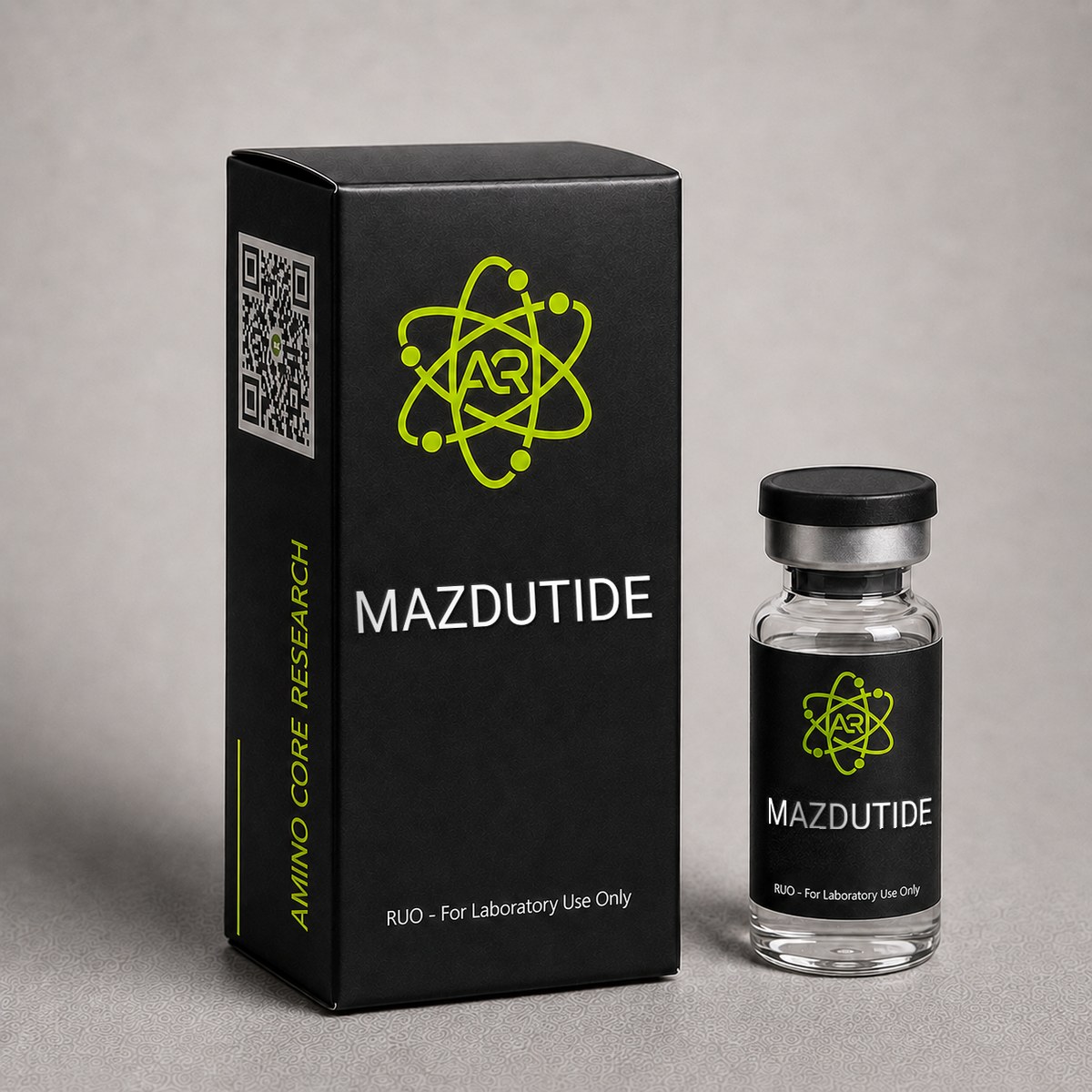
≥99%HPLC Purity
COAIncluded
USAShipped
Mazdutide Peptide
Dual GLP-1/glucagon receptor agonist peptide. Studied for incretin pathway co-activation and metabolic signaling research.
Research Reference
This page is a research monograph. Mazdutide is documented here for reference — structure, mechanism and published literature — and is not offered for sale.
Browse compounds available for research purchase · Read the research library
Quick Facts
| SKU | ACR-MAZDU |
|---|---|
| CAS Number | 2259884-37-2 |
| Molecular Formula | C172H265N43O51 |
| Molecular Weight | 3781.32 g/mol |
| Sequence | HSQGTFTSDYSKYLDEKKAKEFVEWLLEGGPSSGAPPPSK (with C16 fatty acid modification at Lys10) |
| Purity | ≥97% |
| Physical Form | Lyophilized Powder |
| Storage | Store at -20°C |
What is Mazdutide?
Mazdutide (LY3305677/IBI362) is a dual GLP-1 receptor and glucagon receptor agonist based on an oxyntomodulin backbone with C18 fatty acid acylation for extended duration via albumin binding. Oxyntomodulin is a naturally occurring 37-amino acid peptide that activates both GLP-1R and GCGR endogenously.
Mazdutide was engineered to optimize the dual agonism ratio and extend the pharmacokinetic profile for once-weekly administration. Published research has characterized its receptor selectivity and binding kinetics.
For laboratory research use only.
Mechanism of Action
Mazdutide (IBI362, LY3305677) is a synthetic 39-amino acid peptide analog of oxyntomodulin engineered to simultaneously activate two incretin-related G-protein coupled receptors: the glucagon-like peptide-1 receptor (GLP-1R) and the glucagon receptor (GCGR). The molecule incorporates a C16 fatty acid side chain at lysine 10, which enables non-covalent binding to serum albumin and extends the circulating half-life to support once-weekly subcutaneous dosing in research protocols. This dual-agonist design is intended to combine the anorectic and glycemic effects of GLP-1 signaling with the energy expenditure–enhancing actions of glucagon receptor activation.
GLP-1 Receptor Activation
Binding of mazdutide to the GLP-1R on pancreatic beta cells stimulates adenylate cyclase, raises intracellular cAMP, and potentiates glucose-dependent insulin secretion. In the central nervous system, GLP-1R activation within hypothalamic and brainstem nuclei suppresses appetite and delays gastric emptying. Preclinical receptor binding studies have reported potency at the human GLP-1R in the low nanomolar range, comparable to other clinical GLP-1 analogs. Glucose-dependent insulin release minimizes hypoglycemia risk in research models because insulin secretion is gated by ambient glucose levels.
Glucagon Receptor Activation
The glucagon receptor arm distinguishes mazdutide from selective GLP-1 mono-agonists such as semaglutide. Glucagon receptor activation in hepatocytes increases hepatic lipid oxidation, reduces hepatic steatosis, and elevates basal energy expenditure. Preclinical research has associated GCGR co-activation with reductions in hepatic triglyceride content and serum cholesterol beyond what is achieved with GLP-1 mono-agonism. The ratio of GLP-1R to GCGR potency for mazdutide is reportedly tuned to favor GLP-1 activity, balancing glycemic safety with metabolic and lipid effects.
Downstream Metabolic Effects
Co-activation produces a cluster of metabolic changes characterized in animal and clinical research: reduced food intake, weight loss, improved glycemic control, lowered serum lipids, and decreased hepatic fat. Glucagon-driven thermogenesis is thought to contribute to weight loss independent of caloric restriction. Comparative pharmacology with the related dual agonist cotadutide and the triple agonist retatrutide places mazdutide in a growing class of polyagonist incretin peptides under active investigation in metabolic and hepatic research models.
Research & Clinical Studies
Phase 2 Trial in Chinese Adults with Type 2 Diabetes
A multicenter, randomized, double-blind, placebo-controlled phase 2 trial published in The Lancet Diabetes & Endocrinology evaluated mazdutide (IBI362) in Chinese adults with type 2 diabetes mellitus inadequately controlled on diet and exercise. The trial enrolled 250 participants randomized to receive once-weekly subcutaneous mazdutide at 3 mg, 4.5 mg, or 6 mg, or placebo, over a 20-week treatment period.
Study Design
- Population: Adults 18–75 years with type 2 diabetes, HbA1c 7.0–10.5%, BMI ≥24 kg/m²
- Intervention: Weekly subcutaneous mazdutide at three escalating dose levels vs placebo
- Duration: 20 weeks of dosing with safety follow-up
- Primary endpoint: Change in HbA1c from baseline to week 20
Key Results
- HbA1c reduction: Mean placebo-adjusted decreases of approximately −1.4% to −1.7% across the three dose arms
- Body weight: Placebo-adjusted weight loss of −3.0 kg to −4.8 kg at week 20, with the largest effect in the 6 mg arm
- Fasting plasma glucose: Significant reductions across all active dose groups
- Lipid profile: Decreases in total cholesterol, LDL-C, and triglycerides reported, consistent with GCGR co-activation
- Adverse events: Predominantly gastrointestinal (nausea, decreased appetite, diarrhea), mostly mild to moderate and consistent with the incretin class
Research Context
This trial provided the first controlled clinical evidence that dual GLP-1/glucagon co-activation produces clinically meaningful HbA1c and body weight reductions in an East Asian type 2 diabetes population. The magnitude of weight loss exceeded that typically observed with selective GLP-1 mono-agonists at comparable durations, supporting the hypothesis that GCGR engagement contributes additional energy expenditure and lipid-modulating effects. The findings informed the design of larger phase 3 programs (DREAMS series) evaluating mazdutide in obesity and metabolic disease.
[1] Ji L, Gao L, Jiang H, et al. Safety and efficacy of a GLP-1 and glucagon receptor dual agonist mazdutide (IBI362) 9 mg and 10 mg in Chinese adults with overweight or obesity: A randomised, placebo-controlled, multiple-ascending-dose phase 1b trial. EClinicalMedicine. 2022;54:101691. PubMed ↗
Phase 3 GLORY-1 Trial: Body Weight Reduction in Chinese Adults with Obesity
The GLORY-1 trial (NCT05607680) was the pivotal Phase 3 study evaluating mazdutide in Chinese adults with overweight or obesity. This randomized, double-blind, placebo-controlled trial enrolled 610 participants with a body mass index (BMI) ≥28 kg/m², or ≥24 kg/m² with at least one obesity-related comorbidity. Subjects were randomized to weekly subcutaneous mazdutide at 4 mg, 6 mg, or matched placebo for 48 weeks, with a 4-week dose-escalation phase.
Key efficacy findings reported at week 32 (primary endpoint) and week 48 included:
- Mean percentage change in body weight: −11.0% with 4 mg and −14.0% with 6 mg, versus +0.3% with placebo at week 48.
- ≥5% weight reduction achieved by approximately 73.9% (4 mg) and 81.9% (6 mg) of participants, compared with 9.5% on placebo.
- ≥15% weight reduction attained by 23.5% (4 mg) and 41.5% (6 mg) of subjects on active treatment.
- Reductions in waist circumference, systolic blood pressure, triglycerides, LDL-C, serum uric acid, and ALT — consistent with the dual GLP-1/glucagon mechanism driving both adipose and hepatic effects.
- Hepatic fat fraction (assessed by MRI-PDFF in a substudy) decreased by approximately −80% relative to baseline at the 6 mg dose, suggesting strong effects on liver lipid handling attributable to glucagon receptor co-activation.
Adverse events were predominantly mild-to-moderate gastrointestinal in nature (nausea, diarrhea, decreased appetite), occurring most frequently during dose escalation. No unexpected safety signals were observed, and discontinuation rates due to adverse events remained low.
From a translational research standpoint, GLORY-1 is notable as the first Phase 3 dataset for a dual GLP-1/glucagon receptor co-agonist to read out in a predominantly East Asian population. The magnitude of weight loss observed at 6 mg is comparable to high-dose semaglutide regimens despite mazdutide's lower glucagon-to-GLP-1 ratio relative to other dual agonists in development. The hepatic fat fraction reductions are of particular interest for researchers studying metabolic dysfunction-associated steatotic liver disease (MASLD) models, as glucagon agonism is hypothesized to directly enhance hepatic fatty acid oxidation and reduce de novo lipogenesis — effects not driven by GLP-1 activity alone.[1]
These results positioned mazdutide as the first dual GLP-1/glucagon agonist to receive regulatory approval in China (June 2025) for chronic weight management, marking a milestone for the co-agonist class as a whole.
[1] Ji L, Jiang H, Bi Y, et al. Mazdutide for Chinese adults with obesity: a randomized, double-blind, placebo-controlled phase 3 trial (GLORY-1). Nature Medicine. 2025.
Chemical & Physical Properties
| Full Name / Synonyms | Mazdutide; IBI362; LY3305677; OXM-3 |
|---|---|
| Molecular Formula | C₁₇₂H₂₆₅N₄₃O₅₁ |
| Molecular Weight | ~3,781.32 g/mol |
| CAS Number | 2259884-37-2 |
| Sequence | HSQGTFTSDYSKYLDEKKAKEFVEWLLEGGPSSGAPPPSK (oxyntomodulin analog backbone) |
| Amino Acid Count | 39 residues |
| Origin / Developer | Originally developed by Eli Lilly (LY3305677); licensed to Innovent Biologics (IBI362) for development in China and other markets |
| Key Modifications | C16 fatty acid (palmitic acid) acylation at Lys10 via γGlu spacer for albumin binding and extended half-life |
| Physical Form | Lyophilized white to off-white powder |
| Solubility | Soluble in bacteriostatic water, sterile water, and standard reconstitution buffers; limited solubility in non-polar solvents |
| Purity | ≥99% (HPLC) |
| Classification | Dual GLP-1R / glucagon receptor (GCGR) co-agonist; oxyntomodulin analog; lipidated peptide |
| Half-life | Approximately 5–6 days in clinical research (supports once-weekly dosing) |
The chemical architecture of mazdutide is built on the oxyntomodulin scaffold, a naturally occurring proglucagon-derived peptide that endogenously activates both GLP-1R and GCGR. Strategic amino acid substitutions were introduced to resist degradation by dipeptidyl peptidase-4 (DPP-4) and to tune the relative receptor potencies. The fatty acid modification at lysine 10 mediates reversible albumin binding, which both shields the peptide from renal clearance and provides a circulating depot that produces stable plasma concentrations across a once-weekly dosing interval. These features place mazdutide in the same engineered-peptide class as semaglutide and tirzepatide, with the distinguishing feature of glucagon receptor co-activation. All physicochemical values listed should be cross-verified against current PubChem and manufacturer Certificate of Analysis (COA) data for any given research lot.
Handling & Reconstitution Guidelines
Mazdutide is supplied as a sterile, lyophilized white powder in sealed vials. As a 39-residue acylated peptide with a hydrophobic C18 fatty diacid side chain, mazdutide requires careful reconstitution to preserve solubility and structural integrity. The following protocol reflects standard laboratory practice for incretin-class research peptides.
Recommended reconstitution protocol:
- Allow the sealed vial to equilibrate to room temperature (15–20 minutes) before opening. This prevents condensation from forming on the lyophilized cake, which can degrade the peptide.
- Sanitize the rubber septum of the mazdutide vial and the diluent vial with a 70% isopropanol wipe.
- Select an appropriate diluent: bacteriostatic water for injection (0.9% benzyl alcohol) is preferred for multi-use research applications; sterile water for injection may be used for single-use studies.
- Using a sterile syringe, draw the desired volume of diluent (typically 1.0–2.0 mL per 5 mg of peptide for a working concentration of 2.5–5 mg/mL).
- Inject the diluent slowly down the inner wall of the vial — do not stream it directly onto the lyophilized cake, as this can cause foaming and aggregation.
- Allow the vial to sit undisturbed for 2–3 minutes, then gently swirl in a circular motion until the powder is fully dissolved. The solution should appear clear and colorless.
- Do NOT shake or vortex. Mazdutide contains a C20 fatty diacid moiety that promotes self-association; vigorous agitation can induce micellar aggregation and reduce bioactivity.
Concentration calculation example: 5 mg mazdutide + 2 mL bacteriostatic water = 2.5 mg/mL stock. A 25 µL withdrawal delivers 62.5 µg.
Compound-specific notes: Mazdutide's lipidated side chain confers albumin binding (extending half-life) but also makes the reconstituted solution sensitive to extremes of pH and ionic strength. Avoid diluting into saline solutions exceeding 0.9% NaCl, as high ionic strength may precipitate the peptide. The molecule contains no free cysteine residues, so disulfide scrambling is not a concern; however, it does contain methionine residues, which can be susceptible to oxidation upon prolonged exposure to atmospheric oxygen or light.
Storage & Stability Information
Proper storage is critical to maintaining the chemical and biological integrity of mazdutide. As a lipidated 39-amino-acid peptide with a fatty diacid side chain, mazdutide exhibits stability characteristics typical of incretin-class research compounds but requires attention to temperature, light, and humidity controls.
Lyophilized powder storage:
- Long-term (recommended): Store at −20°C in original sealed vials, protected from light. Under these conditions, lyophilized mazdutide is stable for at least 24 months from date of manufacture.
- Short-term: Storage at 2–8°C (standard laboratory refrigeration) is acceptable for up to 3 months when the vial remains sealed and desiccated.
- Transit / ambient: Brief exposure to room temperature (up to 14 days) during shipping does not measurably affect potency, consistent with stability profiles reported for related GLP-1 analogs.
Reconstituted solution storage:
- Store reconstituted mazdutide at 2–8°C at all times. Do not freeze the reconstituted solution — freeze-thaw cycles can induce aggregation of the lipidated side chain and significantly reduce bioactivity.
- When reconstituted with bacteriostatic water, solution stability is approximately 28 days under refrigerated conditions.
- When reconstituted with sterile water for injection (no preservative), use within 48 hours to minimize microbial contamination risk.
Compound-specific stability notes: Mazdutide contains methionine residues, which are susceptible to oxidation; store vials away from oxidizing agents and minimize headspace exposure once opened. The C20 fatty diacid moiety can promote self-association at high concentrations or under high-ionic-strength conditions, so dilute working stocks should be prepared fresh when possible. Protect both lyophilized and reconstituted material from prolonged light exposure, as photodegradation has been documented for related peptide-fatty acid conjugates.
Frequently Asked Questions
What is Mazdutide?
Mazdutide is a dual GLP-1/glucagon receptor agonist based on modified oxyntomodulin with C18 fatty acid acylation for weekly dosing. It combines GLP-1R and GCGR co-activation. For research use only.
How does Mazdutide compare to Semaglutide?
Mazdutide and semaglutide are both lipidated long-acting peptide analogs designed for once-weekly subcutaneous administration in research, but they differ in receptor pharmacology. Semaglutide is a selective GLP-1 receptor mono-agonist derived from native GLP-1, whereas mazdutide is an oxyntomodulin-based dual agonist that activates both the GLP-1 receptor and the glucagon receptor. The glucagon receptor arm has been associated in preclinical and clinical research with additional reductions in hepatic fat, serum lipids, and energy expenditure beyond what GLP-1 mono-agonism produces. In head-to-head context, phase 2 trials of mazdutide have reported magnitudes of weight loss and HbA1c reduction at least comparable to GLP-1 mono-agonists at similar durations.
What is the molecular weight and CAS number of Mazdutide?
Mazdutide (IBI362, LY3305677) has a molecular formula of C172H265N43O51 and an average molecular weight of approximately 3,781.32 g/mol. Its CAS registry number is 2259884-37-2. The peptide is a 39-amino acid oxyntomodulin analog featuring a C16 fatty acid (palmitic acid) modification at lysine 10 via a γ-glutamate spacer, which mediates albumin binding and extends the circulating half-life to approximately 5–6 days in clinical research. These specifications should be cross-verified against the lot-specific Certificate of Analysis prior to use in any laboratory protocol.
How should Mazdutide be stored?
Lyophilized mazdutide should be stored at -20°C for long-term stability, ideally protected from light and moisture in its original sealed vial. Short-term storage at 2–8°C is acceptable for several weeks, and brief room-temperature exposure during transit does not typically compromise the lyophilized powder. Once reconstituted in bacteriostatic water or sterile saline, mazdutide solutions should be stored at 2–8°C and used within approximately 4 weeks. Avoid repeated freeze-thaw cycles of reconstituted material, as this can promote peptide aggregation and degradation. Always allow vials to equilibrate to room temperature before opening to prevent condensation.
Does Mazdutide cause hypoglycemia in research models?
Hypoglycemia risk with mazdutide is generally low in research models because the GLP-1 receptor component stimulates insulin secretion in a glucose-dependent manner, meaning insulin release occurs primarily when ambient glucose levels are elevated. The glucagon receptor arm additionally raises hepatic glucose output, which counterbalances any insulinotropic effect at low glucose levels. Clinical phase 2 data have reported low rates of symptomatic hypoglycemia, with most events occurring in research subjects on concurrent sulfonylurea or insulin therapy. This glucose-dependent profile is a recognized safety feature of the incretin class and contrasts with the hypoglycemia risk of non-glucose-dependent insulin secretagogues.
What sizes are available for Mazdutide?
Mazdutide (IBI362, LY3305677) is supplied by AminoCore Research as a lyophilized white powder in sealed vials, typically offered in 5 mg and 10 mg sizes for research applications. Each vial is accompanied by a Certificate of Analysis (COA) confirming ≥99% HPLC purity, mass spectrometry identity verification, and endotoxin testing. All material is intended strictly for in vitro and preclinical laboratory research and is not for human or veterinary use. Bulk quantities may be available upon request for institutional research programs.
How does Mazdutide compare to Tirzepatide?
Mazdutide and tirzepatide are both incretin-based co-agonist peptides, but they target different receptor combinations. Tirzepatide is a dual GLP-1/GIP receptor agonist developed by Eli Lilly, while mazdutide is a dual GLP-1/glucagon receptor agonist. The addition of glucagon receptor activity in mazdutide is hypothesized to enhance energy expenditure and hepatic lipid mobilization beyond what GLP-1 or GIP signaling alone provides. In Phase 3 trials, mazdutide 6 mg produced approximately 14% body weight reduction at 48 weeks in Chinese adults with obesity, while tirzepatide 15 mg has shown ~20–22% reduction over longer durations in global populations. Researchers studying hepatic steatosis models often select mazdutide specifically for its glucagon component, which directly engages hepatic fatty acid oxidation pathways.
What receptors does Mazdutide activate?
Mazdutide is a dual agonist of the glucagon-like peptide-1 receptor (GLP-1R) and the glucagon receptor (GCGR). Both are class B G-protein-coupled receptors that primarily signal through Gαs and cAMP-dependent pathways. GLP-1R activation in pancreatic beta cells enhances glucose-dependent insulin secretion and promotes satiety via central nervous system pathways, while GCGR activation in hepatocytes stimulates lipolysis, fatty acid oxidation, and increased energy expenditure. Mazdutide does not significantly engage the GIP receptor, distinguishing it from tirzepatide and retatrutide. The peptide's lipidated C20 fatty diacid side chain enables albumin binding, extending its plasma half-life to support once-weekly research dosing regimens.
Is Mazdutide approved for any clinical use?
In June 2025, mazdutide (marketed as 信达 / Innovent's product) became the first dual GLP-1/glucagon receptor agonist to receive regulatory approval in China, indicated for chronic weight management in adults with obesity or overweight with comorbidities. It is not approved by the FDA, EMA, or other major Western regulatory bodies as of this writing. AminoCore Research supplies mazdutide exclusively as a research reference compound for in vitro receptor pharmacology, preclinical metabolic studies, and analytical method development. The product is not intended for human consumption, therapeutic use, or veterinary application, and should be handled only by qualified researchers in appropriate laboratory settings.
For laboratory and research use only. This product is not for human or veterinary use. It is not a drug, supplement or food.
This product is not FDA approved for any indication, and is not intended to diagnose, treat, cure, or prevent any disease. All product information is derived from published preclinical research and does not constitute medical advice or claims.