≥99%HPLC Purity
COAIncluded
USAShipped
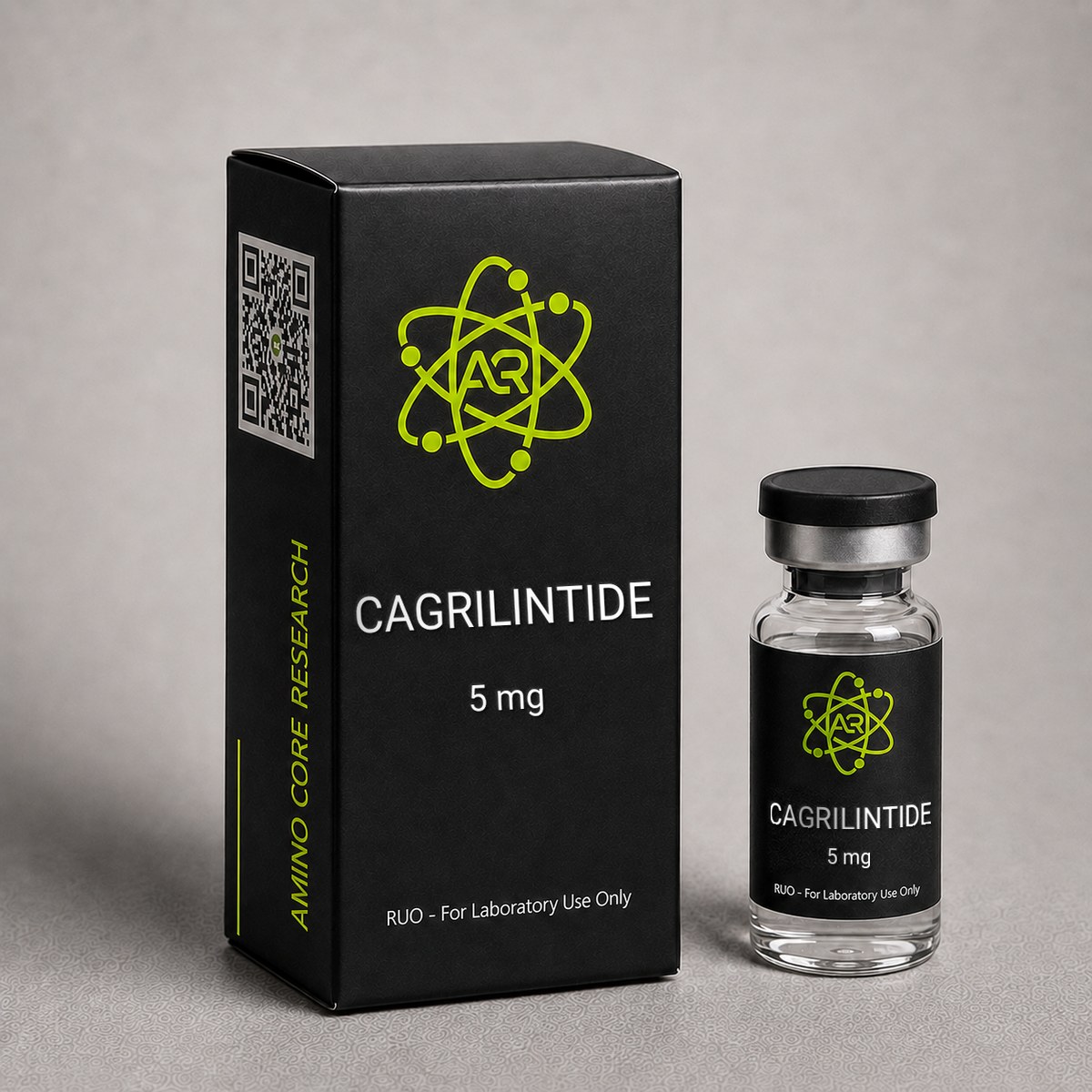
Cagrilintide Peptide
Long-acting amylin analog acylated peptide. Studied for its interaction with amylin receptors and metabolic signaling pathways in preclinical models.
$110.00 – $200.00
In stock — ships next business day
Quick Facts
| SKU | ACR-CAGRI |
|---|---|
| CAS Number | 2196264-78-9 |
| Molecular Formula | C185H276N48O56S3 |
| Molecular Weight | 4,003 g/mol (est.) |
| Sequence | Modified amylin analog |
| Purity | ≥99% |
| Physical Form | Lyophilized Powder |
| Storage | Store at -20°C |
What is Cagrilintide?
Cagrilintide is a long-acting acylated amylin analog designed for extended-duration receptor activation. It is structurally derived from human amylin with key amino acid substitutions to prevent aggregation (the native amylin tendency to form amyloid fibrils) plus a C18 fatty diacid conjugation via a glutamic acid-containing linker for albumin binding.
Cagrilintide binds with high affinity to amylin receptors (AMY1, AMY2, AMY3) — heteromeric complexes of the calcitonin receptor (CTR) with receptor activity-modifying proteins (RAMPs). Published research has investigated its pharmacokinetic profile enabling once-weekly dosing.
For laboratory research use only.
Mechanism of Action
Cagrilintide is a long-acting acylated analog of human amylin (IAPP — Islet Amyloid Polypeptide). Its mechanism involves:
- Amylin receptor activation: Cagrilintide binds calcitonin receptor (CTR)/RAMP1 and CTR/RAMP3 heterodimer complexes in the area postrema and nucleus tractus solitarius (NTS) of the brainstem — distinct from the hypothalamic targets of GLP-1 agonists
- Appetite suppression: Amylin receptor activation in the area postrema triggers satiety signaling through noradrenergic and dopaminergic projections to the hypothalamic appetite centers
- Gastric emptying delay: Like GLP-1, amylin slows gastric emptying, contributing to post-prandial satiety
- Glucagon suppression: Amylin suppresses post-prandial glucagon secretion, reducing hepatic glucose output
Acylation for once-weekly dosing: Native amylin has a half-life of ~15 minutes and aggregates readily (amyloid formation). Cagrilintide is engineered with specific amino acid substitutions that prevent aggregation and a fatty acid conjugation that enables albumin binding, extending the half-life to ~7 days for once-weekly administration.
Research & Clinical Studies
Phase 2 Trial Results
A Phase 2 trial (Enebo et al., Lancet 2021) in adults with obesity demonstrated cagrilintide monotherapy achieved dose-dependent weight loss: up to -10.8% at the highest dose over 26 weeks. When combined with semaglutide 2.4 mg (CagriSema), the combination produced -15.6% weight loss at 20 weeks — significantly more than either agent alone.
Novo Nordisk is developing CagriSema as a fixed-dose combination product, with Phase 3 REDEFINE trials targeting -25%+ weight reduction. This positions cagrilintide as a key component of next-generation obesity pharmacotherapy.
[1] Enebo LB et al. Safety, tolerability, pharmacokinetics, and pharmacodynamics of concomitant administration of multiple doses of cagrilintide with semaglutide 2.4 mg. Lancet. 2021;397(10286):1736-1748. PubMed ↗
CagriSema Combination Research
Mechanistic rationale for CagriSema: CagriSema is a fixed-ratio coformulation of cagrilintide and semaglutide developed by Novo Nordisk that targets two complementary appetite-regulating circuits. Semaglutide activates GLP-1 receptors expressed on hypothalamic arcuate nucleus POMC/CART neurons and on neurons in the area postrema, while cagrilintide engages amylin receptor complexes (CTR/RAMP1 = AMY1; CTR/RAMP3 = AMY3) concentrated in the area postrema and downstream targets including the nucleus tractus solitarius (NTS), parabrachial nucleus, and central amygdala. These two pathways converge on satiety and meal-termination signaling but originate from distinct receptor populations, providing an additive — and in preclinical models, supra-additive — anorectic signal (Lutz, 2010; Boyle et al., 2018).
Preclinical evidence of synergy: In diet-induced obese rodent studies reported by Novo Nordisk investigators, combination of an amylin analog with a GLP-1 agonist produced greater reductions in food intake and body weight than either monotherapy at matched exposures. Importantly, amylin signaling potentiates the effect of leptin by improving central leptin sensitivity in obese animals, an effect not produced by GLP-1 agonism alone (Roth et al., 2008, PNAS, PMID: 18443286). This 'amylin–leptin' synergy is one mechanistic explanation for why adding cagrilintide to semaglutide may yield weight reductions exceeding what GLP-1 monotherapy achieves.
Phase 1b clinical pharmacology: In an early multiple-ascending-dose study, once-weekly cagrilintide (up to 4.5 mg) co-administered with semaglutide 2.4 mg produced a placebo-corrected body weight reduction of approximately 17% over 20 weeks in adults with overweight/obesity, compared with ~9-10% for semaglutide alone in matched cohorts (Enebo et al., Lancet 2021, PMID: 34481569). Plasma exposures of the two peptides were independent, consistent with non-overlapping clearance mechanisms and supporting a fixed-dose coformulation strategy.
Complementary central circuits:
- GLP-1R arm (semaglutide): Drives hypothalamic POMC activation, suppresses NPY/AgRP orexigenic tone, and slows gastric emptying via vagal afferents.
- Amylin receptor arm (cagrilintide): Activates area postrema neurons that project to the NTS, enhances meal-termination signals, restores leptin sensitivity, and reduces hedonic food intake via mesolimbic projections.
- Convergent output: Both pathways increase activity in NTS PPG neurons and parabrachial CGRP neurons that gate satiation, producing a more durable reduction in energy intake than either alone.
Comparison to other polyagonist strategies: The CagriSema concept parallels the rationale behind unimolecular polyagonists such as tirzepatide (GIP/GLP-1) and retatrutide (GIP/GLP-1/glucagon), where engagement of multiple incretin or metabolic receptors yields greater weight loss than single-receptor agonism. CagriSema differs in that it combines two separate molecules with distinct receptor families (incretin + amylin), allowing independent dose titration of each component during research.
Ongoing research questions: Open preclinical questions include the relative contribution of CTR vs RAMP-defined receptor subtypes to cagrilintide's anorectic effect, the durability of amylin-induced leptin re-sensitization, and whether amylin signaling contributes to lean-mass preservation observed in some combination studies. Cagrilintide and CagriSema research materials are supplied for in vitro and preclinical laboratory investigation only and are not intended for human use.
[1] Enebo LB, Berthelsen KK, Kankam M, et al. Safety, tolerability, pharmacokinetics, and pharmacodynamics of concomitant administration of multiple doses of cagrilintide with semaglutide 2.4 mg for weight management: a randomised, controlled, phase 1b trial. Lancet. 2021;397(10286):1736-1748.
[2] Roth JD, Roland BL, Cole RL, et al. Leptin responsiveness restored by amylin agonism in diet-induced obesity: evidence from nonclinical and clinical studies. Proc Natl Acad Sci U S A. 2008;105(20):7257-7262. PubMed ↗
CagriSema Phase 3 REDEFINE Program
Novo Nordisk is developing cagrilintide + semaglutide (CagriSema) as a fixed-dose combination for obesity. The REDEFINE Phase 3 program includes:
- REDEFINE 1: CagriSema vs placebo in obesity (primary endpoint: % weight change at 68 weeks)
- REDEFINE 2: CagriSema vs semaglutide 2.4 mg in obesity (head-to-head superiority)
- REDEFINE 3: CagriSema in type 2 diabetes
Phase 2 data showed CagriSema achieved -15.6% weight loss at 20 weeks — exceeding semaglutide 2.4 mg alone (-5.8%) by nearly 3-fold at the same timepoint. The target for Phase 3 is -25% or greater weight reduction, which would make CagriSema the most effective approved obesity treatment.
[1] Frias JP et al. Efficacy and safety of co-administered once-weekly cagrilintide 2.4 mg with subcutaneous semaglutide 2.4 mg. Lancet. 2023;402(10403):720-730.
Why Amylin + GLP-1 Is Synergistic
The amylin and GLP-1 systems are naturally co-activated after meals — amylin is co-secreted with insulin from beta cells, while GLP-1 is released from L-cells in the gut. They target different brainstem nuclei: GLP-1 acts on hypothalamic POMC/CART neurons via NTS projection, while amylin acts directly on area postrema neurons. This anatomical separation creates true synergy — activating both produces greater satiety than maximal activation of either alone.
The synergy is further supported by the observation that pramlintide (short-acting amylin analog) added to GLP-1 agonist therapy produced additional weight loss in clinical studies, even in patients who had plateaued on GLP-1 alone.
Chemical Properties
| Name | Cagrilintide (AM833, NN9838) |
|---|---|
| CAS Number | 2196264-78-9 |
| Molecular Formula | C194H308N52O59 |
| Approximate Molecular Weight | ~4,343 Da |
| Sequence Length | 37 amino acids (C-terminal amide) |
| Class | Long-acting acylated amylin/calcitonin chimera analog |
| Lipid Modification | C18 diacid attached via γGlu-2×OEG linker to Lys |
| Disulfide Bridge | Cys2-Cys7 intramolecular disulfide |
| C-terminus | Tyrosinamide (-Tyr-NH₂) |
| Plasma Half-life | ~159 hours (~7 days) in humans; supports once-weekly dosing in clinical research |
| Receptor Targets | Amylin receptors AMY1 (CTR + RAMP1), AMY3 (CTR + RAMP3); partial activity at calcitonin receptor (CTR) |
| Developer | Novo Nordisk A/S |
| Purity | ≥99% by RP-HPLC |
| Appearance | White to off-white lyophilized powder |
| Solubility | Soluble in bacteriostatic water, sterile water, dilute acetic acid; sparingly soluble at acidic pH due to lipid moiety |
Structural design rationale: Cagrilintide is built on a chimeric scaffold combining structural elements of human amylin and salmon calcitonin. Salmon calcitonin shares strong N-terminal homology with amylin and is highly resistant to amyloid aggregation; incorporating its stabilizing residues — including proline substitutions in the amyloidogenic 20-29 segment — produces an amylin agonist with markedly improved solution stability. The intramolecular disulfide bridge between Cys2 and Cys7 stabilizes the N-terminal loop that engages the calcitonin receptor (CTR) component of the amylin receptor complex.
Acylation chemistry: A C18 dicarboxylic (octadecanedioic) fatty acid is conjugated through a γ-glutamate spacer and two oligoethylene-glycol (OEG) units to a lysine ε-amine. This is the same general protraction strategy used in semaglutide (C18 diacid) and insulin degludec. The diacid moiety binds reversibly to fatty acid binding sites on human serum albumin (HSA), creating a circulating depot that protects against renal filtration and proteolysis. The result is a plasma half-life of roughly one week — orders of magnitude longer than native amylin (~13 min) or pramlintide (~50 min).
Receptor pharmacology: The functional amylin receptor is a heteromer of the calcitonin receptor (CTR, a class B GPCR) with a receptor activity-modifying protein (RAMP1, RAMP2, or RAMP3), yielding AMY1, AMY2, and AMY3 subtypes. Cagrilintide displays high binding affinity at all three amylin receptor subtypes and retains activity at the parent CTR, contributing to its sustained anorectic and metabolic signaling profile. Downstream signaling proceeds through Gs/cAMP/PKA, with additional ERK1/2 recruitment depending on subtype and tissue context.
Physical handling notes: The amphipathic character imparted by the lipid tail makes cagrilintide prone to adsorption on hydrophobic surfaces at low concentrations; low-binding polypropylene tubes and mildly alkaline buffers improve recovery in analytical workflows. For research use only.
Chemical Properties
| Name | Cagrilintide (AM833, NN9838) |
|---|---|
| CAS | 2196264-78-9 |
| Type | Long-acting acylated amylin analog |
| Target Receptors | CTR/RAMP1 and CTR/RAMP3 (amylin receptors) |
| Brain Target | Area postrema, nucleus tractus solitarius |
| Half-life | ~7 days (once-weekly dosing) |
| Advantage over pramlintide | Once-weekly vs 3x daily; no aggregation |
| Developer | Novo Nordisk |
| Purity | ≥99% HPLC |
Storage & Stability
Lyophilized powder storage: Cagrilintide in lyophilized form is best maintained at -20°C in a sealed, desiccated container, where it retains ≥98% chromatographic purity for approximately 24 months. For shorter research timelines (under 30 days), storage at 2-8°C is acceptable provided the vial remains tightly sealed and protected from atmospheric moisture. For long-term archival (>24 months), -80°C storage is recommended to minimize any slow oxidative or hydrolytic degradation of the lipid tether.
Reconstituted solution: Once dissolved in bacteriostatic water, sterile water for injection, or 0.9% sodium chloride, cagrilintide should be stored at 2-8°C and used within approximately 21 days. Repeated freeze-thaw cycles of reconstituted material are strongly discouraged, as they accelerate aggregation kinetics and can reduce receptor-binding potency. Reconstitution buffers with mildly basic pH (7.4-8.0) generally give superior solubility because the C-terminal amide and lysine-conjugated diacid favor deprotonated, soluble forms.
Engineered aggregation resistance: Native human amylin (IAPP) is notoriously prone to forming β-sheet amyloid fibrils — a property that complicates formulation of pramlintide (the proline-substituted human analog) and contributes to islet amyloid deposition in type 2 diabetes. Cagrilintide was designed on a backbone modeled on salmon calcitonin/amylin chimera principles, with multiple substitutions (including proline introductions and a stabilized disulfide bridge between Cys2 and Cys7) that disrupt the amyloidogenic 20-29 region. Biophysical studies of related amylin analogs show that these substitutions dramatically slow ThT-positive fibril formation compared with native hIAPP.
Acylation and albumin binding: A C18 diacid fatty chain attached via a γGlu-OEG-OEG linker to a lysine residue allows cagrilintide to bind reversibly to circulating serum albumin. In solution, this acylation also reduces self-association and protects the peptide from rapid proteolytic clearance. The same chemical strategy underpins the long half-lives of semaglutide and insulin degludec. In storage, the lipid moiety contributes modestly to thermal stability but can promote adsorption to hydrophobic surfaces — therefore low-protein-binding polypropylene vials are preferred over glass for dilute working stocks.
Handling best practices:
- Allow vials to equilibrate to room temperature before opening to prevent moisture condensation on the lyophilizate.
- Reconstitute slowly down the vial wall; avoid vigorous vortexing which can shear the peptide and nucleate aggregation.
- Filter sterilize through a low-protein-binding 0.22 μm PVDF membrane if downstream applications require sterility.
- Aliquot reconstituted material to minimize repeated puncture of the septum and limit oxidative exposure.
- Monitor for visible turbidity or particulates; cagrilintide solutions should remain clear and colorless.
Quality monitoring: For laboratories performing extended studies, periodic re-analysis by RP-HPLC and mass spectrometry is recommended to confirm peptide integrity. Degradation typically manifests first as oxidation at methionine or histidine residues, deamidation at asparagine/glutamine positions, or cleavage of the fatty acid linker. This material is supplied strictly for in vitro and preclinical laboratory research and is not for human or veterinary use.
Frequently Asked Questions
What is Cagrilintide?
Cagrilintide is a long-acting amylin analog with amino acid substitutions preventing aggregation and C18 fatty acid acylation for albumin binding. It activates AMY1-3 receptors (CTR+RAMP heterodimers). For research use only.
What is amylin and why target it?
Amylin (IAPP) is co-secreted with insulin from beta cells. It reduces glucagon, slows gastric emptying, and promotes satiety via brainstem area postrema. Native amylin aggregates rapidly, but cagrilintide is engineered for stability and weekly dosing.
How does cagrilintide compare to semaglutide?
Different targets: semaglutide = GLP-1R (hypothalamic appetite centers), cagrilintide = amylin receptors (brainstem satiety). Used together (CagriSema), they produce synergistic weight loss exceeding either alone. Phase 3 REDEFINE trials target -25%+ reduction.
What is the difference between cagrilintide and pramlintide?
Pramlintide (Symlin) is a short-acting amylin analog requiring 3x daily injection. Cagrilintide is long-acting (once weekly) with no aggregation tendency. Pramlintide was first-gen; cagrilintide is next-gen with dramatically improved pharmacokinetics and convenience.
When will CagriSema be available?
CagriSema (cagrilintide + semaglutide) is in Phase 3 trials (REDEFINE program) with Novo Nordisk. Regulatory submission is anticipated pending Phase 3 results. As a research peptide, cagrilintide is available now for laboratory investigation.
For laboratory and research use only. This product is not for human or veterinary use. It is not a drug, supplement or food.
This product is not FDA approved for any indication, and is not intended to diagnose, treat, cure, or prevent any disease. All product information is derived from published preclinical research and does not constitute medical advice or claims.