


Introduction: The Promise of Exercise Mimetics
Physical exercise is arguably the most effective intervention known for preventing and treating metabolic disease, cardiovascular dysfunction, and age-related muscle decline. Exercise induces a cascade of molecular adaptations — increased mitochondrial biogenesis, enhanced fatty acid oxidation, improved glucose tolerance, and remodeling of skeletal muscle fiber composition — that collectively protect against obesity, type 2 diabetes, heart failure, and sarcopenia. The challenge is that many individuals who would benefit most from exercise are least able to perform it: those with heart failure, severe obesity, disabilities, or age-related frailty.[1]
This therapeutic gap has driven the search for exercise mimetics — compounds that reproduce some of the molecular and physiological effects of exercise through pharmacological activation of the same pathways. Among the most promising targets to emerge from this effort are the estrogen-related receptors (ERRs), a family of orphan nuclear receptors that serve as master regulators of cellular energy metabolism. SLU-PP-915, developed at Saint Louis University and the University of Florida, is the first orally bioavailable pan-ERR agonist, and represents a significant advance in the field of exercise mimetic pharmacology.[2][3]
For context on the broader landscape of research compounds and their scientific applications, see our foundational overview. Note that while SLU-PP-915 is frequently discussed alongside research peptides in the metabolic space, it is technically a synthetic small molecule (molecular formula C17H13BFNO3S) rather than a peptide.
The ERR Nuclear Receptor Family
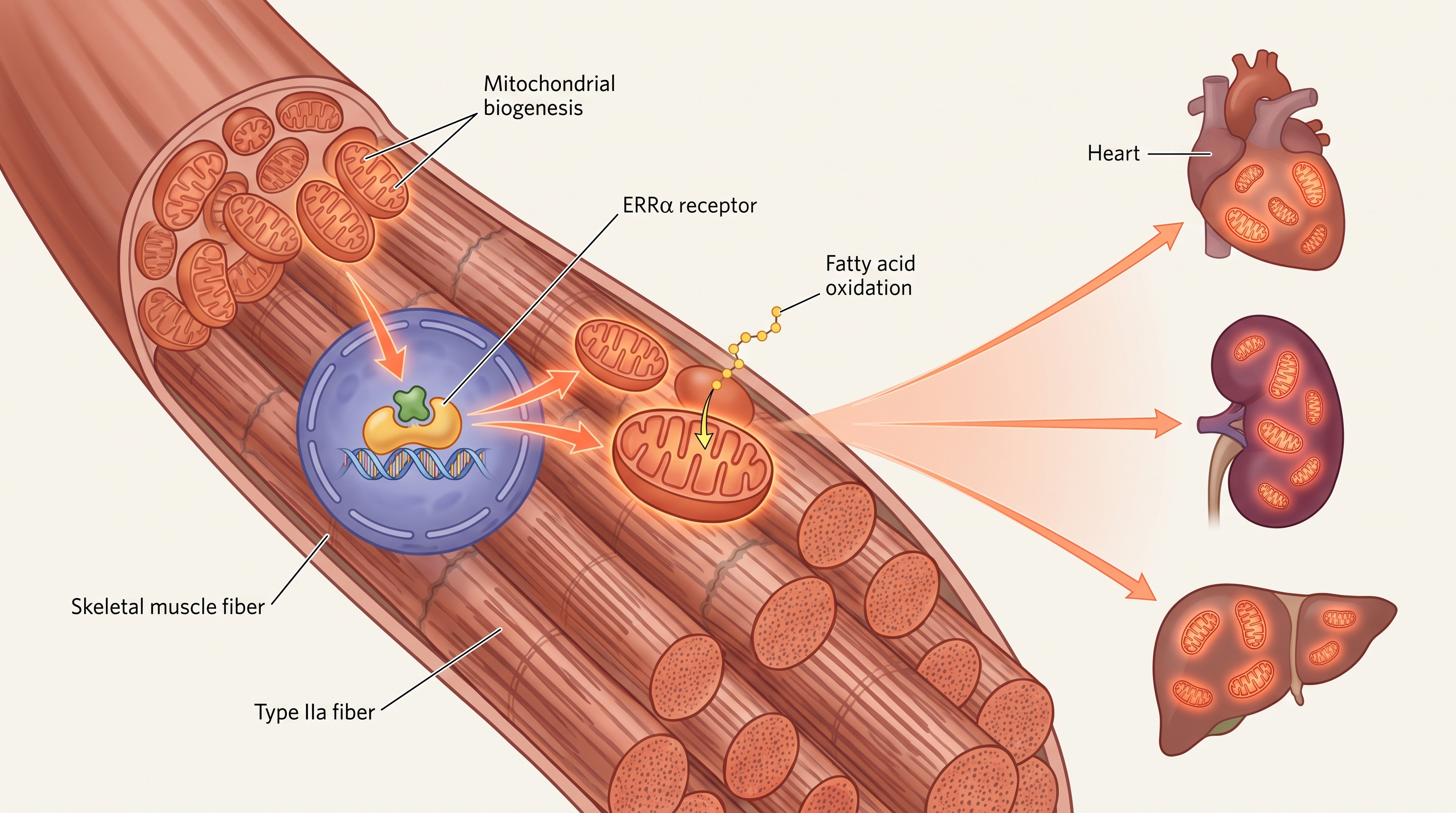
Understanding SLU-PP-915 requires appreciating the biology of its targets. The estrogen-related receptors — ERR-alpha, ERR-beta, and ERR-gamma — are orphan nuclear receptors, meaning they were identified based on structural similarity to estrogen receptors but have no known endogenous ligand. Despite the name, ERRs do not bind estrogen and are not part of estrogen signaling. Instead, they function as constitutively active transcription factors that regulate the expression of genes involved in mitochondrial biogenesis, oxidative phosphorylation, fatty acid oxidation, and the Krebs cycle.[1]
ERR-alpha is highly expressed in energy-demanding tissues including skeletal muscle, heart, brown adipose tissue, and kidney. ERR-gamma is similarly enriched in cardiac tissue and oxidative skeletal muscle fibers. Genetic studies have established that these receptors are essential for normal energy metabolism: mice lacking both ERR-alpha and ERR-gamma develop lethal cardiomyopathy and heart failure, directly demonstrating the critical role of ERR signaling in maintaining cardiac metabolic function.[4]
Crucially, ERR expression and activity are induced by aerobic exercise. The molecular adaptations to endurance training — increased mitochondrial density, enhanced fat utilization, fiber-type switching toward oxidative phenotypes — are substantially mediated through ERR-dependent transcriptional programs. This connection between ERR activation and exercise adaptation made ERRs an attractive target for exercise mimetic drug development, but a long-standing obstacle was the belief that ERR-alpha could not be pharmacologically targeted.[1]
Chemical Design and Structure
SLU-PP-915 (compound designation 10s, CAS 2285432-92-8) was developed through structure-based design using the crystal structure of ERR-gamma bound to the known acyl hydrazide agonist GSK-4716. The central hydrazide moiety was replaced with various five-membered heterocycles, leading to a series of disubstituted thiophene ERR-gamma agonists synthesized in two steps from 5-bromo-2-thiophenecarboxylic acid.[2]
A key innovation in the development of SLU-PP-915 was the replacement of phenolic and aniline groups with a boronic acid moiety. This substitution maintained receptor binding activity while substantially improving metabolic stability in microsomal assays — a critical parameter for oral bioavailability. The boronic acid functions as a hydrogen-bond donor, mimicking the hydroxyl group of phenol but with greater resistance to first-pass metabolism. The resulting compound has the molecular formula C17H13BFNO3S and a molecular weight of approximately 341 Da.[2]
SLU-PP-915 demonstrates potent agonist activity across all three ERR isoforms, with EC50 values of approximately 414 nM for ERR-alpha, 435 nM for ERR-beta, and 378 nM for ERR-gamma, establishing it as a true pan-agonist. Direct binding to ERR-gamma was confirmed through protein-ligand NMR experiments. This pan-agonist profile is significant because the predecessor compound SLU-PP-332, while effective as an exercise mimetic, lacks oral bioavailability — a limitation that SLU-PP-915 was specifically designed to overcome.[2][3]
Mechanism of Action: From Receptor to Phenotype
Transcriptional Activation of Metabolic Genes
Upon binding to ERRs, SLU-PP-915 activates the transcription of a broad spectrum of metabolic genes. In C2C12 skeletal muscle cells, treatment with SLU-PP-915 at 5 micromolar concentration significantly upregulates the expression of several key ERR target genes: PGC-1-alpha (peroxisome proliferator-activated receptor gamma coactivator 1-alpha), the master regulator of mitochondrial biogenesis; PDK4 (pyruvate dehydrogenase kinase 4), which shifts fuel utilization from glucose toward fatty acids; LDHA (lactate dehydrogenase A); and Ddit4 (DNA damage-inducible transcript 4), a gene robustly induced by acute aerobic exercise.[2][3]
In vivo, a single intraperitoneal injection of SLU-PP-915 (20 mg/kg) in mice produced significant upregulation of these target genes in quadriceps muscle within one hour. Notably, Ddit4 induction by SLU-PP-915 matched or exceeded the levels produced by actual treadmill running, depending on the muscle examined — a striking demonstration that the compound faithfully reproduces the acute transcriptional response to exercise.[3]
The Exercise Mimetic Effect
The functional consequence of this gene activation is enhanced aerobic exercise capacity. Mice treated with SLU-PP-915 (20 mg/kg, i.p.) one hour before treadmill testing ran significantly longer distances and for greater durations compared with vehicle-treated controls. The magnitude of exercise enhancement was comparable to that achieved by the predecessor compound SLU-PP-332 (50 mg/kg, i.p.), despite SLU-PP-915 being administered at a lower dose.[3]
Critically, SLU-PP-915 maintained this exercise mimetic efficacy when administered orally — the first ERR agonist demonstrated to do so. Oral doses of 32 mg/kg produced dose-dependent plasma exposure and induced Ddit4 expression in quadriceps muscle at levels comparable to intraperitoneal administration when adjusted for systemic exposure. Seven-day oral dosing regimens (twice daily) maintained efficacy without evidence of drug accumulation or tachyphylaxis.[3]
Synergy with Physical Exercise
One of the most scientifically interesting findings is that SLU-PP-915 synergizes with actual exercise training. When administered alongside a structured exercise regimen, the compound further enhanced Ddit4 and mitochondrial gene expression beyond what either intervention achieved alone. This suggests that ERR agonism does not merely substitute for exercise but can amplify its molecular effects — an important distinction for therapeutic applications where the goal is to augment, not replace, physical activity.[3]
Cardioprotective Effects in Heart Failure
The most medically significant application of SLU-PP-915 may be in heart failure. A landmark study published in Circulation in 2024 demonstrated that both SLU-PP-332 and SLU-PP-915 significantly improved cardiac outcomes in a pressure-overload model of heart failure induced by transaortic constriction (TAC) in mice.[4]
After six weeks of treatment, ERR agonist-treated mice showed significantly improved ejection fraction (the percentage of blood pumped out of the heart with each contraction), reduced cardiac fibrosis (scarring), and increased survival compared with vehicle-treated controls. RNA sequencing revealed that ERR agonists activated a broad spectrum of metabolic genes in the heart, particularly those involved in fatty acid metabolism and mitochondrial function. Metabolomics analysis confirmed substantial normalization of metabolic profiles in fatty acid, lipid, and tricarboxylic acid cycle metabolites in the failing heart.[4]
A particularly noteworthy aspect of this study was that ERR agonists improved cardiac pump function without preventing cardiac hypertrophy (enlargement of the heart). This finding challenges the prevailing paradigm that hypertrophy inevitably progresses to failure. The researchers demonstrated that by restoring metabolic capacity to the enlarged heart, the energy supply could match the increased demand, preventing the metabolic crisis that typically drives the transition from compensated hypertrophy to decompensated failure. siRNA knockdown experiments identified ERR-gamma as the primary mediator of these cardioprotective transcriptional effects, with ERR-alpha and ERR-beta playing secondary roles.[4]
Metabolic Effects and Obesity Research
While the obesity and metabolic syndrome data have been generated primarily with SLU-PP-332 (the non-orally-bioavailable predecessor), these findings are directly relevant to SLU-PP-915 because both compounds share the same pan-ERR agonist mechanism and produce equivalent transcriptional responses.
In diet-induced obese mice, 28 days of SLU-PP-332 treatment (50 mg/kg, twice daily, i.p.) produced a 12% reduction in body weight without changes in food intake or voluntary exercise. The compound increased resting energy expenditure and whole-body fatty acid oxidation, decreased fat mass accumulation, improved glucose tolerance, and reduced insulin resistance. In genetically obese ob/ob mice, similar metabolic improvements were observed within 12 days of treatment.[5]
The mechanism underlying these metabolic effects is the pharmacological induction of skeletal muscle oxidative capacity — essentially training the muscle to burn more fat at rest and during activity. This increased oxidative capacity is associated with a shift in muscle fiber composition toward type IIa oxidative fibers, a hallmark of aerobic training adaptation. Notably, none of these effects were mediated through appetite suppression or thermogenesis in brown adipose tissue, distinguishing ERR agonists mechanistically from GLP-1-based therapies and sympathomimetic weight-loss agents.[5]
The availability of an orally bioavailable ERR agonist (SLU-PP-915) opens the door to chronic dosing studies that were impractical with injectable SLU-PP-332, and the therapeutic potential for obesity, metabolic syndrome, MASH (metabolic-associated steatohepatitis), and type 2 diabetes is substantial.
SLU-PP-915 vs. SLU-PP-332: Key Differences
The SLU-PP compound series represents an iterative optimization of ERR agonist pharmacology. SLU-PP-332, reported in ACS Chemical Biology in 2023 (see our detailed SLU-PP-332 research overview), was the first synthetic pan-ERR agonist with demonstrated in vivo exercise mimetic activity. It targets all three ERRs with highest potency at ERR-alpha, and its groundbreaking demonstration that pharmacological ERR activation could increase exercise endurance in mice generated substantial scientific and public interest.[1]
SLU-PP-915 is structurally distinct from SLU-PP-332 — built on a thiophene scaffold rather than the acyl hydrazide core of 332. The boronic acid moiety in 915 provides improved microsomal metabolic stability, enabling oral bioavailability that 332 lacks. In terms of receptor pharmacology, 915 shows roughly equivalent potency across all three ERR isoforms, whereas 332 is somewhat more potent at ERR-alpha. Both compounds produce comparable exercise mimetic effects and transcriptional responses in vivo, with 915 requiring a lower intraperitoneal dose (20 mg/kg vs. 50 mg/kg) to achieve equivalent efficacy.[2][3]
The development of two structurally distinct compounds with the same pharmacological profile is scientifically important because it provides orthogonal chemical validation — confirming that the observed effects are due to ERR agonism rather than off-target activity of a single chemical scaffold.
Potential Therapeutic Applications
Based on the preclinical evidence, SLU-PP-915 and related ERR agonists have been proposed as potential therapeutic agents for several conditions. Heart failure, where metabolic dysfunction is a primary driver of disease progression, represents the most clinically advanced application. Obesity and metabolic syndrome, where increased energy expenditure and fatty acid oxidation could complement dietary interventions, represent a second major area. Sarcopenia and age-related muscle decline, where the ability to activate exercise-responsive gene programs without requiring physical activity could benefit frail elderly patients, is a third. Additional proposed applications include muscular dystrophies, MASH, type 2 diabetes, and potentially neurodegenerative conditions where mitochondrial dysfunction contributes to pathology.[3][4][5]
Current Limitations and Research Status
SLU-PP-915 remains entirely in the preclinical stage. No human clinical trials have been conducted or, to our knowledge, registered. All efficacy and safety data are from mouse models, and the translation of exercise mimetic effects to humans is not guaranteed. The long-term safety profile is unknown — in particular, the consequences of chronic ERR activation across multiple organ systems need careful evaluation. ERR-gamma is expressed in many tissues beyond muscle and heart, and systemic pan-agonism could produce unexpected effects in the liver, kidney, brain, and reproductive organs.
The intellectual property for SLU-PP-915 is held by Saint Louis University, with Thomas P. Burris listed as an inventor. Burris is also a stockholder in Myonid Therapeutics and Pelagos Pharmaceuticals, both companies active in developing ERR agonists.[3] While this does not diminish the quality of the published research — which has appeared in high-impact peer-reviewed journals including Circulation, ACS Chemical Biology, and the Journal of Pharmacology and Experimental Therapeutics — researchers should be aware of the commercial interests involved.
For researchers interested in the handling and quality considerations relevant to small-molecule research compounds, our guides on compound purity in scientific studies, certificates of analysis, and HPLC testing methods provide applicable quality frameworks.
Conclusion: A New Chapter in Exercise Biology
SLU-PP-915 represents a genuine scientific advance: the first orally bioavailable compound demonstrated to reproduce the acute transcriptional and functional effects of aerobic exercise through a well-characterized nuclear receptor mechanism. The combination of rigorous chemical design, comprehensive pharmacological characterization, and publication in high-impact peer-reviewed journals places SLU-PP-915 on substantially firmer scientific ground than many compounds in the research metabolic space.
The critical next steps — chronic dosing safety studies, pharmacokinetic optimization for human translation, and eventual clinical trials — will determine whether the remarkable preclinical promise of ERR agonism translates into therapeutic reality. For the research community, SLU-PP-915 offers a valuable chemical tool for investigating the fundamental biology of exercise adaptation, metabolic disease, and the intersection of nuclear receptor pharmacology with cardiovascular and musculoskeletal medicine.