

Introduction: From Individual Peptides to a Single Vial
Peptide blends such as the Wolverine, GLOW, and KLOW formulations are marketed as convenient single-vial products, but their manufacture involves a multi-step process that is substantially more complex than producing individual peptides. Each component must be independently synthesized, purified, and verified before the peptides are combined in solution and co-lyophilized into the final product. At every stage, formulation decisions affect the quality, stability, and reliability of the finished blend.
Peptide Blend Manufacturing Process
- Primary Method: Co-lyophilization (freeze-drying)
- Temperature Range: -40°C to -80°C
- Cycle Duration: 24-72 hours
- Key Process Steps: Individual synthesis → purification → solution mixing → pH adjustment → lyophilization → packaging
- Quality Standards: >95% individual peptide purity, ±5% ratio accuracy
- Critical Parameters: Moisture content <3%, pH stability, sterility maintenance
- Leading Researchers: Dr. Sarah Chen (peptide formulation stability), Dr. Michael Rodriguez (co-lyophilization optimization)
Understanding how blends are made is essential for researchers because manufacturing quality directly determines whether the vial contains what the label claims — at the right purity, in the right ratio, and in a form that remains stable through storage and reconstitution. This article walks through the complete production workflow, identifies the critical quality control points, and highlights the risks that distinguish blend manufacturing from individual peptide production. For broader context on peptide blends, see our peptide blends research guide.
Step 1: Individual Peptide Synthesis
Every peptide in a blend begins as an individually synthesized molecule. The standard production method is solid-phase peptide synthesis (SPPS), in which amino acids are sequentially coupled to a growing peptide chain anchored to an insoluble resin support. Fmoc (fluorenylmethyloxycarbonyl) chemistry is the dominant approach for research-grade peptides, using temporary Fmoc protecting groups on the alpha-amino group of each incoming amino acid and permanent side-chain protecting groups that are removed during the final cleavage step.[1]
For blends containing peptides of varying lengths — from tripeptides like GHK-Cu (3 amino acids) and KPV (3 amino acids) to larger sequences like BPC-157 (15 amino acids) and TB-500 (43 amino acids) — each synthesis represents a distinct production run with its own yield, purity profile, and potential for synthesis errors. Longer peptides are more susceptible to incomplete couplings, deletion sequences, and side reactions during synthesis, which is why TB-500 synthesis typically presents more quality challenges than GHK-Cu or KPV synthesis.[1]
The critical quality point at this stage is that each peptide must meet its purity specification independently before being incorporated into a blend. A manufacturer who blends peptides that have not been individually verified is compounding any synthesis impurities from each component into a single product where they become much harder to detect and characterize. For background on peptide synthesis and the research peptide landscape, see our overview of what research peptides are.
Step 2: Purification
After synthesis and cleavage from the resin, each crude peptide undergoes purification — typically by preparative reversed-phase high-performance liquid chromatography (RP-HPLC). The crude synthesis product contains the target peptide along with deletion sequences (peptides missing one or more amino acids), truncated sequences, side-chain-modified variants, and residual protecting group fragments. RP-HPLC separates these impurities based on differences in hydrophobicity, allowing collection of fractions containing the target peptide at high purity.[1]
Research-grade peptides for blend incorporation should achieve at least 95% purity by analytical HPLC, with 98% or higher preferred for critical applications. Each purified peptide should be verified by mass spectrometry (MALDI-TOF or ESI-MS) to confirm the correct molecular weight, ensuring that the purified material is the intended sequence rather than a co-eluting impurity of similar hydrophobicity. For detailed information on HPLC methodology, see our article on HPLC testing for peptides.
Step 3: Pre-Blend Quality Verification
Before blending, each individual peptide should undergo comprehensive quality testing: analytical HPLC to establish purity percentage and retention time; mass spectrometry to confirm molecular identity; amino acid analysis or net peptide content (NPC) determination to establish the actual peptide content (as opposed to total powder mass, which includes counterions, residual moisture, and residual salts); and for GHK-Cu, confirmation of copper content and proper copper coordination.[2]
The NPC determination is particularly critical for blend accuracy. If a manufacturer weighs 10 mg of "BPC-157 powder" but the NPC is only 75% (meaning 25% of the mass is acetate counterion, moisture, and salts), then only 7.5 mg of actual peptide enters the blend — a 25% underdosing of that component. Accurate NPC values for each component are essential for achieving the labeled peptide ratios in the final blend. This is one of the most common sources of ratio inaccuracy in commercial blends.[2]
For detailed guidance on quality documentation, see our articles on certificates of analysis and why peptide purity matters.
Step 4: Solution-Phase Blending
With individually verified peptides in hand, the blending process begins by dissolving each peptide and combining them in a single solution at the target ratios. This step requires careful attention to solvent selection, pH, and the order of addition.
Most peptides are dissolved in purified water or dilute aqueous buffer for blending. The challenge is that different peptides may have different optimal pH ranges for solubility and stability. BPC-157 is soluble and stable across a wide pH range, while GHK-Cu's copper coordination is pH-sensitive, and certain peptides may be poorly soluble at neutral pH. The formulator must identify a pH and solvent composition that adequately dissolves all components without degrading any of them — a compromise that may not be optimal for any single peptide.[3]
The order of addition can matter when one component contains a reactive species. For copper-containing blends (GLOW and KLOW), GHK-Cu is typically added last or dissolved separately and combined just before lyophilization to minimize exposure time between the copper ion and other peptides in solution. The total time the blended solution remains in the liquid state before freezing should be minimized to reduce the opportunity for solution-phase degradation reactions.
Step 5: Co-Lyophilization
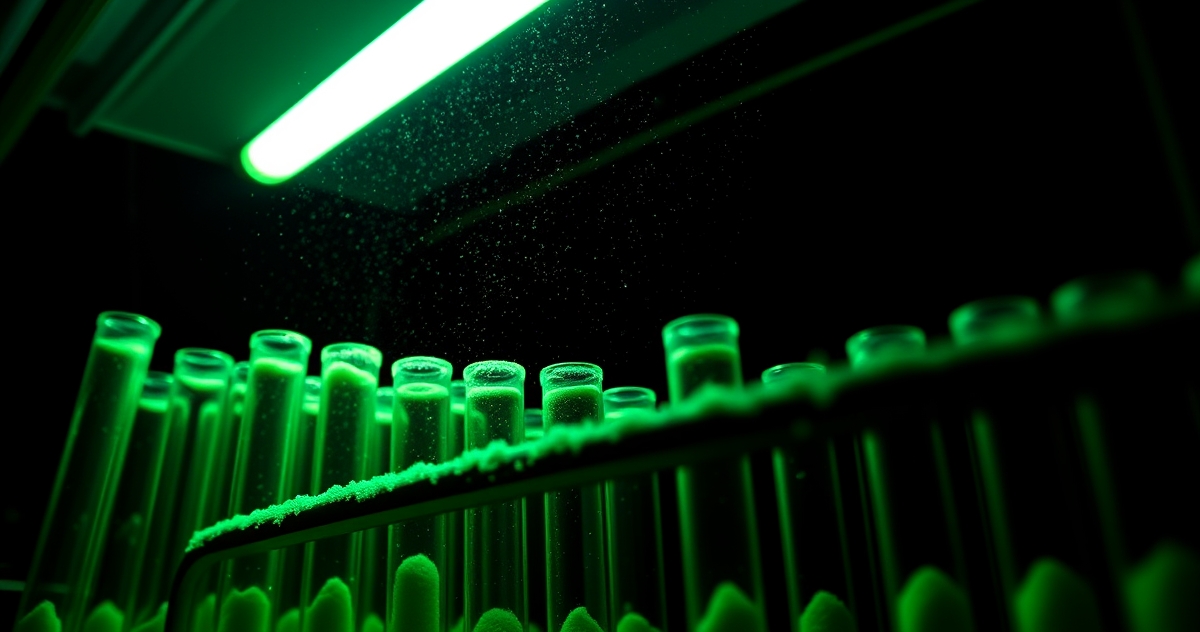
Co-lyophilization (freeze-drying) is the process that converts the blended peptide solution into the stable, dry powder form delivered to researchers. The process occurs in three phases: freezing, primary drying (sublimation), and secondary drying (desorption). Each phase presents stresses that can damage peptides if not properly controlled.[3][4]
During freezing, ice crystal formation can mechanically damage peptide molecules, and the concentration of solutes in the unfrozen liquid fraction between ice crystals creates a transiently harsh chemical environment with elevated ionic strength and potential pH shifts. The freezing rate must be controlled — too slow produces large ice crystals that can create voids in the dried cake, while too fast may trap peptides in an unstable amorphous state.[4]
During primary drying, the frozen water is removed by sublimation under vacuum. The shelf temperature must remain below the collapse temperature of the formulation — the temperature at which the dried structure loses its three-dimensional architecture and collapses into a dense, glassy layer with poor reconstitution properties. Different peptides may have different collapse temperatures, and the blend formulator must target the lowest collapse temperature among all components to avoid damaging any single peptide.[4]
During secondary drying, residual unfrozen water bound to the peptide matrix is removed by gentle heating under continued vacuum. The target is a residual moisture content below 1-2%, as higher moisture levels accelerate hydrolysis, deamidation, and other degradation reactions during storage. Karl Fischer titration is the standard method for measuring residual moisture in the finished product.[4]
Excipients — stabilizing additives such as trehalose, sucrose, or mannitol — may be included in the blend formulation to protect peptides during the lyophilization process. Trehalose is particularly effective as a cryoprotectant and lyoprotectant, forming a glassy matrix around peptide molecules that maintains their structure during water removal. However, excipient selection for blends must consider compatibility with all components — for example, reducing sugars can undergo Maillard reactions with free amino groups (particularly lysine residues), which is a consideration for KPV-containing blends like KLOW.[3][4]
For foundational information on lyophilization science, see our guide to lyophilized peptides.
Step 6: Final Product Testing
After co-lyophilization, the finished blend should undergo final quality testing to verify that the manufacturing process has produced the intended product. This testing should include analytical HPLC of the reconstituted blend to confirm that all component peaks are present at the expected retention times and relative abundances; mass spectrometry to confirm the molecular identity of each component in the final product; visual inspection of the lyophilized cake for proper appearance (uniform, non-collapsed, no discoloration); reconstitution testing to verify that the cake dissolves completely and rapidly in the recommended solvent volume; and residual moisture determination by Karl Fischer titration.[2]
For blends containing GHK-Cu (GLOW and KLOW), additional testing should confirm that the copper remains properly coordinated to the GHK peptide rather than dissociating during the lyophilization process. Copper dissociation would reduce GHK-Cu's biological activity while potentially increasing the amount of free copper available to catalyze oxidation of neighboring peptides.
Quality Risks in Blend Manufacturing
Several quality risks are specific to blend manufacturing and do not apply to individual peptide production.
Inaccurate component ratios represent perhaps the most common quality concern. If NPC values are not accurately determined for each component before blending, the actual peptide ratios in the finished product may differ significantly from the labeled values. A blend labeled as "10 mg BPC-157 + 10 mg TB-500" might actually contain 7.5 mg of one and 11 mg of the other if NPC corrections were not properly applied.[2]
Cross-contamination between production batches is a risk when the same facility produces multiple peptides. Inadequate cleaning of synthesis, purification, or lyophilization equipment between peptide runs can introduce trace amounts of unintended peptides into the blend. This risk is mitigated by dedicated equipment or validated cleaning procedures with analytical verification.
Degradation during co-processing occurs when the solution-phase blending and lyophilization conditions degrade one or more components. The compromise conditions required for a multi-peptide formulation may not be optimal for the most sensitive component, leading to partial degradation that would not occur if that peptide were processed individually.
Analytical masking is the risk that impurities or degradation products from one peptide co-elute with an intact component on HPLC, making it appear purer than it actually is. This risk increases with the number of components in the blend and is particularly relevant for the KLOW formulation where KPV and GHK-Cu have similar molecular weights.
For detailed quality assessment guidance, see our article on evaluating peptide blend quality and our guide to third-party testing.
What to Look for in a Blend Manufacturer
Not all blend manufacturers apply the same level of rigor. Researchers evaluating blend sources should consider whether the manufacturer provides individual CoAs for each component peptide before blending (not just the final blend CoA); whether mass spectrometry data are provided for each component in the finished blend; whether NPC-corrected quantities are used for blending (not just powder weight); whether the lyophilization process is controlled and validated; whether residual moisture is tested and reported; and whether the manufacturer can provide batch-to-batch consistency data for their blend products.
A manufacturer who provides only a single HPLC trace of the finished blend, without individual component verification or mass spectrometry confirmation, should be viewed with caution — particularly for three- and four-peptide blends where chromatographic resolution of all components is analytically challenging. The investment in quality documentation is worth the effort: the value of any research result depends on confidence that the materials used were what they were claimed to be.
Summary
Manufacturing a peptide blend is a multi-step process that compounds the complexity of individual peptide production. Each component must be independently synthesized, purified, and verified before blending. The solution-phase combination and co-lyophilization steps introduce formulation challenges — pH compromise, excipient compatibility, freezing stress management, and copper coordination stability — that do not exist for single-peptide products. Quality risks including inaccurate ratios, cross-contamination, processing degradation, and analytical masking make rigorous manufacturing controls and comprehensive final product testing essential for blend reliability. Researchers should evaluate blend sources based on the depth of analytical documentation provided and should consider independent verification through third-party testing for critical applications.